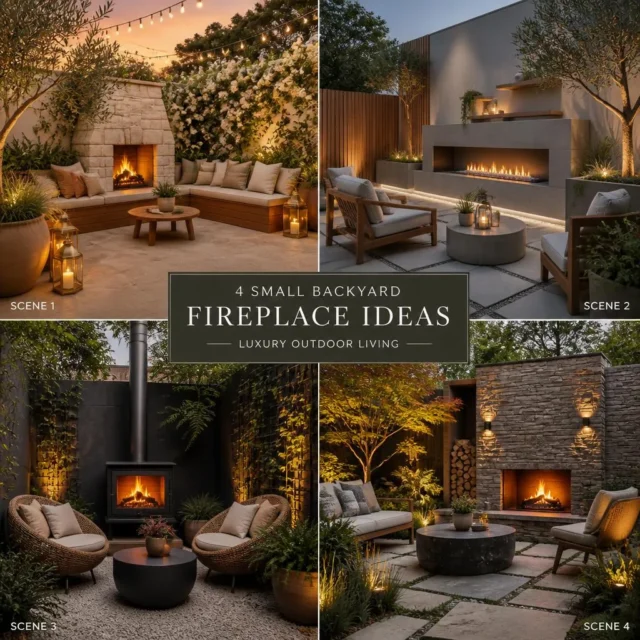

A fire changes what a garden is for. Small backyard ideas with outdoor fireplace turn a patch of concrete you walked past all winter into somewhere you’ll sit until midnight in October, the one feature that genuinely extends how many months a year you use your outdoor space. In a small yard the fireplace also does a second job: it gives the space a focal point, and a reason for the furniture to face somewhere. At Sunday Abode, we love a feature that earns its footprint twice over. These 15 layouts show how to fit one into a tight garden, including the smoke and clearance realities that decide whether it’s a good idea at all.
Key Takeaways
- In a small, enclosed yard, wood smoke is the biggest practical problem, it doesn’t disperse, it drifts into neighbors’ windows, and it’s restricted by law in many areas.
- A gas fireplace sidesteps almost all of that: no smoke, no sparks, no wood store, and instant on and off.
- Check clearances and local rules first. Fireplaces need real distance from fences, siding, and overhanging branches, and permanent builds often require a permit.
- Corner placement is the small-yard trick, it delivers the focal point without eating the middle of the garden.
- Seat people roughly 90–120 cm (3–4 ft) from the firebox: close enough for warmth, far enough to be comfortable.
Before You Build: Smoke, Clearances, and the Rules
In a small backyard, a wood-burning fireplace has one serious drawback that inspiration photos never show: smoke. A tight garden hemmed in by fences and neighboring walls has nowhere for smoke to go, so it lingers, drifts sideways, and ends up in your neighbor’s open windows and washing.
This isn’t only a courtesy issue. Many areas restrict or ban wood burning outright, smoke control zones, seasonal burn bans, and local air quality rules are common, and they vary enormously by country, state, and even by street. Check what applies where you live before you spend anything, because a beautiful masonry fireplace you’re not allowed to light is an expensive ornament. A gas fireplace produces no smoke and is usually the pragmatic answer in a small urban garden.
Clearances matter just as much in a small space, precisely because everything is close to everything else. Follow the manufacturer’s specified clearances to combustibles, fences, house siding, decking, pergola beams, and overhanging branches all count, and don’t guess. Permanent masonry fireplaces frequently need a building permit, and a chimney needs enough height to draw properly, or you’ll be sitting in the smoke yourself. If you’re building against or near the house, get professional advice.
Which Fire Feature Suits a Small Yard?
The fuel you choose matters more in a small garden than a large one. This is the honest comparison before you commit.
| Type | Pros in a small yard | Watch out for |
| Gas fireplace | No smoke, instant on/off, no wood store | Higher install cost; needs a gas line or bottle |
| Wood-burning fireplace | Real flame, crackle, and heat | Smoke, sparks, often restricted; needs dry wood |
| Ethanol fireplace | No flue, no smoke, portable | Low heat output; refuel carefully, never when lit |
| Fire pit / fire bowl | Cheapest, movable, sociable | Smoke drifts every way; less heat direction |
| Electric fireplace | No flame or fumes; safe on covered patios | No real heat outdoors; needs outdoor-rated power |
1. Corner Fireplace with Built-In Bench
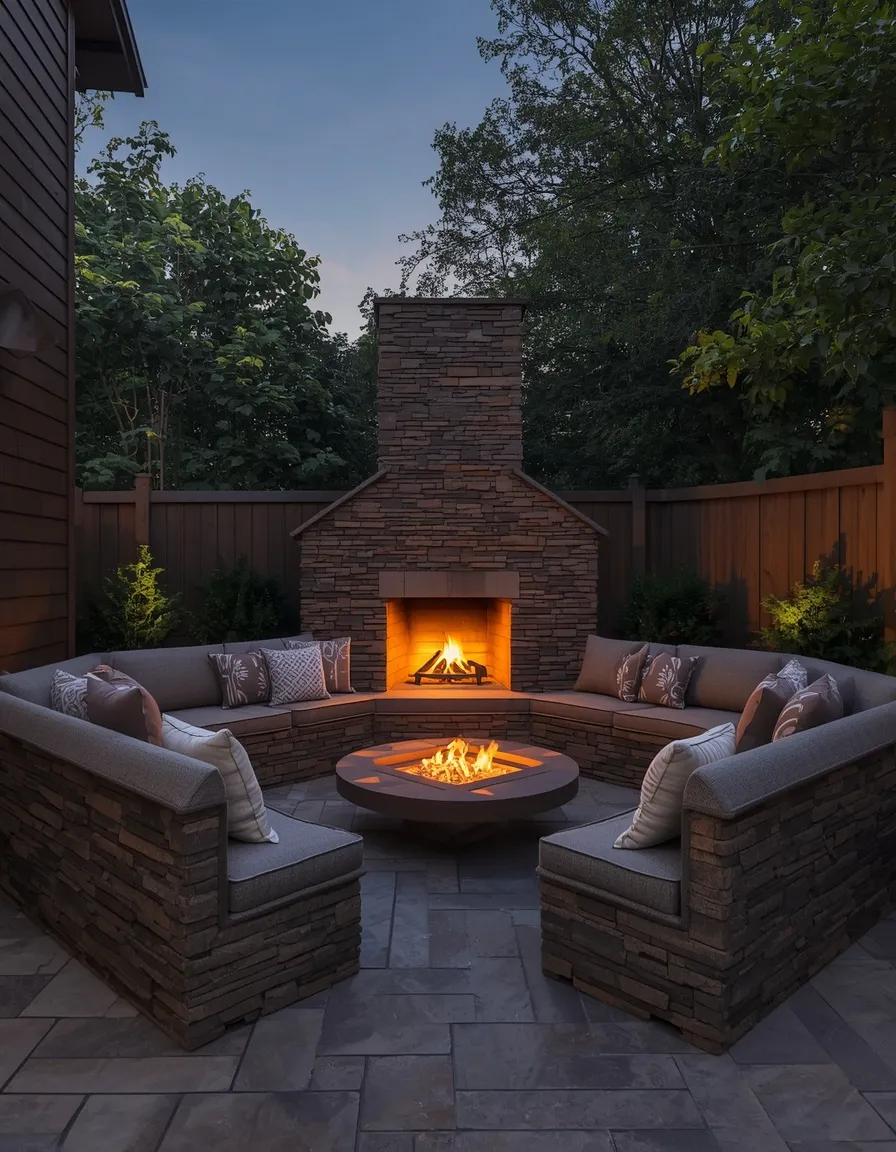
Tucking the fireplace into a corner is the single smartest move in a small backyard. An L-shaped built-in bench wraps around it, cushions soften the seat, and the middle of the garden stays completely open.
A corner is dead space that furniture never uses well, so putting the fireplace there buys you a focal point without sacrificing usable garden. Build bench seating along both adjacent fences at a 43–46 cm (17–18 in) seat height, positioning the seats roughly 90–120 cm (3–4 ft) from the firebox, close enough to feel the heat, far enough to sit comfortably. Keep the required clearance from the fences, which is exactly where a corner build gets risky if you rush it. This suits genuinely small yards and is the layout most others are a variation of.
- Best for: the smallest yards; a focal point that costs no central space.
- Watch out: corners put the firebox close to two fences, respect clearances.
- Key elements: corner fireplace, L-shaped bench at 43–46 cm, seating 90–120 cm back.
2. Compact Outdoor Kitchen and Fire
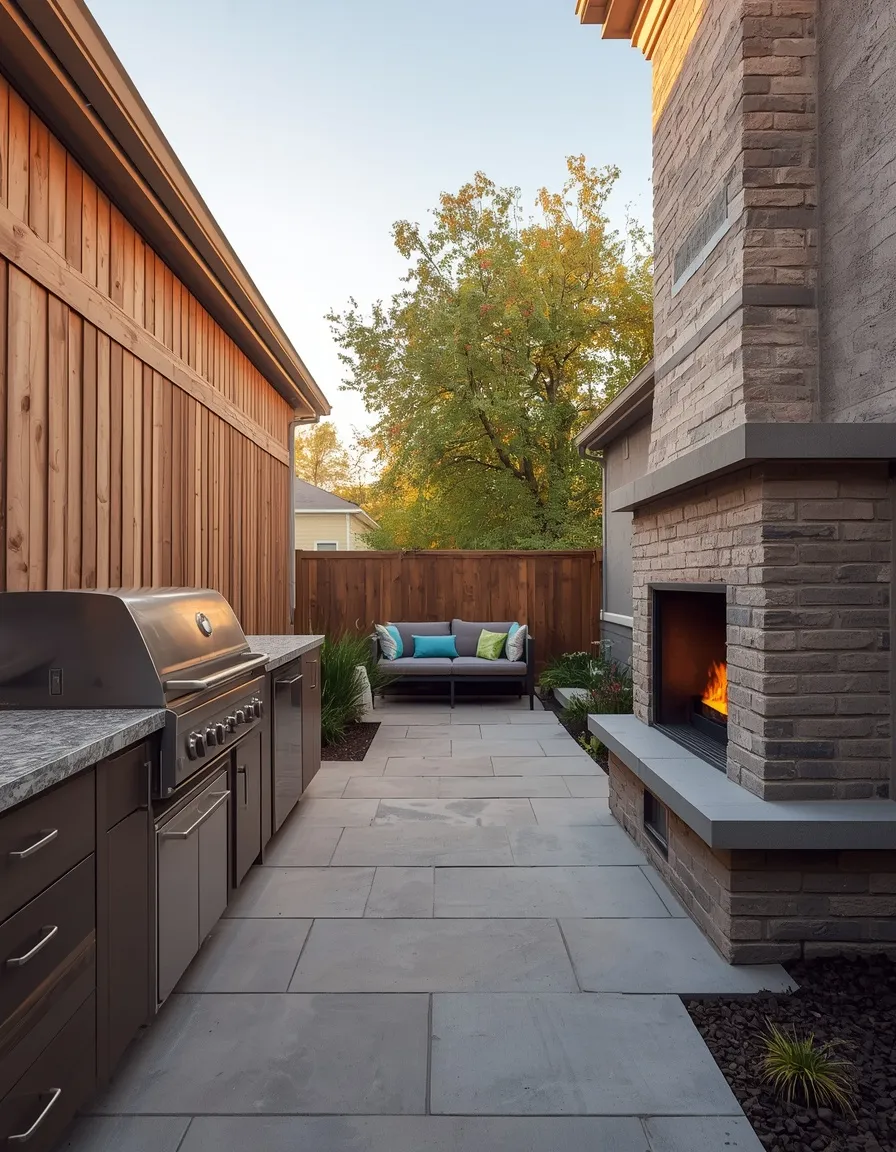
Pairing a slim outdoor kitchen with a fireplace makes a small yard feel like a proper outdoor room. A narrow run of counter with a built-in grill sits along one fence, with the fireplace anchoring the far end and a bench between them.
Keep the kitchen run shallow, around 60 cm (24 in) deep, so it doesn’t devour the garden, and give yourself at least 90–100 cm (36–40 in) of clear standing space in front of it. Put the grill and the fireplace at opposite ends rather than side by side, so the cook isn’t standing in radiant heat all evening. A grill needs its own clearances from fences and structures too, and never sits under an unventilated cover. This suits keen cooks and anyone who entertains outdoors in a tight space.
- Best for: keen outdoor cooks working with a narrow garden.
- Watch out: separate grill and fireplace; don’t cook in the fire’s radiant heat.
- Key elements: 60 cm counter run, built-in grill, fireplace anchoring the far end.
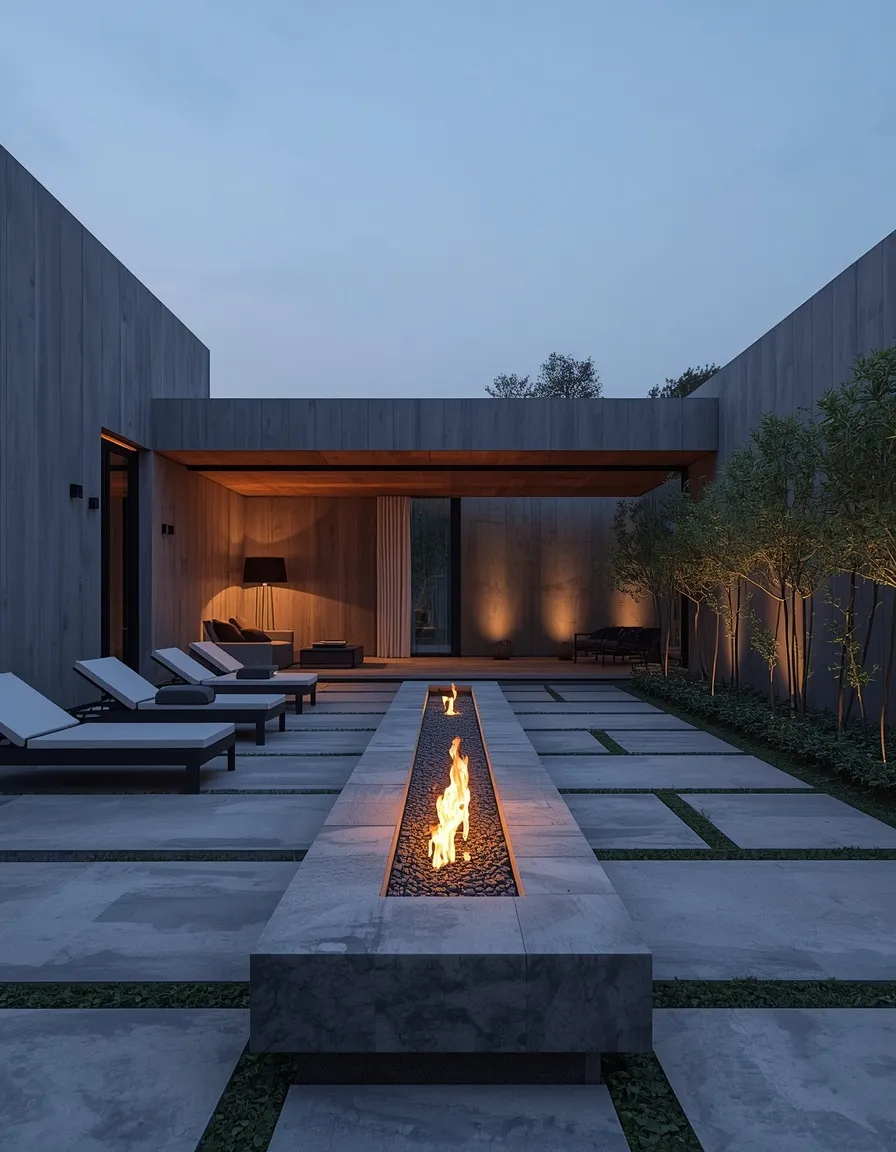
3. Modern Concrete Courtyard
A poured concrete courtyard with a linear gas fireplace is small-garden design at its most architectural. Smooth grey slabs, a low rendered fireplace with a long ribbon of flame, and a pair of clean-lined loungers make a calm outdoor room.
Choose a slim, linear gas unit rather than a bulky masonry chimney, since a large traditional fireplace can visually swallow a small courtyard. Gas also removes the smoke problem entirely, which matters enormously in an enclosed urban space. Break up the concrete with a strip of planting or gravel so it doesn’t read as a car park, and add warm timber in the furniture to stop it feeling cold. Concrete gets hot in direct sun, so plan some shade. This suits modern homes, urban courtyards, and low-maintenance gardens.
- Best for: urban courtyards and low-maintenance modern gardens.
- Why it works: a slim linear gas unit gives the fire without the visual bulk.
- Watch out: break up the concrete with planting, or it reads as a car park.
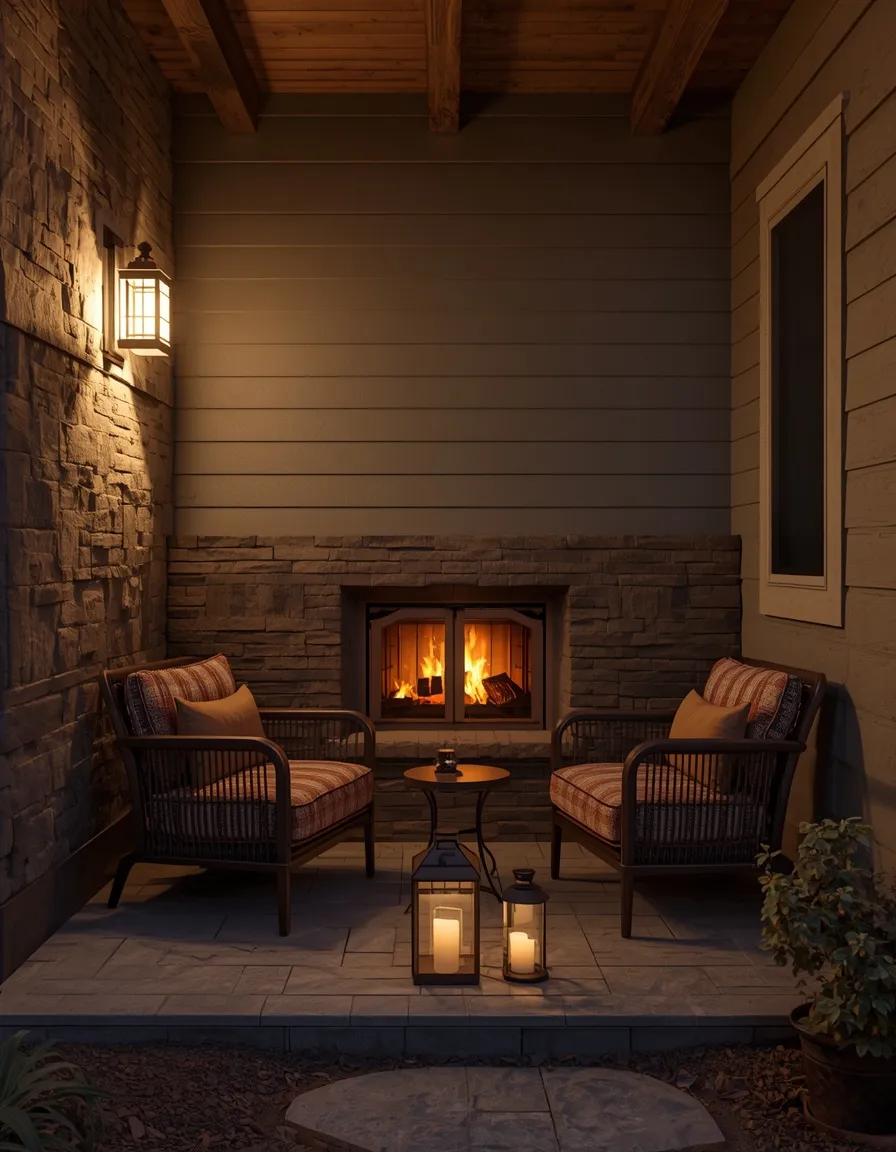
4. Two-Chair Fireside Nook
Sometimes the whole garden is only big enough for two chairs and a fire, and that’s genuinely enough. Two comfortable armchairs angled toward a compact fireplace, a small side table between them, and a lantern make an intimate evening spot.
Resist the urge to squeeze in more seating than the space can hold, which is the classic small-garden mistake and leaves you with a cramped yard and nowhere to walk. Two good chairs beat four bad ones. Angle them slightly toward each other rather than lining them up in a row, so the arrangement invites conversation. Keep the fireplace modest in scale, a compact freestanding or corner unit, and add a small table within reach of both. This suits couples, tiny yards, courtyards, and anyone furnishing a narrow space.
- Best for: tiny yards, couples, and narrow courtyards.
- Why it works: two good chairs beat four cramped ones in a small footprint.
- Key elements: two angled armchairs, compact fireplace, shared side table, lantern.
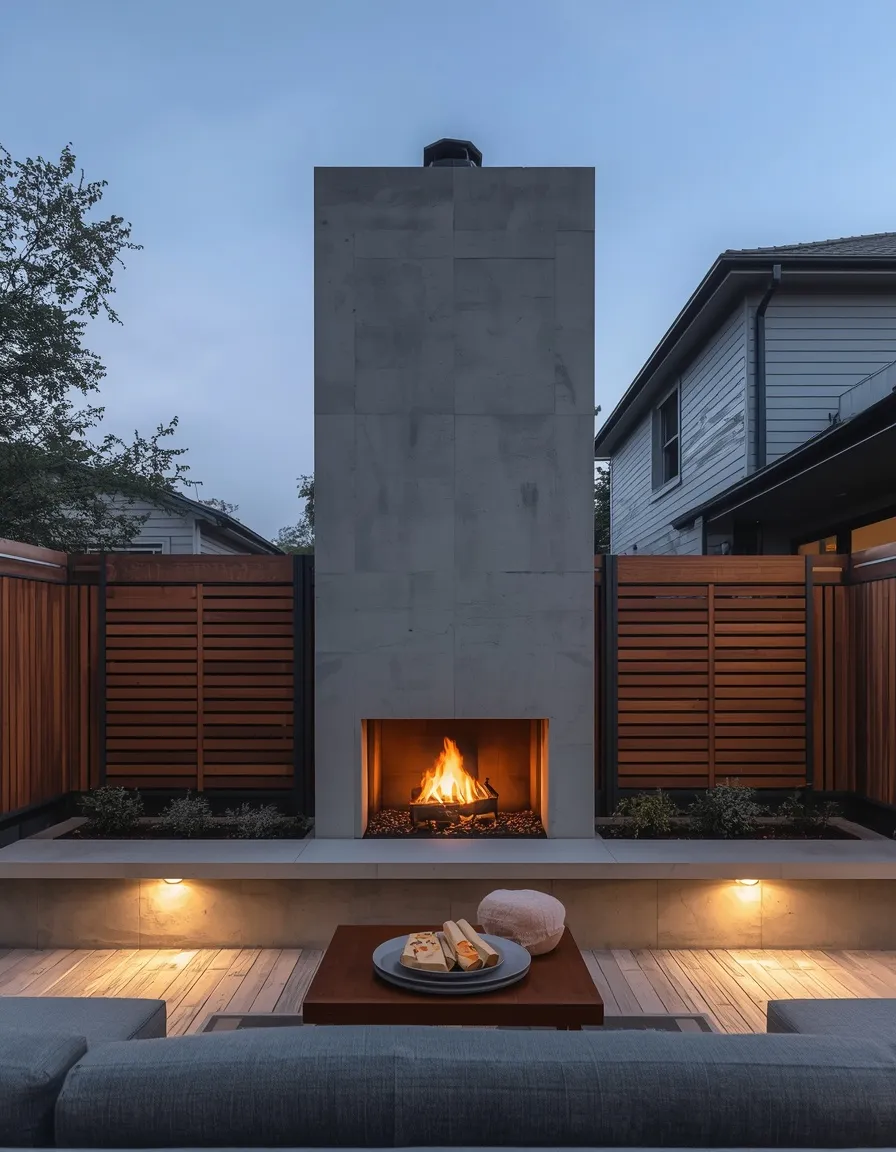
5. Fireplace as a Privacy Wall
A tall fireplace built into a boundary wall does double duty as a privacy screen. The chimney breast rises to block a neighbor’s window or an unwanted view, while the firebox below gives the garden its heart.
Building the fireplace into a screen wall means one structure solves two problems, which is exactly the kind of efficiency a small garden needs. Height brings rules, though: many areas limit the height of boundary structures, and a tall masonry build almost certainly needs a permit and proper foundations. Check both before designing. Extend the wall with slatted timber either side to soften the mass and let some wind through. This suits overlooked urban gardens and anyone who needs privacy as much as they want a fire.
- Best for: overlooked gardens needing privacy and a focal point at once.
- Watch out: boundary height limits and permits apply; get foundations right.
- Key elements: fireplace built into a screen wall, slatted timber either side.
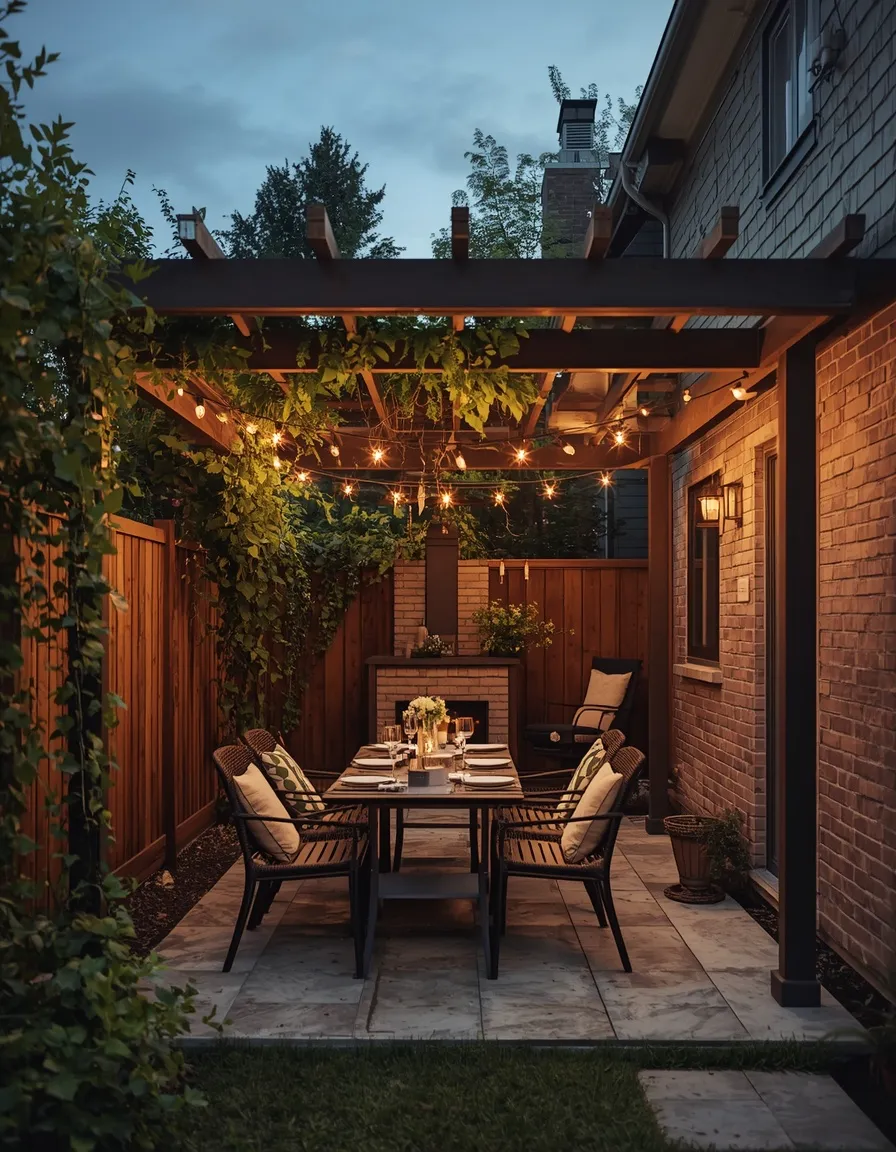
6. Pergola Dining and Fire Zone
A pergola over a dining table, with a fireplace at one end, makes a small backyard usable in almost any weather. Climbing greenery overhead, string lights, a compact table, and firelight create a genuine outdoor dining room.
The critical detail is clearance: a wood-burning fireplace under or beside a pergola is a real fire risk, and overhanging beams, climbing plants, and dry foliage are all combustible. Keep the firebox well outside the pergola footprint at the manufacturer’s specified distance, or choose a gas unit, which produces no sparks. Never enclose a wood fire under a solid roof unless the system is specifically rated for it. This suits gardens used for outdoor meals and anyone wanting shade and fire together.
- Best for: gardens used for outdoor dining; shade and fire in one space.
- Watch out: pergola beams and climbers are combustible; keep the firebox well clear.
- Key elements: pergola over dining, fireplace outside the footprint, string lights.
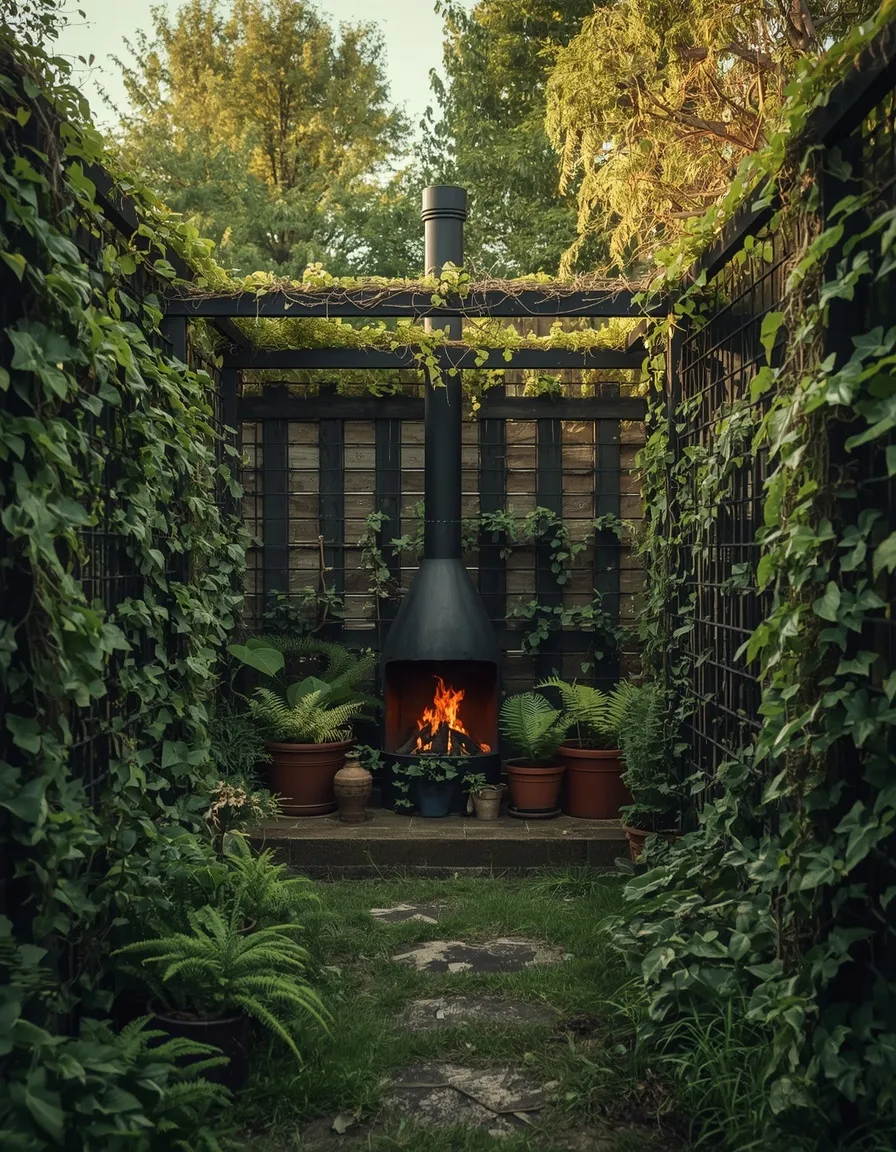
7. Green Wall Fireside Retreat
Framing a fireplace with living green makes a small yard feel lush rather than hemmed in. Vertical planting or trellised climbers on the surrounding fences, ferns in pots, and a fire at the center create a leafy, sheltered retreat.
Vertical planting is the small-garden answer to having no ground to spare: it delivers greenery without giving up a single square meter of floor. Keep plants a safe distance from the firebox, since dry foliage near heat is a genuine hazard, and choose evergreens so the retreat still works in winter when you’ll most want the fire. Ferns, ivy, and climbing hydrangea suit shaded fences. This suits urban gardens surrounded by fences and anyone who wants a fire without losing the garden feeling.
- Best for: fence-enclosed urban gardens wanting greenery and fire together.
- Watch out: keep foliage well clear of the firebox; dry leaves near heat burn.
- Key elements: trellised climbers, potted ferns, evergreens for winter, central fire.
8. Sunken Fire Lounge
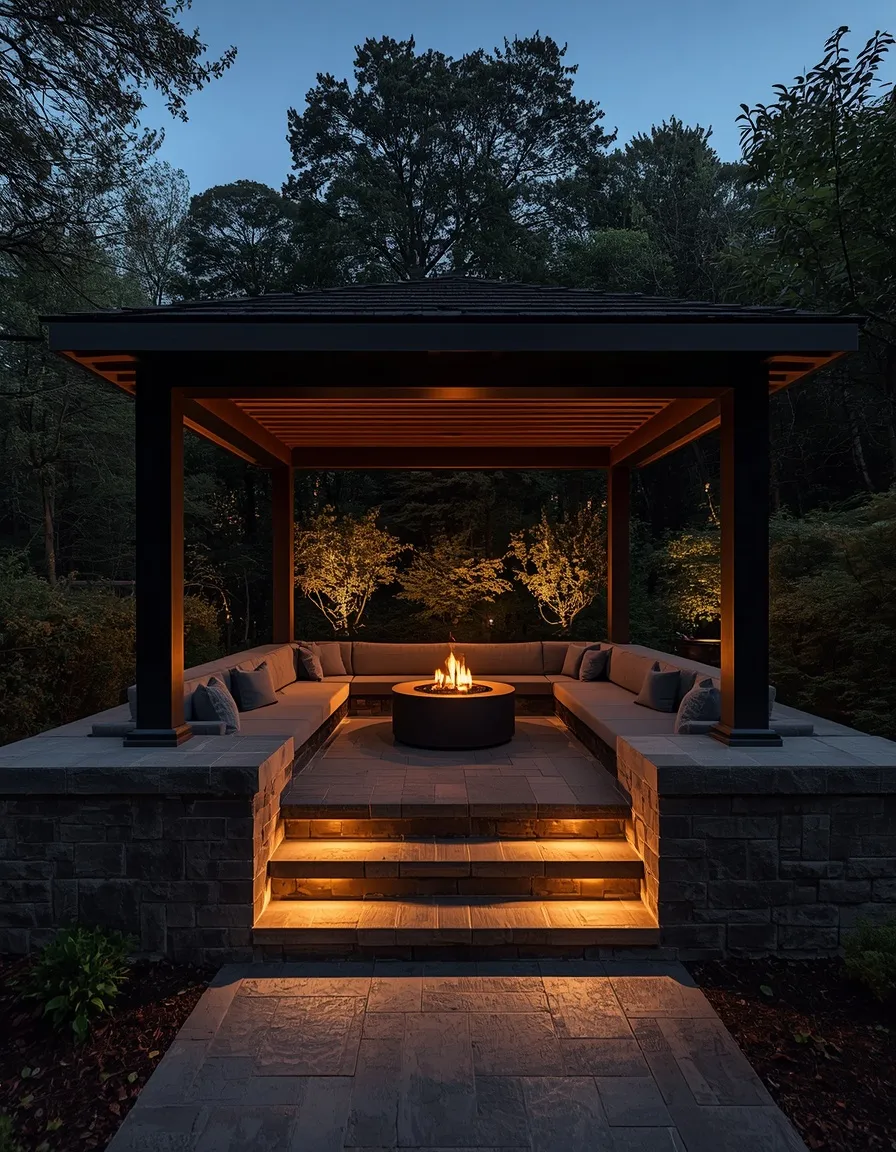
Dropping the seating area a step below the rest of the garden creates a sheltered fire lounge. The surrounding level acts as a natural windbreak and backrest, wrapping a small space around the fire.
A sunken area feels significantly more sheltered and intimate than seating on an open patio, which is why it’s worth the excavation on a sloping plot. Drainage is the make-or-break detail: a sunken space collects water, so it needs a proper drainage solution beneath rather than relying on gaps between paving. Light the step clearly, since an unexpected level change is a genuine trip hazard in the dark, and especially so around a fire. This suits sloping gardens and ambitious renovations with a bit of budget.
- Best for: sloping plots and ambitious builds; maximum shelter and intimacy.
- Watch out: sunken areas flood, plan drainage, and light the step properly.
- Key elements: dropped seating level, surrounding ground as windbreak, drainage.
9. Budget Portable Fire Feature
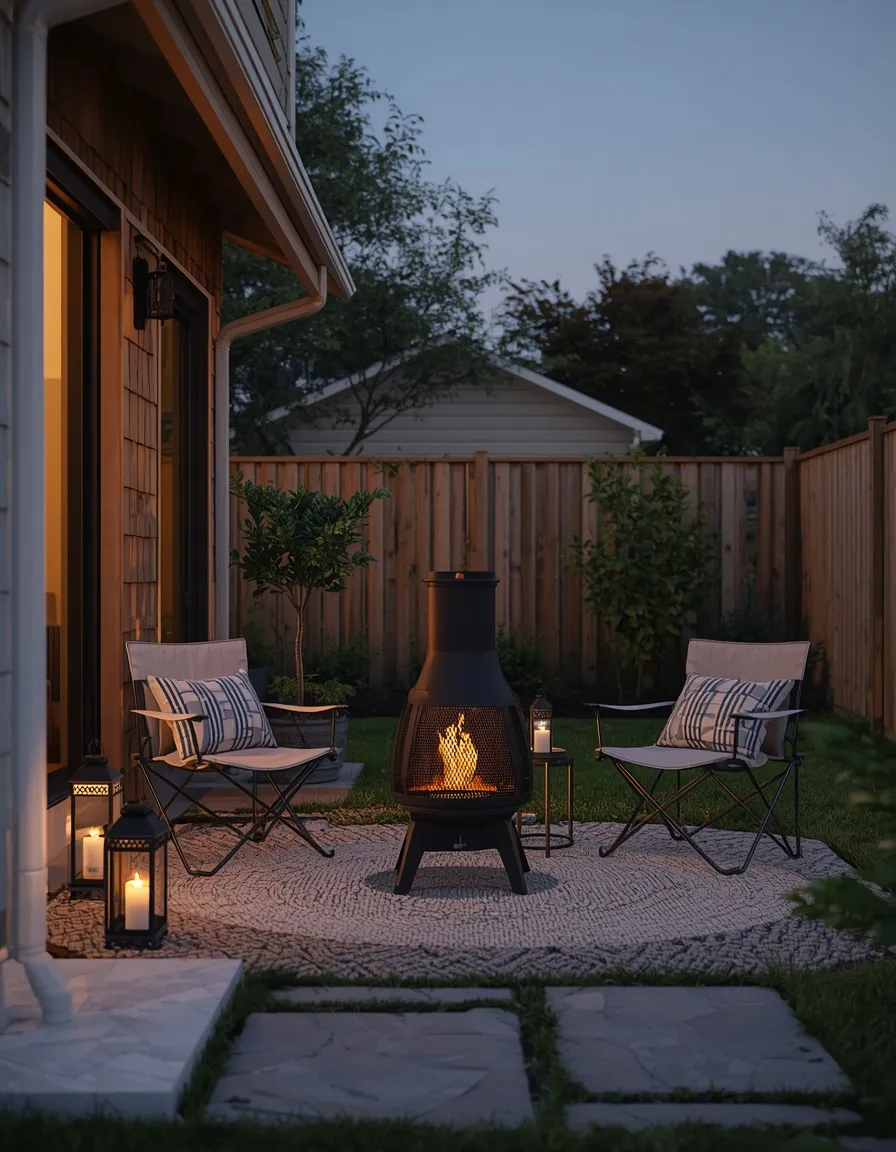
A portable fireplace or chiminea delivers most of the magic for a fraction of the money. A freestanding unit on a paved corner, a few folding chairs, and a rug make a fireside evening happen without building anything.
The great advantage is flexibility: a freestanding fire feature can be moved to suit the wind, packed away in winter, and taken with you when you move, which is why it’s the right answer for renters, who shouldn’t be building masonry in someone else’s garden. Stand it on a non-combustible base such as paving or a fire-resistant mat, never on decking or grass, and keep the manufacturer’s clearances from fences. This suits renters, tight budgets, and anyone testing whether they’ll actually use a fire before committing.
- Best for: renters and tight budgets; testing the idea before building.
- Watch out: stand it on paving or a fire-resistant mat, never on decking or grass.
- Key elements: portable fireplace or chiminea, non-combustible base, folding chairs.
10. Rustic Stone Fireplace with Log Store
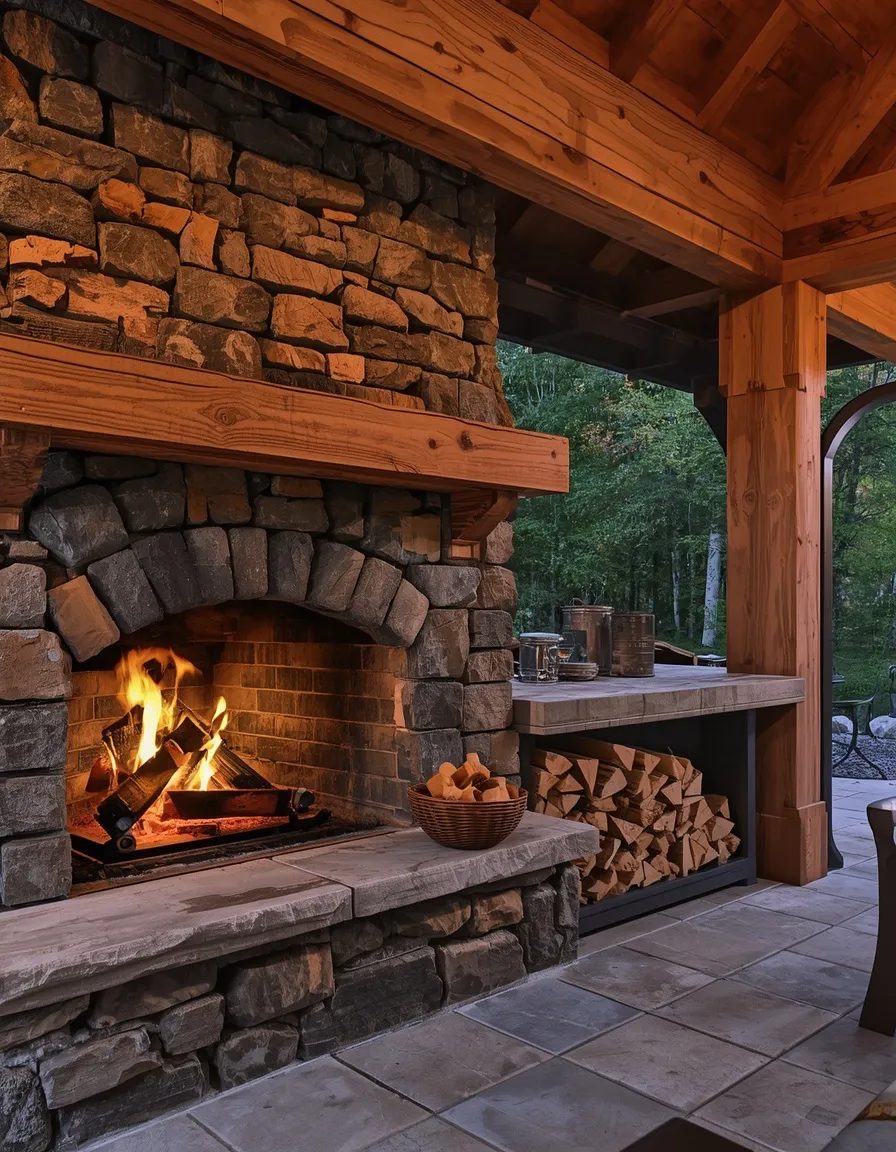
A stone fireplace with a built-in log store beside it looks the part and solves a real problem. Stacked firewood becomes a design feature, filling a recess beside the chimney breast with texture and warmth.
Building the log store into the fireplace structure means the wood is stored where you need it, which is precisely the sort of double-duty a small garden demands. Store only seasoned wood, timber dried to roughly 20 percent moisture or below, because green, wet wood smokes heavily, and in a small enclosed yard that smoke has nowhere to go. Keep the store ventilated and raised off the ground so the wood stays dry, and don’t stack it against the hot firebox. This suits rustic gardens and anyone committed to a real wood fire.
- Best for: rustic gardens; those committed to a genuine wood fire.
- Watch out: burn only seasoned wood (~20% moisture); wet wood smokes badly.
- Key elements: stone fireplace, recessed ventilated log store raised off the ground.
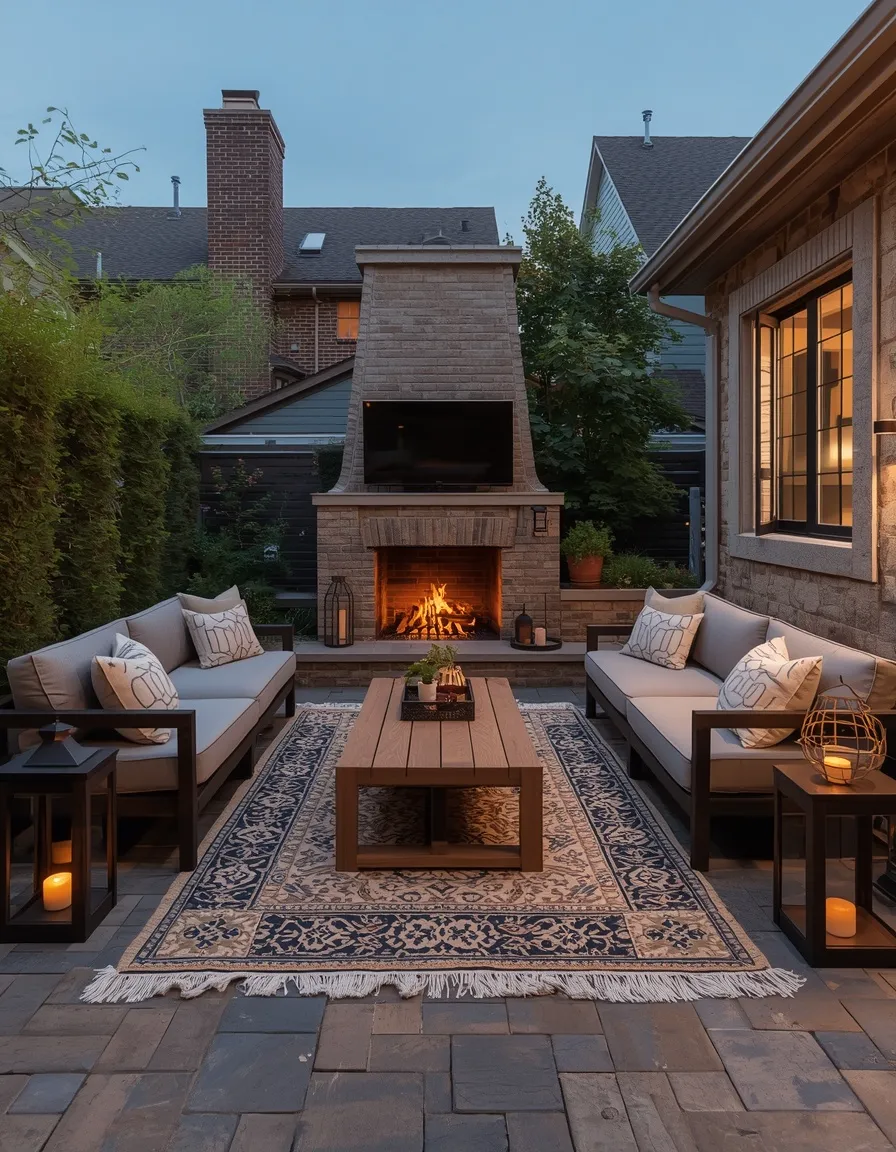
11. Outdoor Living Room with Rug
Treating the fire zone as a proper room is what makes a small yard feel bigger, not smaller. An outdoor rug anchors the seating, a low coffee table sits at the center, and the fireplace takes the place a television would indoors.
An outdoor rug does something clever in a small garden: it draws a visible boundary around the seating, which makes the space read as a defined room rather than furniture floating on paving. Choose a rug rated for outdoor use in polypropylene, which sheds water and won’t rot, and keep it clear of the firebox and any spark zone. Add lanterns and cushions in performance fabric. This suits anyone wanting their small yard to feel like an extension of the house rather than a leftover space.
- Best for: making a small yard read as a genuine extension of the house.
- Why it works: a rug visually bounds the seating so it reads as a room, not clutter.
- Watch out: keep the rug clear of the firebox; use outdoor-rated polypropylene.
12. Fireplace Mantel Styling
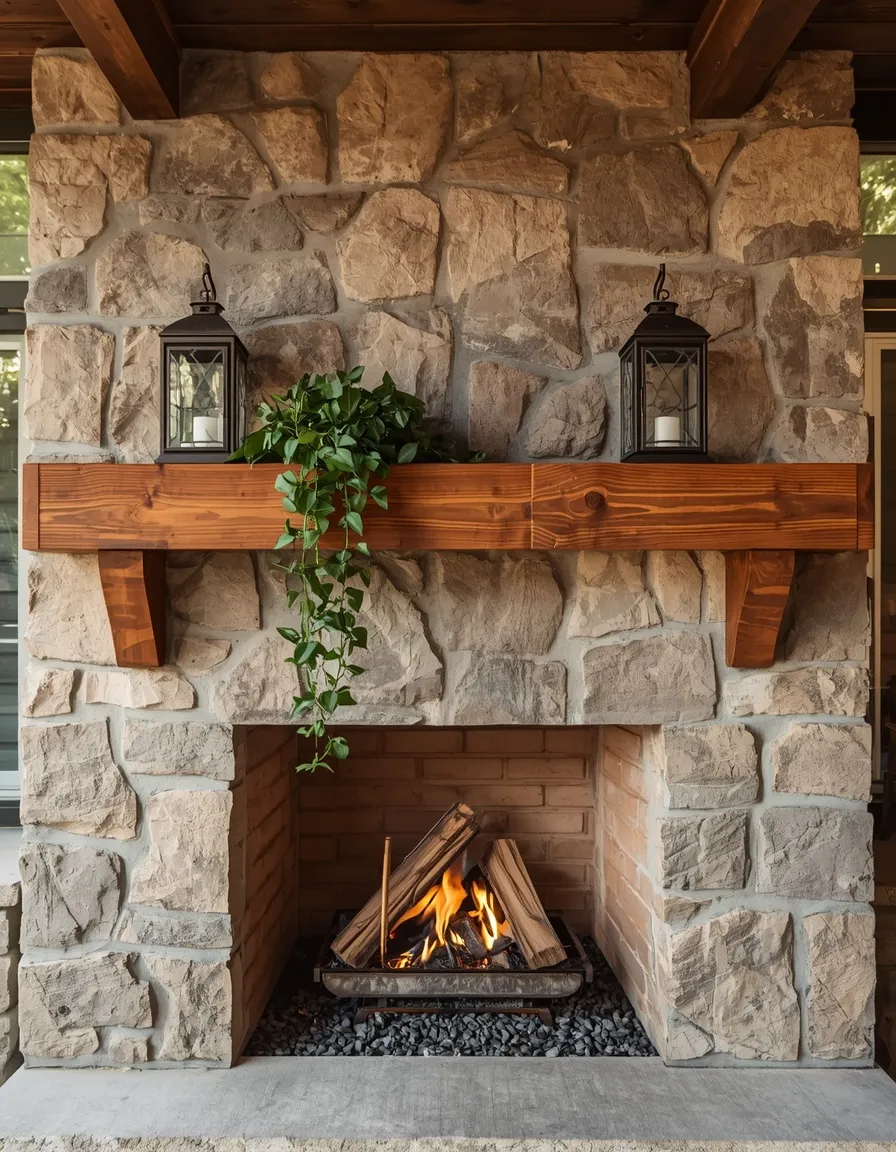
An outdoor fireplace deserves a mantel, and a styled one turns a functional structure into a designed feature. A timber or stone mantel shelf holds lanterns, a trailing plant, and a piece of weatherproof art above the firebox.
Style the mantel with things that can genuinely live outside: lanterns rather than paper, a hardy trailing plant, weathered timber, and metal that’s allowed to patina. The mistake is treating it like an indoor mantel, since anything delicate will be ruined by the first heavy rain. Keep the shelf material and anything on it a safe distance above the firebox opening, following the manufacturer’s clearance, as heat rises directly up the face. This suits anyone who wants their outdoor fireplace to feel considered rather than merely installed.
- Best for: making an outdoor fireplace look designed rather than just built.
- Watch out: heat rises up the face, respect the clearance above the opening.
- Key elements: weatherproof mantel shelf, lanterns, hardy trailing plant, patina metal.
13. Family-Friendly Fire Zone
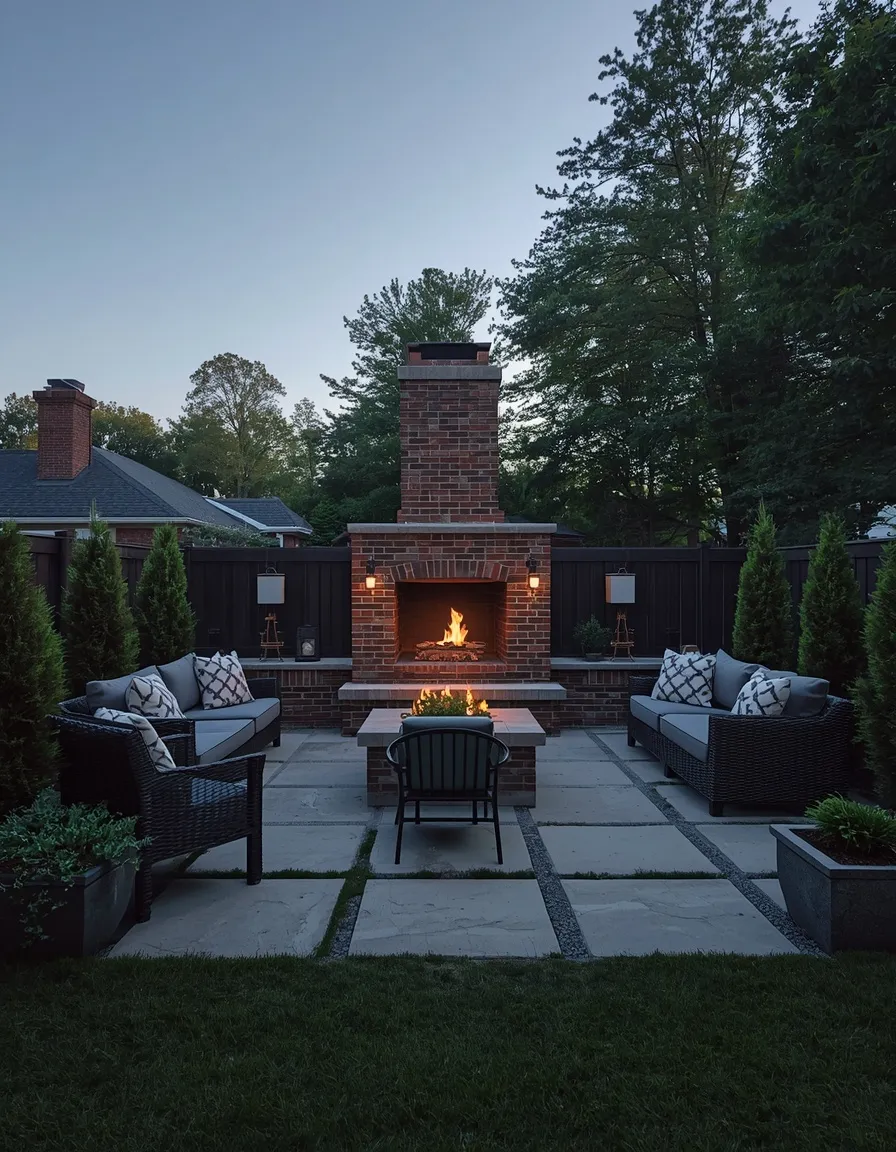
With children around, the fire needs a clear, obvious boundary. A raised firebox, a paved zone that visibly changes underfoot, and seating pushed back create a family garden where the fire is part of the evening rather than a constant worry.
Raise the firebox off the ground so it’s not at toddler height, and use a change of paving material or a low planter run to mark a visible boundary children learn to stay outside of. A screen or glass front on the firebox stops sparks reaching small hands and clothing. Never leave a lit fire unattended with children in the garden, and keep a bucket of water or an extinguisher to hand. Gas units, which have no sparks or embers, are usually the safer choice. This suits families with young children.
- Best for: families with young children who still want a fire.
- Watch out: raise the firebox, fit a spark screen, and never leave it unattended.
- Key elements: raised firebox, visible paving boundary, screen front, seating pushed back.
14. Multi-Level Deck Fireplace
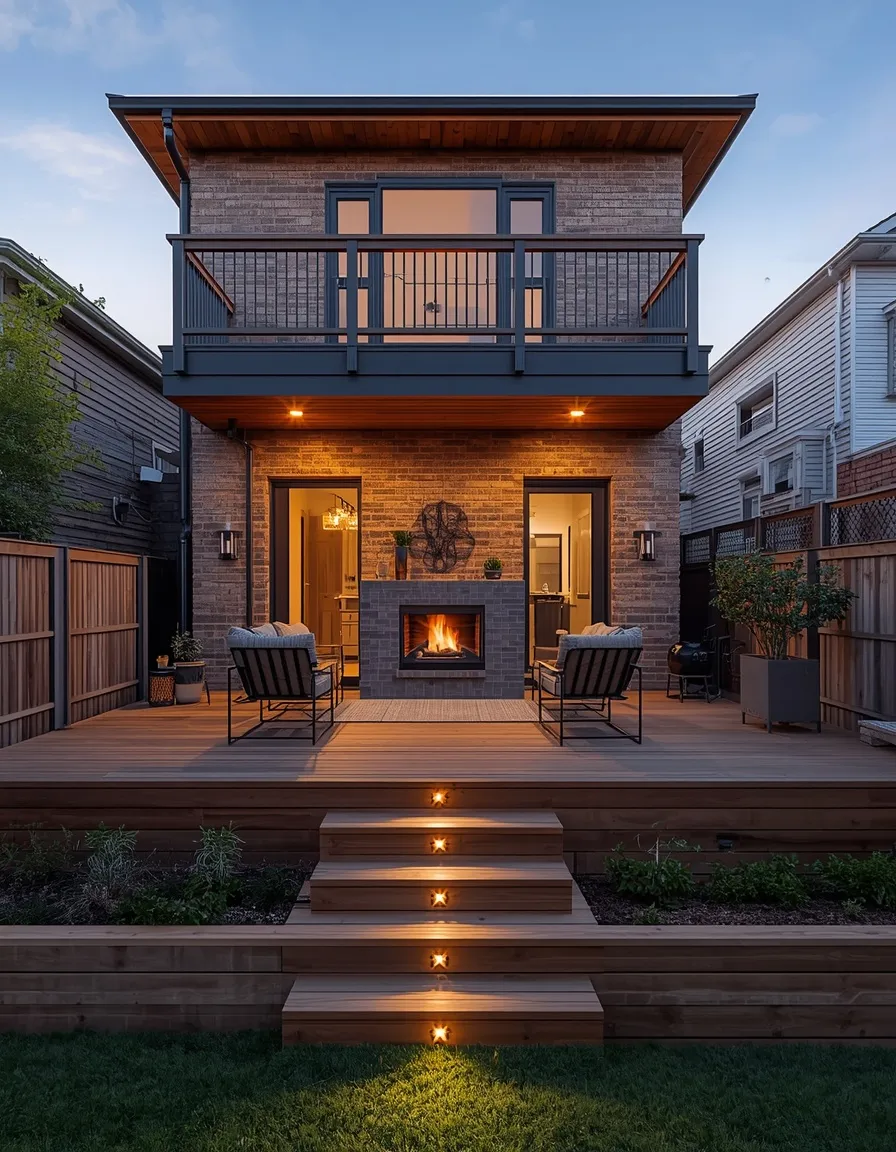
Splitting a small yard into levels makes it feel considerably larger, and a fireplace anchors the upper deck beautifully. A raised timber platform holds the seating and the fire, with steps down to planting or a small lawn.
Level changes create the illusion of more space by breaking a small garden into distinct zones rather than one cramped rectangle. The important caution: a fireplace on a timber deck needs a proper non-combustible base and heat shield beneath it, and many decks simply aren’t suitable for a wood fire at all. A gas unit on a rated hearth pad is the safer route on timber. Confirm the deck framing can carry the fireplace’s weight, which is substantial for masonry. This suits sloping plots and anyone re-landscaping from scratch.
- Best for: sloping plots; making a small garden feel like several spaces.
- Watch out: fire on timber decking needs a rated non-combustible base and heat shield.
- Key elements: raised deck, fireplace on a rated hearth, steps to planting below.
15. Fireside Entertaining Setup
For a small gathering, the fire becomes the natural center of the party. Perimeter bench seating, string lights overhead, a compact drinks station, and glowing firelight turn a modest yard into somewhere people happily stay all evening.
Push all the seating to the perimeter and leave the center open, which is how a small yard holds far more people than its size suggests, the same principle that makes a party gravitate to the kitchen. Add a narrow drinks or serving counter along one fence rather than a bulky table. Crucially, if you’re hosting a crowd, keep a clear, unobstructed path between the fire and the exit, and don’t let guests place chairs or bags inside the fire’s clearance zone as the evening goes on. This suits entertainers and anyone hosting small outdoor gatherings.
- Best for: entertainers hosting small outdoor gatherings in a tight garden.
- Why it works: perimeter seating with an open center holds far more people.
- Watch out: keep the exit path clear and don’t let chairs creep into the fire zone.
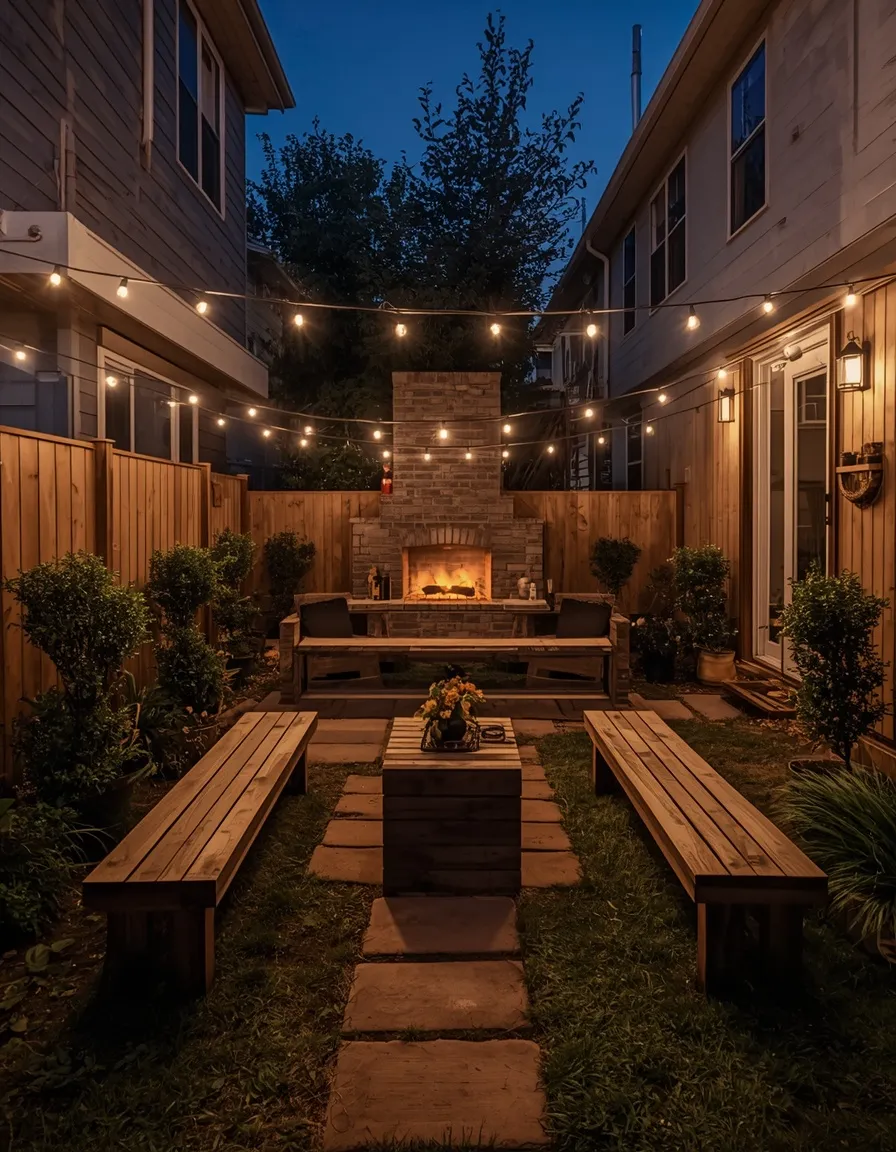
How Do You Fit a Fireplace Into a Small Backyard?
Put the fireplace in a corner or against a boundary, and keep the center of the garden open. In a small yard, the middle is the space that makes everything else feel possible, and a fireplace sited there will make the garden feel half its size.
Match the fireplace’s scale to the garden. A full masonry chimney breast can visually dominate a courtyard, whereas a slim linear gas unit or a compact corner build delivers the same focal point without the bulk. Seat people roughly 90–120 cm (3–4 ft) from the firebox, push seating to the perimeter, and use a rug or a change of paving to define the zone. Vertical planting keeps the garden green without spending any floor area.
A mantel is worth styling, indoors or out. Our guide to summer mantel styling has ideas worth adapting for a weatherproof outdoor shelf, and you’ll find more ways to make a modest plot work harder in our garden design ideas.
Conclusion
The best small backyard ideas with outdoor fireplace all start from the same two questions: where can the fire go without eating the garden, and what will the smoke do once it’s lit. Answer those honestly, a corner site, a scale that suits the space, and gas rather than wood if your yard is enclosed and your neighbors are close, and the rest is enjoyable detail. Get it right and you’ll gain months of evenings you’d otherwise have spent indoors. For more ways to make a small plot work harder, browse our garden design ideas, then go stand in your yard at dusk and decide where the fire wants to be.
Frequently Asked Questions
Q: Can you have an outdoor fireplace in a small backyard?
Yes, and a corner placement is usually the best way to do it, since it delivers a focal point without eating the open center of the garden. The real questions are smoke and clearances rather than space: in an enclosed yard, wood smoke has nowhere to disperse, and every fireplace needs a specified distance from fences, siding, and overhanging branches.
Q: Is a gas or wood outdoor fireplace better for a small yard?
Gas is usually the pragmatic choice in a small, enclosed garden. It produces no smoke or sparks, needs no wood store, and switches on and off instantly, which matters when your neighbors are close and wood burning may be restricted where you live. Wood gives you the crackle and the real heat, but the smoke in a tight yard is a genuine and frequently underestimated problem.
Q: How far should seating be from an outdoor fireplace?
Around 90–120 cm (3–4 ft) from the firebox is comfortable for most people, close enough to feel the heat, far enough not to be uncomfortable. Push seating to the perimeter of a small yard and keep the center clear, and never let chairs, rugs, or bags creep inside the manufacturer’s stated clearance zone as an evening goes on.
Q: Do you need a permit for an outdoor fireplace?
Often, yes, particularly for a permanent masonry build. Requirements vary enormously by country, state, and local authority, and many areas also restrict wood burning through smoke control zones or seasonal burn bans. Check your local rules before spending anything, since a fireplace you’re not permitted to light is an expensive ornament.
Q: Can you put an outdoor fireplace on a deck or under a pergola?
Only with real care. A fire on timber decking needs a rated non-combustible base and heat shield, and many decks aren’t suitable for a wood fire at all. Under a pergola, the beams and any climbing plants are combustible, so the firebox must sit well outside the structure at the manufacturer’s specified clearance. A gas unit is far safer in both situations.
Q: What is the cheapest way to add a fire feature to a small yard?
A portable fireplace, chiminea, or fire bowl costs a fraction of a built-in fireplace and can be moved to suit the wind or packed away in winter. It’s also the sensible choice for renters, who shouldn’t be building masonry in someone else’s garden. Stand it on paving or a fire-resistant mat rather than decking or grass.