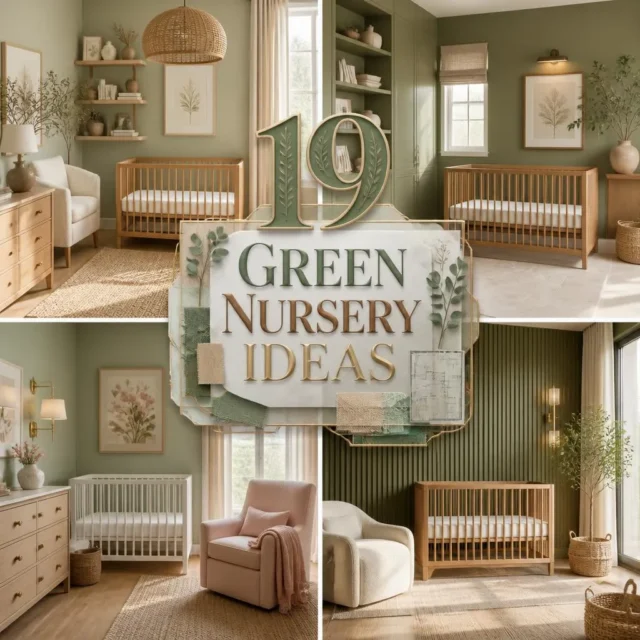

Green is the color a nursery wants to be. Green nursery ideas work because the shade sits somewhere between a neutral and a real color, restful enough to sleep in, warm enough to feel like a decision, and free of the pink-or-blue conversation entirely. It’s the closest thing to a color everyone agrees on. At Sunday Abode, we spend a lot of time with plants and paint charts, and green is where the two meet. These 19 nurseries span every shade and pairing, plus the two things nobody tells you: which green will actually work in your light, and which of those beautiful trailing plants are safe near a baby.
Key Takeaways
- Green shifts more than any other color. A cool grey-sage in a north-facing room reads flat and murky; warm, yellow-based greens hold their color in low light.
- Test large patches in daylight and lamplight. A warm bulb at night can turn a cool sage muddy.
- Many popular houseplants are toxic if chewed, pothos, philodendron, monstera, peace lily, ZZ plant, and ivy among them.
- Once a baby crawls and pulls up, a plant on a low shelf is within reach. Keep plants genuinely out of reach or choose non-toxic species.
- The usual nursery rules still apply: a bare crib, nothing hung above it, anchored furniture, cordless blinds, and low-VOC paint.
Which Green Suits Your Room?
Choose your green by its undertone and your room’s light. Green shifts more dramatically than almost any other color, which is why two people can paint the same sage and end up with completely different rooms.
Greens run from cool and grey-based to warm and yellow-based. A north-facing nursery receives soft, indirect light all day, and a cool grey-sage in that light will read flat, murky, and slightly cold, the opposite of the calm you were after. A warm sage or olive with a yellow base holds its color there and feels alive. Bright south-facing rooms can carry cooler, greyer greens happily.
Test properly, and test twice. Paint a patch at least 30 x 30 cm (12 x 12 in) on more than one wall, and look at it in morning light, afternoon light, and, crucially, under the lamp you’ll actually use at 2 a.m. A warm 2700K bulb can turn a cool sage distinctly muddy, and the nursery is a room you’ll spend a lot of time in after dark.
Green Shade Guide
Use this as a starting point before you buy a single tester pot.
| Shade | Undertone | Best suited to |
| Sage green | Cool, grey-based | Bright south-facing rooms; modern schemes |
| Warm sage | Slightly yellow | North-facing and dim rooms; the safe all-rounder |
| Olive | Warm, yellow-brown | Low-light rooms; minimalist and earthy schemes |
| Eucalyptus | Soft, muted, dusty | Gender-neutral rooms; pairs with everything |
| Mint / light green | Fresh, cool, bright | Small rooms; light and airy schemes |
| Forest / deep green | Rich, cool, saturated | Cozy rooms with good lamp lighting |
The Plant Problem in a Green Nursery
Many of the houseplants that fill green nursery photographs are toxic if chewed. Pothos, philodendron, monstera, peace lily, ZZ plant, dieffenbachia, and ivy are all common, all photogenic, and all best kept well away from a baby.
The timing catches people out. A plant on a low shelf is perfectly safe next to a newborn and becomes a genuine hazard the moment that baby starts crawling and pulling up to stand, which is typically somewhere around six to nine months. The nursery you photograph at three months is not the room you’ll have at nine.
If you want plants in the room, either place them genuinely out of reach, high shelves, hanging planters well away from the crib and the changing table, or choose species that aren’t toxic. Spider plant, parlor palm, areca palm, Boston fern, calathea, and prayer plant are all widely considered non-toxic and safe choices. Check any plant you’re unsure about against the ASPCA’s toxic and non-toxic plant database before it comes into the house. Remember too that soil and decorative pebbles are choking hazards in their own right.
1. Sage Green Sanctuary
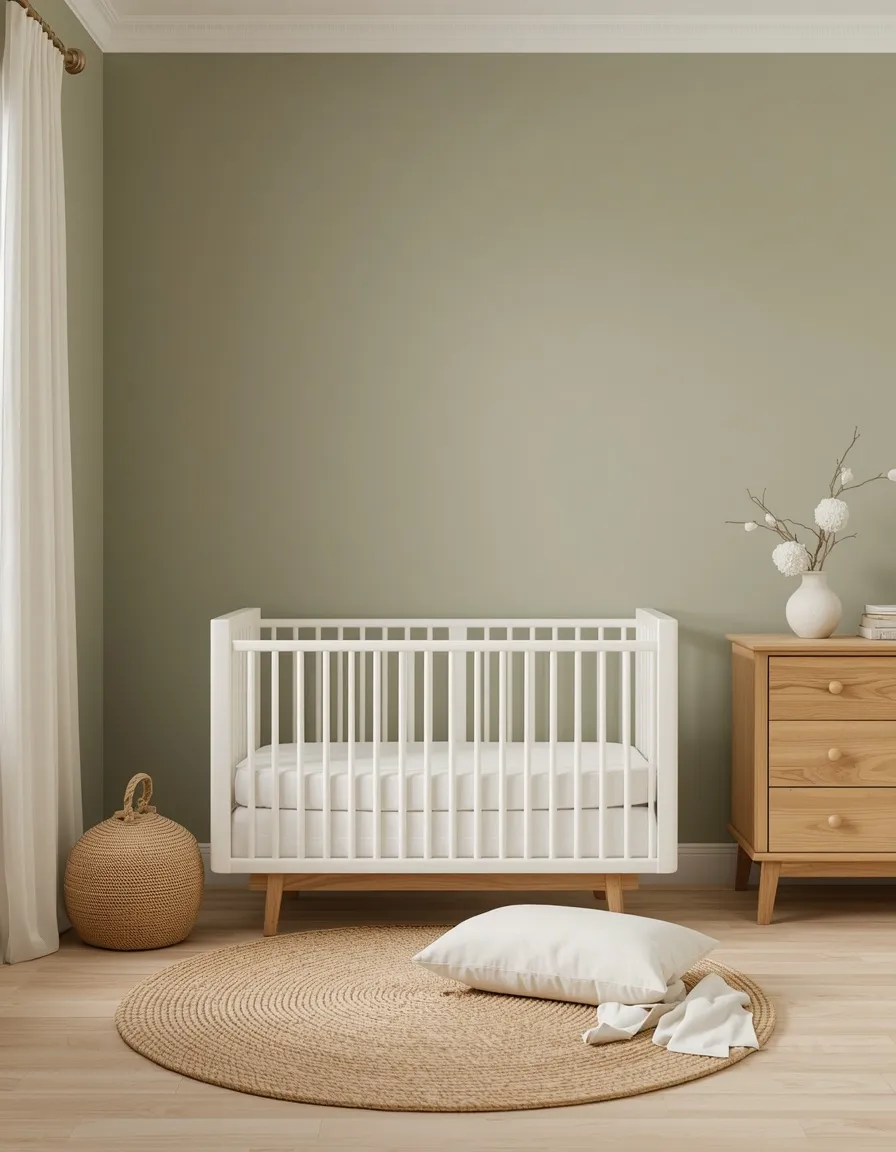
Sage is the green everyone means when they say green nursery. Soft sage walls, cream bedding, warm oak furniture, and a jute rug create a room that feels calm the moment you walk into it.
Sage works because it sits almost exactly between a color and a neutral, it has personality without energy, which is precisely what a sleeping room needs. Pair it with cream, oat, and warm oak rather than cool grey, which can drag it toward drab. If your nursery faces north, choose a warm sage with a yellow base rather than a cool grey-sage, which will read flat in that light. This suits almost any home and is the safest starting point if you’re undecided.
- Best for: almost any home; the safest starting point if you’re undecided.
- Watch out: north-facing rooms need a warm sage, not a cool grey-sage.
- Key elements: sage walls, cream bedding, warm oak, jute rug.
2. Olive Minimalist Nursery
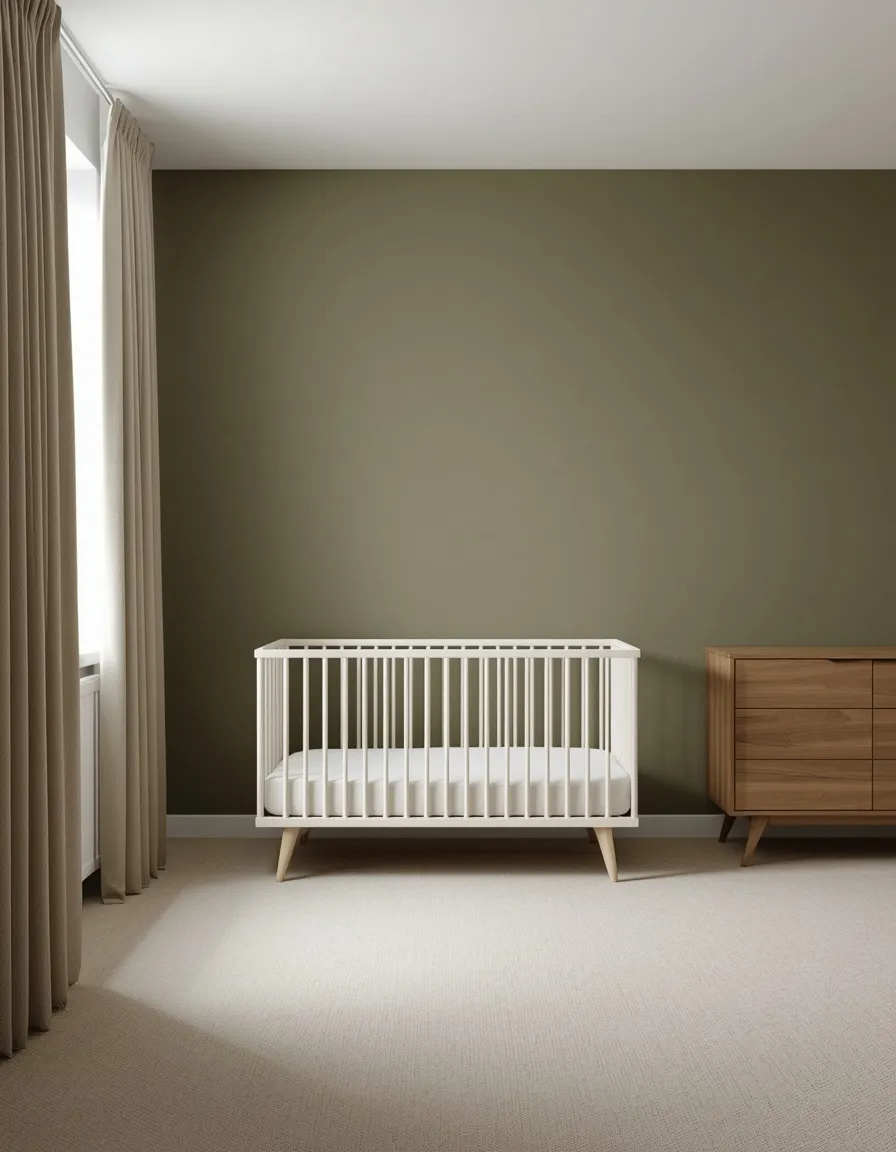
An olive nursery is grown-up and quietly beautiful. Muted olive walls, a bare white crib, one linen curtain, a simple oak dresser, and almost nothing else, the restraint is the whole design.
Olive has a warm, yellow-brown base that makes it genuinely forgiving in low light, where cooler greens fall flat, so it’s a strong choice for a dim or north-facing room. Keep the room deliberately sparse: three or four objects, generous empty wall, and texture through linen and wood rather than color. Choose a scrubbable eggshell rather than flat matte, because a nursery wall meets sticky hands sooner than you’d think. This suits minimalists and anyone who finds decorating overwhelming.
- Best for: minimalists and dim, north-facing rooms.
- Why it works: olive’s warm base holds its color where cooler greens go flat.
- Key elements: muted olive walls, bare crib, linen, oak, generous empty space.
3. Soft Mint Nursery
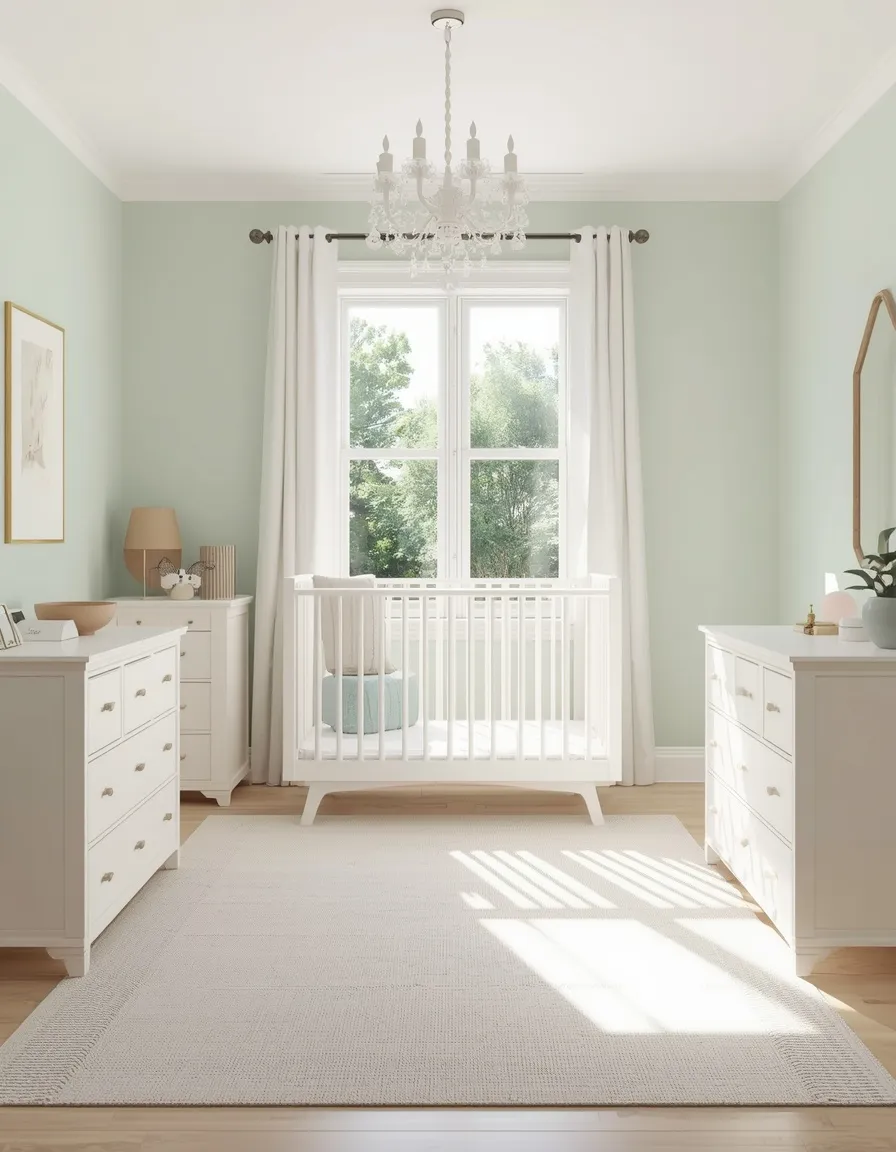
Mint is green at its lightest and freshest. Pale mint walls, white furniture, pastel accents, and plenty of natural light create a nursery that feels airy, sweet, and gently retro.
Light greens make a small nursery feel larger, because they reflect light in a way deeper shades can’t, so this is the shade to reach for in a box room. Keep the mint soft and slightly muted rather than a bright, sharp mint, which tips quickly into dated. Pair with white, pale wood, and a single warm accent such as blush or mustard. This suits small nurseries, bright rooms, and anyone who wants green without any depth or moodiness.
- Best for: small and bright nurseries; green with no moodiness at all.
- Watch out: keep mint soft and muted; a sharp bright mint dates fast.
- Key elements: pale mint walls, white furniture, pale wood, one warm accent.
4. Deep Forest Green Nursery
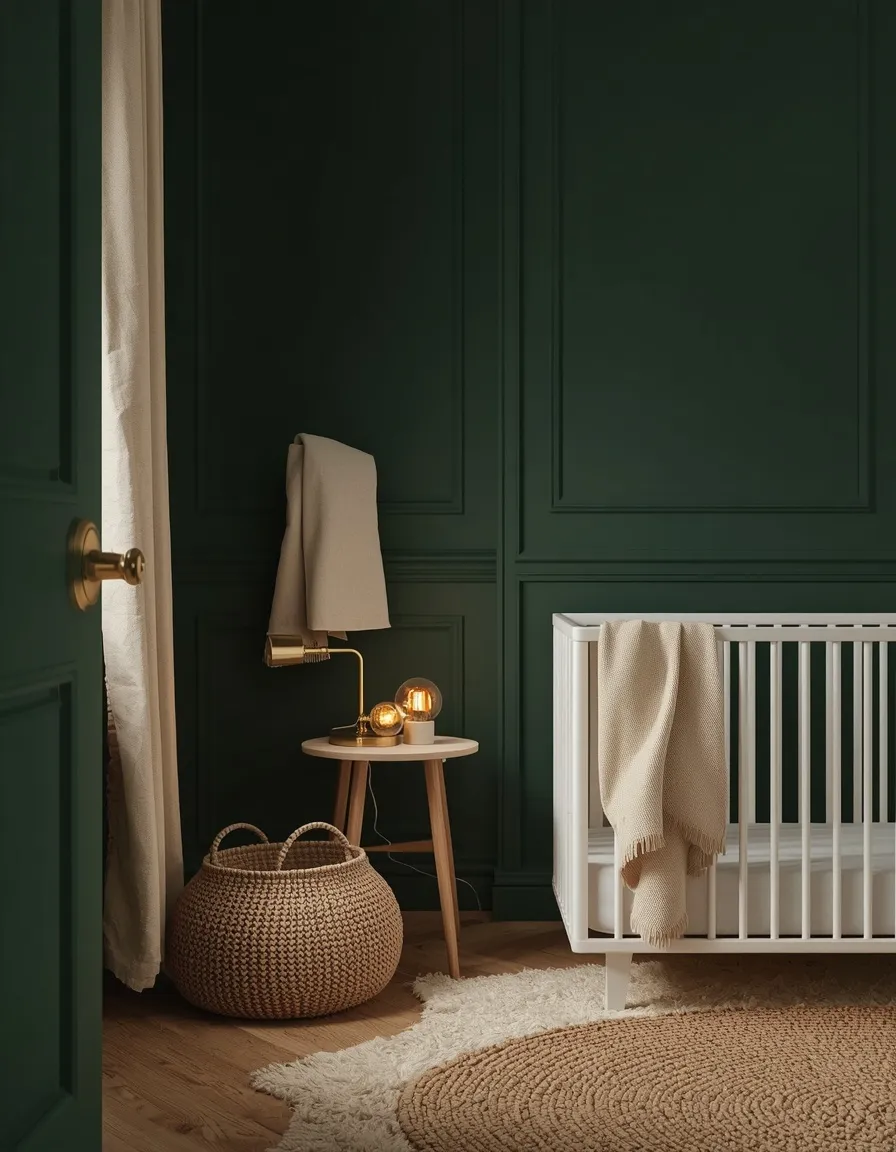
A forest green nursery is enveloping and genuinely cozy. Rich deep green walls, warm brass fittings, cream textiles, and soft lamplight create a room that feels like a den in the best possible way.
Deep greens absorb light, which is exactly what makes them feel snug, and exactly why they need proper lamp lighting rather than a single overhead, or the room will simply feel dark. Layer a floor lamp and a table lamp with warm bulbs. Balance the depth with cream bedding, pale wood, and brass so the room reads rich rather than heavy. This suits cozy nurseries, larger rooms that can carry the depth, and parents who find pale rooms cold.
- Best for: cozy nurseries; parents who find pale rooms cold and clinical.
- Watch out: deep green needs layered lamps, an overhead alone leaves it gloomy.
- Key elements: forest green walls, brass, cream textiles, warm layered lamplight.
5. Eucalyptus and Cream
Eucalyptus green is soft, dusty, and endlessly agreeable. Muted eucalyptus walls, cream and oat textiles, rattan storage, and a linen curtain create a nursery with quiet, textural warmth.
Eucalyptus is the most agreeable green there is, because its dusty, muted quality means it sits happily beside almost anything, cream, terracotta, blush, black, or wood. That makes it a genuinely low-risk choice if you’re nervous about color. Build the room on texture rather than contrast: linen, bouclé, rattan, and jute. This suits gender-neutral nurseries and anyone who wants a color that will never fight with whatever they buy next.
- Best for: gender-neutral nurseries; a green that never fights anything else.
- Why it works: its dusty, muted quality means it pairs with almost any color.
- Key elements: eucalyptus walls, cream and oat textiles, rattan, linen.
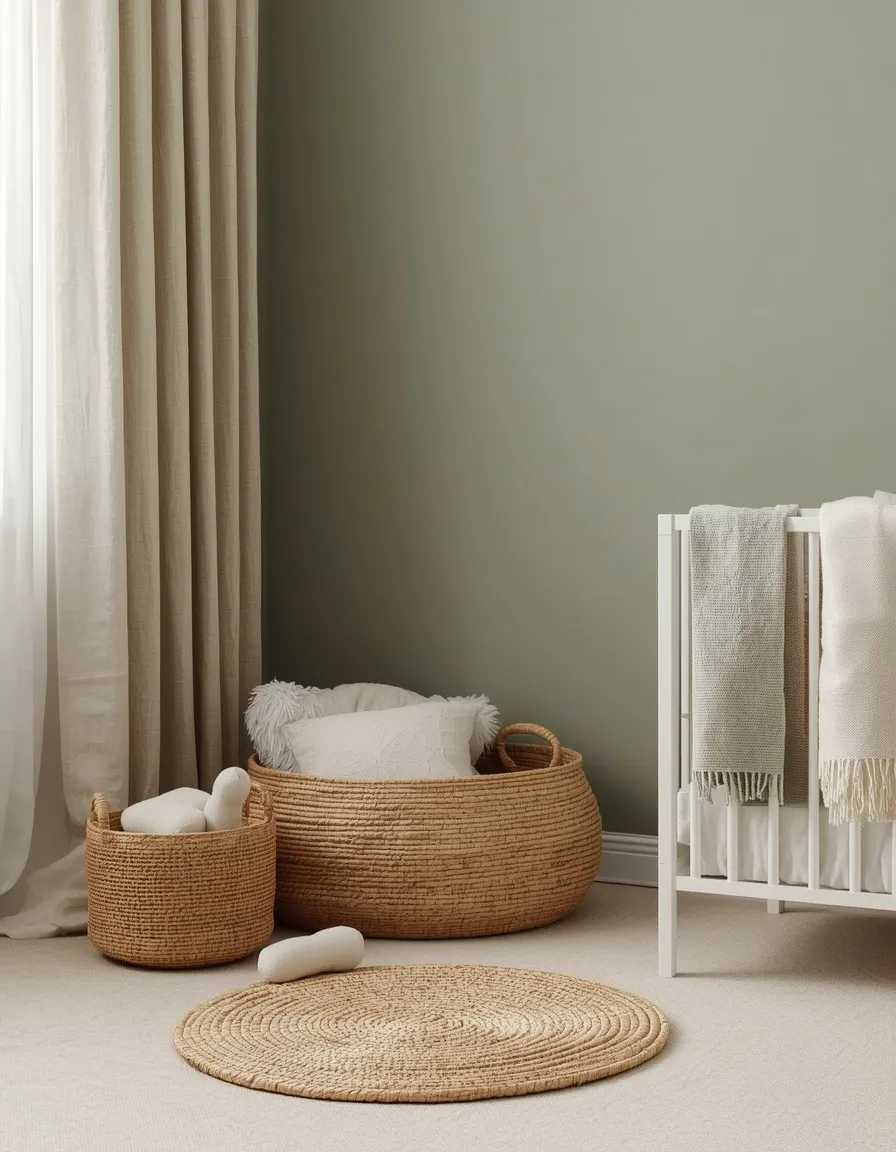
6. Pink and Sage Nursery
Sage with dusty pink is one of the loveliest color pairings in interiors. Soft sage walls, blush textiles in the rug and cushions, brass accents, and cream bedding create a room that’s gentle, feminine, and completely unclichéd.
Green and pink sit opposite each other on the color wheel, which is precisely why they flatter each other rather than clash, but only in muted form. Keep both dusty and desaturated, since bright pink against bright green is a very different and much harder look. Use pink as roughly 20 percent of the room, in textiles rather than paint, so it can be dialed down as she grows. Warm brass ties the two together. This suits girls’ nurseries done with restraint.
- Best for: girls’ nurseries; feminine without a trace of cliché.
- Watch out: keep both dusty; bright pink and bright green genuinely clash.
- Key elements: sage walls, blush textiles at ~20%, brass, cream bedding.
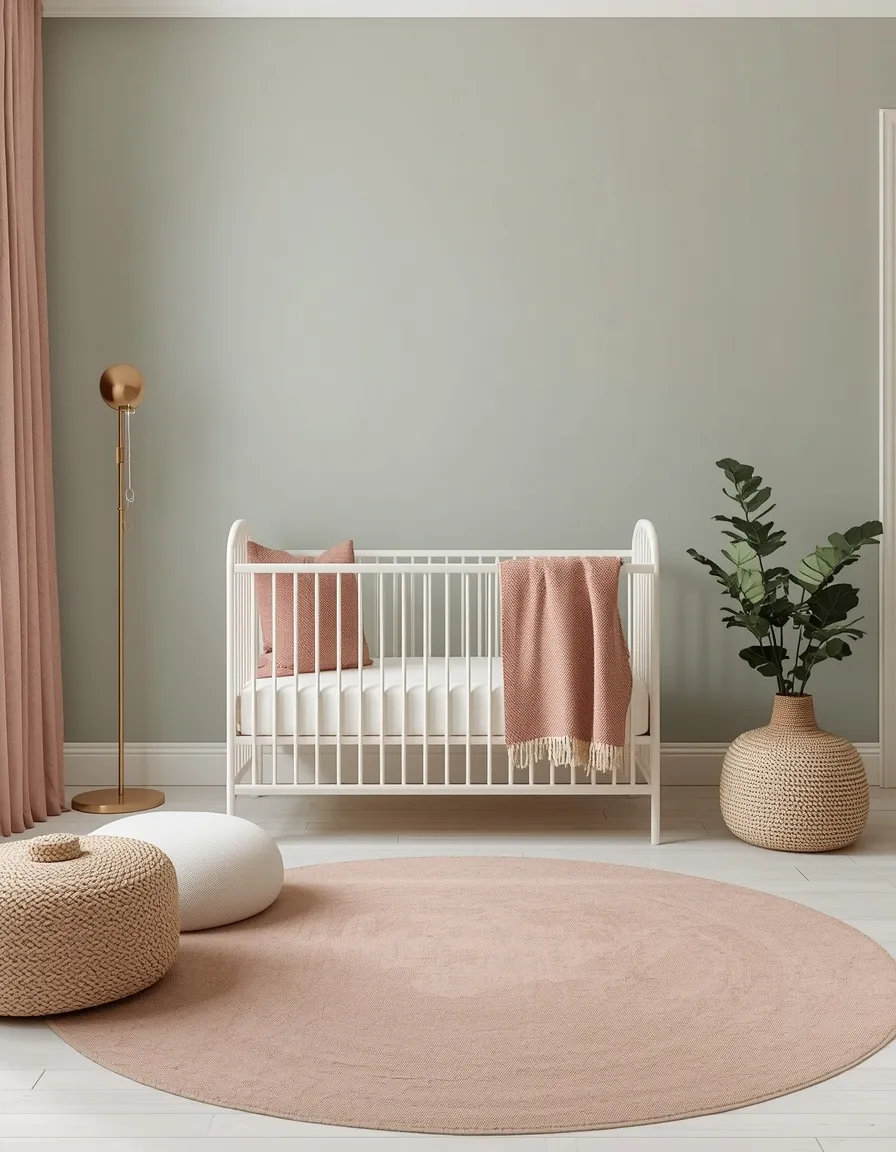
7. Purple and Green Nursery
Lilac and sage is an unexpected pairing that works beautifully. Soft green walls, muted lavender textiles, cream and white accents, and warm wood create a nursery that feels fresh, gentle, and a little unusual.
Purple and green sit close on the color wheel, which is what makes them harmonious rather than jarring, and both look best here in their softest, dustiest forms. Keep the lilac muted and pale, a strong purple will overwhelm the green and the room. Use it in the rug, a cushion, and one print rather than on the walls. Add cream and warm oak to ground it. This suits parents wanting something distinctive that still feels calm.
- Best for: parents wanting something distinctive that’s still restful.
- Why it works: purple and green sit close on the wheel, so they harmonize.
- Watch out: keep the lilac pale and muted; strong purple overwhelms the green.
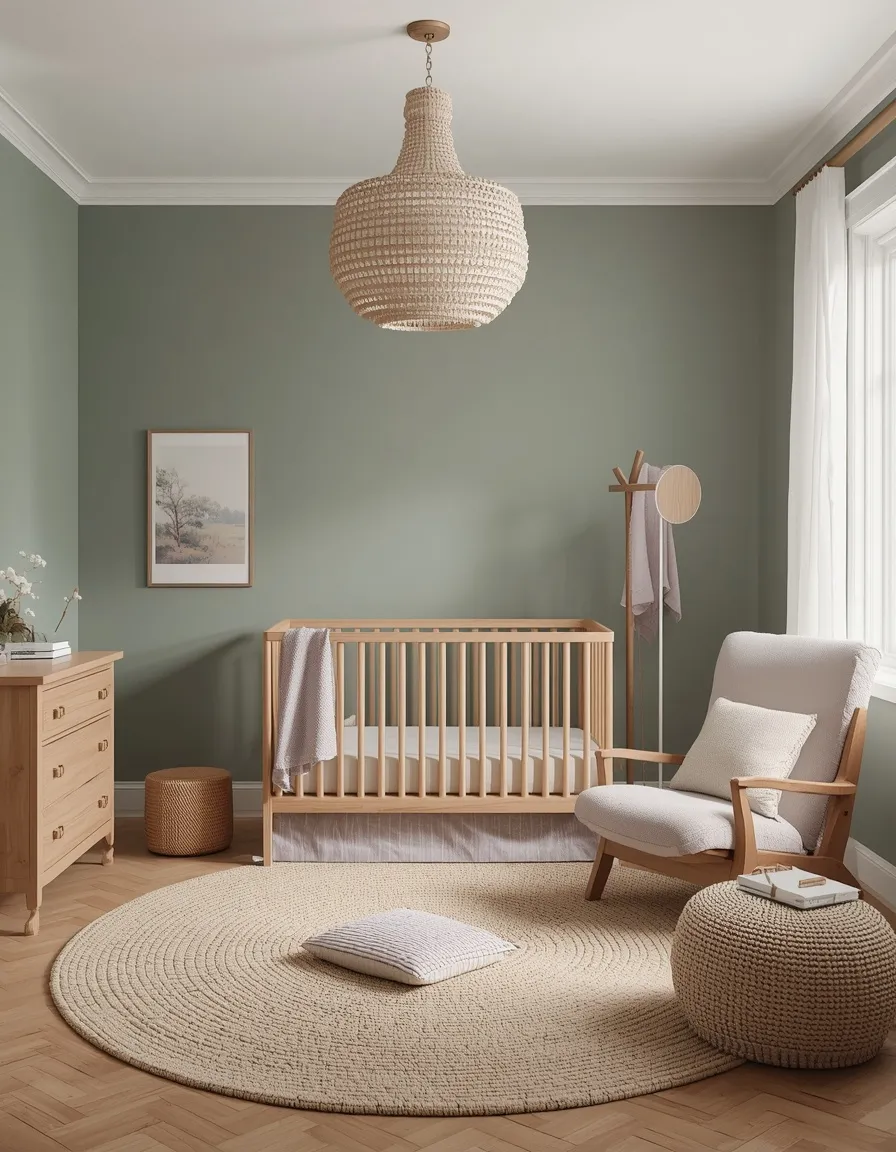
8. Green and Cream Neutral
Green with cream is the most timeless version of this palette. Sage or eucalyptus walls, cream bedding, oat textiles, and pale wood furniture create a nursery that reads as a warm neutral rather than a colored room.
This is green used as a neutral, which is the reason it works in so many nurseries, it gives you the calm and warmth of color with none of the commitment. Keep every tone warm: cream, oat, bone, and pale oak, and avoid any cool blue-white, which will look dirty against the greens. Layer texture through linen, wool, and bouclé. This suits parents who want the room to feel serene and to survive any change of taste.
- Best for: parents wanting serenity and a room that survives any taste change.
- Watch out: keep every tone warm; a cool blue-white looks dirty against green.
- Key elements: sage or eucalyptus walls, cream and oat textiles, pale oak.
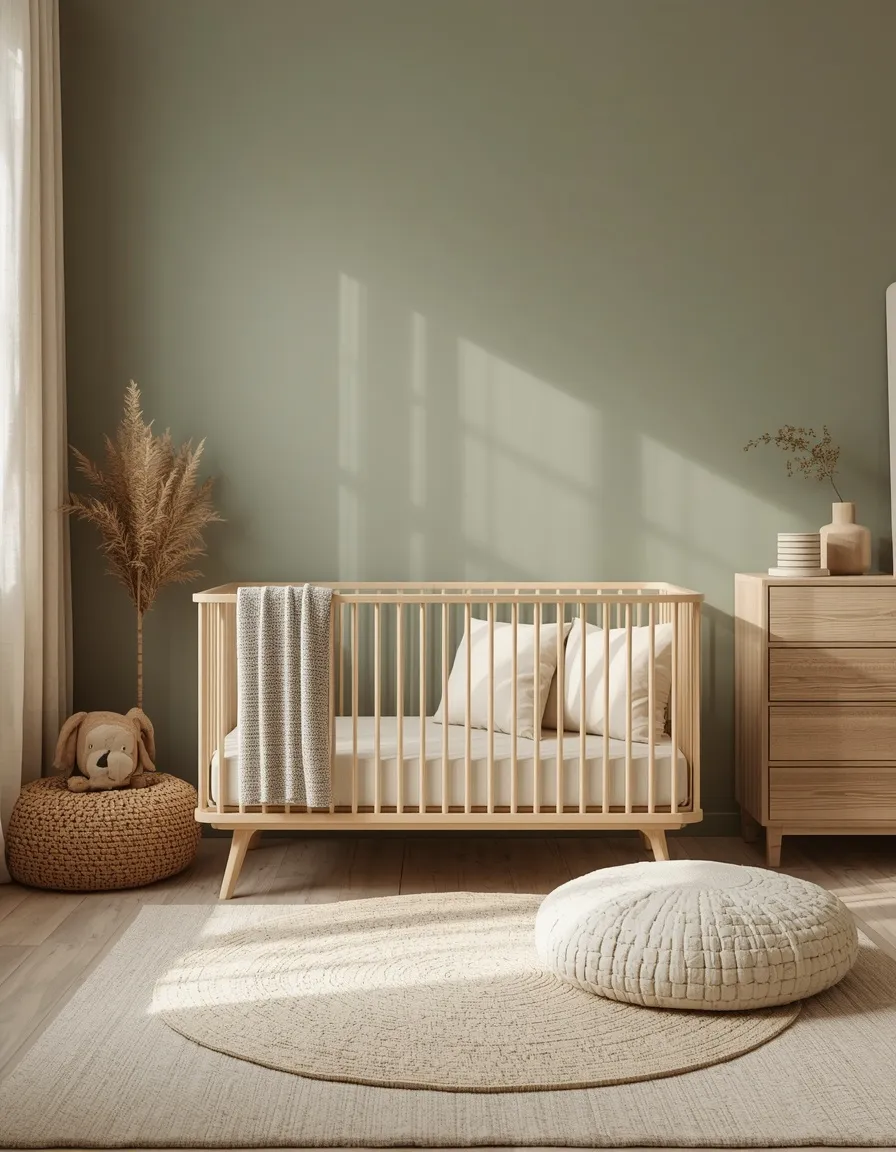
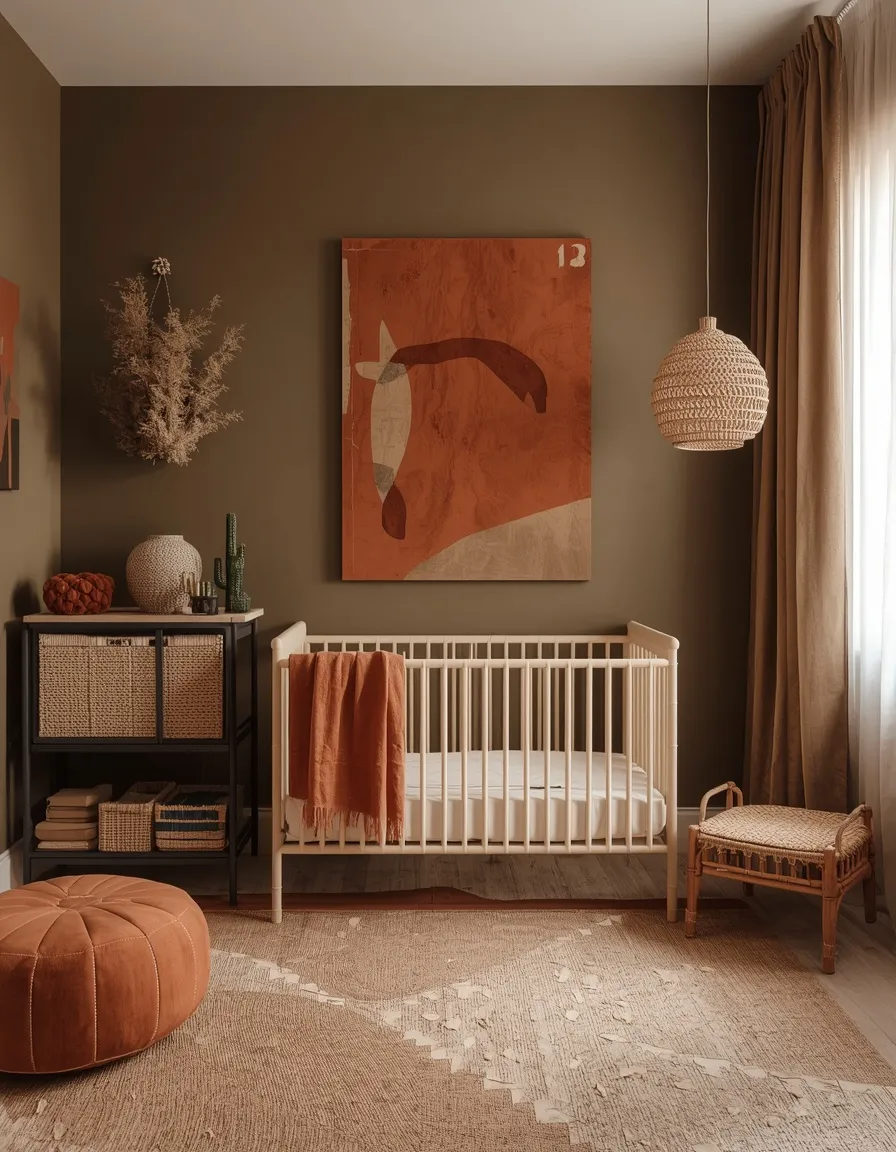
9. Green and Terracotta Earth
Green with terracotta is warm, earthy, and quietly bold. Olive or sage walls, rust and clay textiles, leather details, and rattan storage create a nursery with a grounded, desert-warm character.
Terracotta and rust are green’s natural companions, since both come straight from the same earthy palette, think olive trees against clay soil. Keep the terracotta in textiles and pottery rather than on walls, and add leather, rattan, and cream to warm it further. This palette handles a north-facing room beautifully, where cooler schemes would feel bleak. This suits parents who like a warm, characterful, slightly western-leaning nursery that isn’t remotely babyish.
- Best for: warm, earthy, western-leaning nurseries that aren’t babyish.
- Why it works: olive and clay are drawn from the same earthy palette.
- Key elements: olive walls, rust and clay textiles, leather, rattan, cream.
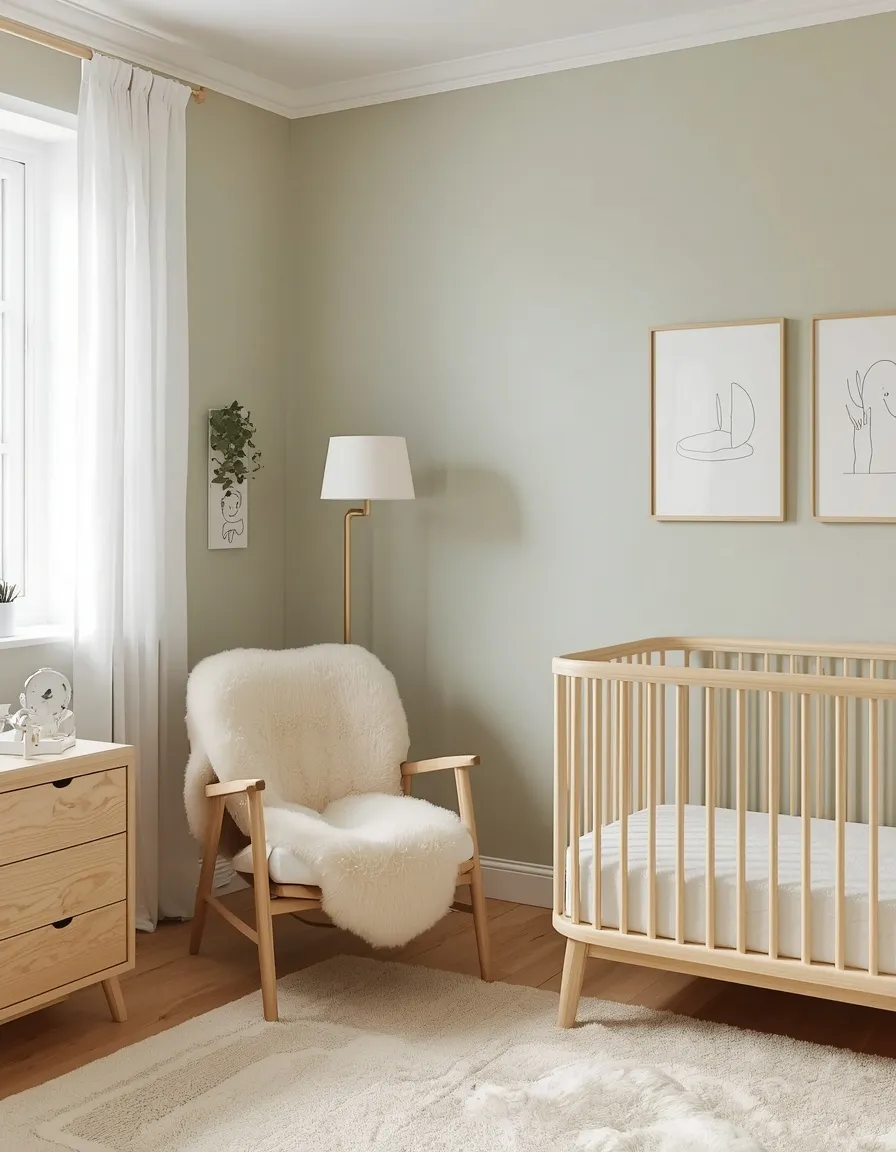
10. Green and Wood Scandi
Green with pale wood is the Scandinavian nursery at its best. Soft sage walls, blonde oak and birch furniture, white bedding, a sheepskin, and simple line-drawn prints create a room that’s bright, warm, and utterly calm.
Blonde woods are what stop green from feeling cold, so bring oak, birch, or ash in at three points, the crib, the dresser, and one smaller item like a stool or shelf. Keep everything else white and simple. This is a genuinely forgiving scheme in cooler, darker climates, where wood warmth does real work in the winter light. This suits almost any home, and it’s the version most likely to still look lovely in ten years.
- Best for: almost any home; the version most likely to age gracefully.
- Why it works: blonde wood at three points stops green from ever feeling cold.
- Key elements: sage walls, oak or birch furniture, white bedding, sheepskin.
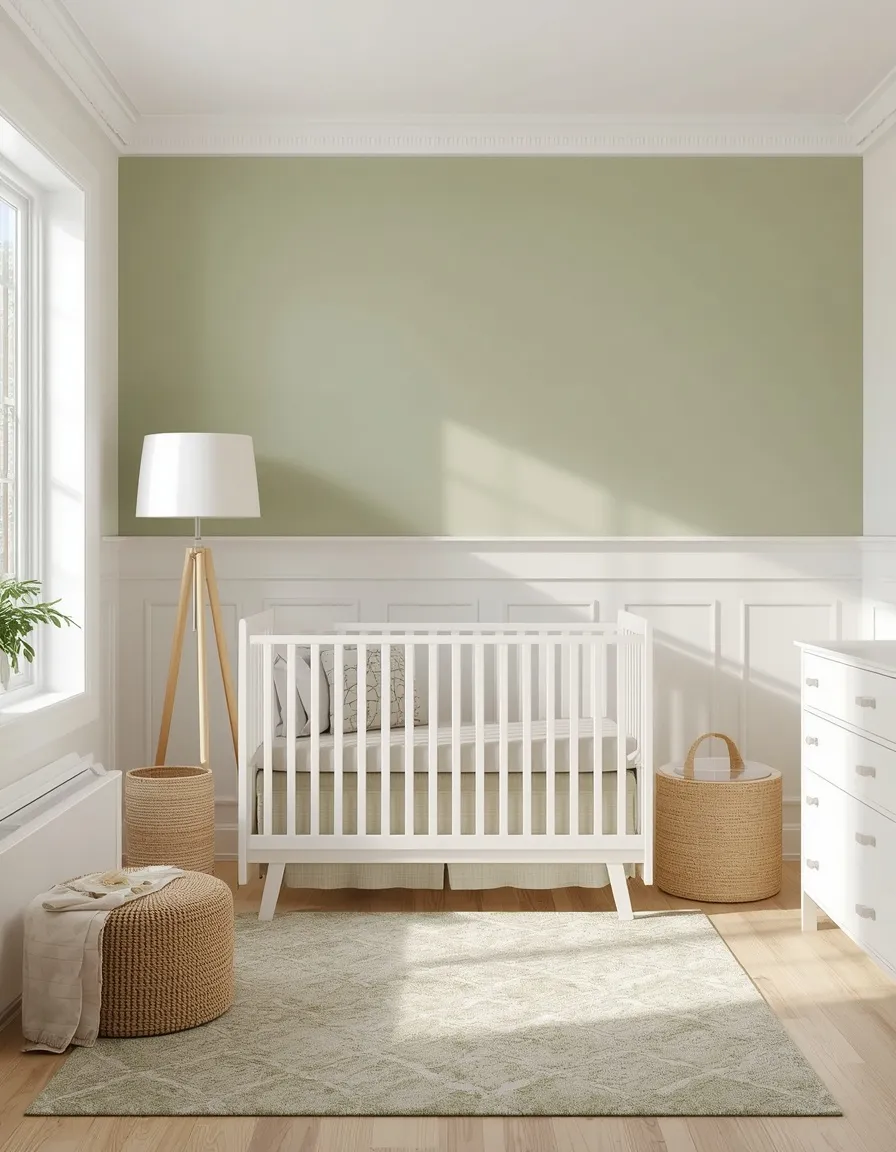
11. Fresh Green and White
Green with crisp white is the brightest, cleanest version of this palette. A sage or mint wall against white trim, white furniture, and a green-and-white patterned rug creates a nursery that feels fresh and light-filled.
White trim gives green a crisp line to sit against, which is what keeps a soft green from blurring into mush, it’s the same reason white skirting makes a colored wall look intentional. Keep the furniture white, the green on one or two walls, and add pale wood for warmth. This is also the easiest scheme to keep bright in a small or dark nursery. This suits small rooms and parents who want green without any heaviness.
- Best for: small and darker nurseries; green with zero heaviness.
- Why it works: white trim gives soft green a crisp line so it reads as intentional.
- Key elements: sage or mint walls, white trim and furniture, patterned rug.
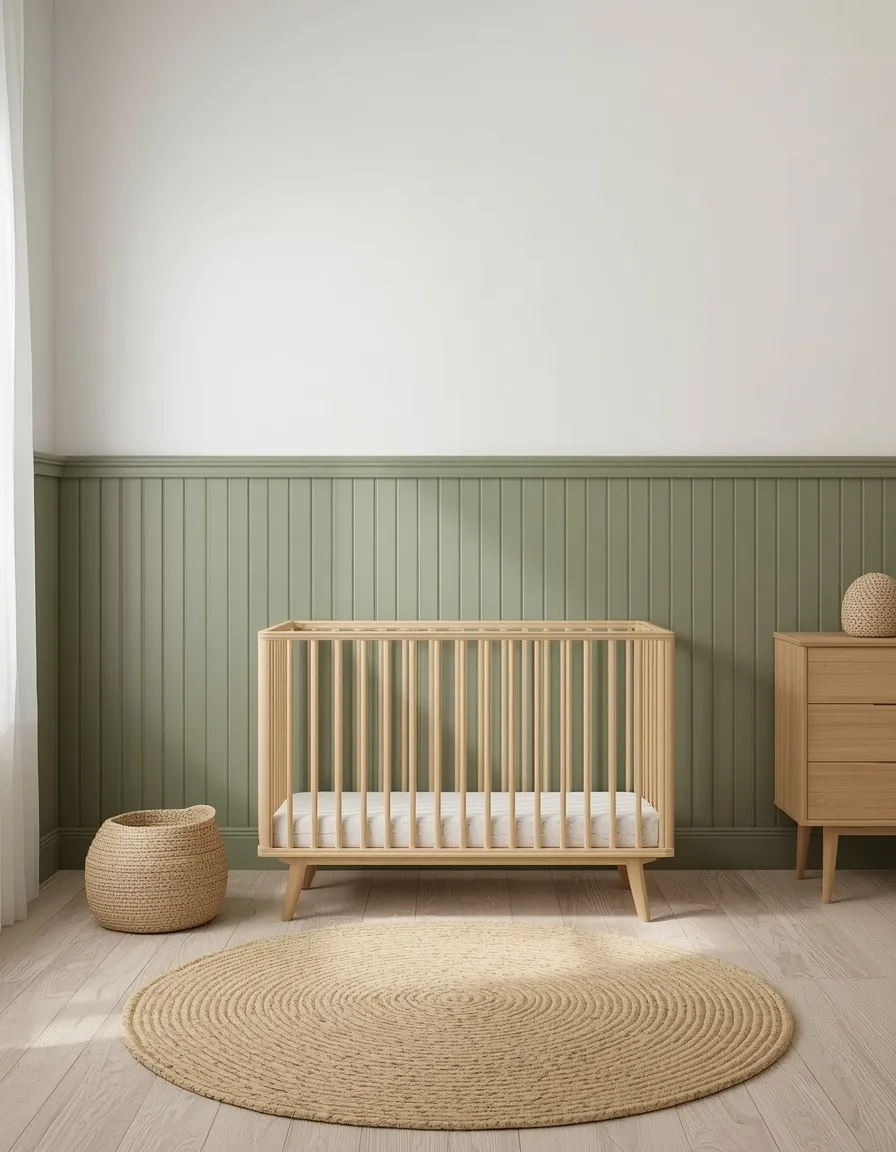
12. Green Panelled Nursery
Panelling in green turns a plain nursery into something architectural. Slatted or beaded panelling painted in sage, running to about two-thirds of the wall height behind the crib, with white above and warm wood throughout.
Panelling adds real character to a box-shaped room, and painting it green rather than white makes it a feature rather than a background. Take it to roughly two-thirds height, around 100–120 cm (40–47 in), which reads better than half-height and gives a chair rail line. Use a scrubbable eggshell, since panelling collects dust and small hands. Fix it properly and paint with low-VOC paint weeks before the birth. This suits homeowners and anyone renovating a plain, featureless room.
- Best for: homeowners; adding character to a plain, featureless box room.
- Why it works: two-thirds height (100–120 cm) reads far better than half-height.
- Key elements: slatted or beaded panelling in sage, white above, warm wood.
13. Painted Green Arch
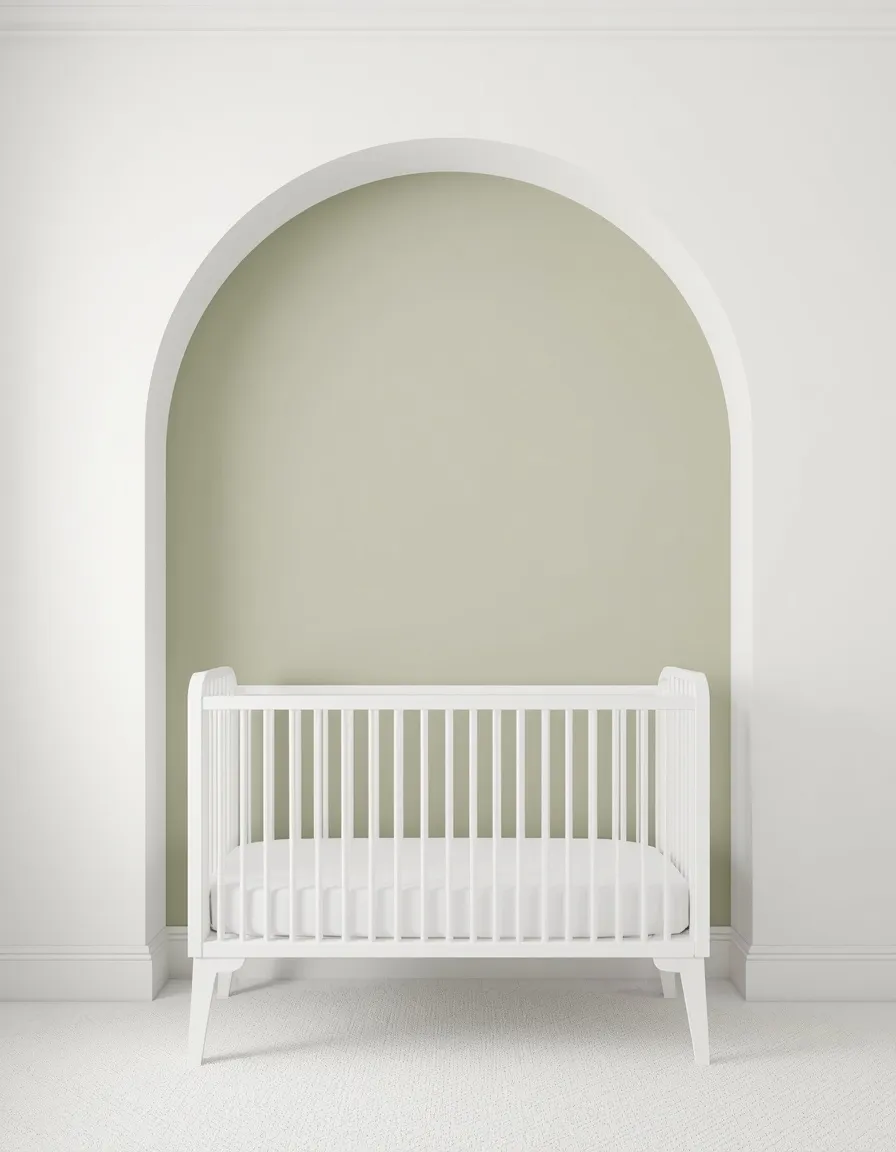
A single painted arch behind the crib is the cheapest way to make a nursery look designed. A soft sage arc rising behind the cot, framing it like a headboard, with the rest of the room kept white.
An arch needs a pencil, a length of string, and a tester pot, and it looks custom, which makes it the highest-return decorating move available. Center it on the crib and make it 20–30 cm (8–12 in) wider than the crib on each side so it frames rather than crowds. Painted decoration is also the safe way to decorate above a crib, since nothing can fall. This suits renters, small budgets, and anyone who wants impact without buying a thing.
- Best for: renters and small budgets; maximum impact for a tester pot.
- Why it works: painted decoration above a crib is safe, nothing can fall.
- Key elements: sage arch centered on the crib, 20–30 cm wider each side.
14. Green Rug as the Anchor
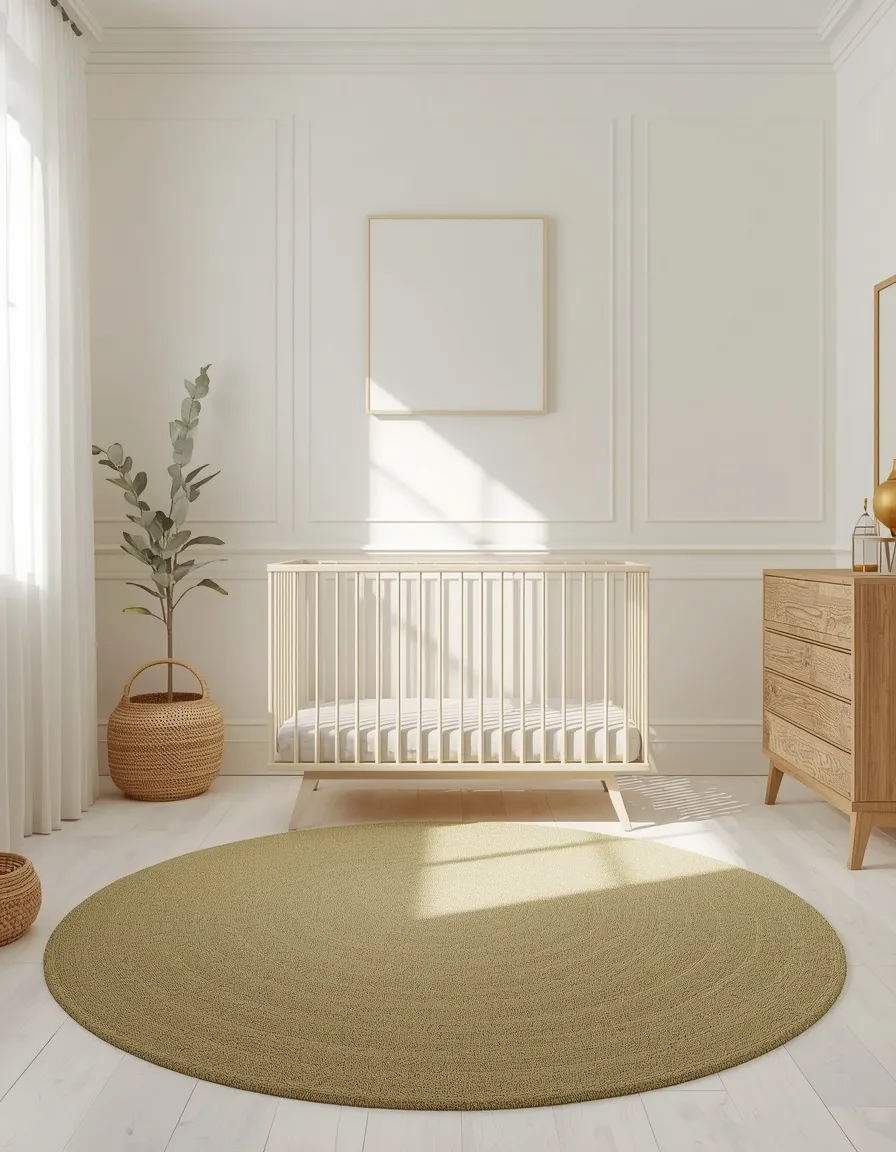
Sometimes the green belongs on the floor. A soft moss or sage rug against white or cream walls delivers the color, the warmth, and the softness underfoot, and the walls stay untouched.
This inverts the usual approach and suits renters perfectly, since the rug is the single easiest thing to change and requires no paint at all. Choose a washable, low-pile rug with a non-slip backing or a rug pad, you’ll be crossing it half-asleep carrying a baby, and it will be spilled on. A wool or washable cotton rug in sage or moss brings real warmth to a pale room. This suits renters, cautious decorators, and anyone testing whether they like green at all.
- Best for: renters; testing whether you like green before committing to paint.
- Watch out: non-slip backing is essential, you’ll cross it half-asleep.
- Key elements: washable low-pile sage or moss rug, white or cream walls.
15. Botanical Green Nursery
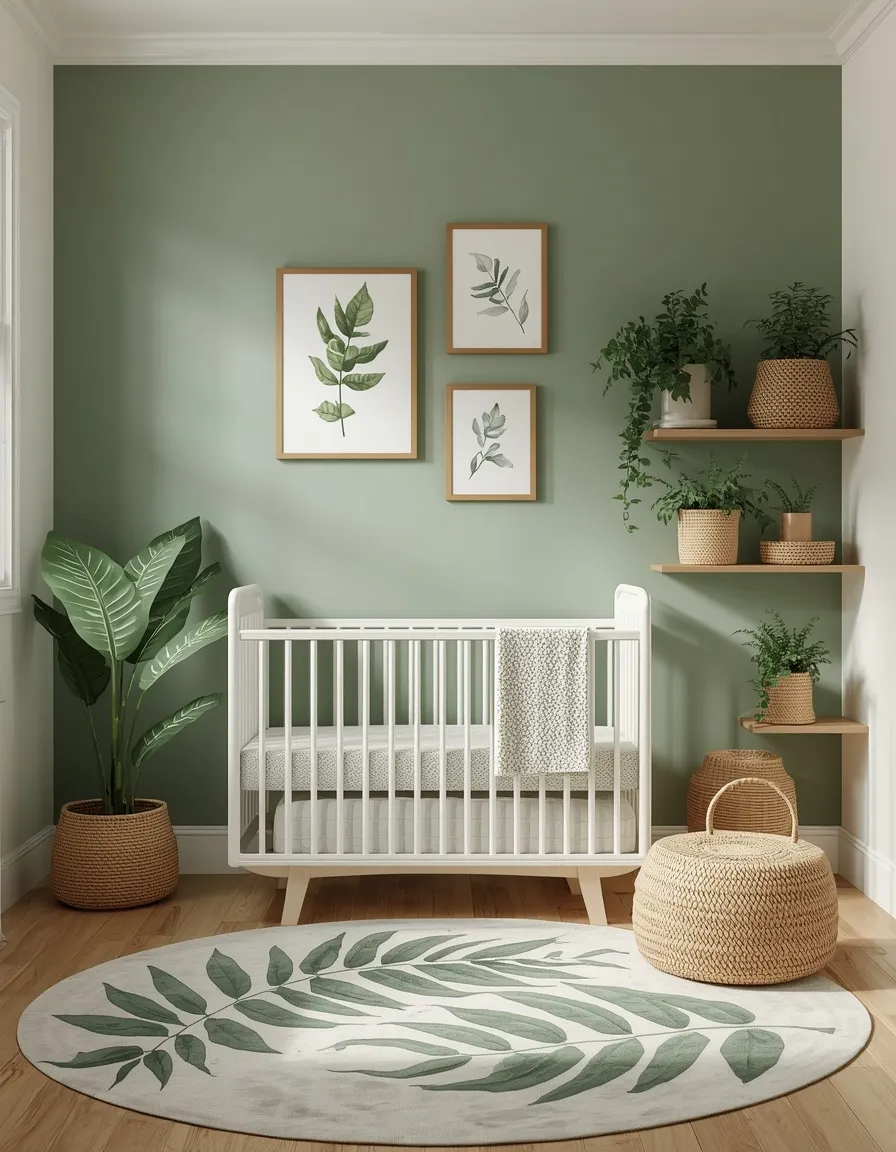
A botanical nursery brings the garden indoors. Sage walls, framed botanical prints, a leaf-patterned rug, rattan baskets, and a few carefully chosen plants placed well out of reach create a room that feels like a greenhouse in the best way.
Choose your plants with real care, because this is where green nurseries go wrong. Pothos, philodendron, monstera, peace lily, ZZ plant, and ivy are all toxic if chewed, and once a baby crawls and pulls up at around six to nine months, anything on a low shelf is within reach. Choose non-toxic species instead, spider plant, parlor palm, areca palm, Boston fern, calathea, or prayer plant, and keep them high regardless. Botanical prints give you the look with none of the risk. This suits plant lovers who want the room to be genuinely safe.
- Best for: plant lovers who want the look and a genuinely safe room.
- Watch out: pothos, monstera, philodendron, peace lily, and ivy are toxic if chewed.
- Key elements: botanical prints, leaf rug, rattan, non-toxic plants kept high.
16. Green Nursery for a Boy
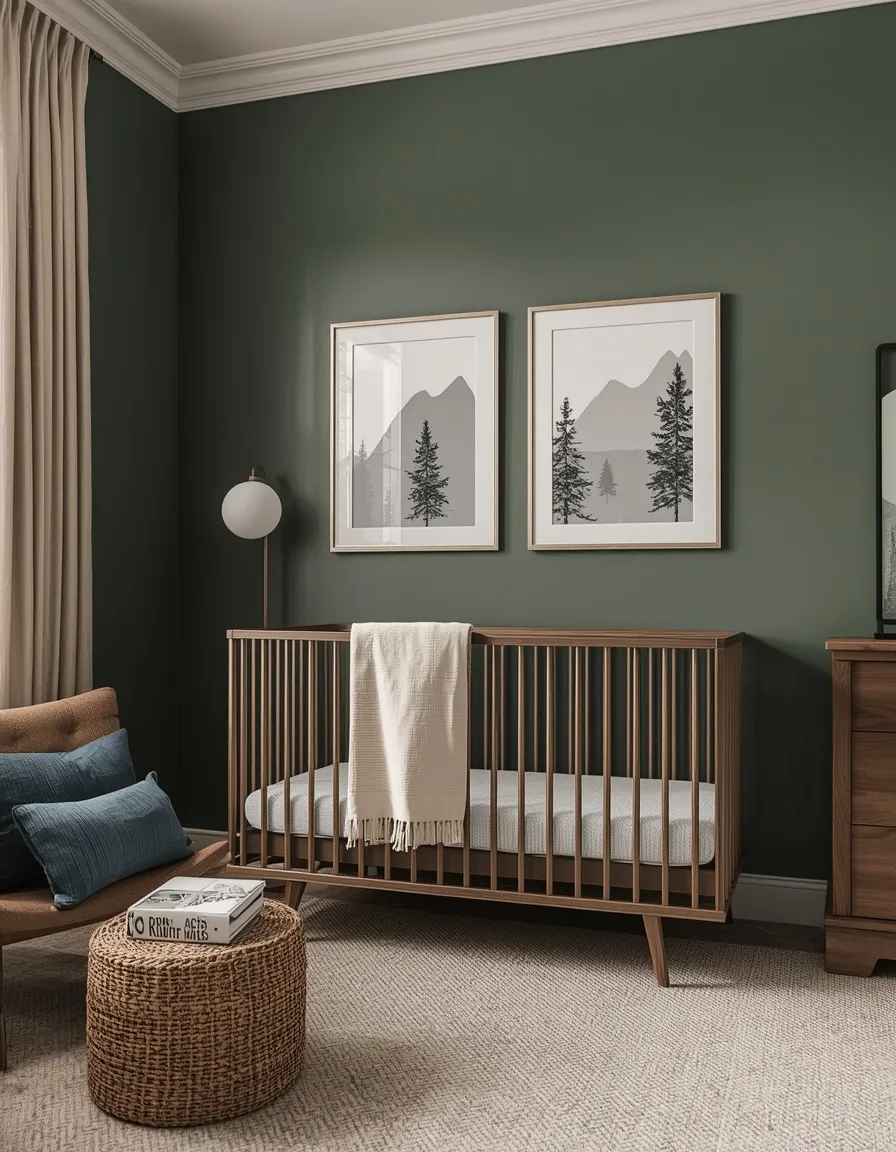
Green is the boy’s nursery color that isn’t blue. Deep sage or olive walls, navy and cream textiles, warm oak furniture, and simple mountain or forest prints create a room that’s handsome and grows up beautifully.
Green paired with navy and warm wood reads as calm and masculine without a single vehicle, animal, or primary color in sight, and, crucially, it still suits a ten-year-old. Keep the walls green, the furniture pale, and the theme confined to a couple of prints. When he outgrows the nursery, the room simply becomes a bedroom. This suits parents who want to decorate once and who find traditional boys’ nursery themes tiresome.
- Best for: parents who want to decorate once and dislike babyish themes.
- Why it works: green with navy and oak still suits a ten-year-old.
- Key elements: sage or olive walls, navy and cream textiles, oak, simple prints.
17. Green Nursery for a Girl
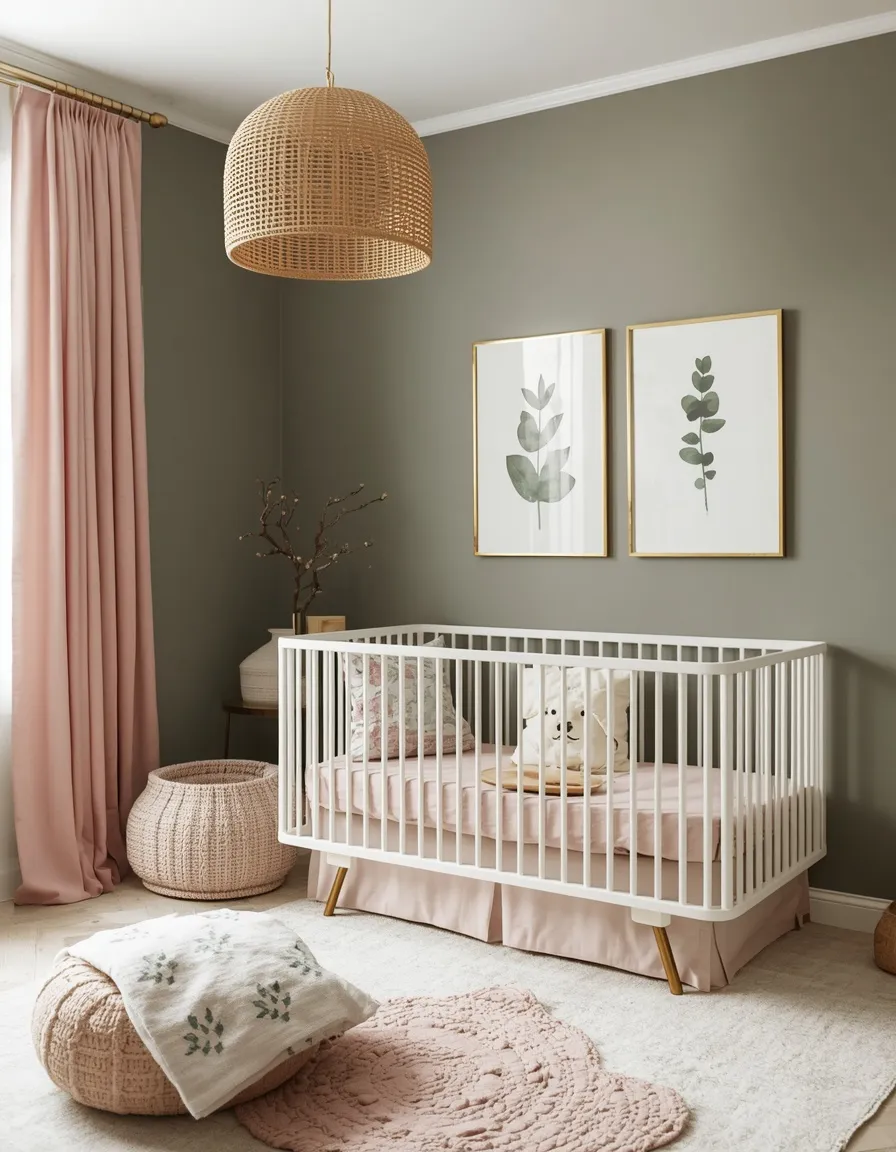
A green nursery for a girl is soft, grown-up, and free of pink obligation. Sage walls, blush or cream textiles, brass accents, a rattan pendant, and floral or botanical prints create a room that’s feminine on its own terms.
Green gives you a genuinely feminine room without defaulting to pink, and it means she isn’t stuck with a color she may not want at six. Use blush, cream, and brushed brass as accents, keep them in textiles rather than paint, and add rattan and linen for texture. If she later wants more pink, or none at all, the sage walls accommodate both. This suits parents of girls who want elegance and flexibility rather than a pink box.
- Best for: girls’ nurseries; feminine without defaulting to pink.
- Why it works: sage walls accommodate more pink later, or none at all.
- Key elements: sage walls, blush and cream textiles, brass, rattan, botanical prints.
18. Gender-Neutral Green Nursery
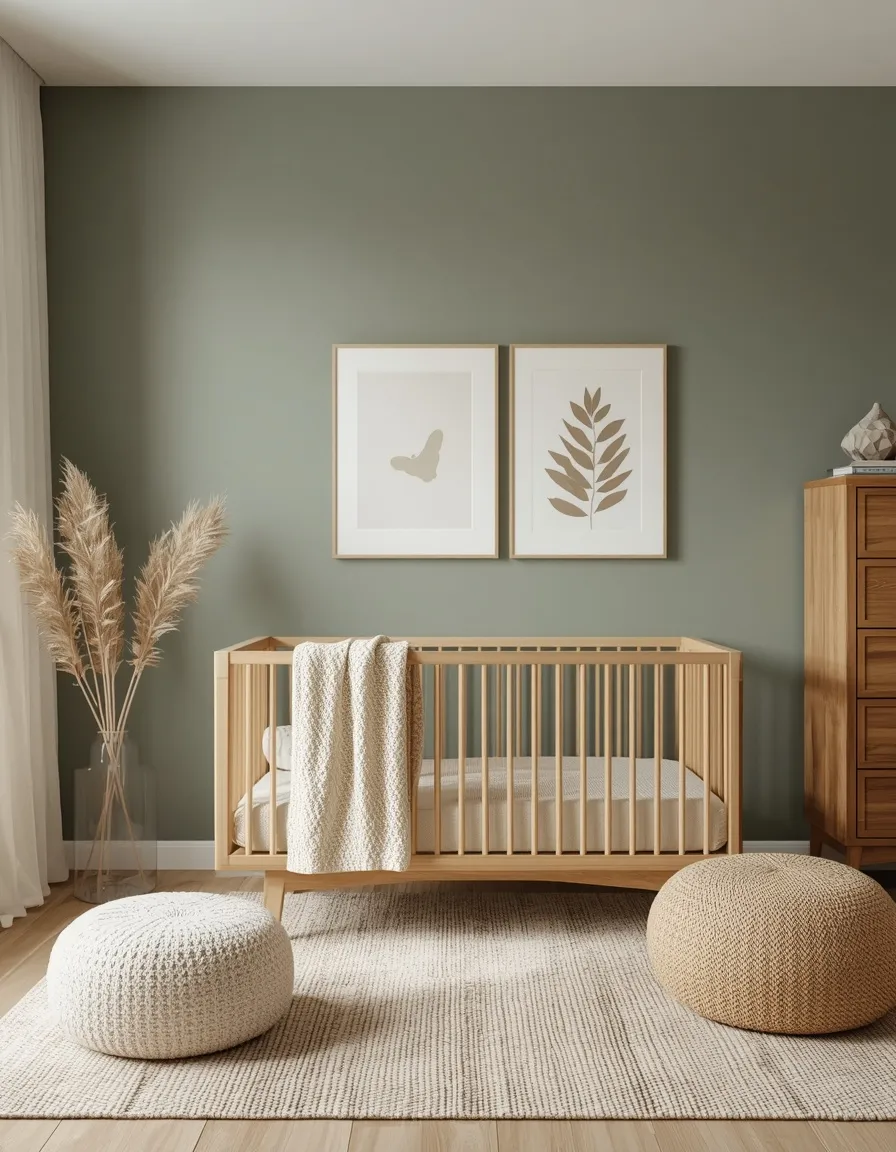
Green is the gender-neutral color that actually feels like a color. Eucalyptus or sage walls, oat and cream textiles, natural wood, and simple nature-led prints create a nursery that works before you know and long after.
Nature is the reliable neutral theme, leaves, mountains, animals, arches, and it dates far more slowly than any color-coded scheme. Green carries it perfectly, and because the palette isn’t tied to anything, the room takes a second child without a single change. Add texture through jute, linen, and rattan. This suits parents not finding out the sex, families planning more children, and anyone who dislikes the pink-and-blue convention entirely.
- Best for: parents not finding out; families planning a second child.
- Why it works: nature-led themes date far more slowly than color-coded ones.
- Key elements: eucalyptus walls, oat and cream, natural wood, nature prints.
19. Cozy Layered Green Nursery
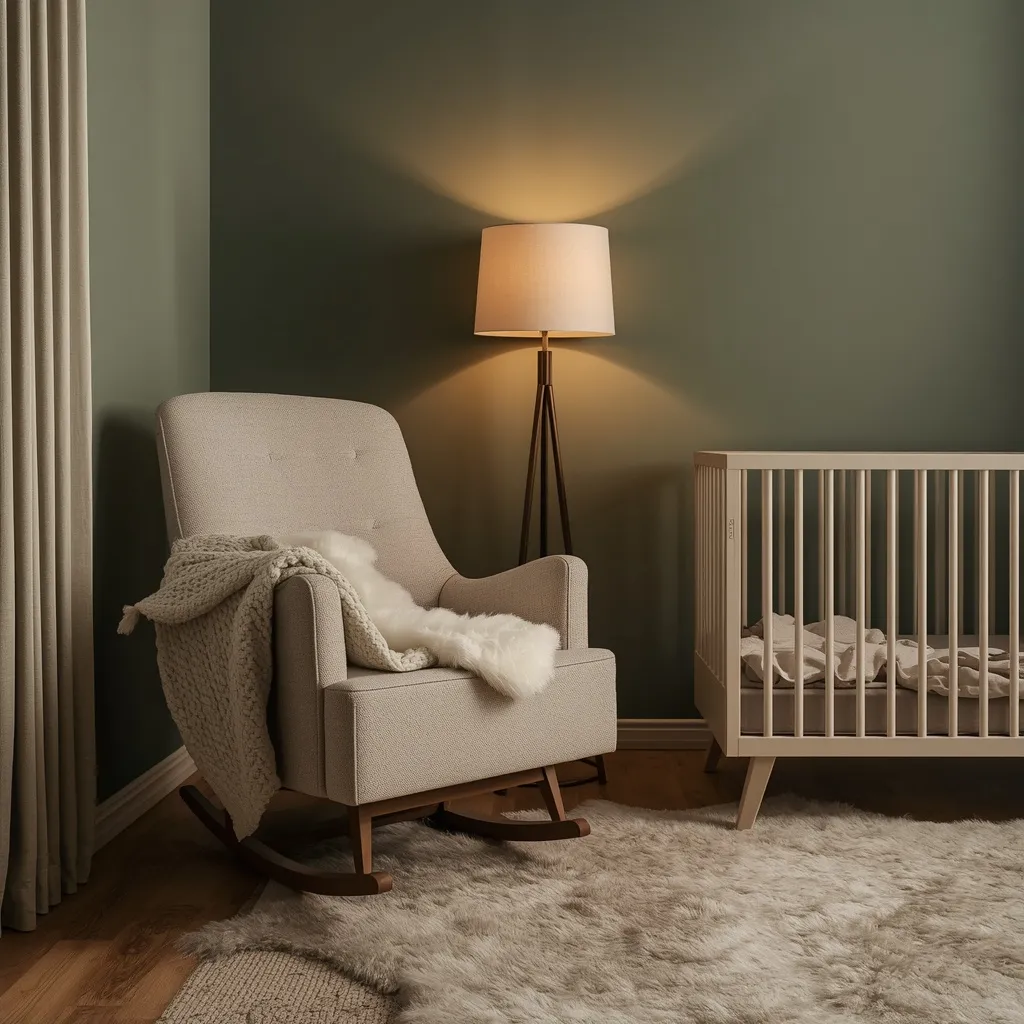
Texture is what turns a green nursery from pretty to genuinely comforting. Sage or forest walls, a bouclé glider, a chunky knit throw over its arm, a sheepskin, a deep-pile rug, and warm lamplight layer up into a room that feels soft before you touch anything.
Combine at least four contrasting textures, bouclé, waffle cotton, wool, jute, linen, because with a single wall color doing the work, texture is what gives the room depth. All the soft things belong outside the crib: the throw goes over the chair, never over the cot rail, where a baby could pull it in. Choose machine-washable covers wherever you can, and add warm, dimmable lamplight for night feeds. This suits anyone who wants a nursery that feels like a hug.
- Best for: anyone who wants a nursery that feels genuinely comforting.
- Watch out: soft things go on the chair, never over the crib rail.
- Key elements: bouclé, chunky knit, sheepskin, deep-pile rug, dimmable lamps.
The Nursery Rules That Don’t Change
Whatever color you choose, the safety fundamentals are the same. A safe crib is a bare crib: a firm, flat mattress, a fitted sheet, and nothing else, no pillows, quilts, bumpers, or soft toys, all of which are suffocation risks.
Anchor every dresser, bookshelf, and changing unit to the wall with anti-tip straps, since furniture tip-overs are a leading cause of injury to children at home. Fit cordless blinds, because pull cords are a strangulation hazard. And hang nothing above the crib, no shelves, no heavy framed art, no hanging planters, since anything that can fall eventually will. A painted arch is the safe way to decorate that wall.
Paint with a low-VOC or zero-VOC product several weeks before the birth, ventilating the room well while it cures. Safe-sleep guidance is updated periodically and varies by country, so check your national health service or paediatric body for the current advice.
If you’re weighing green against a paler scheme, it’s worth seeing both properly, our guide to modern white nursery design makes the case for the other end of the spectrum, and you’ll find plenty more across our kids’ room ideas.
Conclusion
The best green nursery ideas start with two questions nobody asks: which green will hold its color in your particular light, and which plants can safely live in a room a baby will soon be crawling around. Choose a warm sage or olive if the room faces north, test a large patch under the lamp you’ll use at 2 a.m., keep the crib bare and everything anchored, and put the trailing pothos somewhere else entirely. Do that and you’ll have the calmest room in the house. For more, browse our kids’ room ideas.
Frequently Asked Questions
Q: What shade of green is best for a nursery?
Sage is the most popular and the safest starting point, but the right shade depends on your light. Green shifts more than almost any other color: a cool grey-sage in a north-facing room reads flat and murky, while a warm sage or olive with a yellow base holds its color there. Bright south-facing rooms can carry cooler greens happily. Test a large patch before committing.
Q: Are plants safe in a nursery?
Many popular houseplants are not. Pothos, philodendron, monstera, peace lily, ZZ plant, dieffenbachia, and ivy are all toxic if chewed. A plant on a low shelf is fine beside a newborn and becomes a hazard once a baby crawls and pulls up, typically around six to nine months. Choose non-toxic species such as spider plant, parlor palm, areca palm, Boston fern, or calathea, keep them well out of reach regardless, and check anything you’re unsure of against the ASPCA’s plant database.
Q: Is green a good color for a gender-neutral nursery?
It’s arguably the best. Green is restful enough to sleep in, warm enough to feel like a real decision, and completely free of the pink-or-blue convention. Eucalyptus and sage in particular pair with almost anything, which means the room takes a second child without a single change and still works when the nursery becomes a bedroom.
Q: What colors go with sage green in a nursery?
Cream, oat, and warm oak are the most reliable partners. Dusty blush makes a beautiful, unclichéd pairing for a girl’s room, navy reads calm and grown-up for a boy’s, terracotta and rust give a warm earthy scheme, and pale lilac is an unexpected pairing that works because purple and green sit close on the color wheel. Keep every partner tone muted rather than bright.
Q: Does green make a small nursery look smaller?
Not if you choose a light shade. Pale mint, soft sage, and light greens reflect light and keep a small room feeling airy, especially with white trim and white furniture, which gives the green a crisp line to sit against. Deep forest greens are cozy but absorb light, so save those for larger rooms or ones with good lamp lighting.
Q: Can you paint a nursery while pregnant?
Choose a low-VOC or zero-VOC paint, ventilate the room thoroughly, and, the simplest answer, have someone else do the painting several weeks before the birth so the fumes have fully cleared. That’s a genuine reason to start the nursery early rather than a nice-to-have. Check with your midwife or doctor if you’re unsure.