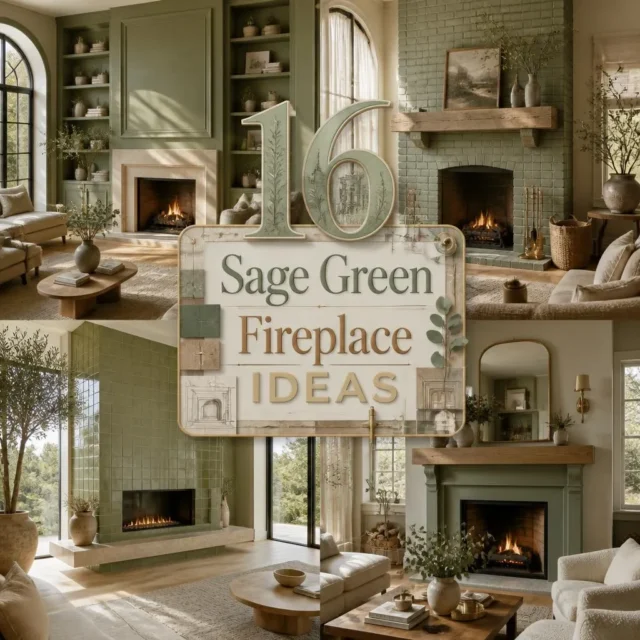

Paint a fireplace sage green and the whole room changes character in a weekend. A sage green fireplace is soft enough to feel calm and grounded enough to feel intentional, the rare color that reads as neutral while being unmistakably a decision. It flatters warm oak and cool stone, it sits happily beside cream, brass, black, or even blush, and it makes a plain chimney breast look like architecture. At Sunday Abode, we love a change with that much return on effort. These 16 ideas cover every version of it, plus the paint rules that decide whether the finish survives its first winter.
Key Takeaways
- Sage isn’t one color. Warm sage (yellow-green) flatters north-facing rooms; cool grey-sage can read cold and dull there.
- Paint type depends on the zone. The mantel, surround, and wall take ordinary paint, but anything in or immediately around the firebox needs heat-resistant stove paint.
- Painting brick is close to irreversible, and ordinary latex can trap moisture. Use a breathable mineral or masonry paint on an old chimney breast.
- Use matte on the wall but eggshell or satin on the mantel shelf, which gets touched, dusted, and needs wiping.
- Sage pairs beautifully with warm wood, brass, cream, black, and blush pink, which makes it one of the easiest colors to build a room around.
Which Paint Can You Actually Use Where?
You cannot use the same paint across a whole fireplace. The mantel, surround, and chimney breast take ordinary interior paint, but anything in or immediately beside the firebox needs heat-resistant paint rated for high temperatures.
This is the detail that decor articles skip, and it matters. Standard emulsion or latex on a surface that gets genuinely hot will blister, discolor, and can give off fumes as it heats. Heat-resistant stove paint is formulated for exactly that job. If your fireplace is decorative and never lit, the question is moot, but if you burn in it, be precise about where each product goes.
Fireplace Paint Zones
Use this to work out what goes where before you buy a single tin.
| Zone | Paint to use | Why |
| Chimney breast / wall | Standard interior emulsion or latex | Far enough from heat; matte finish suits it |
| Mantel shelf | Eggshell or satin | Gets touched and dusted; needs to wipe clean |
| Wooden surround | Eggshell or satin, primed first | Durable, wipeable, and holds up to knocks |
| Painted brick | Breathable mineral or masonry paint | Lets the masonry breathe; latex traps moisture |
| Firebox interior / heat zone | Heat-resistant stove paint | Ordinary paint blisters and can give off fumes |
| Cast iron insert | High-temperature stove paint only | Rated for the temperatures it actually reaches |
Prep matters as much as product: degrease and wash off soot, fill and sand, prime bare masonry or timber, and mask the firebox before you start.
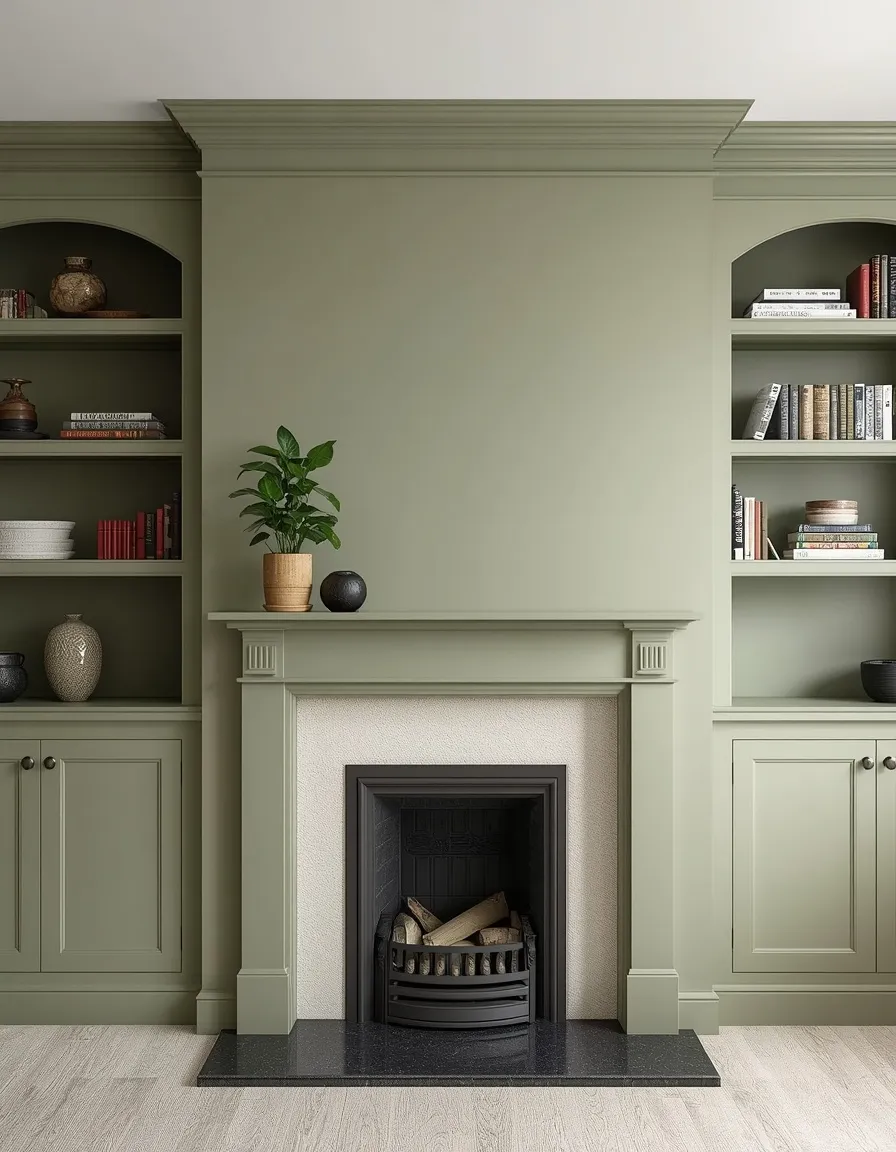
1. Sage Fireplace with Built-Ins
Sage green built-ins flanking a fireplace turn a plain wall into joinery worth looking at. Painted shelving and cabinets either side, wrapping the chimney breast in one continuous color, make the whole composition read as designed rather than assembled.
Paint the built-ins and the chimney breast in the same sage so the wall reads as a single architectural element, using a different color on the shelves is what makes a built-in look bolted on. Style the open shelves sparingly with books, ceramics, and one or two plants, leaving real breathing space. Use eggshell or satin on the joinery, since shelves get handled and dusted constantly and matte will mark. This suits living rooms with alcoves either side of the chimney breast, which is most period homes.
- Best for: living rooms with alcoves either side of the chimney breast.
- Why it works: one continuous color makes the whole wall read as designed joinery.
- Key elements: matched sage built-ins and breast, sparse shelf styling, satin finish.
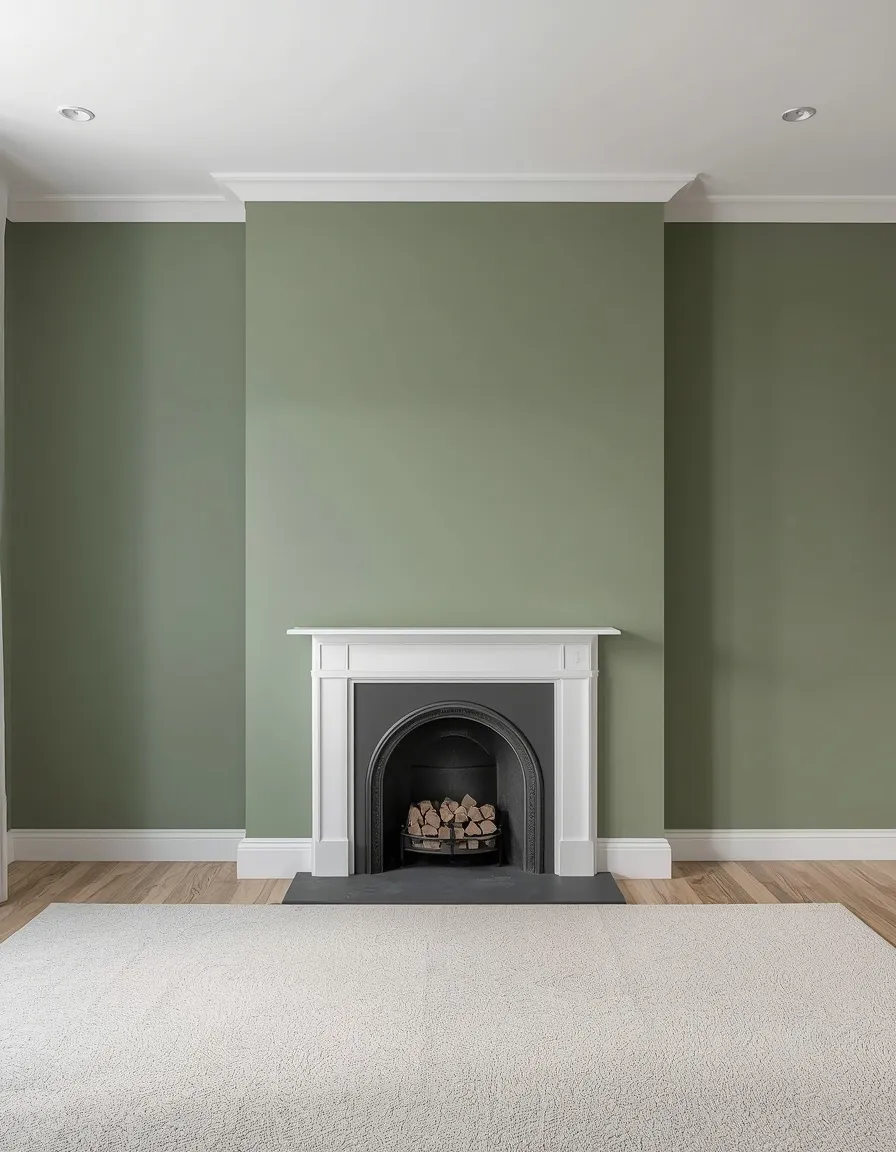
2. Full Sage Accent Wall
Taking sage floor-to-ceiling across the whole fireplace wall is bolder and often better. The color wraps the chimney breast and the wall around it, making the fireplace feel built into the architecture rather than stuck on it.
Painting only the chimney breast can leave it looking like a stripe, whereas carrying the color across the entire wall gives the room a proper anchor. Use a matte finish on the wall for depth, and consider running the color over any picture rail or up onto the ceiling line for a more enveloping effect. Keep the remaining three walls light so the room doesn’t close in. This suits medium and large living rooms and anyone who wants a real color commitment.
- Best for: medium and larger living rooms wanting a genuine color statement.
- Why it works: painting the full wall stops the chimney breast reading as a stripe.
- Key elements: floor-to-ceiling matte sage, light adjacent walls, wrapped detailing.
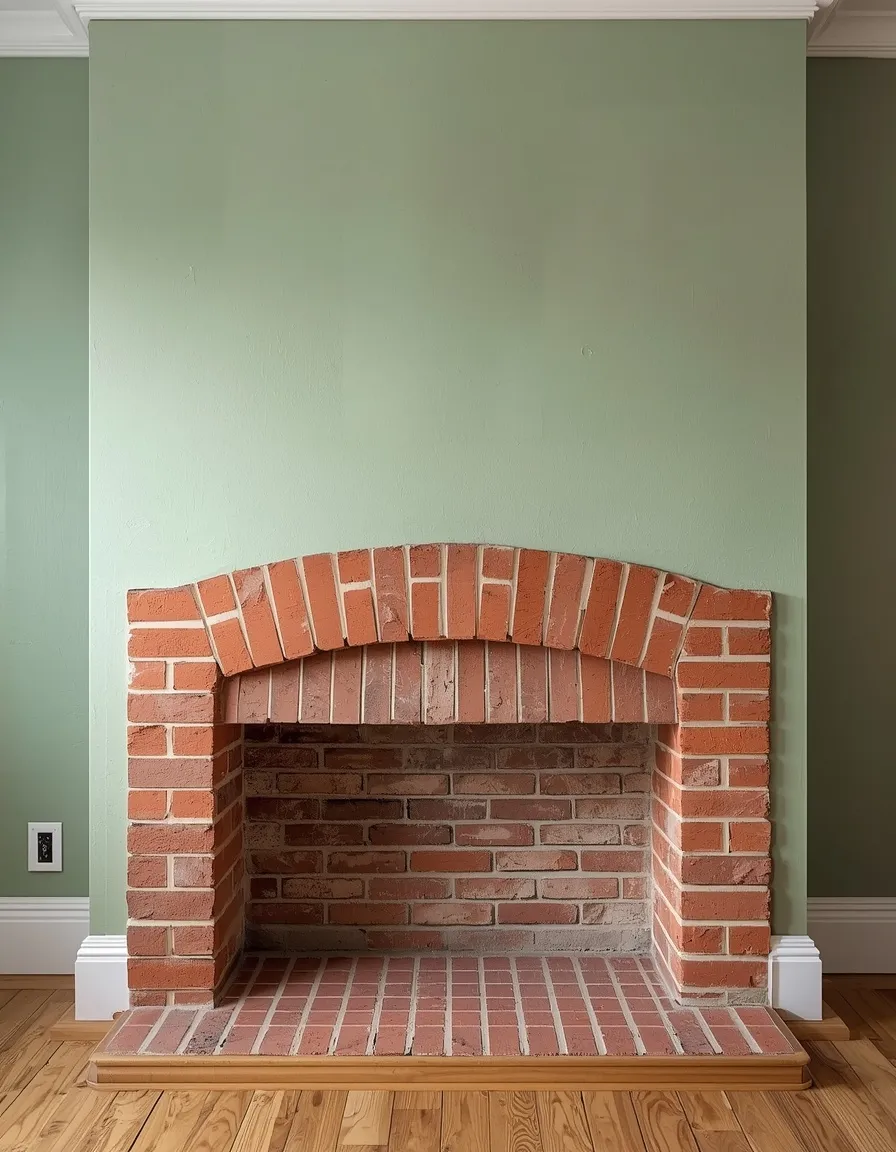
3. Painted Sage Brick Fireplace
Sage green over red brick is one of the most transformative changes you can make to a room. The paint calms the brick’s orange heat while keeping every bit of its texture, so the fireplace still reads as brick, just quieter.
Two cautions before you start, and they matter. Painting brick is close to irreversible, since stripping it later is a brutal job, so be certain. And use a breathable mineral or masonry paint rather than a standard latex, because a plastic-like film traps moisture in the masonry and can cause damp and efflorescence on an old chimney breast. Clean off soot and grease thoroughly and prime first. This suits period homes stuck with brick they dislike but can’t remove.
- Best for: period homes with brick they dislike but can’t remove.
- Watch out: painting brick is near-irreversible, use breathable masonry paint.
- Key elements: breathable mineral paint, thorough degreasing, texture retained.
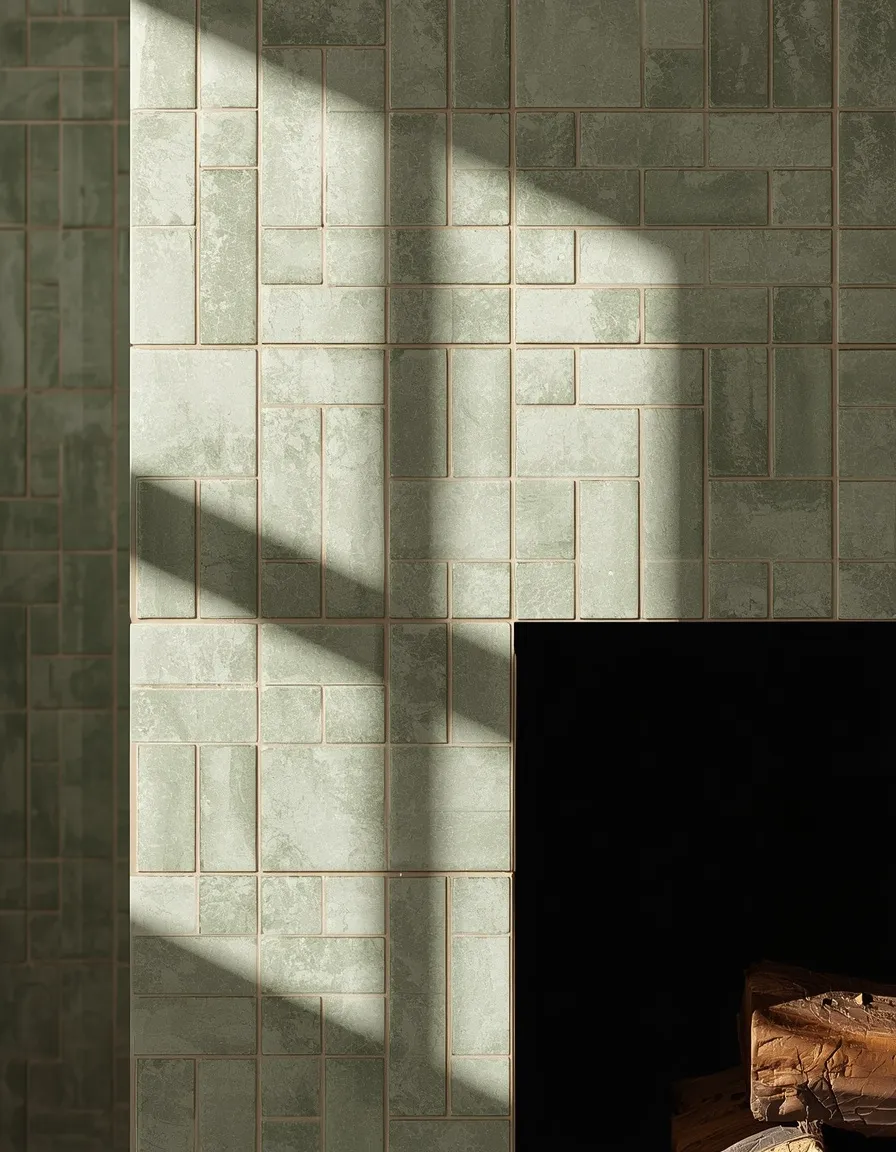
4. Sage Green Tiled Surround
Glazed sage tiles around a firebox catch light in a way paint never can. Handmade zellige or crackle-glaze tiles in soft green, each one slightly different, frame the opening with subtle variation and a gentle shine.
Handmade tiles like zellige vary in tone and surface, and that irregularity is the entire appeal, a uniform machine-made tile in the same color looks flat by comparison. Use heat-resistant tile adhesive and grout rated for a fireplace, since ordinary adhesive can fail near heat. Choose a grout a shade darker than you think, as pale grout beside a working fire discolors quickly. This suits anyone renovating a surround and wanting texture rather than flat color.
- Best for: renovations where you want texture and light, not flat color.
- Watch out: use heat-rated adhesive and grout; pale grout discolors near a fire.
- Key elements: zellige or crackle-glaze sage tiles, darker grout, irregular tone.
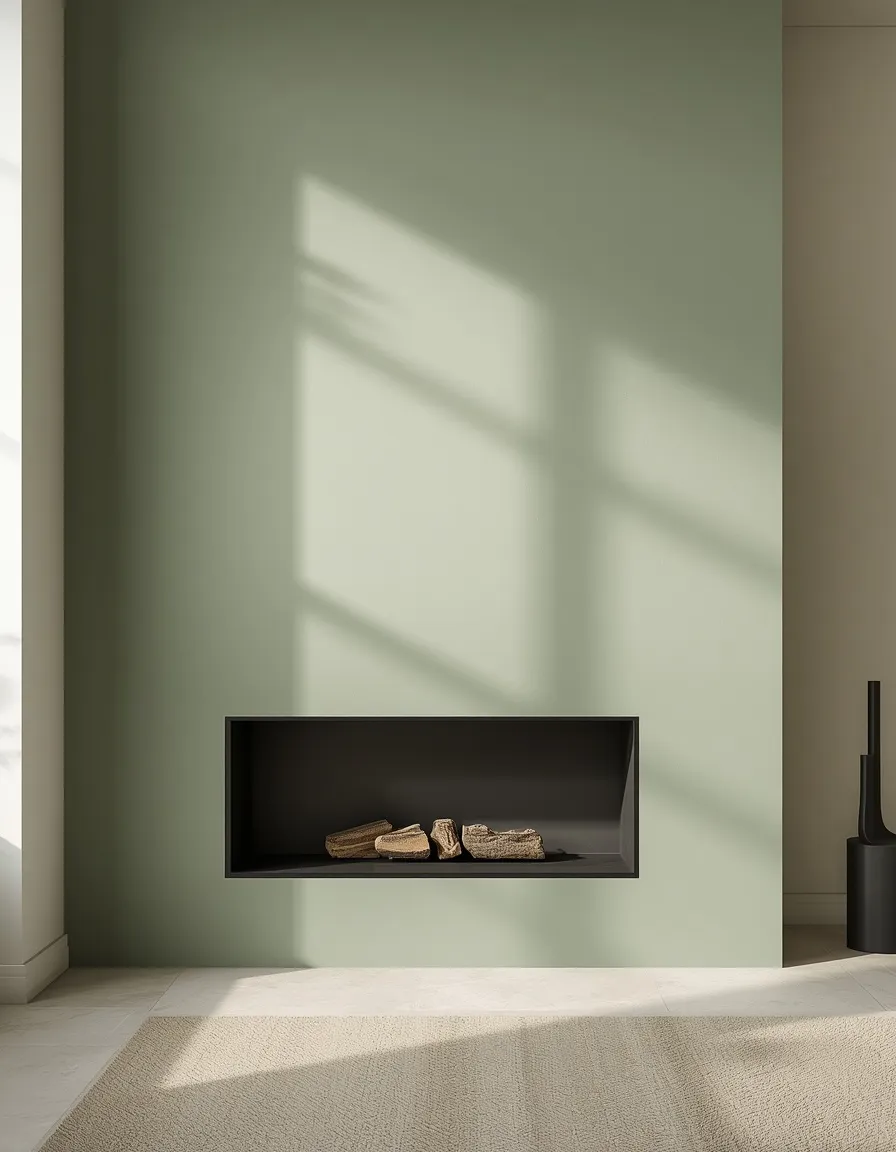
5. Modern Minimalist Sage
A modern sage fireplace is a flush, unadorned plane of color. No mantel, no molding, just a clean rendered chimney breast in soft green with a linear firebox set into it and nothing else competing.
With no detail to hide behind, the finish carries everything: use a flat or matte paint on a properly smooth surface, since any sheen will spotlight every imperfection across a large plane. Skip the mantel entirely, or use a slim floating shelf if you need somewhere to put things. A single sculptural object nearby is enough. This suits modern and new-build homes, and it’s the cheapest way to make a boxy builder-grade fireplace look deliberate.
- Best for: modern homes; making a builder-grade fireplace look deliberate.
- Watch out: matte only, sheen on a big flat plane exposes every imperfection.
- Key elements: flush rendered breast, no mantel, linear firebox, one object.
6. Sage with Warm Wood Mantel
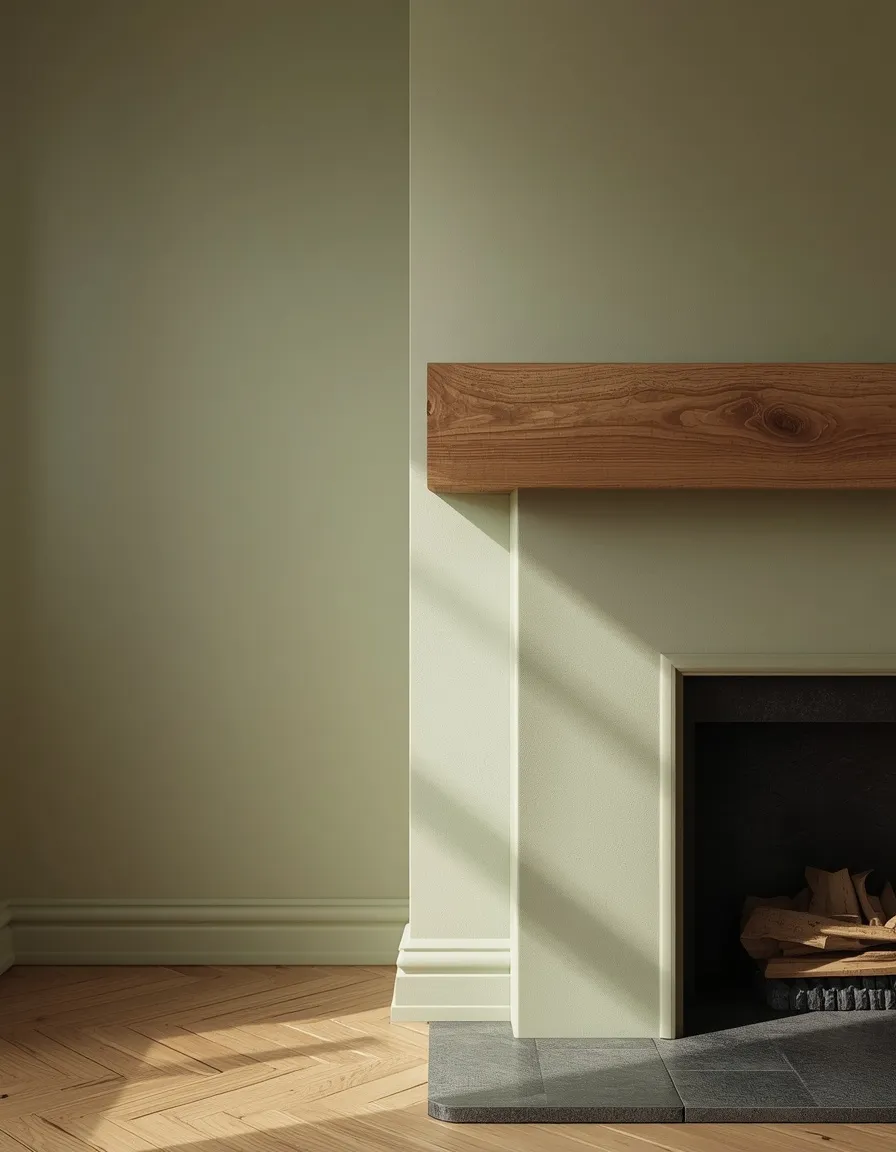
Sage green against a chunky oak mantel is the pairing that makes the color sing. The green cools and the wood warms, and the contrast between painted plane and living grain gives the fireplace real depth.
Choose a warm-toned sage, one with a yellow-green rather than grey-blue base, because a cool grey-sage beside warm oak can look slightly muddy and unresolved. A chunky reclaimed beam or a thick oak shelf gives the weight this look needs; a thin, delicate mantel gets lost against a wall of color. Oil the wood rather than varnishing it to keep the grain matte and honest. This suits modern rustic, farmhouse, and Scandinavian rooms.
- Best for: modern rustic, farmhouse, and Scandi rooms.
- Watch out: use a warm sage; cool grey-sage beside warm oak looks muddy.
- Key elements: warm sage, chunky oiled oak mantel, contrast of paint and grain.
7. Sage and Cream Traditional
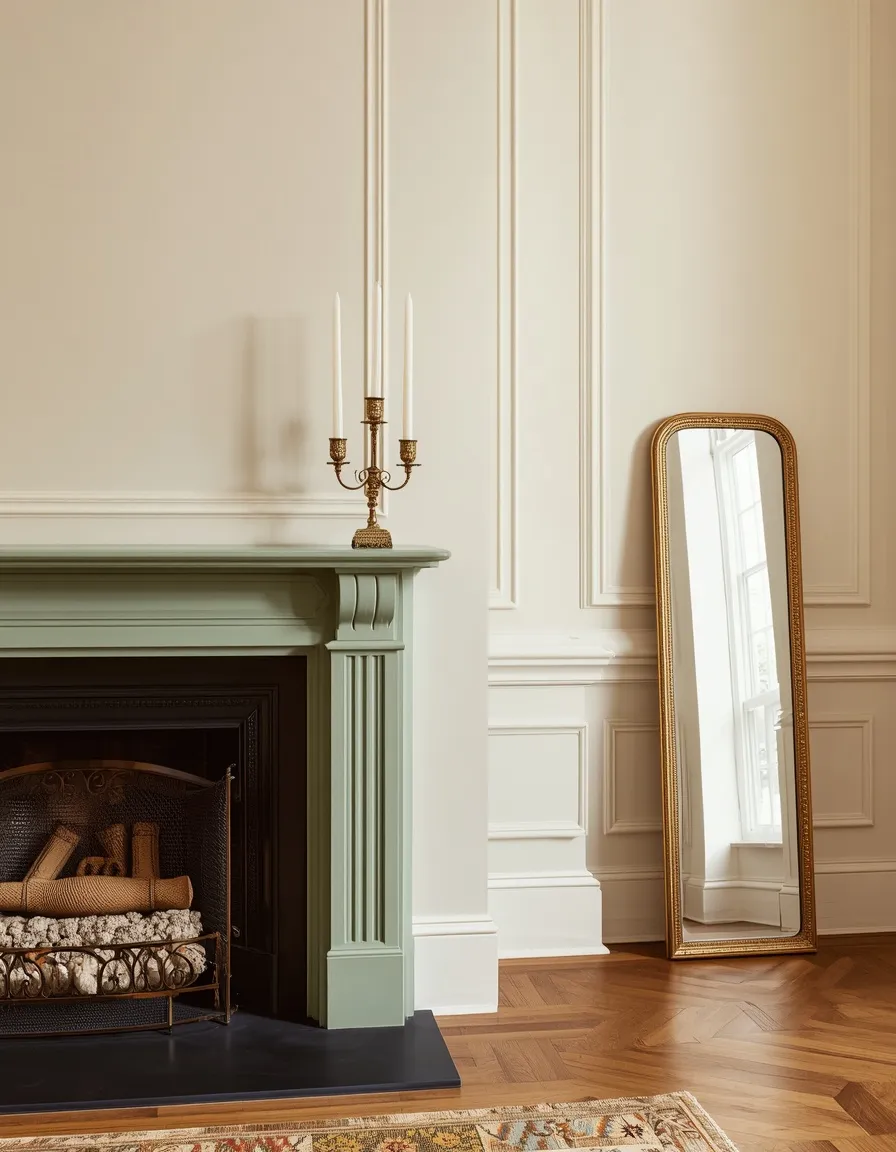
Sage with cream is the classic, quietly English version. A soft green surround against cream walls, with white molding, a gilded mirror, and brass candlesticks, feels timeless rather than trend-led.
Keep the sage on the fireplace and the cream on the walls, letting white molding and skirting act as the crisp line between them, which is what stops the two soft colors blurring into each other. Use a muted, slightly grey sage rather than a bright one for a period feel. Add antique brass and a leaning gilded mirror. This suits period homes, traditional interiors, and anyone who wants color without anything that will look dated in five years.
- Best for: period and traditional homes; color that won’t date.
- Why it works: white molding gives the two soft colors a crisp line between them.
- Key elements: muted sage surround, cream walls, white molding, antique brass.
8. Sage Green and Blush Pink
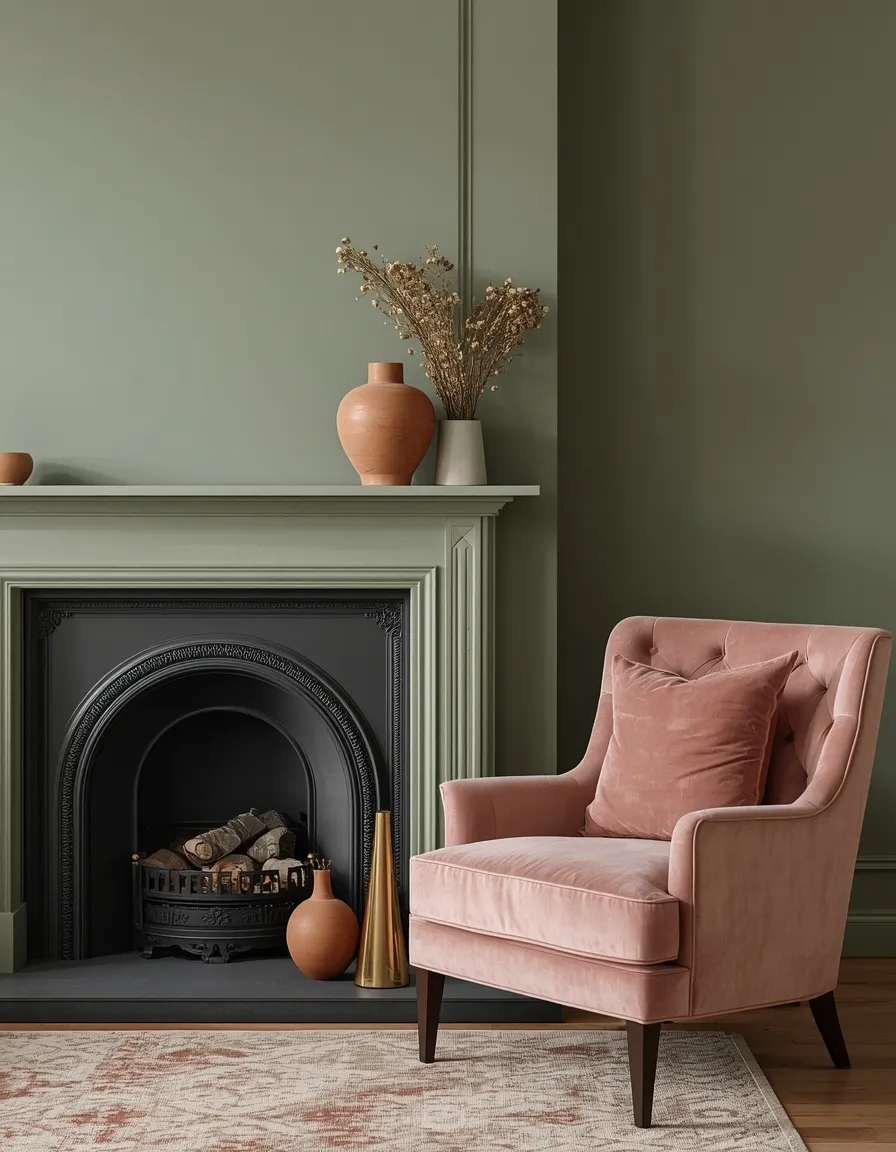
Sage and blush pink is the unexpected pairing that keeps working. A sage fireplace with dusty pink velvet, terracotta pots, and warm brass creates a room that’s soft, feminine, and far more sophisticated than it sounds.
Green and pink sit opposite each other on the color wheel in muted form, which is precisely why they flatter one another rather than clashing. Keep both dusty and desaturated, a bright pink beside a bright green is a very different, much harder look. Use pink sparingly, in a velvet cushion, a throw, or a single armchair, and let sage do the heavy lifting. Warm brass ties them together. This suits eclectic, modern, and romantic interiors.
- Best for: eclectic and romantic rooms wanting an unexpected pairing.
- Watch out: keep both dusty and muted; bright pink and green is a harder look.
- Key elements: sage fireplace, blush velvet accents, terracotta, warm brass.
9. Sage with Brass Accents
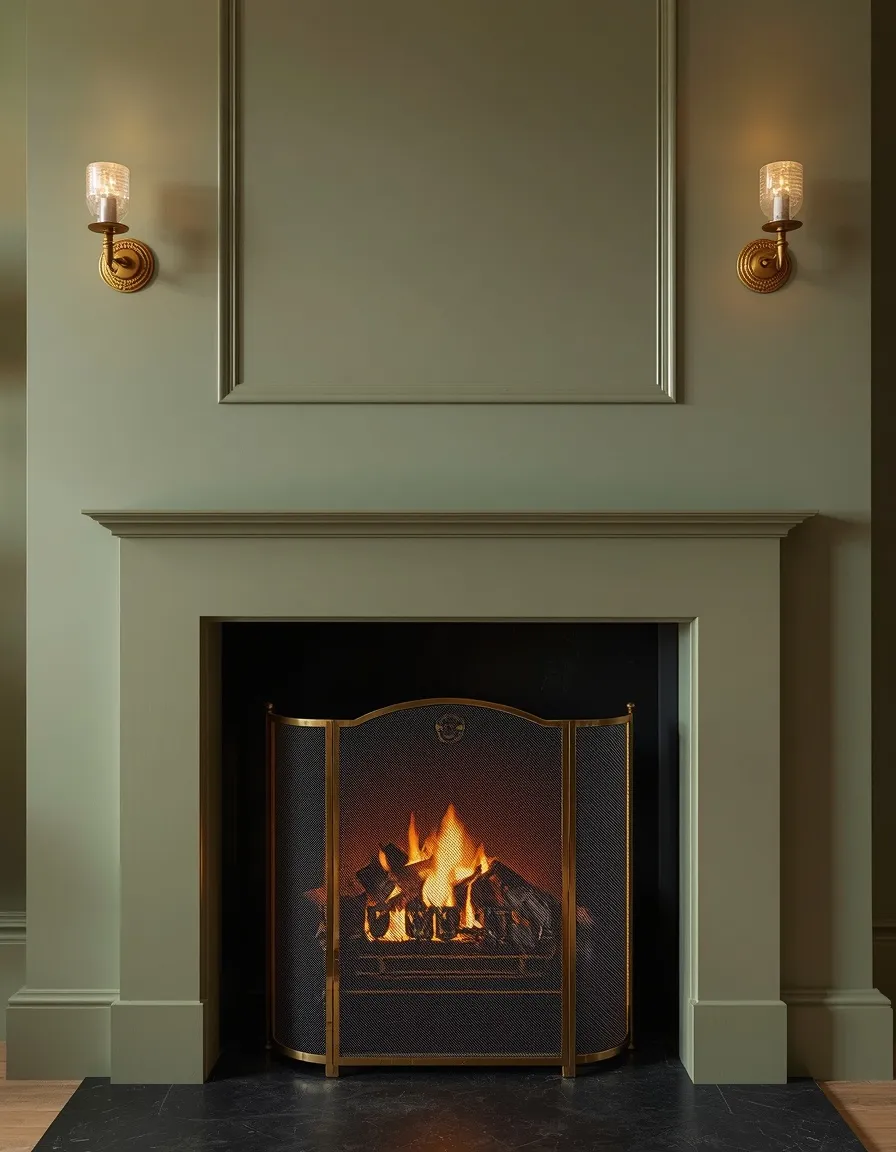
Brass against sage green is the detail that lifts the whole thing. Antique brass sconces either side of the chimney breast, a brass fire screen, and brass hardware on the built-ins catch the firelight and warm the cool green.
Sage is a cool color and can feel flat without a warm metal to lift it, which is exactly what brass does. Choose unlacquered or antique brass rather than bright polished, since it patinas over time and suits the softness of sage far better. Repeat the metal at least three times around the room so it reads as a scheme rather than an accident. Wall sconces either side of the breast are the single most effective addition. This suits every style from traditional to modern.
- Best for: almost any style; the easiest way to lift a cool green.
- Why it works: warm brass counteracts sage’s coolness and catches firelight.
- Key elements: antique brass sconces, fire screen, hardware, repeated three times.
10. Limewashed Sage Fireplace
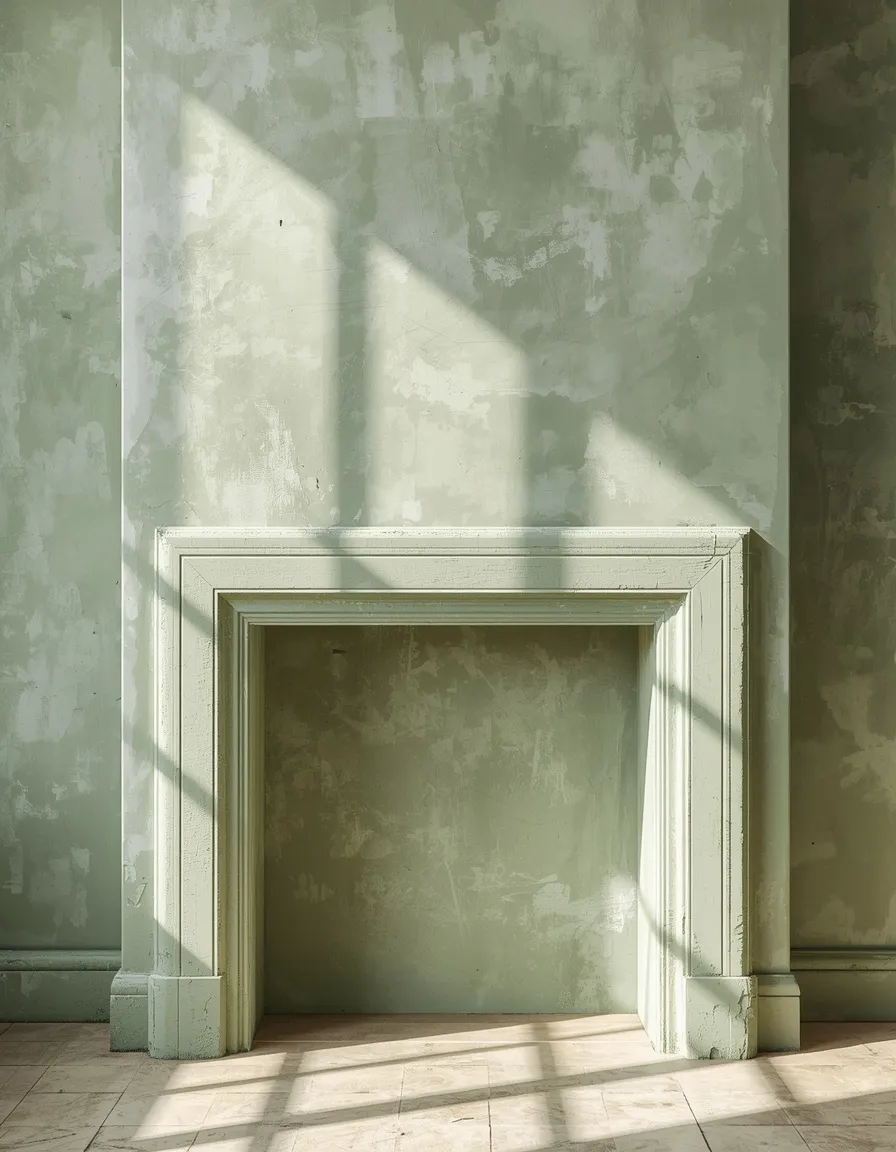
A limewashed sage fireplace has a soft, cloudy depth that flat paint can’t touch. The mottled, chalky finish shifts as the light moves across it, giving a plain chimney breast the look of aged plaster.
Limewash and mineral paints are genuinely breathable, which makes them the right choice on masonry and old brick that needs to let moisture out. Apply in thin, cross-hatched coats with a brush, letting the irregularity happen rather than fighting it, the variation is the point. The finish is chalky and can mark, so it’s better on a wall than on a mantel shelf you’ll touch daily. This suits rustic, Mediterranean, and old-world interiors and anyone who finds flat paint lifeless.
- Best for: rustic and old-world rooms; masonry that needs to breathe.
- Watch out: limewash is chalky and marks, better on the wall than the shelf.
- Key elements: breathable limewash, cross-hatched brush coats, cloudy variation.
11. Sage Cottage Fireplace
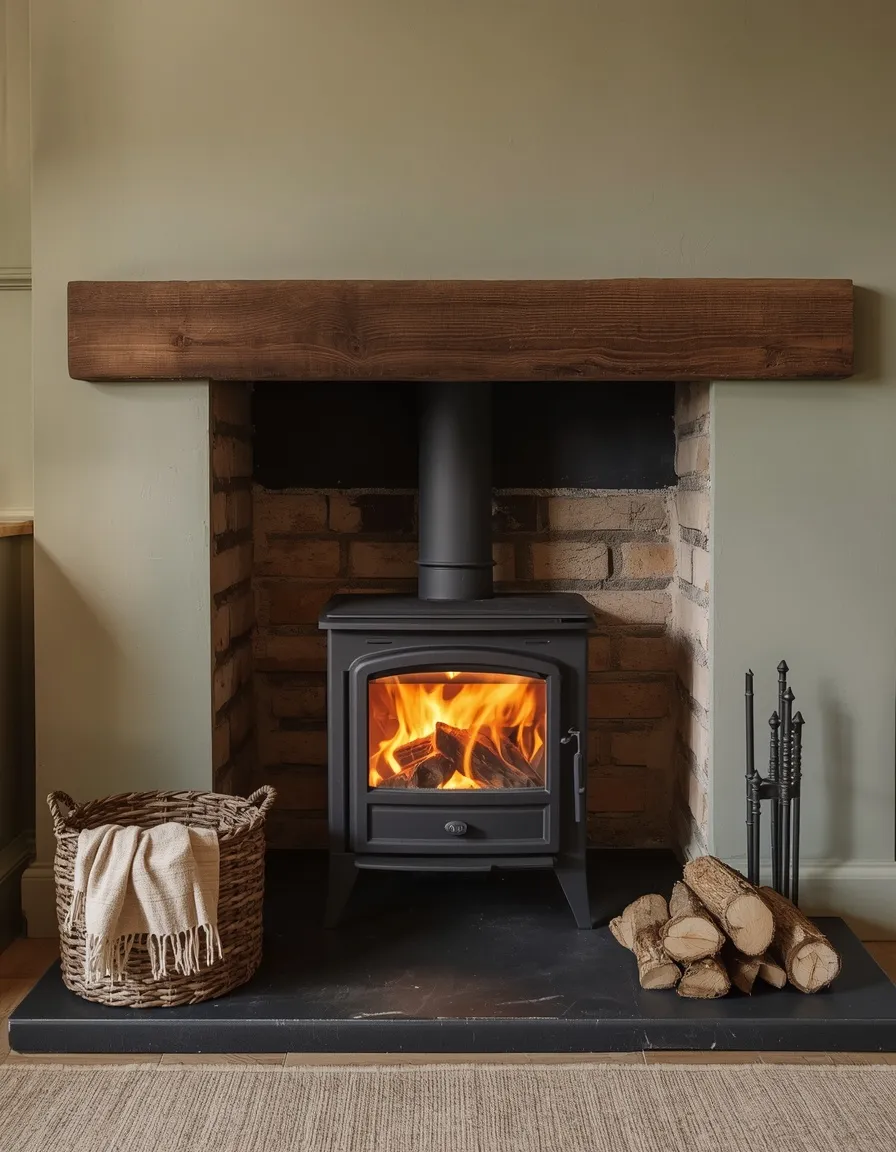
In a cottage, sage green feels like it was always there. A softly painted surround, a chunky beam mantel, a woodburner in the opening, and a basket of logs beside it make a fireplace that’s cozy without being twee.
Keep the sage soft and slightly muted rather than bright, which reads as period-appropriate rather than modern. A cast-iron woodburner set into a simple painted opening is the heart of the look, and note that a cast-iron stove and the area immediately around it need high-temperature stove paint, not ordinary emulsion. Add a log basket, a wool throw, and worn flagstones or timber underfoot. This suits cottages, period homes, and rural properties.
- Best for: cottages and period homes with a woodburner.
- Watch out: cast iron and the immediate heat zone need high-temp stove paint.
- Key elements: muted sage surround, beam mantel, cast-iron stove, log basket.
12. Sage and Black Contrast
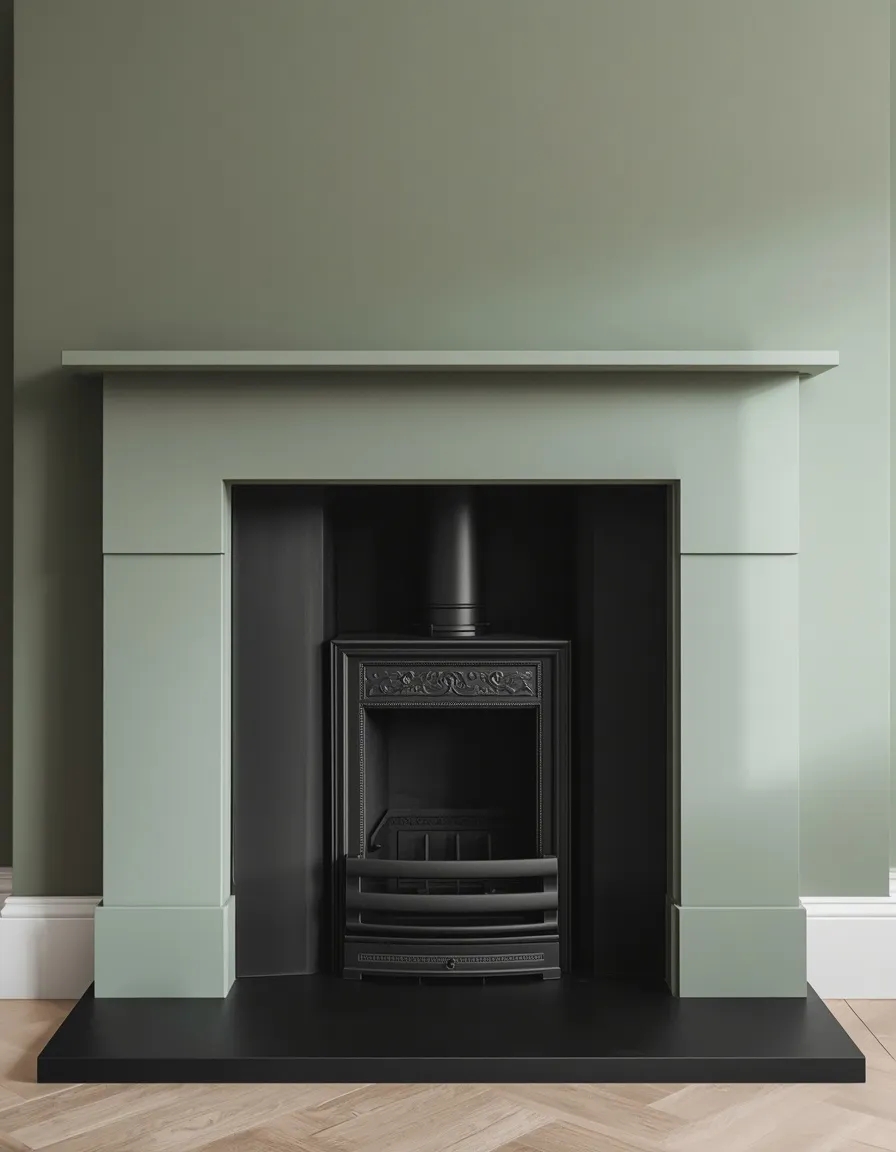
Sage with black is the sharpest, most contemporary version of this color. A soft green chimney breast with a matte black firebox surround, black window frames, and black metal accents gives the softness a hard, confident edge.
Black stops sage from tipping into sweetness, which is the risk with soft greens in a modern room. Keep the black restricted to genuinely architectural elements, the firebox frame, a slim metal shelf, the hardware, rather than scattering black objects around. Use matte black rather than gloss, which shows dust and fingerprints badly at close range. Add pale wood to stop the pairing feeling severe. This suits modern, industrial, and contemporary interiors.
- Best for: modern and contemporary rooms; stops sage tipping into sweetness.
- Watch out: use matte black; gloss shows every fingerprint at close range.
- Key elements: sage breast, matte black firebox frame and hardware, pale wood.
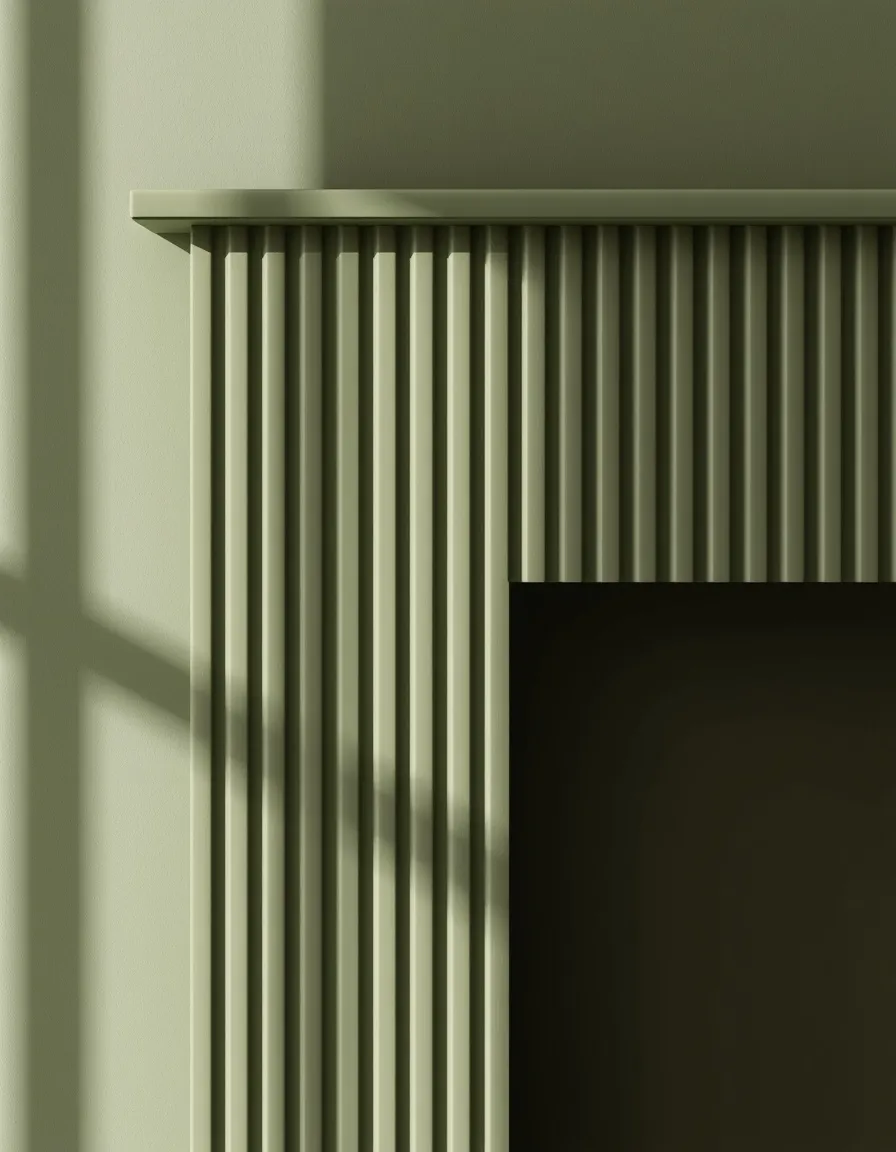
13. Fluted Sage Surround
A fluted or reeded surround painted in sage catches light in vertical ribbons. The narrow grooves throw fine shadows across the green, giving a flat chimney breast genuine dimension and a considered, custom feel.
Fluted panels are widely available as ready-made boards you can fix to the chimney breast and paint, which makes this look far more achievable than it appears. Paint the flutes in a matte or eggshell finish, since gloss fills the grooves visually and kills the shadow that makes the whole effect work. Light the wall from above or the side to emphasize the ribbing. This suits modern, art deco, and contemporary interiors and anyone wanting texture without tiling.
- Best for: modern and deco rooms; texture without the cost of tiling.
- Watch out: matte or eggshell only, gloss kills the shadow that makes it work.
- Key elements: ready-made fluted panels, matte sage, side or top lighting.
14. Sage Fireplace in a Small Room
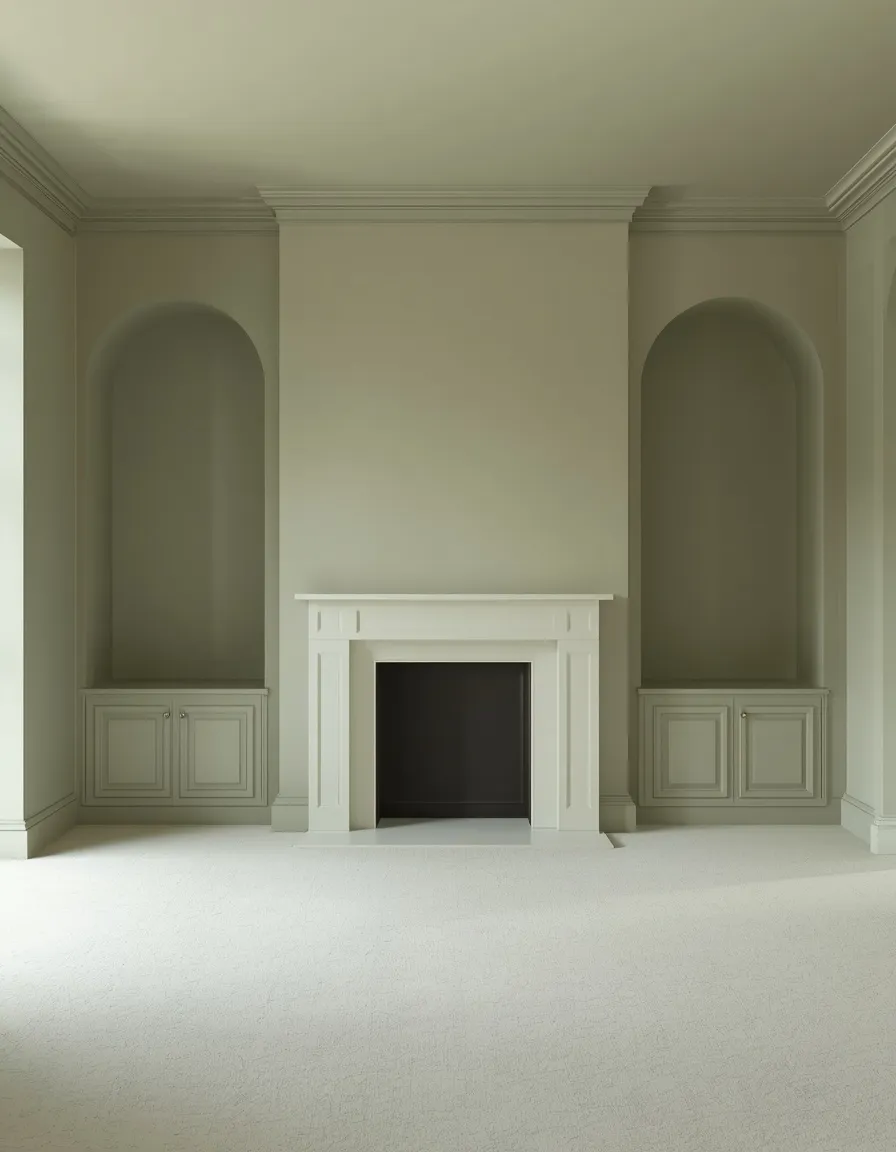
In a small living room, a sage fireplace can make the space feel larger rather than smaller. Painting the chimney breast and the alcoves the same soft green blurs the wall’s edges, so the room reads as one calm volume.
Color-drenching a small room, taking the same shade across the walls, breast, and joinery, removes the visual breaks that chop a small space into pieces, and it works far better than a single dark accent wall, which draws a hard line and shortens the room. Choose a lighter, softer sage and use a matte finish. Keep the floor and ceiling pale. This suits small living rooms, snugs, and anyone who’s been told not to use color in a small space.
- Best for: small living rooms and snugs; color-drenching beats an accent wall.
- Why it works: one continuous color removes the breaks that chop up a small room.
- Key elements: lighter sage across breast, walls, and alcoves; pale floor and ceiling.
15. Two-Tone Sage Scheme
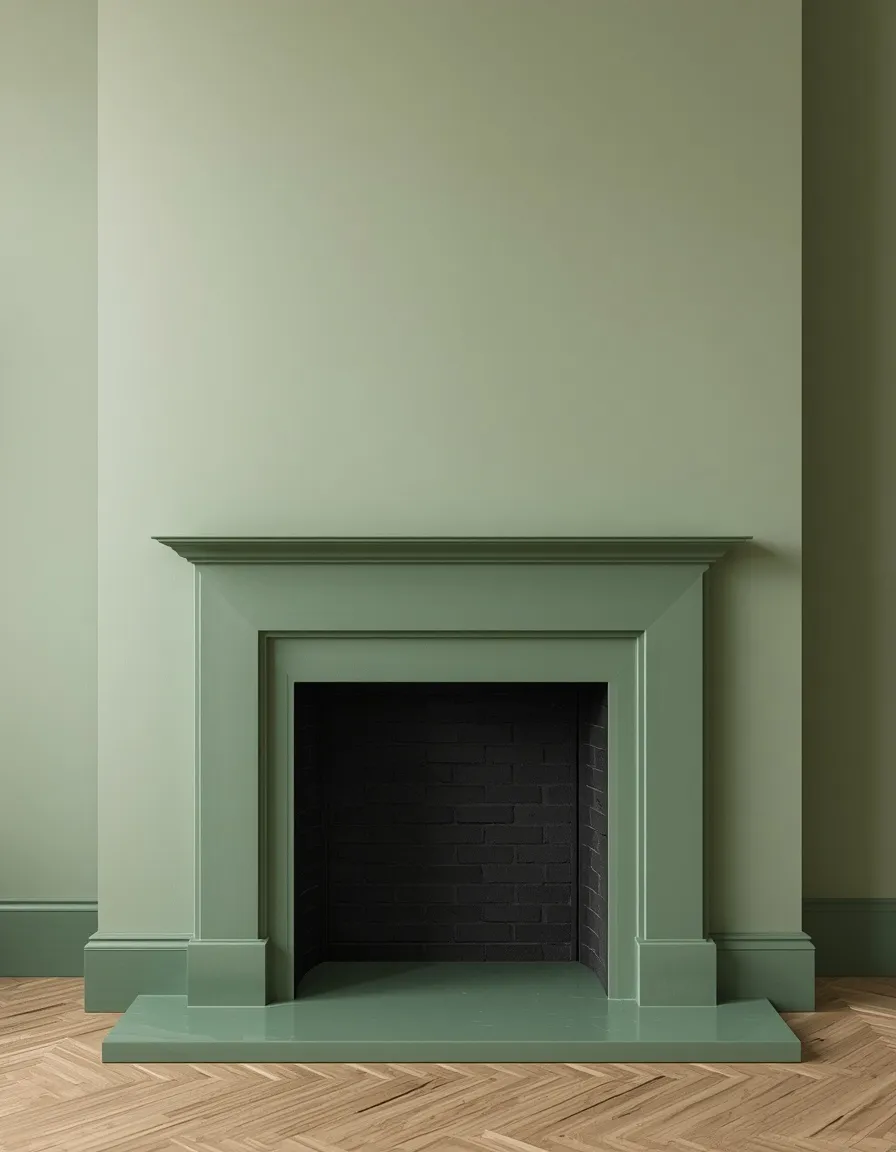
Two shades of sage give a fireplace depth without introducing another color. A deeper green on the surround with a softer, paler sage on the surrounding wall creates a subtle frame that draws the eye to the firebox.
Choose two shades several steps apart on the same paint strip, tones that are too close simply look like a patch repair or a mistake. Put the darker shade on the surround and the lighter on the wall, which frames the fireplace and pushes the wall back. Use eggshell on the surround and matte on the wall, so even the finishes differentiate them. This suits anyone who loves sage and wants more of it, and rooms where a single flat color feels underwhelming.
- Best for: sage lovers who want depth without adding a second color.
- Watch out: pick shades several steps apart, or it reads as a patch repair.
- Key elements: deeper sage surround, paler sage wall, eggshell against matte.
16. Styled Sage Mantel
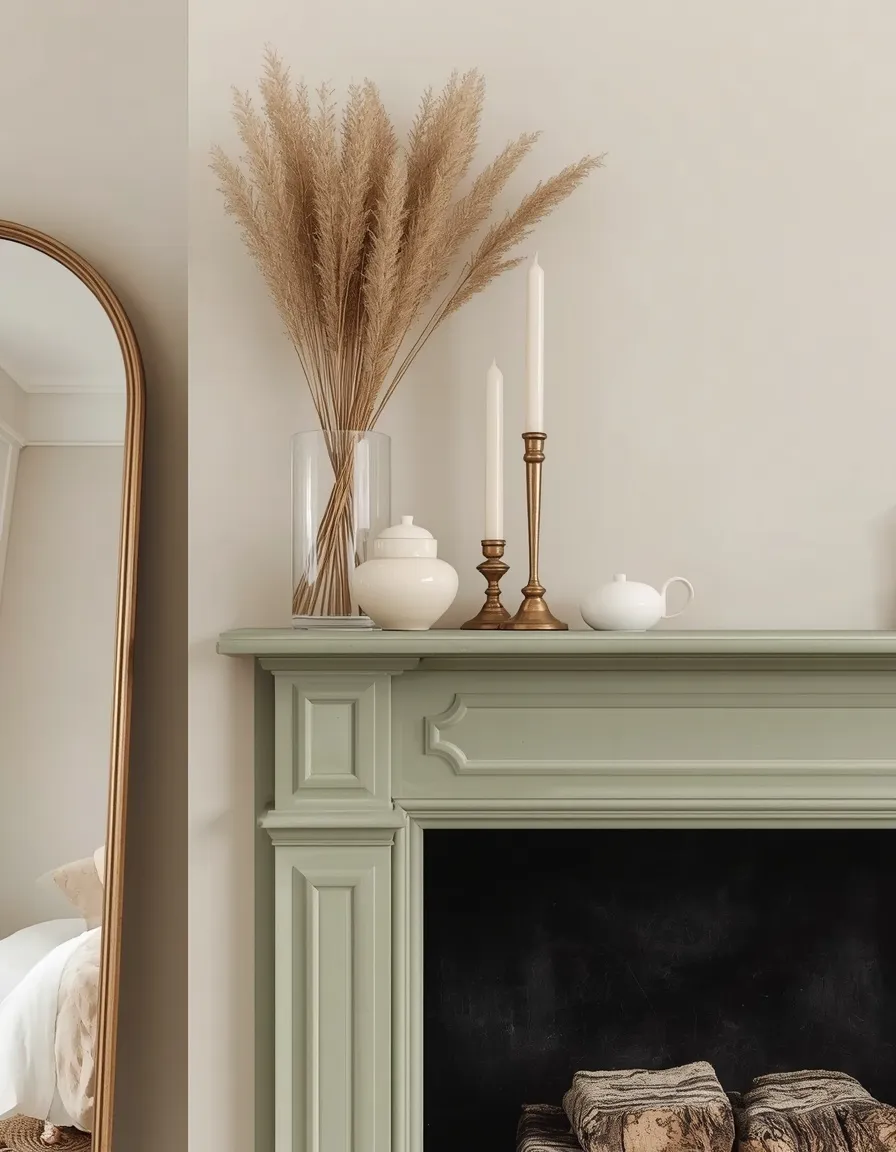
A sage fireplace gives a mantel the best possible backdrop. Cream ceramics, dried grasses, brass candlesticks, and a leaning arched mirror all read beautifully against soft green, which flatters almost everything you put in front of it.
Sage is a genuinely forgiving backdrop, sitting happily behind cream, brass, wood, black, and dried botanicals alike. Anchor the mantel with one tall item placed off-center, size any leaning art at roughly two-thirds the mantel’s width, group in odd numbers, and leave about a third of the shelf visibly empty. One safety note that matters: dried grasses and pampas are highly flammable, so keep them well clear of a working firebox and never leave candles unattended beneath overhanging decor.
- Best for: anyone with a sage fireplace wondering what to put on it.
- Watch out: dried grasses are flammable, keep clear of a lit firebox.
- Key elements: off-center anchor, art at two-thirds width, odd-numbered groups.
How Do You Choose the Right Sage?
Choose your sage by its undertone and your room’s light. Sage runs from warm yellow-green to cool grey-green, and the two behave completely differently, which is why two people paint ‘sage’ and end up with entirely different rooms.
A cool grey-sage in a north-facing room, which receives soft indirect light all day, will read grey, flat, and slightly cold. A warm sage with a yellow-green base holds its color in that light and feels alive. Bright south-facing rooms can carry a cooler sage happily. Match the undertone to your fixed materials too: warm oak and brass want a warmer sage, while cool grey stone and chrome suit a cooler one.
Test properly. Paint a sample patch at least 30 x 30 cm (12 x 12 in) directly on the chimney breast, not on a card held against it, and look at it in morning light, afternoon light, and lamplight before committing. Greens shift more dramatically through the day than almost any other color.
A fireplace is the natural focal point of a room, and scale changes how you treat it. Our guide to two-story fireplace design tackles the same question at a very different height, and you’ll find plenty more in our fireplace ideas.
Conclusion
A sage green fireplace is one of the highest-return changes in a house: a weekend, a few tins, and the room has a focal point it didn’t have on Friday. Choose the undertone to suit your light, warm sage for north-facing rooms, cooler for bright ones, carry the color across the whole wall rather than a lone stripe, lift it with brass or warm wood, and use the right paint in the right zone, with heat-resistant stove paint anywhere near the firebox. For more ways to make the fireplace the best thing in the room, browse our fireplace ideas.
Frequently Asked Questions
Q: What paint do you use on a sage green fireplace?
It depends on the zone. The chimney breast and wall take ordinary interior emulsion or latex in a matte finish, and the mantel and wooden surround want eggshell or satin so they wipe clean. Anything in or immediately around the firebox needs heat-resistant stove paint, because standard paint will blister, discolor, and can give off fumes when heated.
Q: Can you paint a brick fireplace sage green?
Yes, and it’s one of the most transformative changes you can make, but two cautions apply. Painting brick is close to irreversible, since stripping it later is a difficult job. And you should use a breathable mineral or masonry paint rather than standard latex, because a plastic-like film traps moisture in old masonry and can cause damp and efflorescence.
Q: What colors go with a sage green fireplace?
Sage is unusually easy to build around. Warm wood and antique brass lift its coolness, cream and white give it a crisp frame, matte black adds a contemporary edge, and dusty blush pink makes a soft, sophisticated pairing. Terracotta and dried botanicals also sit beautifully against it.
Q: Which shade of sage should I choose?
Match the undertone to your room’s light. Sage runs from warm yellow-green to cool grey-green: a cool grey-sage in a north-facing room will read grey and cold, while a warm sage holds its color there. Bright south-facing rooms can take a cooler shade. Test a large patch on the chimney breast itself and check it in morning, afternoon, and lamplight.
Q: Will a sage green fireplace make a small room look smaller?
Not if you color-drench it. Painting the chimney breast, the surrounding walls, and the alcoves in the same soft sage removes the visual breaks that chop a small room into pieces, so the space reads as one calm volume. That works far better than a single dark accent wall, which draws a hard line and can shorten the room.
Q: Should I paint just the chimney breast or the whole wall?
The whole wall usually looks better. Painting only the chimney breast can leave it reading as a stripe stuck onto a pale wall, whereas carrying the color across the full wall, and the built-ins, if you have them, makes the fireplace feel built into the architecture. Keep the remaining walls light so the room stays open.