

Key Takeaways
- Light, not humidity, is what limits bathroom plants, match the plant to how much daylight the room actually gets.
- Bathroom humidity is intermittent, spiking during a shower and dropping soon after, so it helps ferns but won’t rescue a plant in a dark room.
- Humid air means plants dry out more slowly, so water less often than elsewhere, overwatering kills more bathroom plants than neglect.
- A genuinely windowless bathroom needs either a rotation system, a small grow light, or good faux plants, no living plant thrives in permanent darkness.
- Many popular bathroom plants, including pothos, peace lily, and aloe, are toxic to cats and dogs, so check the ASPCA lists before choosing.
Introduction
Steam curling around a trailing vine is one of the easiest wins in home styling. The best plants for bathroom spaces aren’t just the ones that tolerate damp, they’re the ones matched to the light your room actually gets, in a spot where they’ll thrive rather than slowly decline. These 16 setups pair the right species with the right placement, vessel, and conditions.
Below are complete planted setups covering bright windowsills, medium-light shelves, and genuinely dark bathrooms with no window at all, plus hanging displays, tiny-bathroom solutions, and schemes for wood, white, and vintage interiors. Each explains the plant, where to put it, how to water it, and who it suits. Consider it your guide to choosing greenery that will still look good six months from now in the bathroom of your abode, not just on the day you bring it home.
The correction most plant lists get wrong: Bathrooms are often described as ideal for plants because they’re humid. Humidity helps, but light is the real limiting factor, a fern in a windowless bathroom will still decline no matter how steamy it gets. Bathroom humidity is also intermittent: it spikes for perhaps twenty minutes during a shower, then falls back. Match the plant to your light level first, then let the humidity be a bonus, and water less often than you would in a dry room.
16 Best Plants for Bathroom Setups
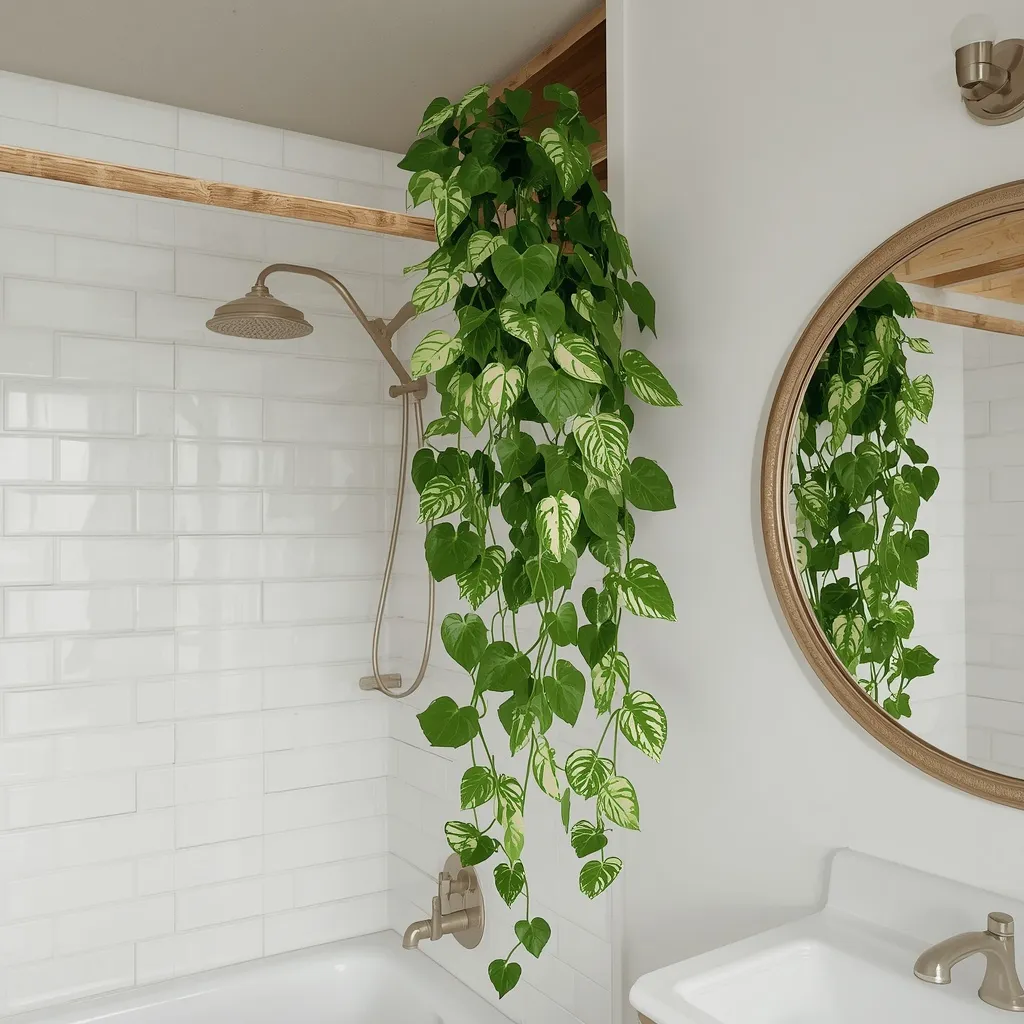
1. Trailing Pothos Curtain
Golden pothos cascading from a high shelf or hanging planter turns a plain bathroom wall into a living curtain: heart-shaped leaves tumbling 90 cm (3 ft) or more, softening tile and mirror edges. Lush and forgiving, pothos is the plant that makes bathrooms look effortlessly green. Trailing, easy, and hard to kill.
Hang or shelf a golden pothos (Epipremnum aureum) where its vines can fall freely, ideally 1.8 — 2 m (6–7 ft) up so growth clears heads. Pothos tolerate low to medium light, variegated types keep their markings better in brighter spots, and need watering only when the top 2–3 cm (1 in) of soil is dry, which in a humid bathroom may be every two to three weeks. Secure hanging hooks into a joist or a proper wall anchor rather than plasterboard alone. Note that pothos is toxic to cats and dogs if chewed.
- Why it works: Long trailing vines soften hard tile edges and tolerate low to medium light.
- Best for: Beginners, renters, medium-light bathrooms without pets at leaf height.
- Key elements: golden pothos, high shelf or secured hanger, free-falling vines, infrequent watering.
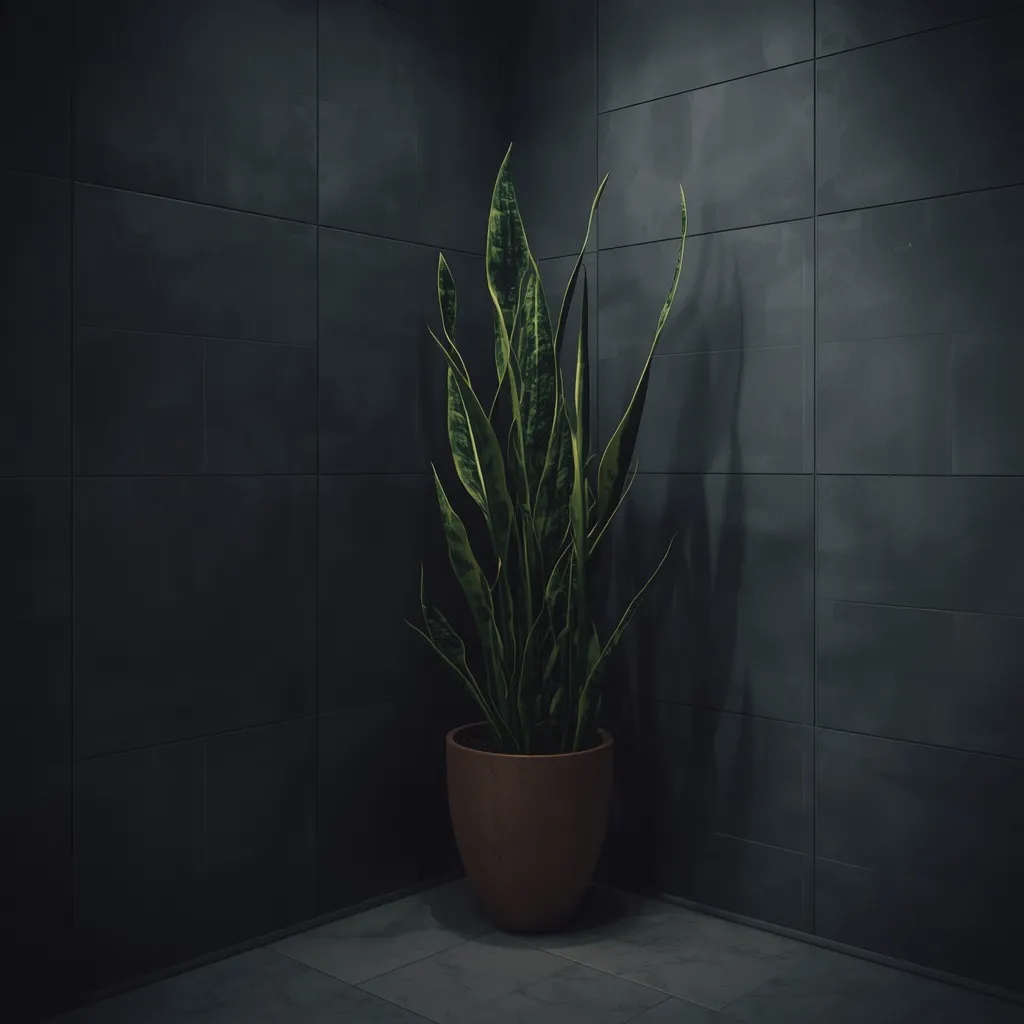
2. No-Window Snake Plant Corner
A snake plant standing sentry in a dim bathroom corner brings vertical structure where nothing else survives: stiff upright leaves in a simple ceramic pot, sculptural against plain tile. Architectural and unbothered, this is the plant for rooms with almost no daylight. Upright, tough, and genuinely low-light.
Place a snake plant (Dracaena trifasciata, still widely sold as Sansevieria) in a floor pot in the darkest corner, it copes with low light better than almost any common houseplant, though it grows slowly there rather than thriving. Water sparingly, roughly every three to four weeks in a humid bathroom, and let the soil dry out fully between waterings, since root rot is the main way people kill it. In a truly windowless room, rotate it out to a bright room every few weeks. Snake plant is toxic to cats and dogs.
- Why it works: Tolerates genuinely low light and infrequent watering better than most houseplants.
- Best for: Dark bathrooms, forgetful waterers, modern interiors.
- Key elements: snake plant, floor pot, darkest corner, full dry-out between waterings, occasional rotation.
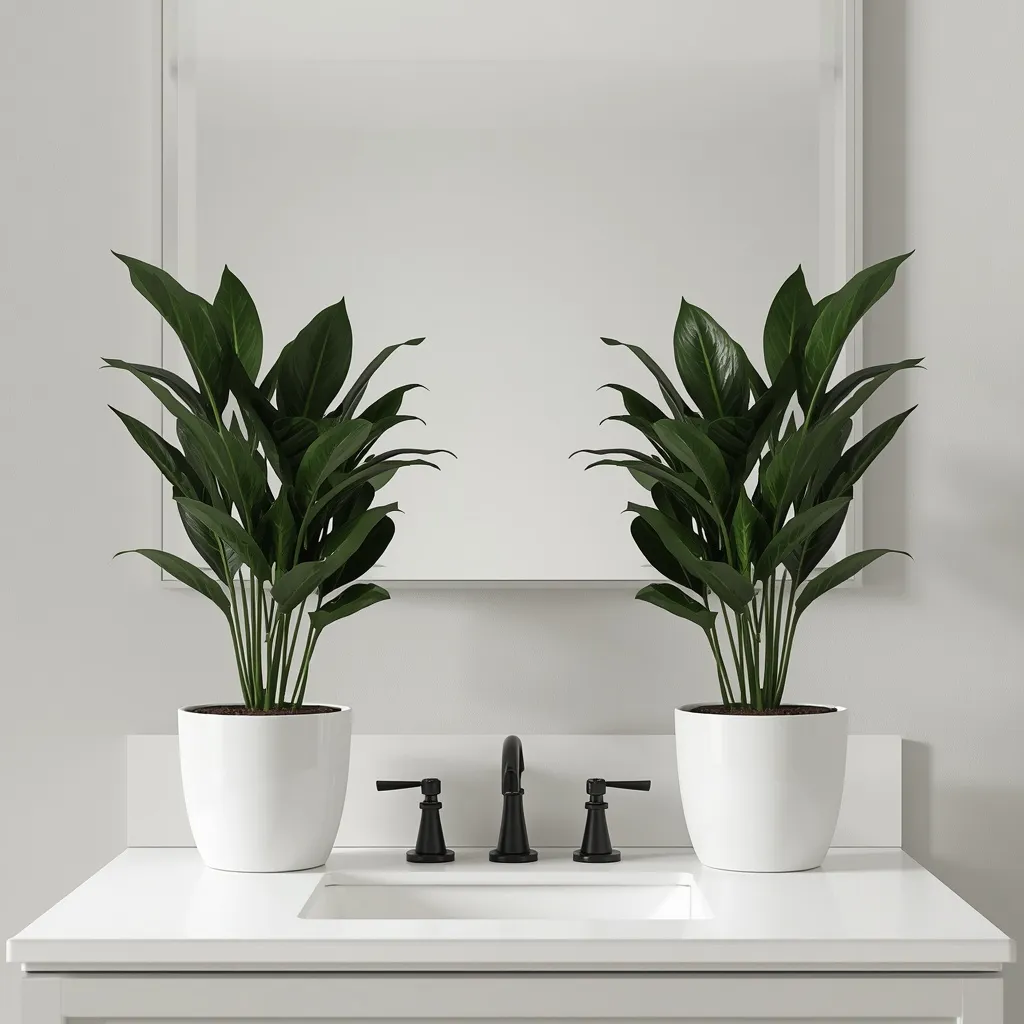
3. ZZ Plant Vanity Pair
Two matching ZZ plants flanking a bathroom vanity create instant symmetry: glossy dark green leaves fanning upward from identical pots either side of the mirror. Polished and low-effort, the ZZ plant looks expensive and asks for almost nothing. Glossy, symmetrical, and near-indestructible.
Set a matched pair of ZZ plants (Zamioculcas zamiifolia) either side of a vanity or mirror, using identical pots so the symmetry reads as deliberate. The ZZ stores water in thick underground rhizomes, which is why it tolerates low light and long gaps between waterings, every three to four weeks is usually plenty in a humid room. Its leaves are naturally glossy, so wipe dust off with a damp cloth rather than using leaf shine. The ZZ plant is toxic to cats and dogs if ingested.
- Why it works: Water-storing rhizomes make it thrive on low light and neglect.
- Best for: Low-light bathrooms, busy households, formal symmetrical schemes.
- Key elements: matched pair of ZZ plants, identical pots, either side of the mirror, monthly watering.
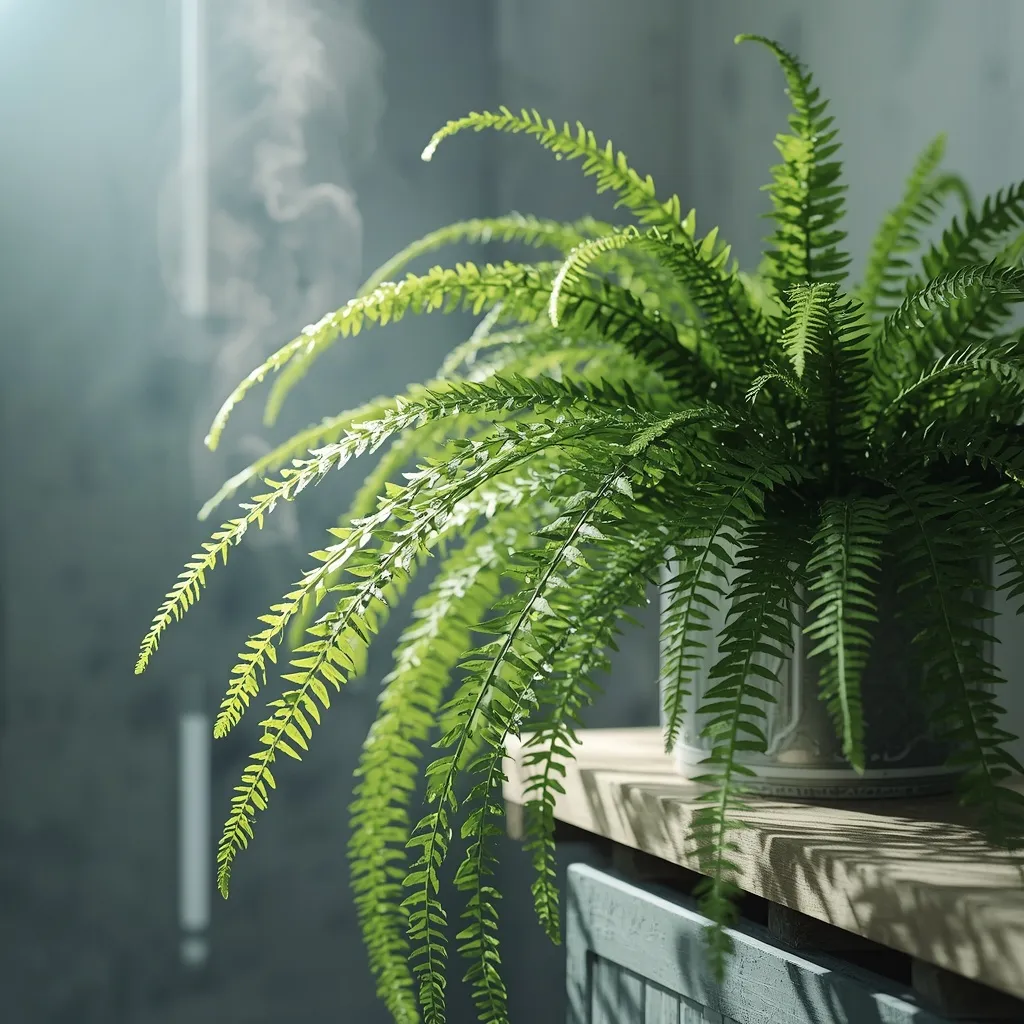
4. Steamy Shower Fern Shelf
A Boston fern on a shelf near the shower is bathroom greenery at its most classic: arching fronds drinking in the steam, spilling over the shelf edge in a soft green fountain. Lush and old-fashioned in the best way, ferns genuinely benefit from a bathroom. Feathery, full, and steam-loving.
Position a Boston fern (Nephrolepis exaltata) on a shelf within a couple of meters of the shower where it catches the steam, in bright indirect light rather than direct sun, which scorches the fronds. Ferns are the group that genuinely appreciates bathroom humidity, since dry air causes the crispy brown edges most people struggle with. Keep the soil lightly moist rather than soggy, and trim dead fronds at the base. Boston fern is one of the few classics generally listed as non-toxic to cats and dogs, though check the ASPCA lists to confirm the exact species.
- Why it works: Ferns genuinely benefit from shower steam, which prevents crispy frond edges.
- Best for: Bathrooms with a window; pet households (species-dependent).
- Key elements: Boston fern, shelf near the shower, bright indirect light, evenly moist soil.
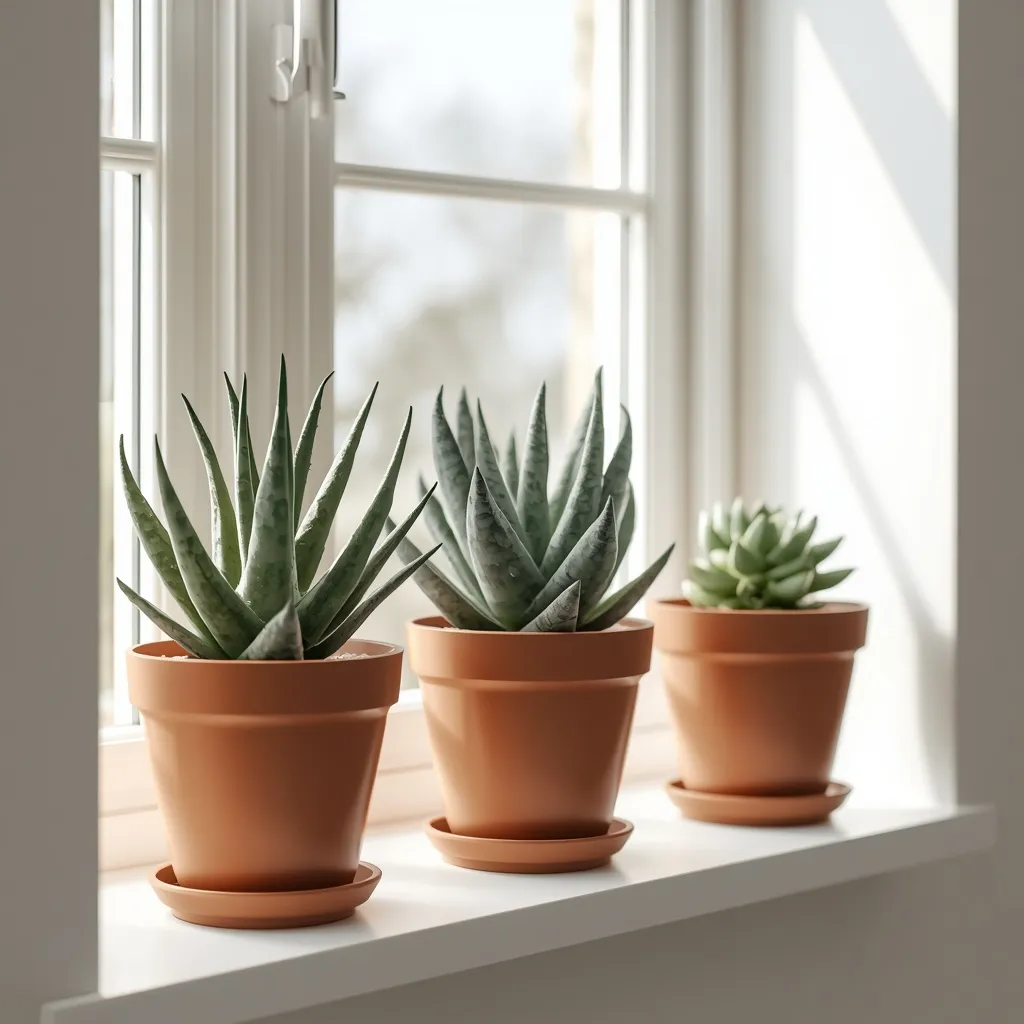
5. Sunny Windowsill Aloe Row
A row of aloe and small succulents along a bright bathroom windowsill looks crisp and architectural: chunky grey-green rosettes lined up in matching terracotta pots, catching direct morning sun. Sculptural and tidy, succulents suit a bright bathroom perfectly. Structured, sunny, and low-thirst.
Line up three or five small aloes or succulents in matching pots along a windowsill that gets several hours of direct sun, these are the plants for a bright bathroom, not a dark one. Use a free-draining cactus or succulent compost, since ordinary potting mix stays too wet in a humid room and causes rot, and water only when the soil is completely dry, perhaps monthly. Terracotta helps by wicking moisture away. Note that aloe vera is toxic to cats and dogs if eaten, despite its use on human skin.
- Why it works: Free-draining mix plus a sunny sill suits succulents where humidity would otherwise rot them.
- Best for: Bright, sunny bathrooms; minimal-care gardeners.
- Key elements: aloe and succulents, matching terracotta pots, cactus compost, bright direct sun, rare watering.
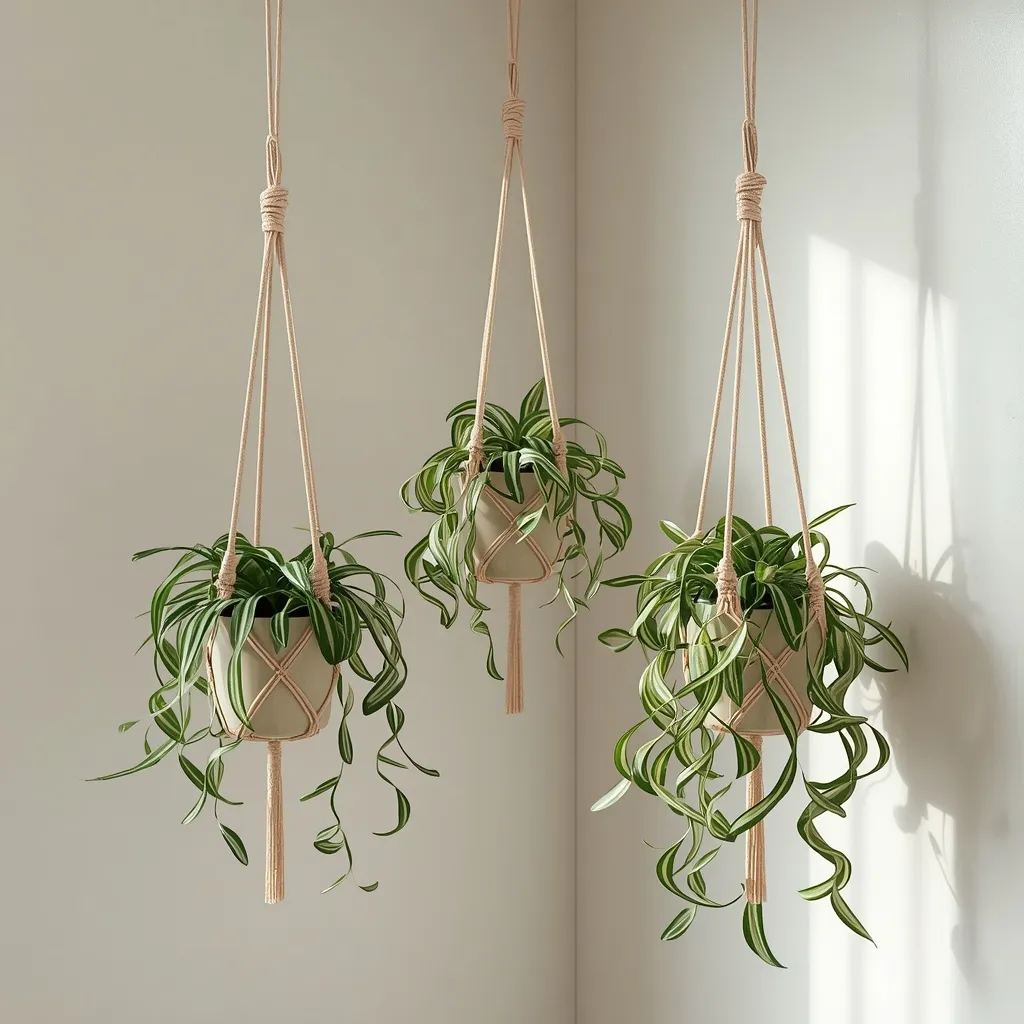
6. Spider Plant Hanging Trio
Three spider plants hung at staggered heights fill a bathroom corner with movement: arching striped leaves and dangling plantlets on long stems, like a small green mobile. Playful and generous, spider plants multiply themselves into a display. Striped, cascading, and cheerfully productive.
Hang three spider plants (Chlorophytum comosum) at different heights in a corner, using macramé or simple hangers secured into solid fixings. They prefer bright indirect light but tolerate medium light, and the baby plantlets they throw out can be rooted in water to make new plants for free, a genuine advantage for filling a bathroom cheaply. Brown leaf tips are common and usually relate to water quality, so try filtered or left-to-stand water. Spider plants are widely listed as non-toxic to cats and dogs.
- Why it works: Free plantlets let one plant fill a whole corner over time.
- Best for: Pet households, budget planting, medium to bright light.
- Key elements: three spider plants, staggered heights, secure fixings, plantlets rooted in water.
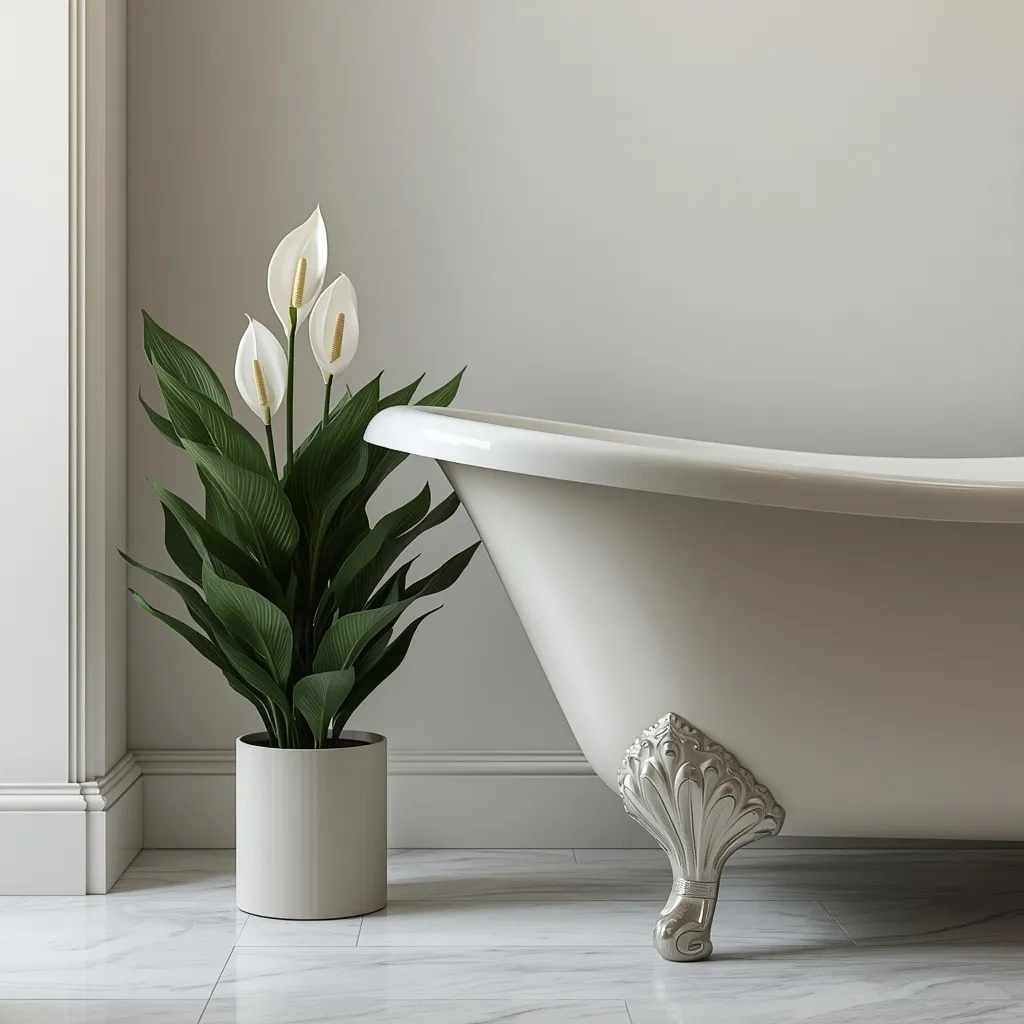
7. Peace Lily Floor Statement
A peace lily standing beside the bath makes a quietly elegant floor statement: deep green leaves topped with white spathes rising above a simple pot. Refined and forgiving, the peace lily flowers in conditions where most plants only survive. Elegant, tolerant, and softly flowering.
Place a peace lily (Spathiphyllum) in a floor pot in medium to low indirect light, it’s one of very few flowering houseplants that will bloom away from a bright window, though flowering reduces as light drops. It tells you when it’s thirsty by dramatically drooping, then recovers within hours of watering, which makes it forgiving for beginners, though repeatedly letting it wilt weakens it. Wipe the broad leaves occasionally to keep them glossy. Peace lily is toxic to cats and dogs if chewed.
- Why it works: One of the few plants that flowers in medium to low indirect light.
- Best for: Beginners; medium-light bathrooms with floor space.
- Key elements: peace lily, floor pot, medium indirect light, water when leaves droop.
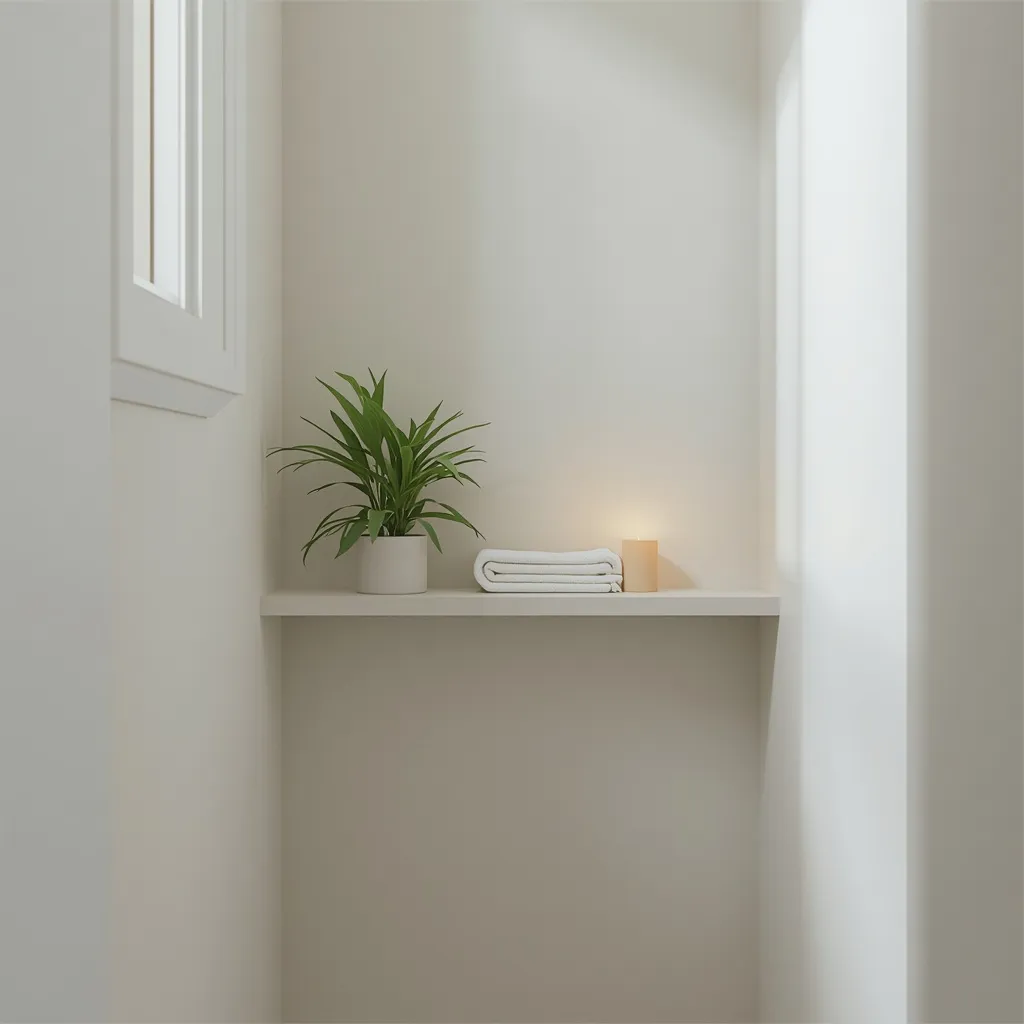
8. Tiny Bathroom Single Shelf
In a tiny bathroom, one small shelf holding a single well-chosen plant does more than a scattering of pots: a compact green plant beside a folded towel and one candle, complete and uncluttered. Restrained and space-smart, small rooms need editing rather than volume. Compact, tidy, and deliberate.
Choose one plant with a compact habit, a small ZZ, a young pothos, or an air plant, and give it a single floating shelf about 15–20 cm (6–8 in) deep, keeping the rest of the surfaces clear. In a very small bathroom, several small pots read as clutter while one plant reads as a decision. Wall-mounted shelves and hanging planters free up the vanity, which matters most where counter space is scarce. Fix shelves into studs or use anchors rated for the weight, since a wet pot is heavier than a dry one.
- Why it works: One plant on one shelf reads as intentional where several pots read as clutter.
- Best for: Tiny bathrooms and cloakrooms with no counter space.
- Key elements: one compact plant, single floating shelf 15–20 cm deep, clear surfaces, rated fixings.
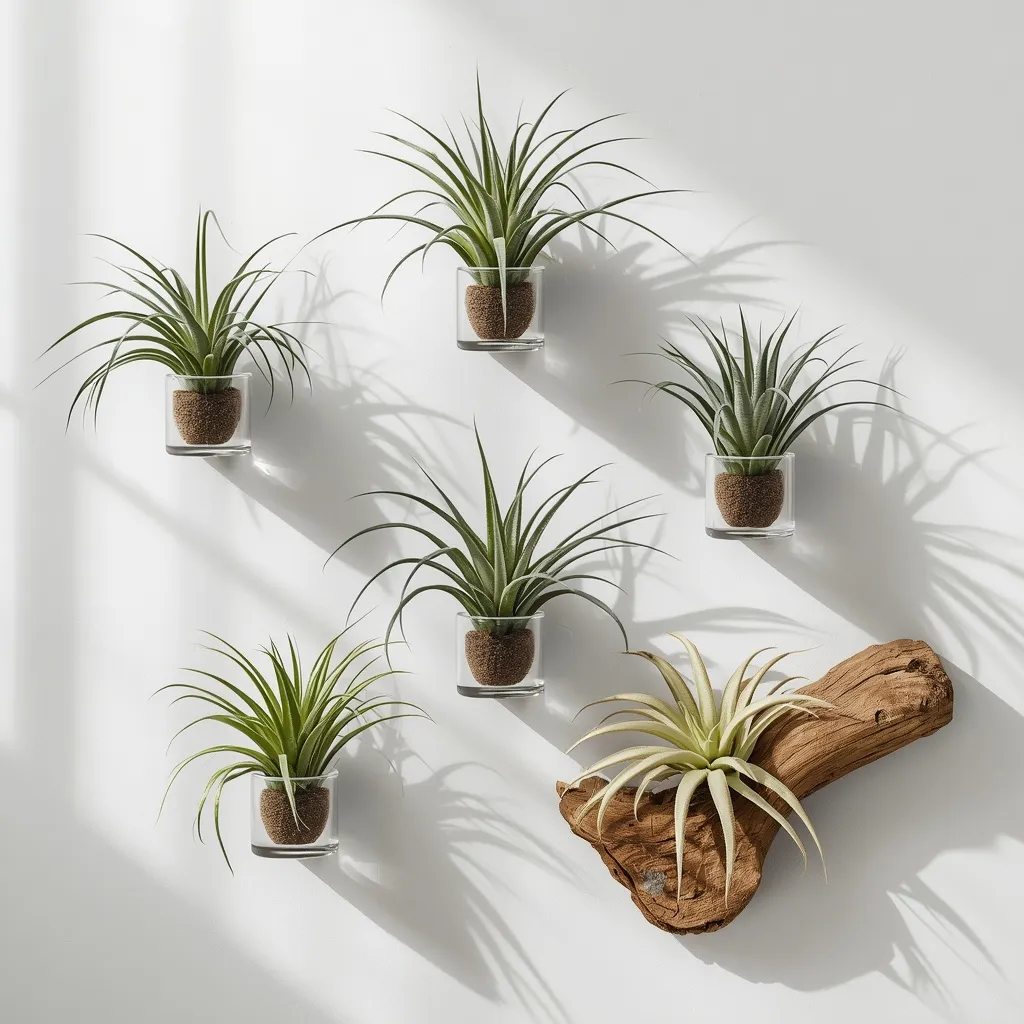
9. Air Plant Wall Display
Air plants mounted on a bathroom wall float without soil or pots: spiky silver-green rosettes held in small wall clips or a piece of driftwood, arranged like living sculpture. Modern and weightless, air plants suit bathrooms better than almost anywhere. Soilless, sculptural, and space-free.
Mount three or five Tillandsia air plants on a wall board, in glass holders, or tucked into driftwood, since they need no soil and take moisture from the air through their leaves, which makes a humid bathroom genuinely suitable. Even so, they need a proper soak: submerge them in water for 20–30 minutes every one to two weeks, then shake off excess and let them dry upside down so water doesn’t sit in the center and rot the crown. They need bright indirect light. Tillandsia species are generally listed as non-toxic to pets.
- Why it works: Soil-free plants absorb humidity through their leaves and take up no surface space.
- Best for: Tiny bathrooms, modern schemes, pet households.
- Key elements: three to five Tillandsia, wall mounts or driftwood, 20–30 minute soak fortnightly, dried upside down.
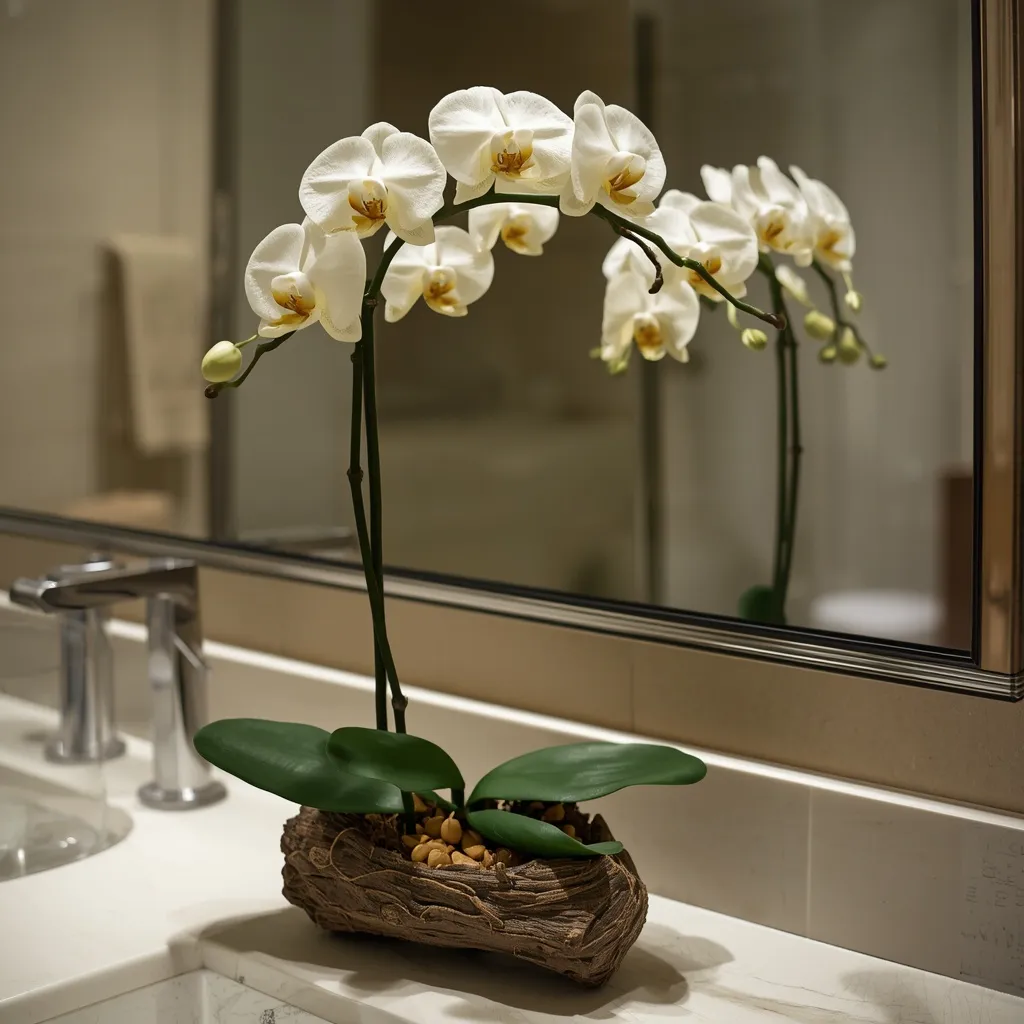
10. Orchid on the Vanity
A single moth orchid on the vanity brings quiet luxury: an arching spray of white or blush blooms above glossy leaves, reflected in the mirror. Elegant and long-flowering, an orchid makes a bathroom feel like a hotel. Refined, sculptural, and surprisingly durable.
Set a moth orchid (Phalaenopsis) on the vanity in bright indirect light, where bathroom humidity genuinely suits it, these are epiphytes that grow on trees in nature, not in ordinary soil. Water by soaking the bark mix under the tap for a minute or so every 7–10 days, letting it drain completely, and never leave the pot standing in water, which rots the roots. Blooms typically last two to three months, and the plant will reflower from the same spike if you cut just above a node. Phalaenopsis orchids are generally listed as non-toxic to cats and dogs.
- Why it works: Epiphytic orchids genuinely benefit from bathroom humidity and bloom for months.
- Best for: Bright-ish bathrooms; pet households; hotel-style schemes.
- Key elements: Phalaenopsis orchid, bark mix, bright indirect light, weekly soak-and-drain, no standing water.
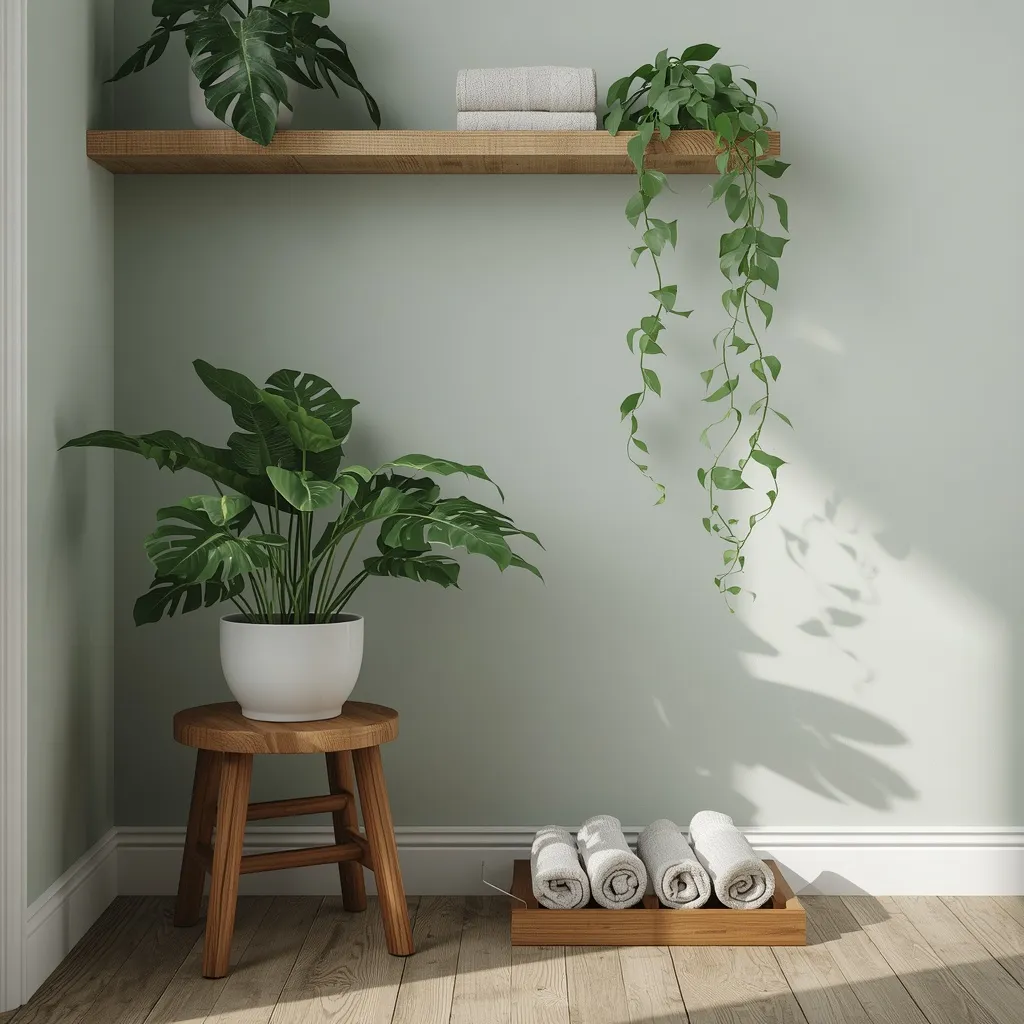
11. Wood and Green Spa Corner
A wood-and-plant corner turns a bathroom into a spa: a teak stool holding a leafy plant, a wooden bath caddy, rolled towels, and a second plant trailing from a timber shelf above. Warm and natural, wood and greenery together soften every hard surface. Calm, organic, and restorative.
Combine untreated or oiled timber, a teak or bamboo stool, shelf, and bath caddy, with two or three plants at different heights, keeping the palette to green, wood, and white so the scheme stays calm. Wood and plants work together because both introduce organic texture into a room otherwise built from tile, glass, and porcelain. Choose timber rated for damp use or oil it periodically, since untreated softwood will swell and stain in a wet bathroom. This suits spa-style, Japandi, and natural-material bathrooms.
- Why it works: Wood and foliage both add organic texture to a room built from hard surfaces.
- Best for: Spa, Japandi, and natural-material bathrooms.
- Key elements: teak or bamboo stool and shelf, two or three plants at varied heights, green-wood-white palette, damp-rated timber.
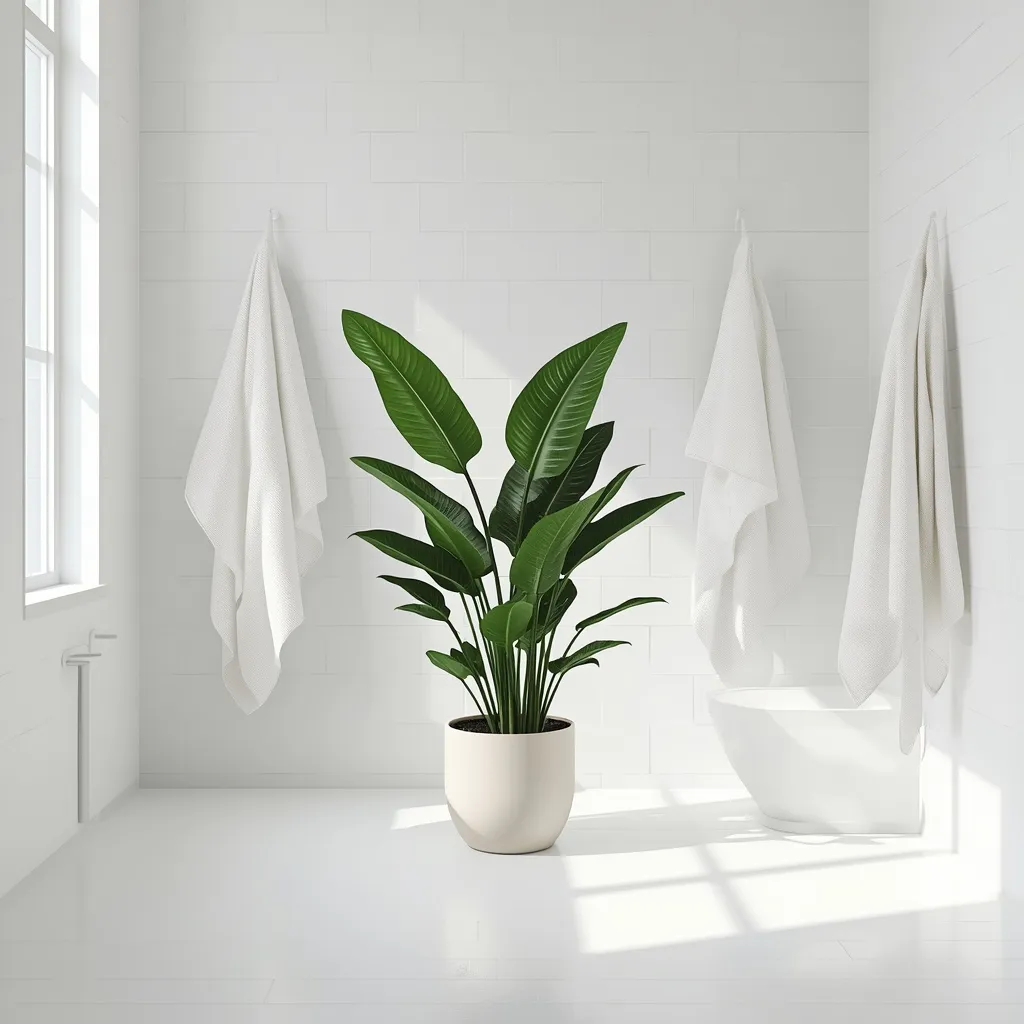
12. Green Accent in a White Bathroom
In an all-white bathroom, a single large plant is the entire color scheme: deep green leaves standing out against white tile, white walls, and white towels like a brushstroke. Graphic and fresh, one plant does what a whole palette would. Crisp, striking, and effortless.
Keep everything white and let one substantial plant supply the only color, choosing a species with strong leaf shape, a monstera, a rubber plant, or a large peace lily, in a plain white or pale ceramic pot so nothing competes. A single large plant against white reads as designed, while several small pots dotted around dilute the effect. Use a pot at least 25–30 cm (10–12 in) across for enough presence. This suits minimalist, modern, and Scandinavian bathrooms, and it’s the cheapest way to warm up an all-white room.
- Why it works: One large plant against white supplies all the color a minimal scheme needs.
- Best for: All-white, minimalist, and Scandinavian bathrooms.
- Key elements: one large strong-leaved plant, plain pale pot 25–30 cm across, everything else white.
13. Vintage Brass and Trailing Ivy
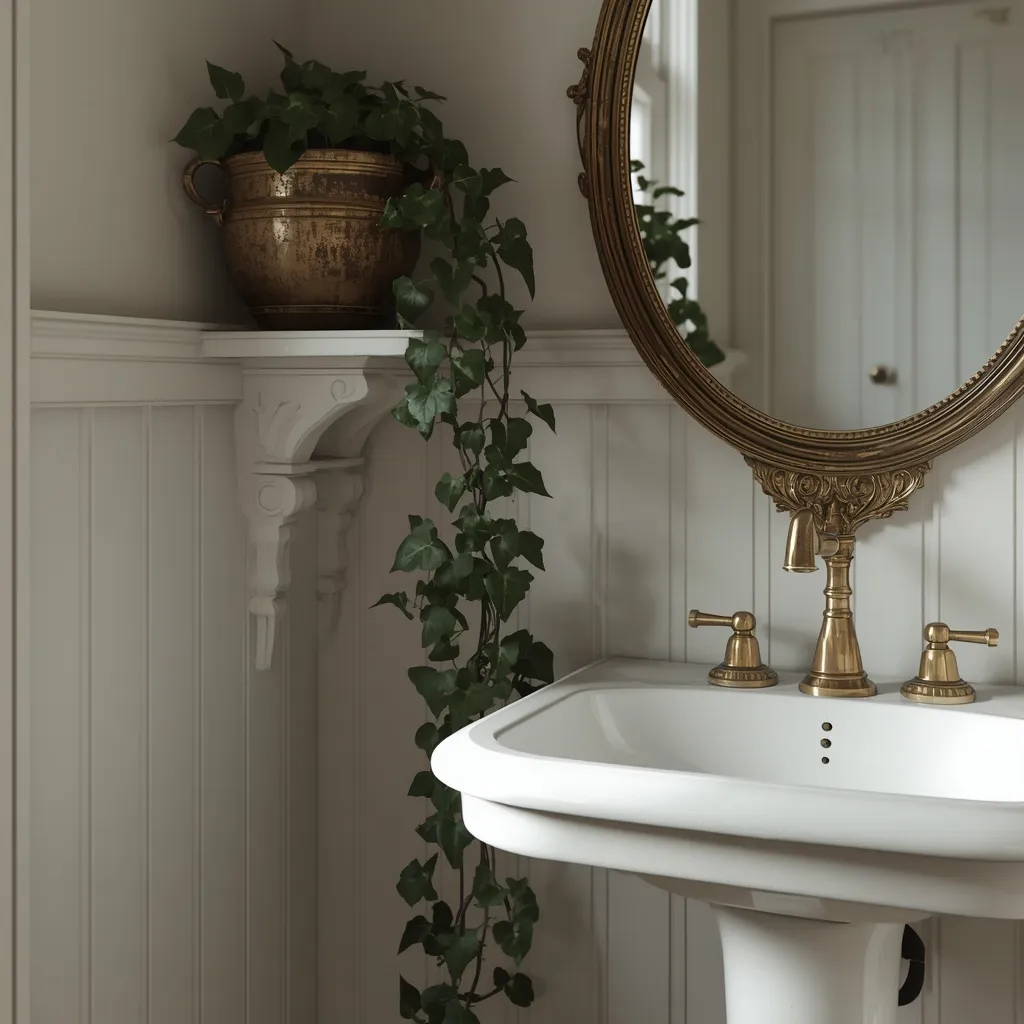
English ivy spilling from an aged brass planter suits a vintage bathroom perfectly: small dark leaves tumbling over patinated metal, set beside a pedestal basin and a gilt-framed mirror. Characterful and period-correct, ivy and brass belong together. Antique, trailing, and full of character.
Pair trailing English ivy (Hedera helix) with vintage brass, copper, or ceramic containers, placing it on a high shelf or the cistern top where it can trail down beside a pedestal basin. Ivy prefers cooler, bright indirect conditions and can struggle in a hot, permanently steamy room, so it suits bathrooms that ventilate well. If planting directly into a metal container, use a plastic liner so damp compost doesn’t corrode it. Note that English ivy is toxic to cats and dogs, and its sap can irritate skin, so wear gloves when trimming.
- Why it works: Trailing dark ivy against aged brass reads as authentically period.
- Best for: Vintage, Victorian, and traditional bathrooms with good ventilation.
- Key elements: English ivy, brass or copper container with liner, high shelf, bright indirect light, gloves when trimming.
14. Maidenhair Fern Humidity Pocket
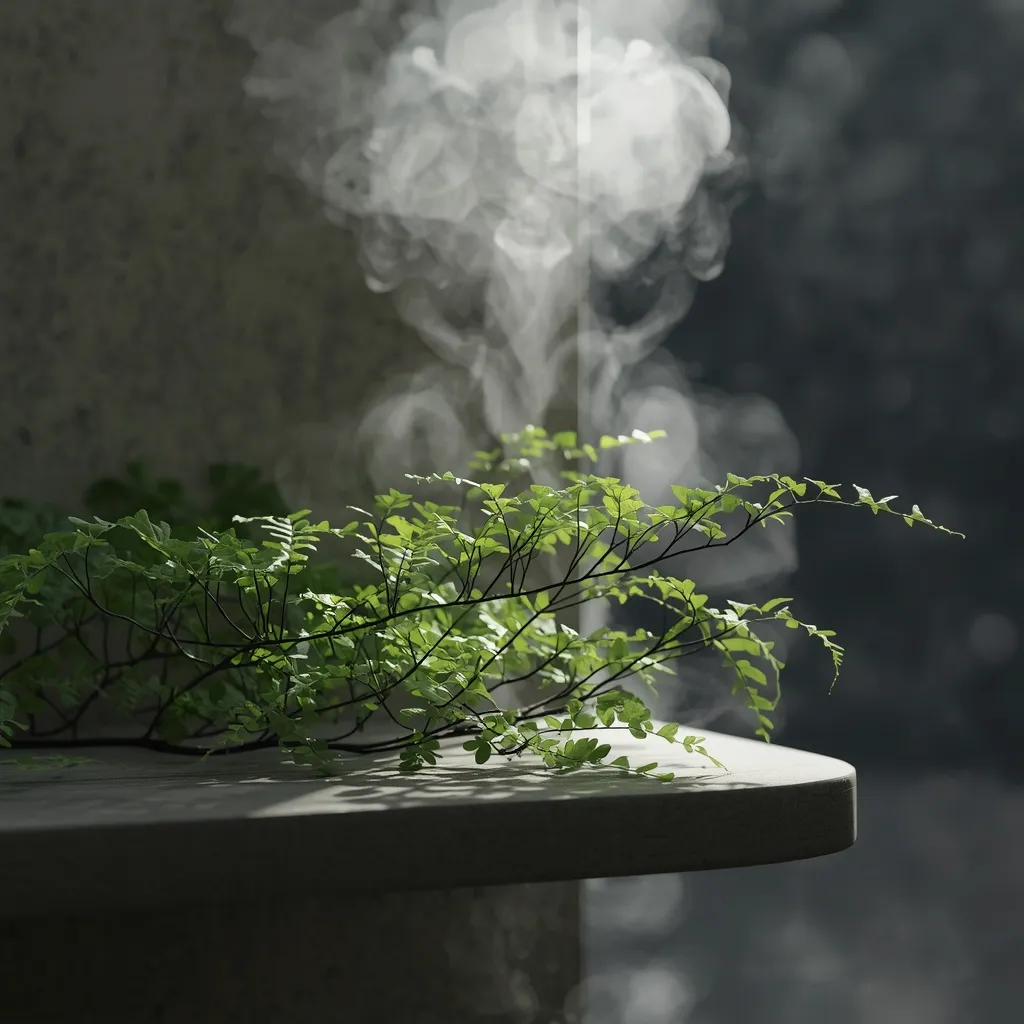
A maidenhair fern on a low shelf near the shower is delicate and cloud-like: tiny fan-shaped leaflets on wiry black stems, trembling in the steam. Fine-textured and demanding, this is the plant that only really works in a bathroom. Airy, fragile, and worth the effort.
Give a maidenhair fern (Adiantum) the steamiest, most consistently humid spot you have, in bright indirect light and never direct sun. This is the fern that fails in normal rooms because dry air crisps it within days, so a regularly used shower room is genuinely one of the few places it succeeds. It must never dry out completely, check soil moisture every few days and keep it lightly damp. Honest caveat: it’s a demanding plant, so start with a Boston fern if you’re new to ferns. Adiantum is generally listed as non-toxic to pets.
- Why it works: A regularly used shower room supplies the constant humidity it fails without elsewhere.
- Best for: Frequently used bathrooms; confident plant owners; pet households.
- Key elements: maidenhair fern, steamiest spot, bright indirect light, soil never dry, checked every few days.
15. Monstera Statement in a Large Bathroom
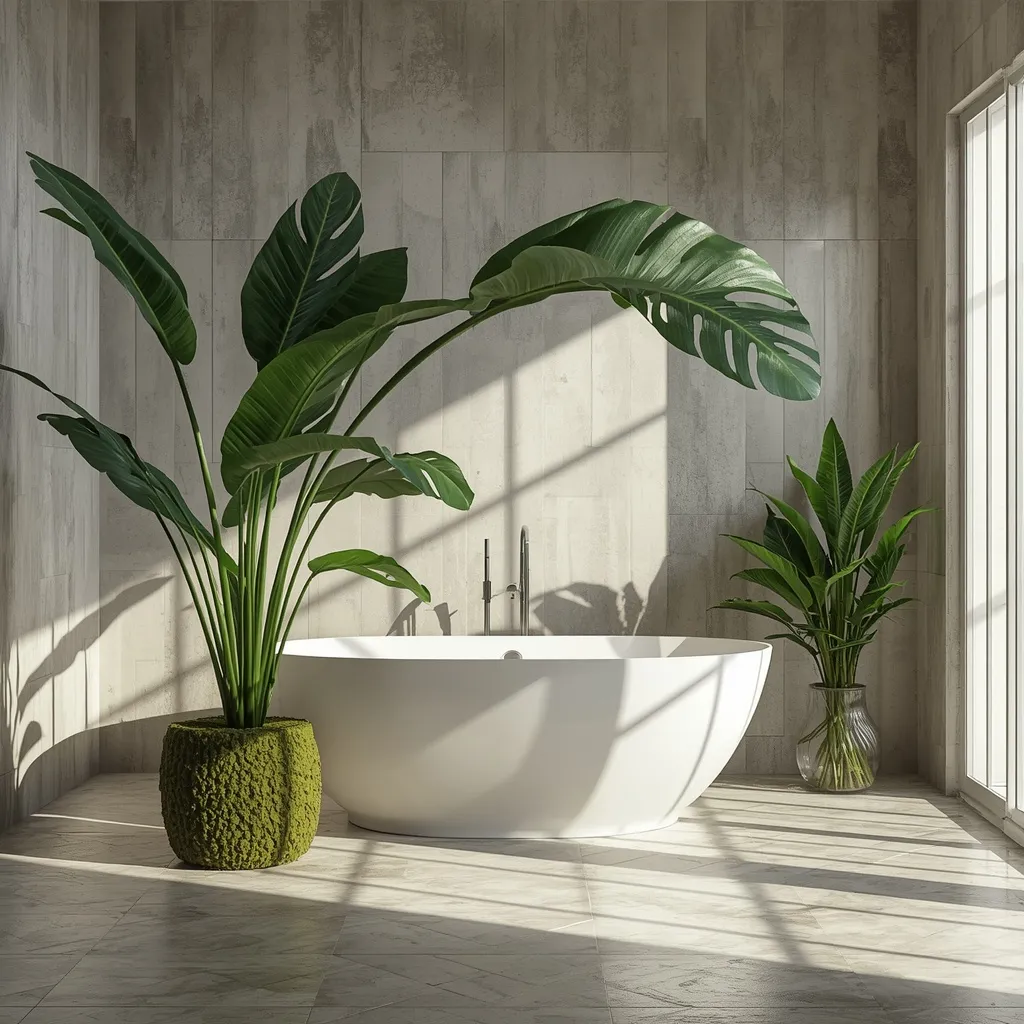
A mature monstera fills a generous bathroom with drama: huge split leaves arching over a freestanding bath, casting patterned shadows across tile. Bold and tropical, one big plant can carry an entire large room. Sculptural, dramatic, and unmistakably tropical.
Place a monstera (Monstera deliciosa) in a floor pot where it has room to spread, mature plants reach well over 1.5 m (5 ft) across, so it needs genuine space rather than a corner it will outgrow in a year. It wants bright indirect light; in dim conditions new leaves emerge smaller and without the characteristic splits. Support it with a moss pole and wipe the large leaves monthly, since dust reduces the light they can use. Monstera is toxic to cats and dogs if chewed.
- Why it works: One large split-leaf plant can carry a big room that small pots would get lost in.
- Best for: Large bathrooms with bright indirect light and floor space.
- Key elements: monstera, large floor pot, moss pole, bright indirect light, monthly leaf wipe.
16. Grow-Light Rotation for Dark Rooms
A genuinely windowless bathroom needs a system rather than a hopeful plant: two matching pots swapped between the bathroom and a bright room every fortnight, or a discreet grow light doing the work permanently. Practical and honest, this is what actually keeps plants alive in the dark. Realistic, workable, and effective.
For a bathroom with no natural light, run a rotation: keep two identical plants, one in the bathroom and one recovering in a bright room, swapping them every two to three weeks so neither declines. Alternatively, fit a small LED grow light on a timer for six to eight hours a day, choosing a bathroom-appropriate fitting and having any hardwired electrical work done by a qualified electrician, since bathroom wiring is subject to specific safety rules almost everywhere. If neither suits, good-quality faux plants are a legitimate choice, no living plant thrives in permanent darkness, whatever the humidity.
- Why it works: Rotation or supplementary light solves the actual problem, which is darkness not dryness.
- Best for: Internal and windowless bathrooms; basement flats.
- Key elements: two identical plants swapped fortnightly, or a timed LED grow light, qualified electrician for wiring, faux as a valid fallback.
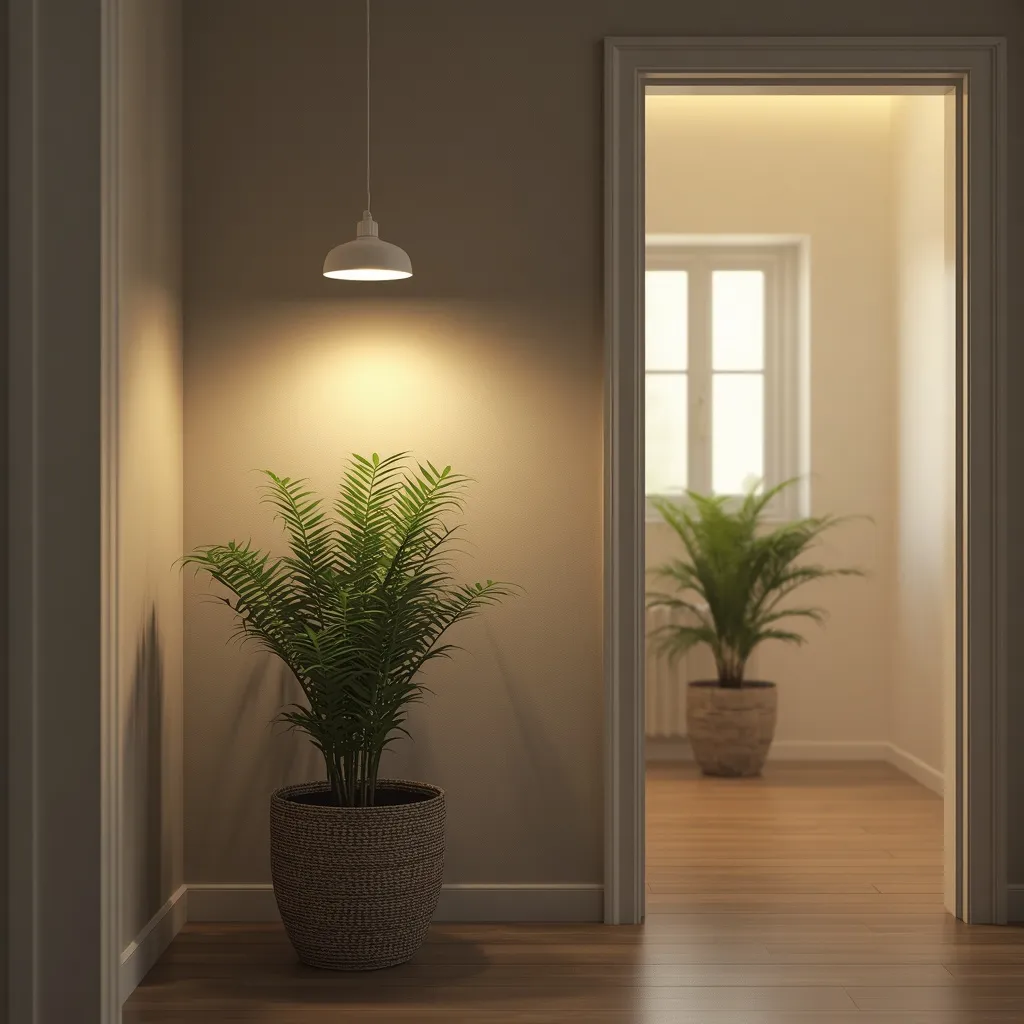
What Plants Do Well in a Bathroom Without Windows?
Snake plants, ZZ plants, and pothos cope best with low light, but no living plant genuinely thrives in a bathroom with no natural light at all. The honest solutions are a rotation system, keeping two identical plants and swapping them with a bright room every two to three weeks, or a small LED grow light on a timer for six to eight hours daily. Humidity does not compensate for darkness.
Advice that works in a real home rather than only in a photograph is central to the Sunday Abode approach. Greenery looks especially striking against a deep wall color, as our guide to navy powder room schemes shows. For more on planning the space, browse the rest of our bathroom ideas.
Bathroom Plant Quick Comparison
Match the plant to your light level first, then check care level and pet safety. Toxicity notes below are general guidance, always confirm the exact species against the ASPCA toxic plant lists before buying if you have cats or dogs.
| Plant | Light needed | Care level | Pets |
| Snake plant | Low to bright | Very easy | Toxic |
| ZZ plant | Low to medium | Very easy | Toxic |
| Pothos | Low to medium | Very easy | Toxic |
| Peace lily | Medium, indirect | Easy | Toxic |
| Spider plant | Medium to bright | Easy | Non-toxic |
| Boston fern | Bright indirect | Moderate | Non-toxic |
| Orchid | Bright indirect | Moderate | Non-toxic |
| Air plant | Bright indirect | Moderate | Non-toxic |
| Aloe | Direct sun | Easy | Toxic |
| Maidenhair fern | Bright indirect | Demanding | Non-toxic |
Safety & practical notes: many popular bathroom plants, including pothos, philodendron, peace lily, monstera, snake plant, ZZ plant, aloe, and English ivy, are toxic to cats and dogs if chewed, so check the ASPCA toxic and non-toxic plant lists before buying and keep trailing vines out of reach of curious pets and small children. Secure hanging planters and shelves into joists or properly rated wall anchors, remembering that a freshly watered pot is considerably heavier than a dry one. Never let pots sit in standing water, which rots roots and can encourage mold on nearby surfaces. Keep plants clear of extractor fan vents so airflow isn’t blocked, since ventilation matters more than plants for controlling bathroom damp. Any hardwired grow light or new bathroom electrical fitting should be installed by a qualified electrician, as bathroom wiring is governed by specific safety regulations in most countries. Wear gloves when trimming ivy, whose sap can irritate skin.
Frequently Asked Questions
What are the best plants for a bathroom?
The best choice depends almost entirely on your light. For low-light bathrooms, snake plants, ZZ plants, and pothos are the most reliable. For bright indirect light, ferns, orchids, and spider plants do well and genuinely enjoy the humidity. For a sunny windowsill, aloe and succulents work best. Match the plant to the light first, then treat the humidity as a bonus rather than the deciding factor.
Is bathroom humidity actually good for plants?
It helps some plants considerably, particularly ferns, orchids, and air plants, which suffer from crispy edges in dry indoor air. What it doesn’t do is replace light. Bathroom humidity is also intermittent rather than constant, it spikes for around twenty minutes during a shower, then drops back. A humid but dark bathroom is still a poor home for most plants.
How often should you water plants in a bathroom?
Less often than in a dry room, because humid air slows evaporation and the soil stays damp for longer. Check by pushing a finger into the soil rather than following a fixed schedule: water most plants when the top 2–3 cm (1 in) is dry. Overwatering is the most common cause of death in bathroom plants, since people keep to the same routine they use elsewhere in the house.
Which bathroom plants are safe for cats and dogs?
Spider plants, Boston ferns, maidenhair ferns, Phalaenopsis orchids, and Tillandsia air plants are generally listed as non-toxic to cats and dogs. Several bathroom favorites are not, including pothos, philodendron, peace lily, monstera, snake plant, ZZ plant, aloe, and English ivy. Check the exact species against the ASPCA toxic plant lists before buying, since common names cover several different plants.
Can you keep plants in a bathroom with no natural light?
Not sustainably without help. Snake plants, ZZ plants, and pothos survive longest in very low light, but all decline eventually in true darkness. The practical fixes are a rotation system, keeping two identical plants and swapping them with a bright room every two to three weeks, or a small LED grow light on a timer for six to eight hours a day. Good faux plants are a legitimate alternative.
What plants work in a tiny bathroom?
One well-chosen plant beats several small ones in a tiny room, where multiple pots read as clutter. Use vertical space rather than counter space: a single floating shelf, a hanging planter, or wall-mounted air plants all keep surfaces clear. Compact species like a small ZZ plant, a young pothos, or Tillandsia suit the scale without outgrowing the room within a season.
Why are my bathroom plant’s leaves turning yellow?
Yellowing leaves in a bathroom most often indicate overwatering rather than underwatering, because humid air keeps soil damp far longer than in other rooms. Check whether the soil is still wet a few centimeters down and whether the pot has drainage holes, since pots sitting in water rot roots quickly. Yellowing paired with slow, leggy growth usually points to insufficient light instead.
Conclusion
Choosing the best plants for bathroom spaces comes down to being honest about your light rather than hopeful about your humidity. A snake plant or ZZ will hold its own in a dim corner, ferns and orchids genuinely flourish in the steam of a well-lit shower room, and a windowless bathroom needs a rotation system or a grow light rather than wishful thinking. Water less often than you would elsewhere, check toxicity if you have pets, and secure anything you hang. For more ways to shape the space, explore the bathroom ideas collection on Sunday Abode and save the setup that matches your light.