
Introduction
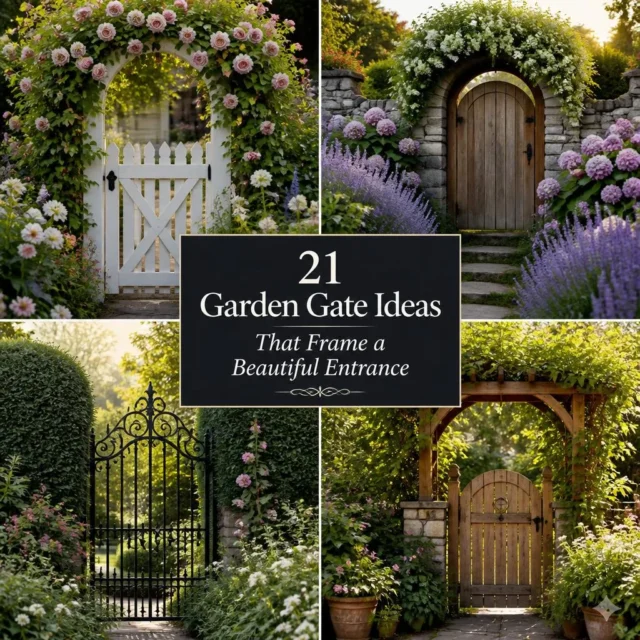
Picture stepping through a gate that makes your garden feel like a destination rather than a boundary line. That first impression is exactly what the best garden gate ideas are built around, whether the goal is a cottage-style entrance, a sleek modern courtyard, or a simple upgrade to a plain, sagging fence gap. This guide gathers twenty-one workable designs across wood, metal, wrought iron, and budget DIY builds, so there is an option whether you are dressing up a rental fence or planning a permanent architectural entrance. In keeping with Sunday Abode’s approach to home and garden design, each idea pairs the visual inspiration with practical notes on materials, hardware, and safety, so read on for garden design ideas that hold up outdoors, not just on a mood board.
Classic and Cottage-Style Garden Gates
Cottage-style entrances lean on softness: curved lines, flowering companions, and materials that age gracefully. These five ideas work well for period homes, informal front gardens, and anyone who wants their gate to feel like a warm welcome rather than a hard stop.
1. Classic White Picket Gate
A crisp white picket gate is the entrance most people picture when they imagine a classic garden: gently pointed pickets rising above a low fence, framed by hydrangeas or a climbing rose spilling over the top rail. It reads as tidy and welcoming on cottage homes, colonial-style houses, and small urban front gardens alike, signaling a well-tended space before a visitor even reaches the door.
Build it from cedar or pressure-treated pine for natural rot resistance, and prime all cut edges before painting so moisture cannot creep into the end grain. Exterior satin or semi-gloss enamel holds up better against rain and UV fading than a flat finish, and a fresh coat every two to three years keeps the pickets from graying. A common mistake is hanging the gate flush with the fence’s top rail; dropping it 5 to 8 centimeters (2 to 3 inches) lower gives it a lighter, more traditional silhouette. If children or pets use the garden, choose a latch mounted high enough, or with a mechanism, that they cannot easily flip open unsupervised.
- Suits cottage, colonial, and traditional suburban homes without looking dated
- Pairs naturally with climbing roses, clematis, or sweet peas along the top rail
- Solves the problem of a fence that feels like a barrier rather than a welcome
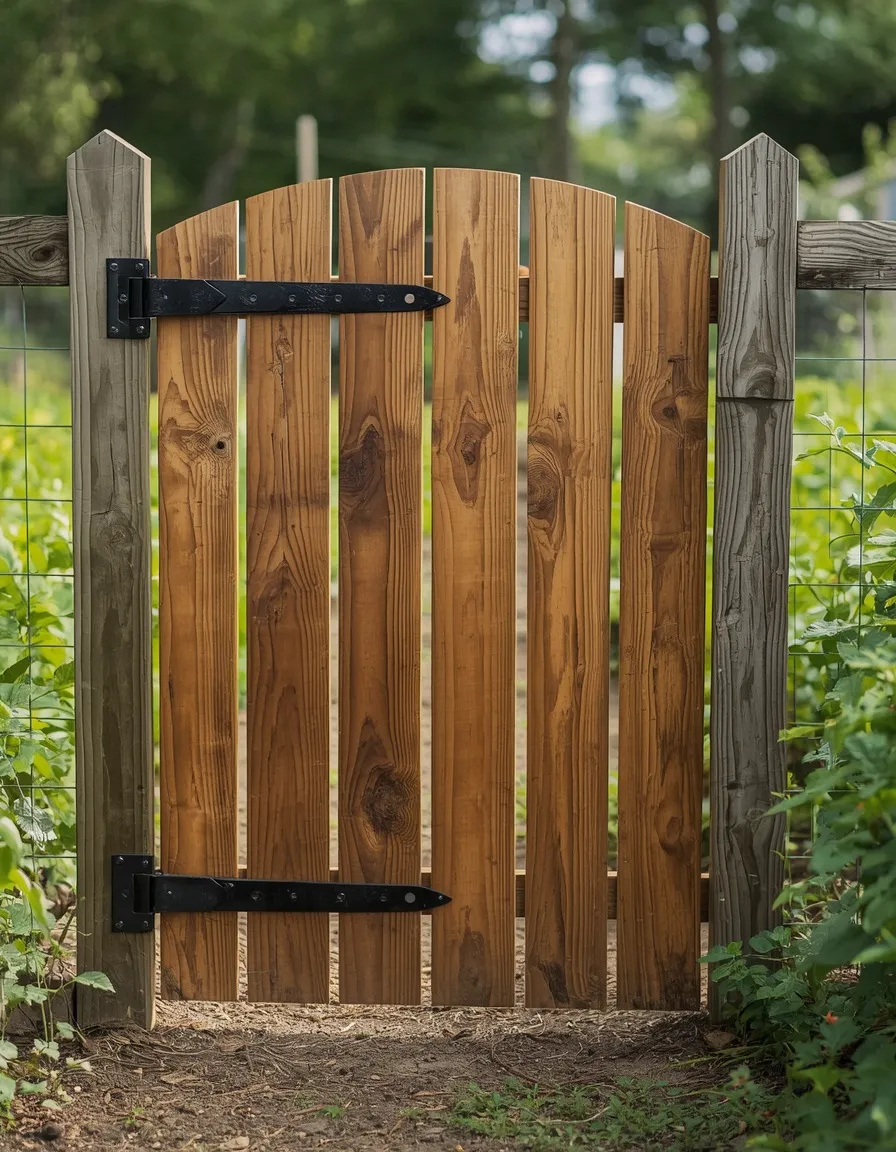
2. Arched Cottage Garden Gate
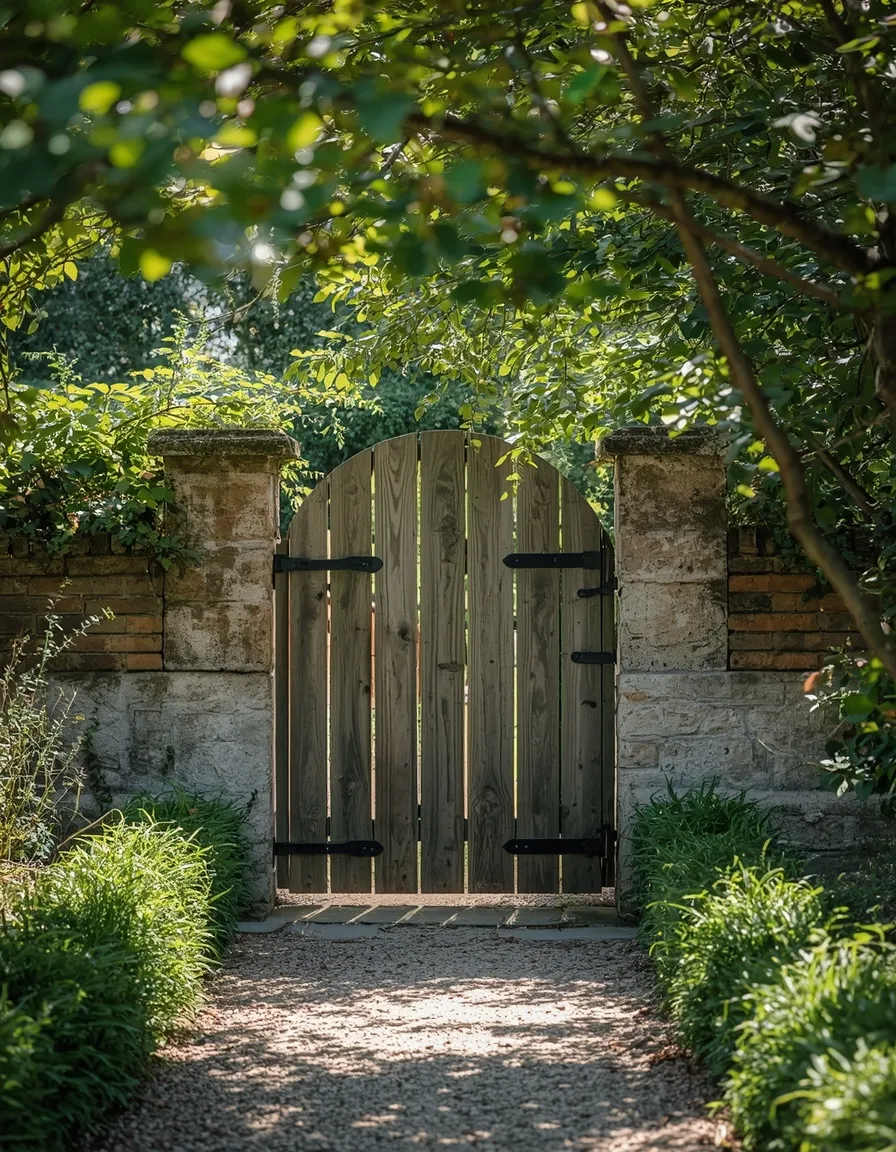
An arched top turns an ordinary wooden gate into a small piece of architecture, drawing the eye upward and framing whatever lies beyond it, a stone path, a vegetable patch, or a burst of cottage-garden planting. The curve softens what would otherwise be a flat, utilitarian rectangle and gives the entrance a storybook quality that photographs beautifully.
The arch is typically cut from the top two or three pickets or boards, so it is achievable with a jigsaw and a simple plywood template rather than specialist joinery. Keep the curve shallow rather than a full semicircle; an exaggerated arch can look ornamental in a way that clashes with a plain fence line. Pair the gate with matching arched fence posts or a simple overhead trellis for continuity, and treat any exposed end grain at the curve’s high point, since that area sheds water more slowly and is prone to early rot.
- Adds architectural interest to an otherwise flat fence line
- Works especially well framing a path, arbor entry, or side gate
- Solves the problem of a fence that reads as purely functional, not decorative
3. Vine-Covered Living Gate
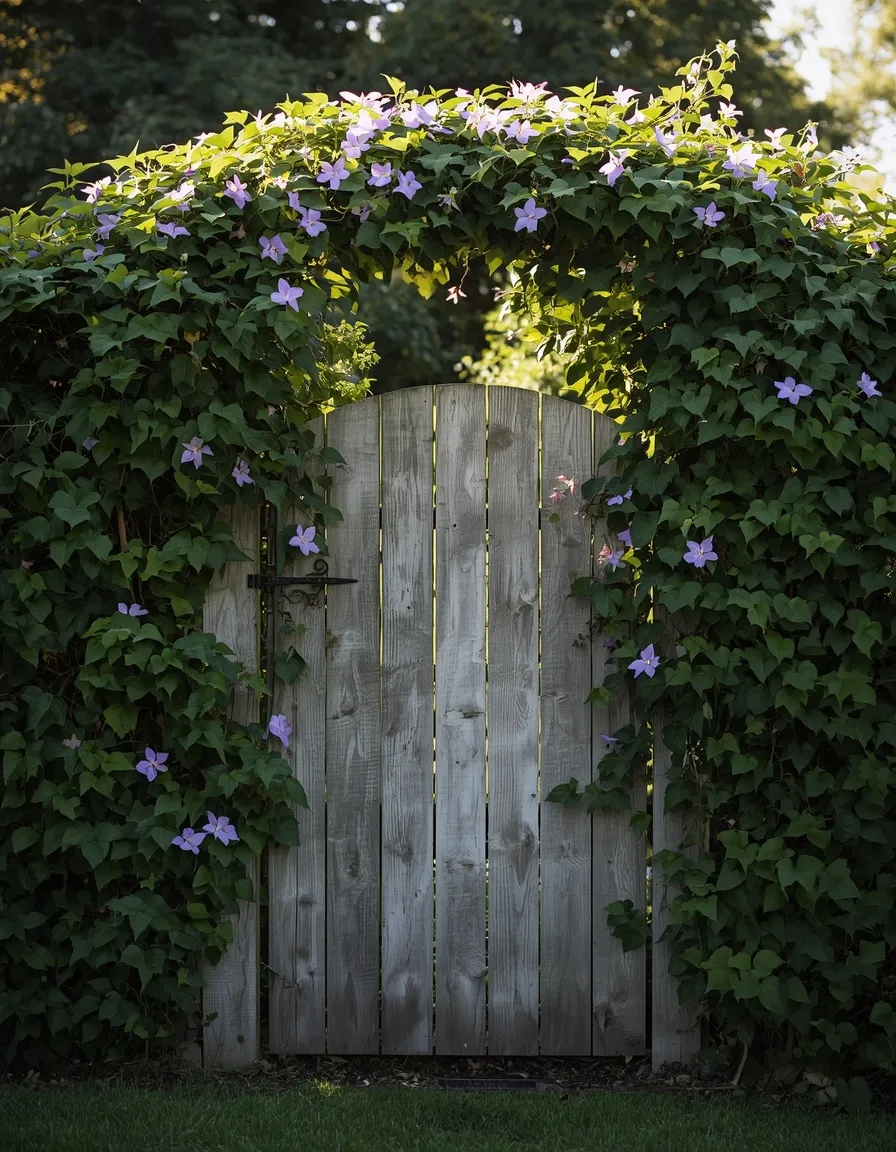
A living gate lets planting do most of the visual work: a simple wood or metal frame gate disappears under clematis, climbing hydrangea, or an old-fashioned rambling rose, so the entrance feels grown rather than built. This idea suits gardeners who want a romantic, slightly wild look, and it is especially effective for gates that sit within a hedge or informal boundary rather than a crisp, manicured fence.
Start with a sturdy frame gate rather than a solid panel, since climbers need something to twine or be tied onto, and horizontal wires or a light trellis attached to the frame give young growth a head start. The Royal Horticultural Society advises putting climber supports in place before planting, with wires or trellis spaced roughly 30 to 45 centimeters apart, so stems have something to grip as they mature. Choose a self-clinging or twining variety suited to your climate zone, and prune back growth around the hinges and latch each year so the gate still opens freely; a vine left untended can quietly weld a gate shut within a season or two.
- Turns a plain frame gate into a seasonal, ever-changing feature
- Works well for informal hedgerows, cottage gardens, and romantic planting styles
- Solves the problem of a hard, visible gate breaking up soft greenery
4. Rustic Reclaimed Wood Gate
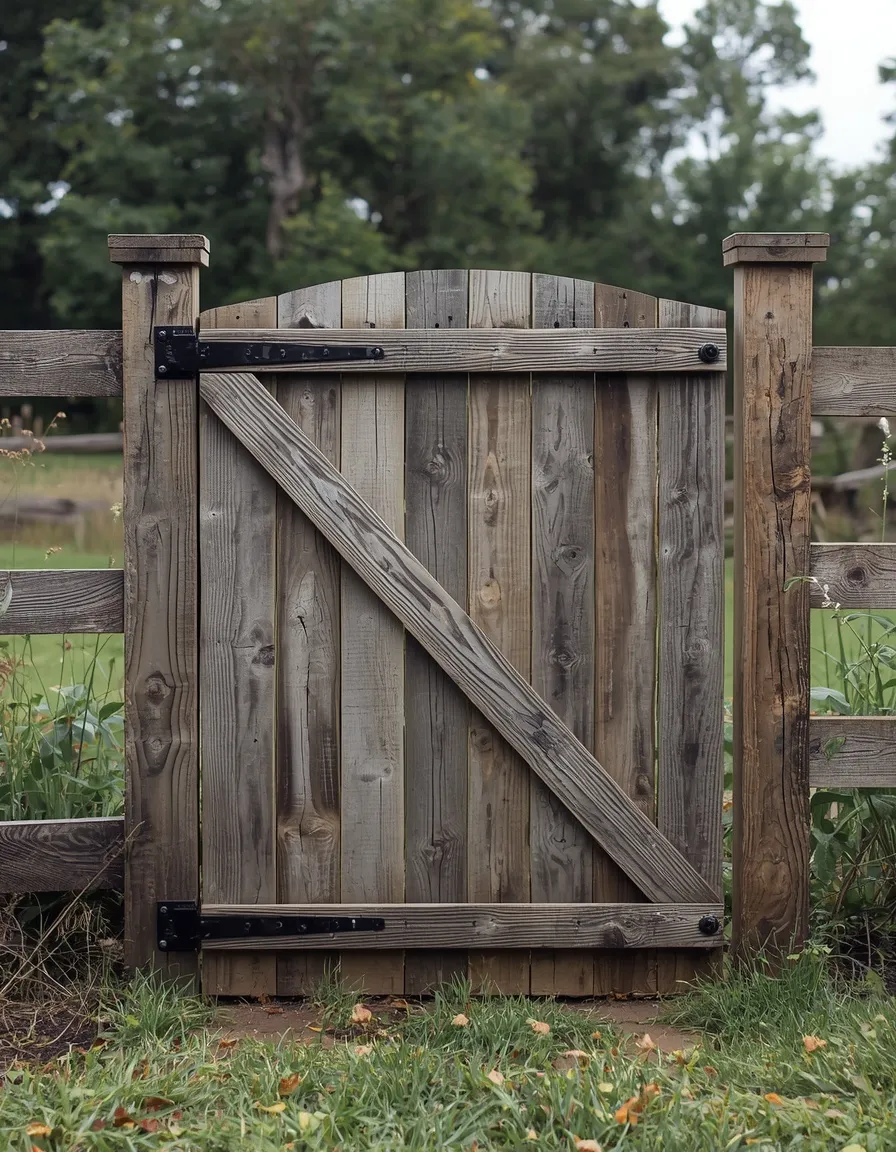
Reclaimed boards, whether from an old barn, a dismantled fence, or salvaged decking, bring a weathered patina that new lumber simply cannot fake. The mismatched grain, nail holes, and soft gray or silvered tone give a rustic or farmhouse garden real character, and no two reclaimed gates ever look quite the same, which is part of the appeal for anyone tired of catalog-perfect hardware store options.
Source reclaimed timber from architectural salvage yards rather than random curbside finds, and ask specifically whether older fencing or decking boards were chemically pressure-treated, since older treated lumber can contain preservatives that need careful handling. The U.S. Environmental Protection Agency notes that wood treated with chromated arsenical preservatives was commonly used in outdoor residential settings from the 1970s through the early 2000s, so wear gloves, avoid sanding it indoors, and seal cut edges before reuse. Once assembled, a single coat of clear exterior oil deepens the existing patina without covering up the character that made the wood worth salvaging in the first place.
- Gives an instant sense of history and age to a brand-new fence line
- Works particularly well for farmhouse, rustic, and cottage-core garden styles
- Solves the problem of a new build looking too crisp or characterless
5. Bold Painted Statement-Color Gate
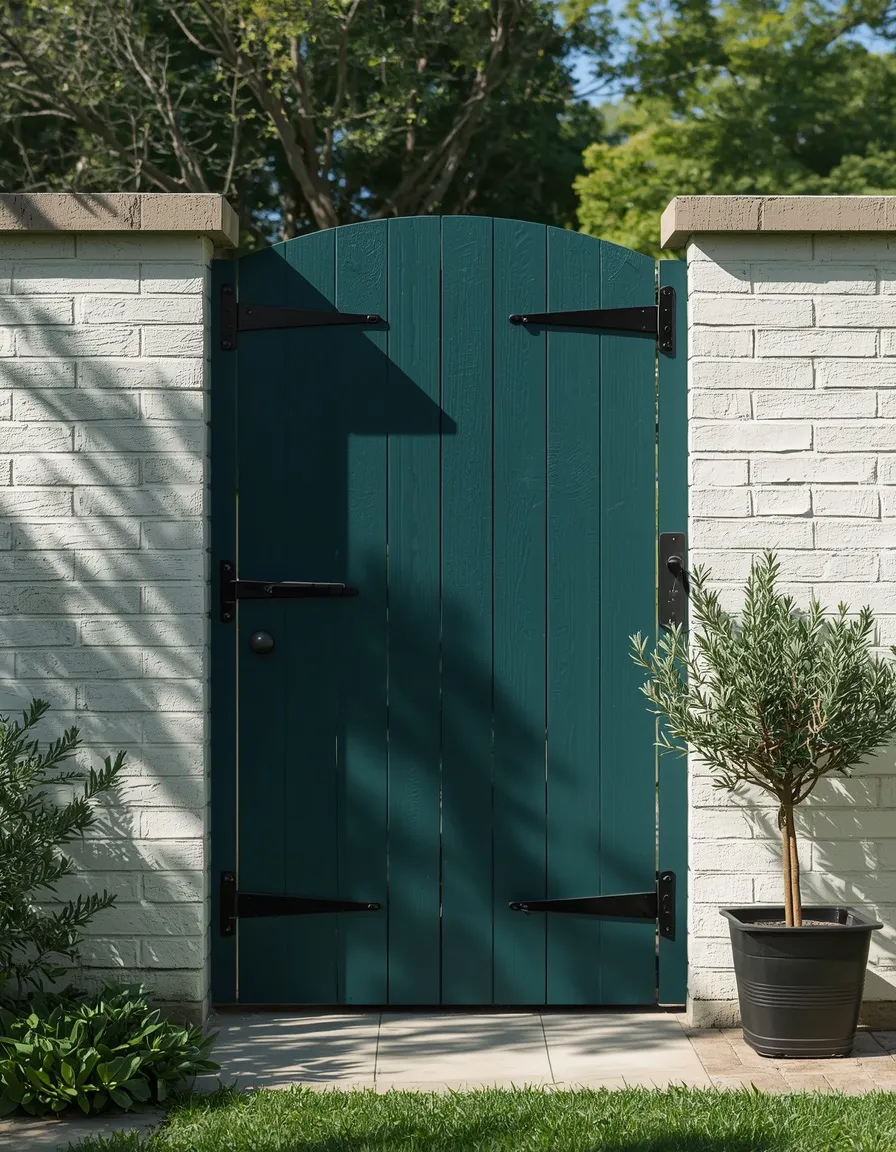
Sometimes the easiest garden gate upgrade is not a new build at all, but a can of paint. A saturated color, deep teal, terracotta, mustard yellow, or matte black, turns an existing plain gate into the focal point of the whole front garden, especially against neutral render, brick, or greenery. This is one of the lowest-cost, highest-impact ideas on this list and suits renters and homeowners equally well.
Choose an exterior-grade enamel or door-and-trim paint rated for outdoor wood or metal, since standard interior paint will chalk and peel within a season. Sand and prime bare or previously varnished surfaces first, and apply two thin coats rather than one thick one to avoid drips pooling in joints. A useful styling trick is to echo the gate color in a single small accent elsewhere, a planter, a house number, or a mailbox, so the color reads as an intentional choice rather than an isolated feature.
- Costs far less than replacing the gate structure itself
- Instantly modernizes a dated or weathered wooden or metal gate
- Solves the problem of a front garden that lacks a clear focal point
Modern and Minimalist Garden Gates
Contemporary homes generally call for cleaner lines, restrained materials, and hardware that recedes rather than announces itself. These five ideas suit new-build gardens, courtyard entries, and anyone styling toward a pared-back aesthetic.
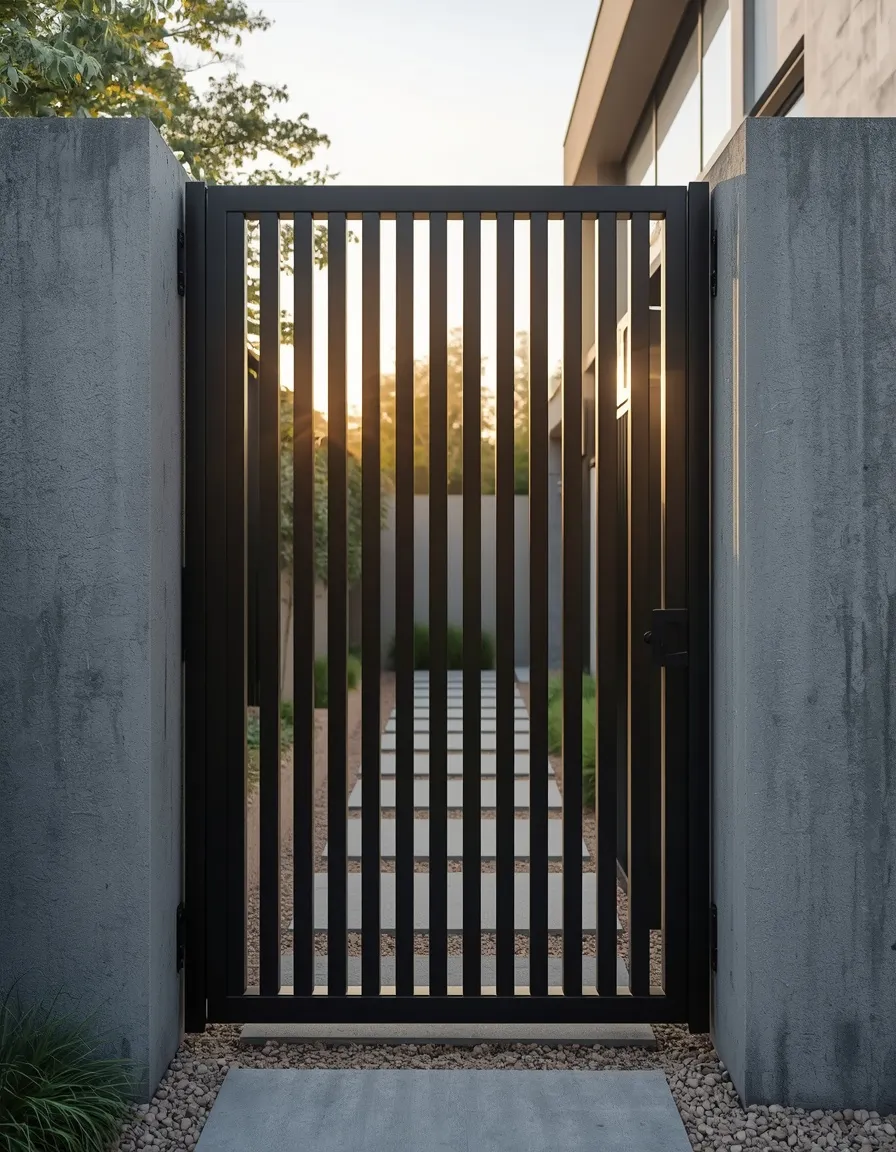
6. Modern Black Matte Metal Slat Gate
Vertical steel or aluminum slats finished in matte black have become one of the defining looks of contemporary garden design, largely because the thin, evenly spaced bars read as architectural rather than decorative. The gate functions almost like a piece of minimalist screening, offering privacy and security while still allowing light and air through the gaps, which keeps a small courtyard from feeling boxed in.
Powder-coated steel or aluminum resists rust and chipping far better than painted mild steel, so specify powder coating rather than standard paint if the gate sits in a coastal or high-rainfall climate. Keep slat spacing consistent, typically 5 to 10 centimeters apart, both for visual rhythm and to meet common safety guidance for gates near play areas, where wider gaps can pose an entrapment risk for small children. Pair the gate with matching black house numbers or a light fixture to tie the entrance to the wider facade.
- Suits modern, minimalist, and new-build homes with clean architectural lines
- Balances privacy with airflow better than a solid panel gate
- Solves the problem of a courtyard or side entry feeling closed-in
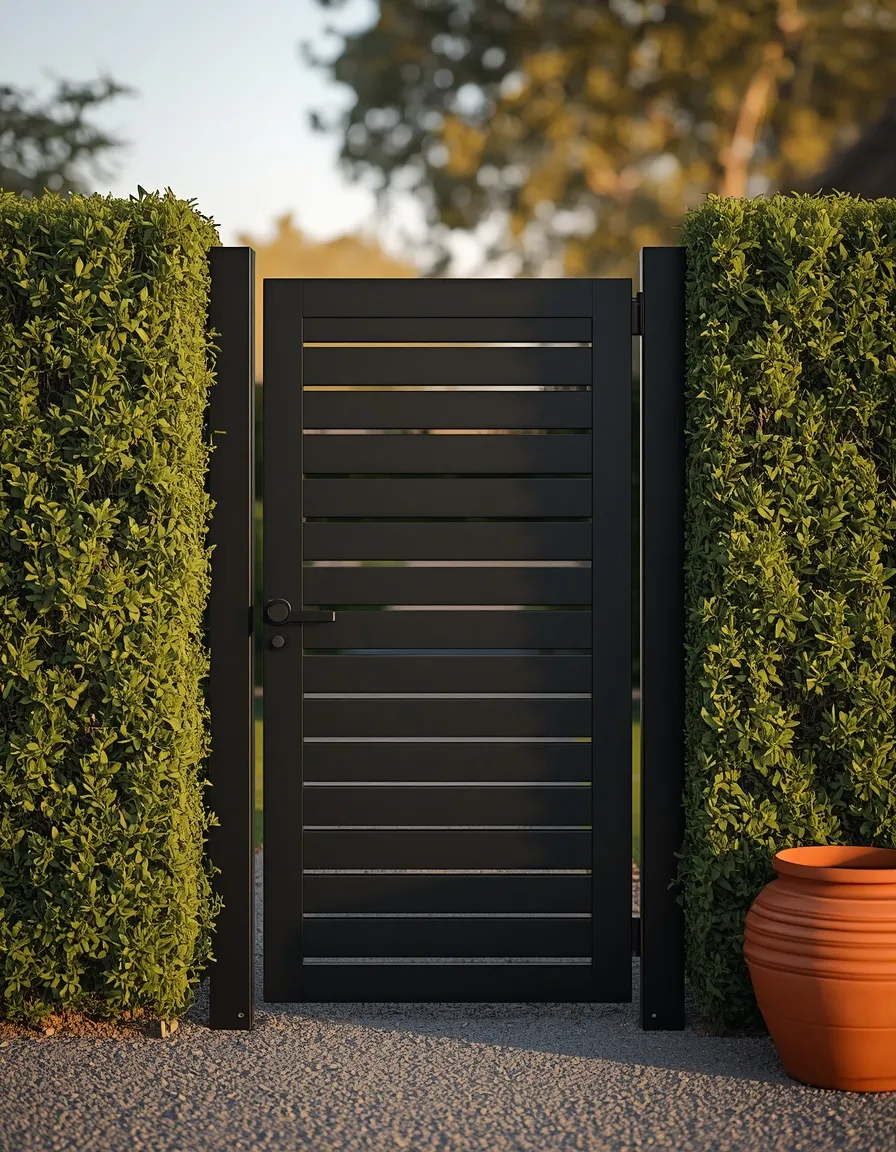
7. Minimalist Horizontal Slat Gate
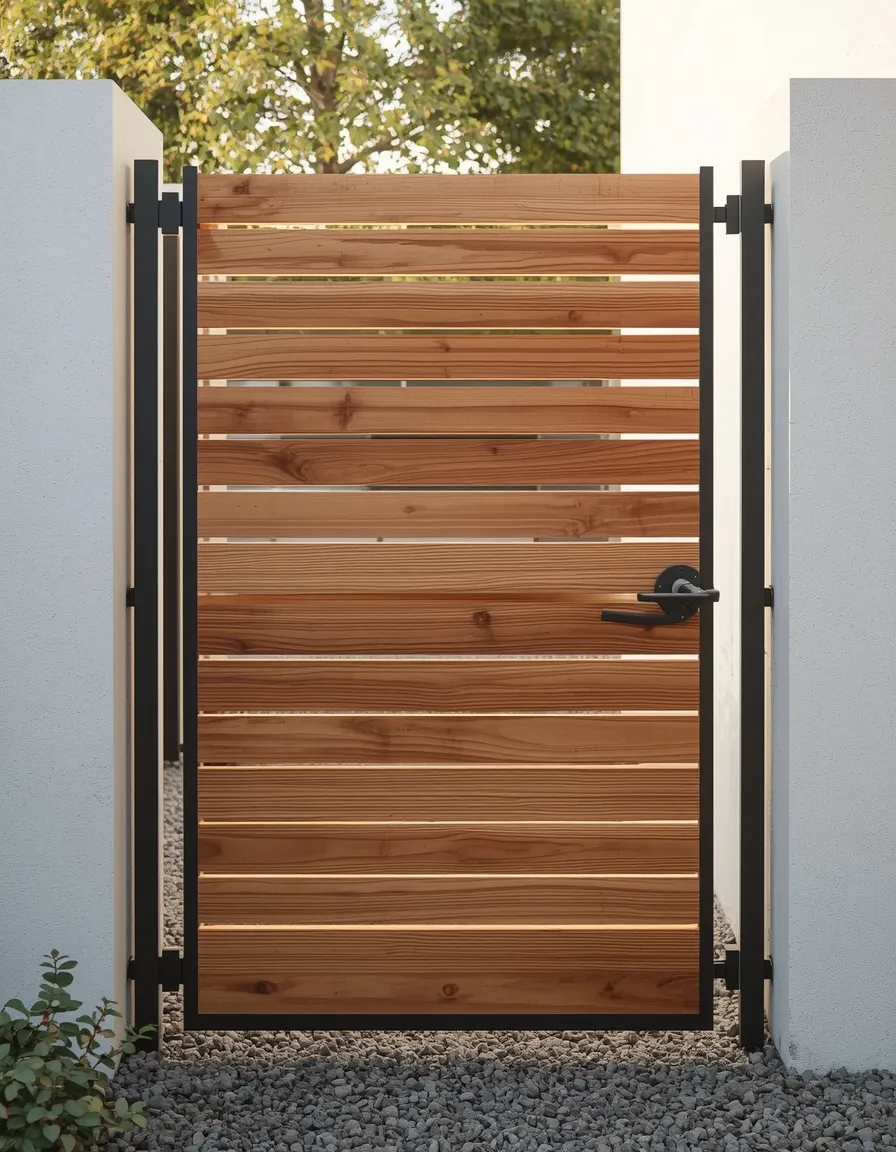
Where vertical slats feel architectural, horizontal slats feel calmer and wider, visually stretching a narrow gate opening and echoing the linear look popular in modern fencing and cladding. Cedar or thermally modified pine slats set with even reveals between them create a warm, Scandinavian-influenced take on minimalism that softens an otherwise stark, boxy garden layout.
Use a galvanized steel or powder-coated aluminum frame beneath the wood slats for long-term structural stability, since horizontal slats alone are not rigid enough to resist wind load or sagging over time. Space the boards with consistent gaps, generally 1 to 2 centimeters, using scrap wood as spacers while fixing them in place, which keeps the finished gate looking machine-precise rather than hand-built. Avoid mixing more than two wood tones on the same gate, since minimalist design relies on restraint rather than variety to feel intentional.
- Visually widens a narrow gate opening or side passage
- Works well alongside horizontal cladding, decking, or slatted fencing already on-site
- Solves the problem of a modern build feeling cold by adding warm wood texture
8. Metal-and-Wood Combination Gate
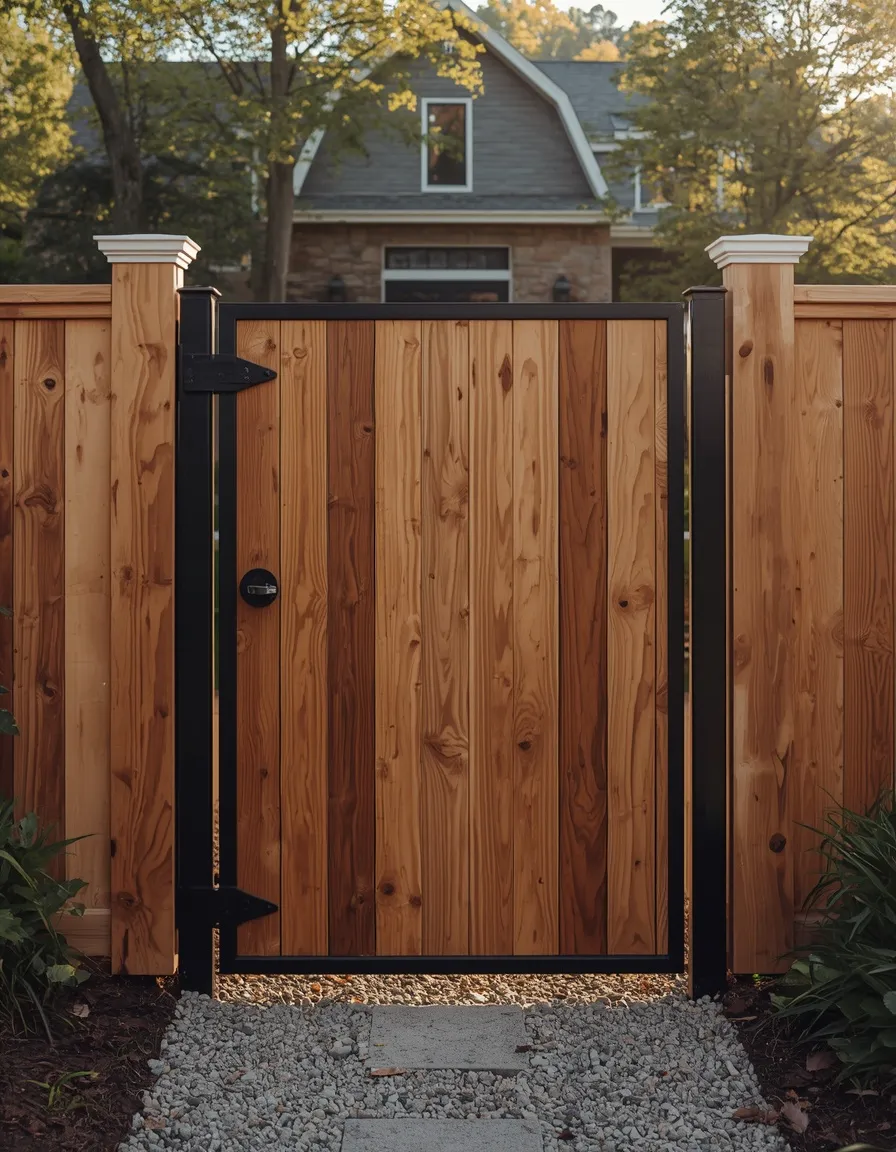
Pairing a slim steel or iron frame with timber infill panels gives a gate the structural rigidity of metal and the warmth of natural wood, without fully committing to either material on its own. It is a particularly strong choice for modern farmhouse and transitional gardens, where an all-metal gate can feel too industrial and an all-wood gate can feel too traditional.
The metal frame carries the structural load, so the timber infill can be thinner and lighter than a solid wood gate would require, which also reduces long-term sagging. Have the frame welded or bolted by a metalworker to precise dimensions before the wood slats are fitted, since even small frame irregularities become obvious once straight timber battens are set against them. Choose a wood species that will weather to a similar gray tone as the metal ages, such as untreated cedar, so the two materials continue to look coordinated rather than mismatched after a few seasons outdoors.
- Bridges modern farmhouse, transitional, and rustic-modern garden styles
- Combines the strength of a metal frame with the warmth of natural wood
- Solves the problem of an all-metal or all-wood gate feeling too one-note
9. Solar-Lit Modern Entrance Gate
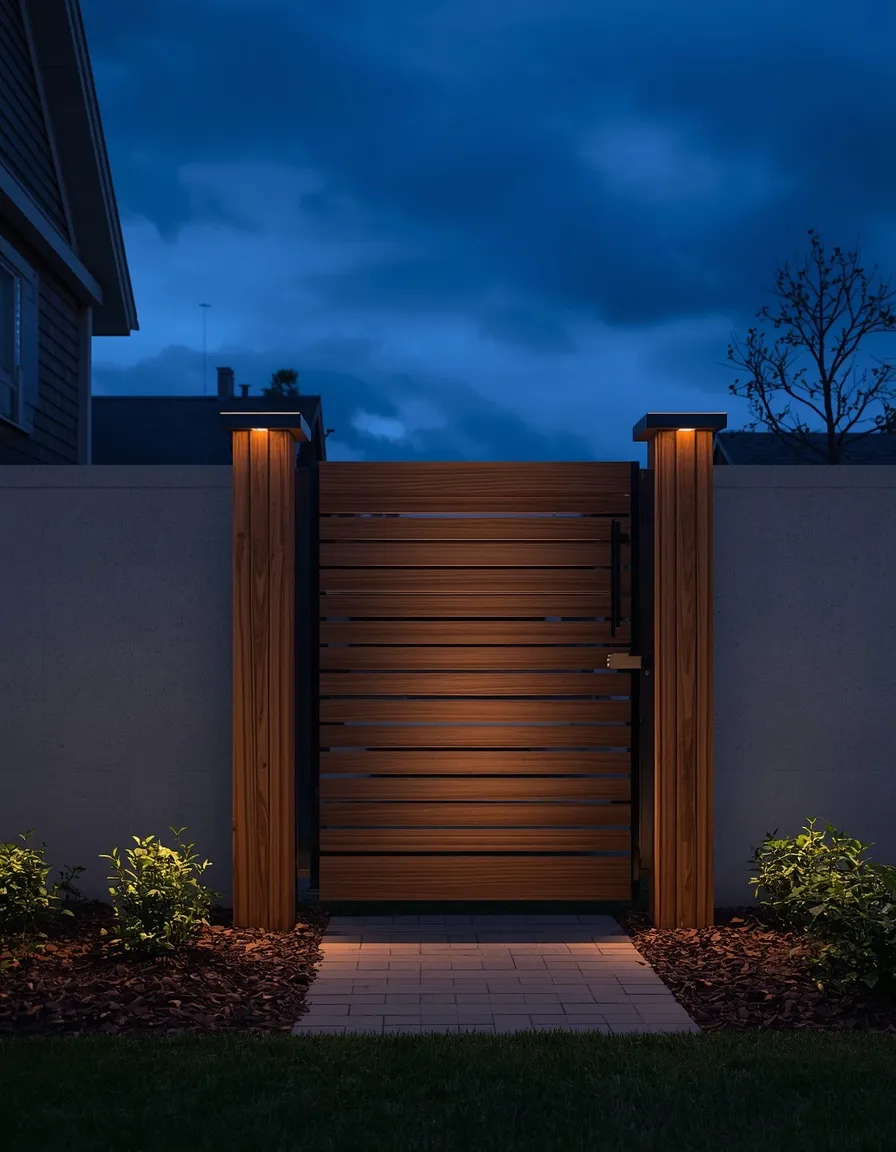
Integrating low-voltage solar lighting into the gate posts turns a purely daytime feature into something that works at dusk and after dark too, marking the entrance for guests, deliveries, and anyone walking up a path after sunset. Small solar-powered cap lights or recessed LED strips built into the post face give a soft, modern glow without the cost or complexity of running mains electricity outdoors.
Choose fixtures rated IP65 or higher for full weather resistance, and position solar panels or collectors where they receive several hours of direct sun daily, since deep shade will noticeably shorten runtime. If you use any low-voltage wired lighting rather than fully solar units, keep transformers and connections in a weatherproof enclosure and away from standing water, and have any mains-connected outdoor electrical work checked by a qualified electrician rather than treating it as a casual DIY task. A warm white light temperature, rather than cool blue-white, keeps the entrance feeling inviting instead of clinical.
- Extends the gate’s usefulness and visual impact into the evening hours
- Suits modern homes with clean-lined posts and minimal daytime hardware
- Solves the problem of a dark, hard-to-find entrance after sunset
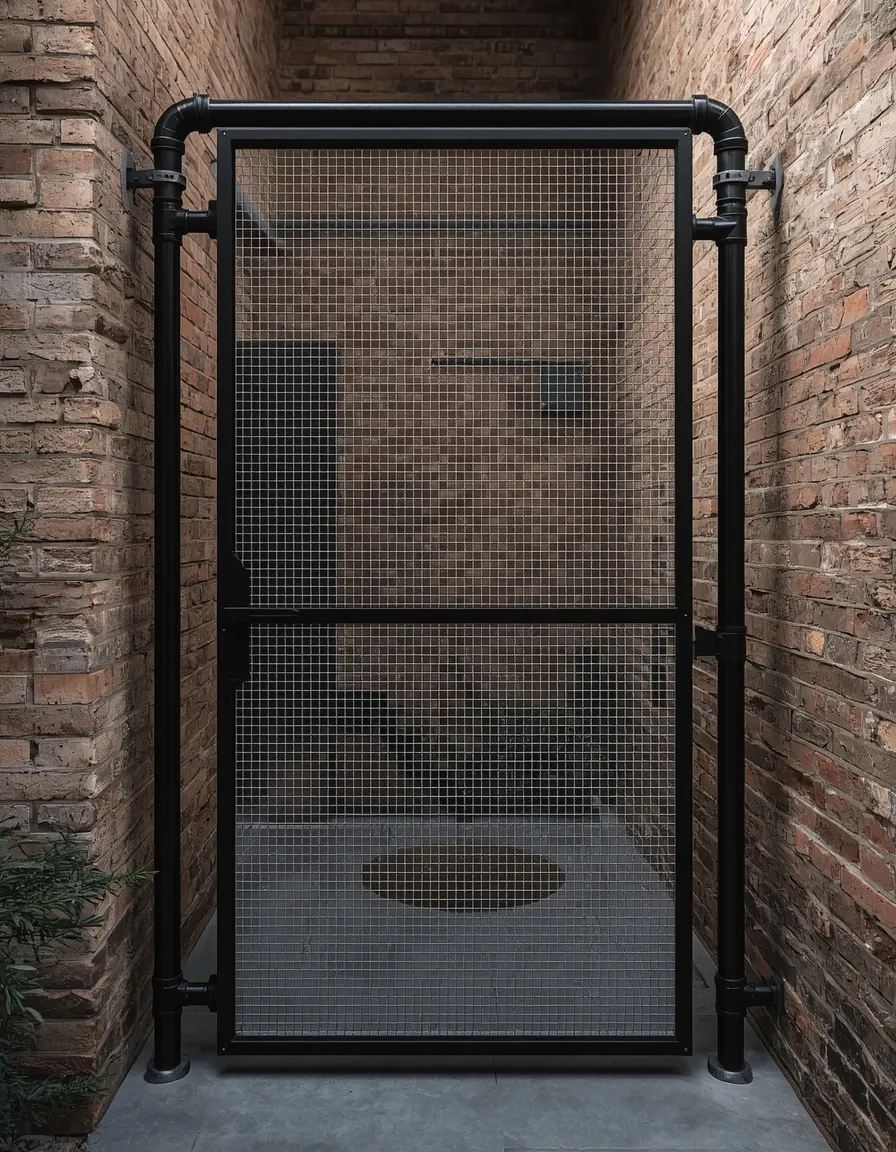
10. Industrial Pipe-and-Mesh Gate
Black iron pipe fittings paired with a steel wire mesh infill give a gate an unmistakable industrial edge, borrowed from loft-style interiors and urban courtyard gardens. The exposed pipe joints and visible mesh texture work particularly well in city gardens, rooftop terraces, and any space already leaning into raw, unfinished materials like exposed brick or concrete.
Threaded black iron pipe fittings, sold for DIY shelving and furniture projects, can be assembled into a simple rectangular frame without welding, which makes this one of the more approachable metal gate builds for a confident DIYer. Stretch and staple galvanized welded wire mesh across the frame under tension so it does not sag or rattle, and file down any sharp cut edges on the mesh before installation, since raw wire ends can snag clothing or scratch skin. Seal exposed pipe threads with a clear matte lacquer to slow rust in humid climates while keeping the raw metal look intact.
- Suits urban courtyards, rooftop gardens, and industrial-style outdoor spaces
- Achievable without welding, using threaded pipe fittings and basic tools
- Solves the problem of a fence style that feels too soft for a hard-edged space
Rustic, Farmhouse, and Budget DIY Garden Gates
Not every gate needs a large budget or professional installation. This group focuses on ideas that prioritize either genuine DIY accessibility or a distinctly rustic, lived-in look.
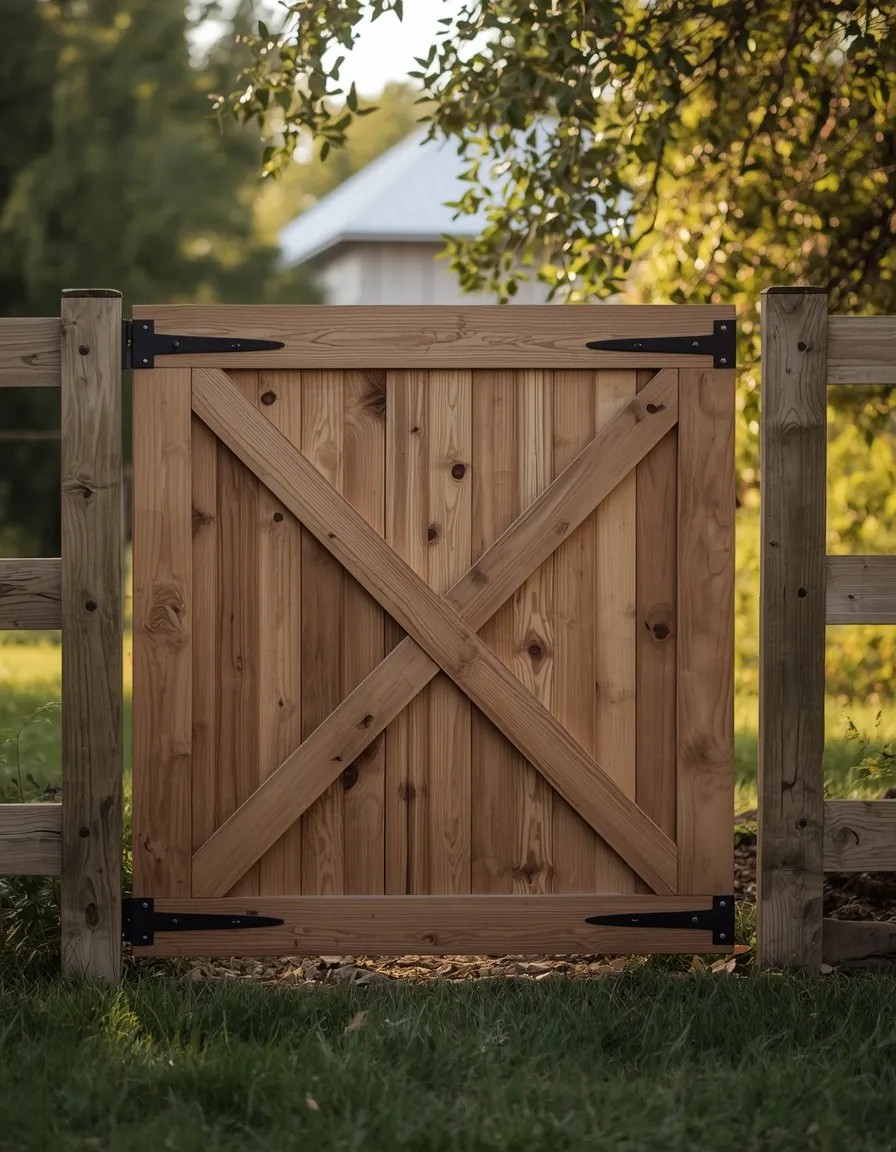
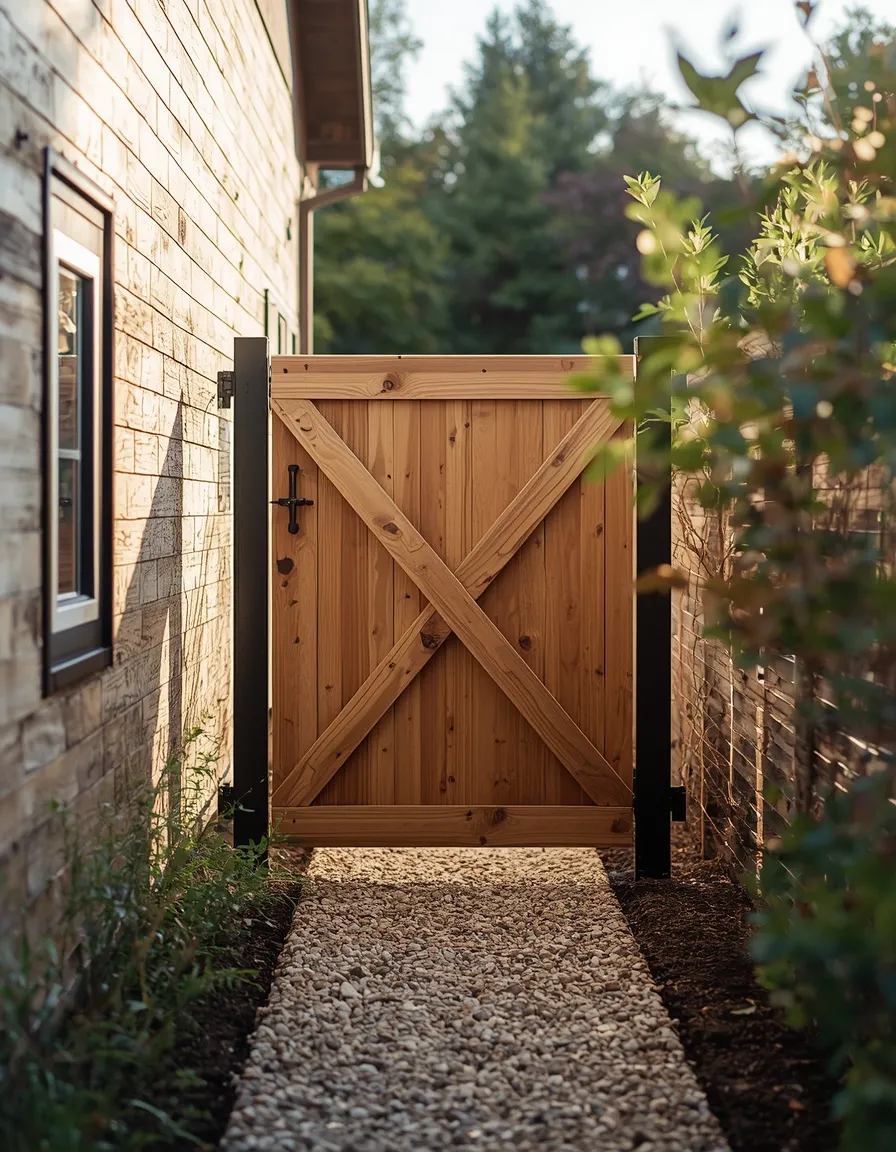
11. Farmhouse X-Brace Gate
The diagonal cross brace running corner to corner across a farmhouse gate is not just decorative, it is genuinely structural, resisting the racking and sagging that plagues simple square-framed gates over time. Left unpainted or finished in a warm wood stain, the X pattern reads instantly as farmhouse or rural style, and it pairs naturally with board-and-batten fencing or a barn-red outbuilding nearby.
Build the perimeter frame first from pressure-treated 5×10 centimeter (2×4 inch) lumber, then measure and cut the diagonal braces to fit snugly into the corners before fixing everything with exterior-grade screws rather than nails, which hold better against the gate’s constant swinging motion. Attach a heavy-duty strap hinge, not a lightweight butt hinge, since farmhouse gates are typically larger and heavier than decorative garden gates and need hardware rated for that load. Check that the gate still swings freely after a full season outdoors, since lumber can shift slightly as it dries and settles.
- Genuinely strengthens the gate structure, not just a decorative pattern
- Suits farmhouse, rural, and ranch-style properties with board fencing
- Solves the problem of a large wooden gate sagging on its hinges over time
12. DIY Pallet Wood Gate
For a genuinely low-cost build, disassembled shipping pallets provide enough sturdy softwood boards for a small garden gate at little more than the cost of hinges, a latch, and finishing materials. The slightly irregular board widths and visible grain give it an easy, unpretentious look that suits vegetable gardens, allotments, and casual side-yard entries rather than a formal front approach.
Check the stamp on each pallet before using it: look for “HT” (heat-treated), which is safe to repurpose, and avoid pallets stamped “MB” (methyl bromide fumigated) or with no stamp at all, since their treatment history is unknown. Wear gloves when prying boards apart, since old pallet nails and staples are a genuine splinter and puncture risk, and remove every fastener rather than just bending it flat. Sand rough edges thoroughly before assembly, then seal the finished gate with an exterior wood stain or oil to slow weathering, since pallet softwood is not naturally rot-resistant.
- One of the lowest-cost garden gate ideas that still looks intentional
- Ideal for vegetable gardens, allotments, and informal side entries
- Solves the problem of wanting a custom gate without a lumber-yard budget
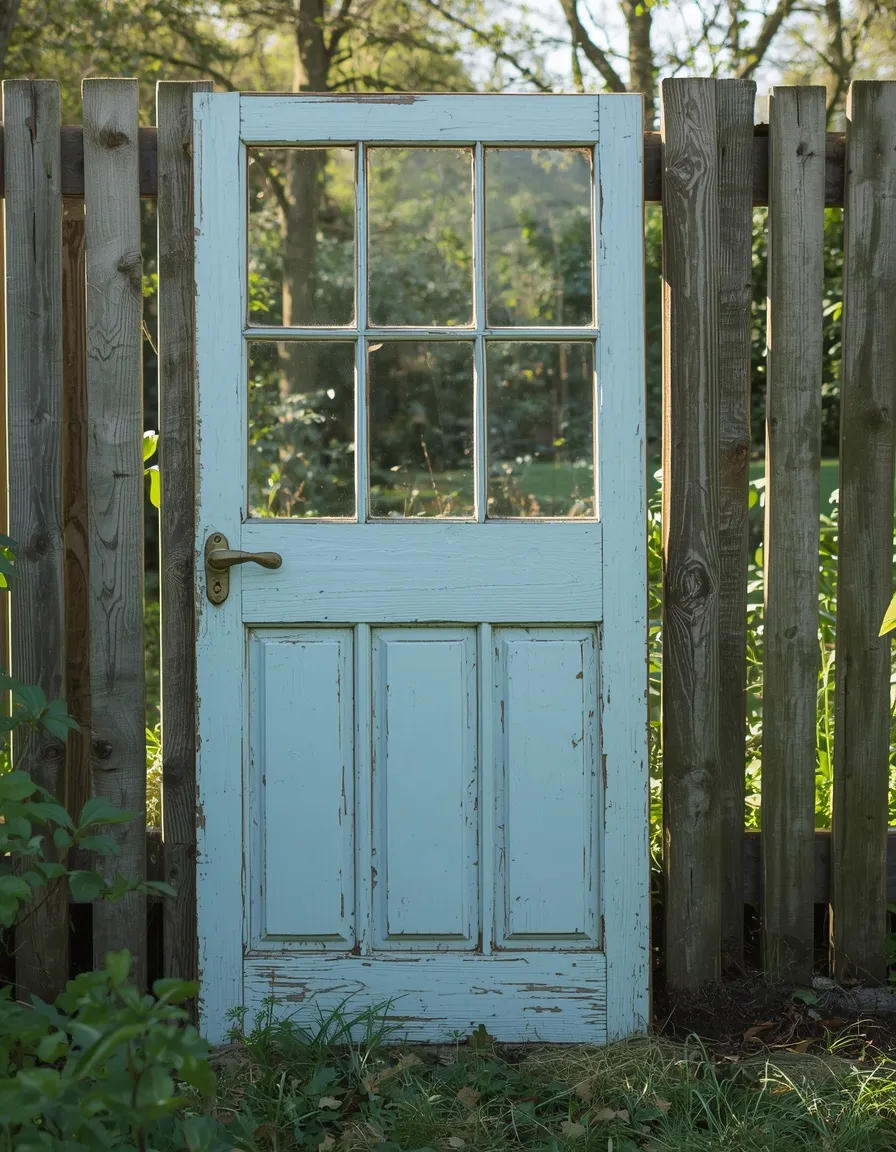
13. Upcycled Window or Door Gate
An old window sash or a salvaged interior door, hung sideways or fitted with new hardware, turns a garden gate into a genuine conversation piece. Chippy original paint, mismatched panes, or vintage hardware left intact give this idea a whimsical, collected-over-time character that a brand-new build cannot replicate, and it works especially well in cottage, eclectic, or artist’s-garden settings.
Reinforce the back of an old window frame with a simple wood batten cross-brace before hanging it, since original glazing putty and joints were never designed to handle the weight and movement of a swinging gate. If the window still has glass, replace it with clear acrylic or simply remove the panes entirely and leave the frame open, both for safety and to reduce weight on the hinges. Choose salvage with a weathered, worn finish already in place, since new paint over old wood rarely captures the same authentic texture.
- Creates a genuinely one-of-a-kind entrance no catalog gate can match
- Suits cottage, eclectic, and creatively styled gardens over formal ones
- Solves the problem of every garden gate on the street looking the same
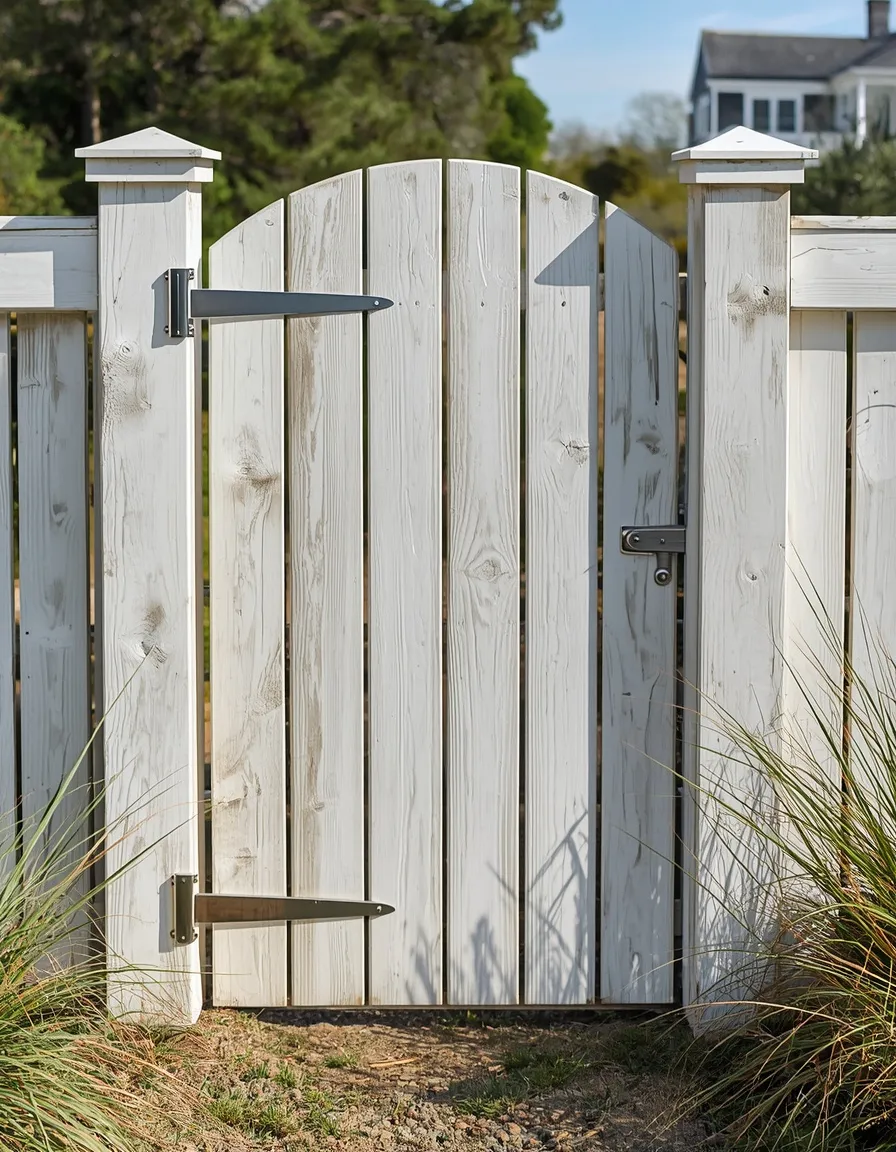
14. Coastal Whitewashed Driftwood Gate
A gate built from driftwood-toned, whitewashed timber captures a relaxed, beach-house feel that suits coastal gardens, seaside cottages, and any outdoor space styled around a soft, sun-bleached palette. Irregular board widths and a pale, washed finish give the impression of wood shaped by salt air and sun rather than a straight lumber-yard cut, even when the boards themselves are new.
Achieve the look with a whitewash technique rather than solid paint: thin white or off-white exterior paint roughly 1 part paint to 1 part water, brush it on, then wipe back with a rag while wet so the natural wood grain still shows through. In genuinely coastal climates, choose a rot- and salt-resistant species such as cedar or teak, and use stainless steel or marine-grade hardware for hinges and latches, since standard galvanized fittings corrode noticeably faster within a few hundred meters of the ocean. Reapply the whitewash every one to two years, as salt air accelerates fading more than an inland garden would experience.
- Suits coastal, seaside, and beach-house style gardens specifically
- Uses a technique, not just a color, so the wood grain stays visible
- Solves the problem of standard paint finishes wearing unevenly in salt air
15. Bamboo Privacy Screen Gate
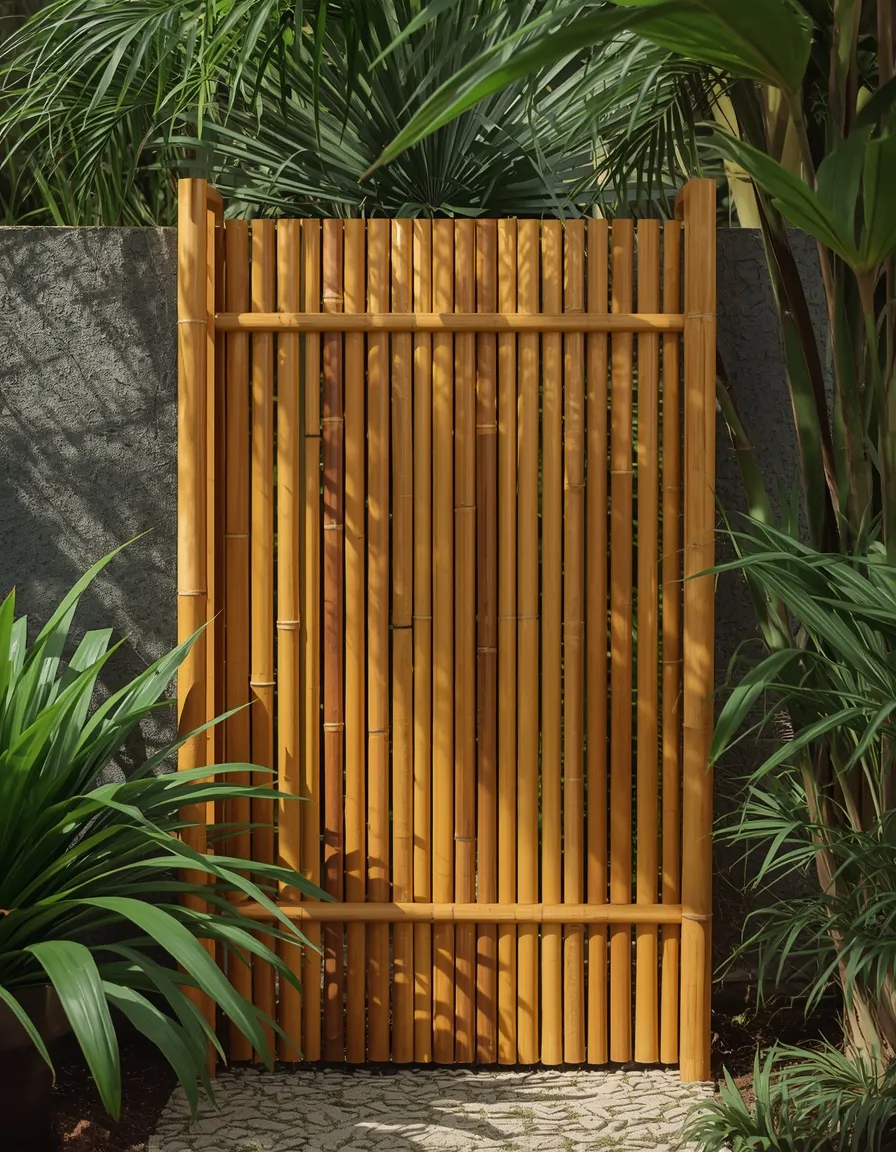
Densely spaced bamboo poles or woven bamboo panels create a natural, textural privacy screen that suits tropical, coastal, and Asian-influenced garden styles far better than a solid timber panel would. The warm, golden tone and slightly irregular pole widths give the entrance a relaxed, organic feel, and bamboo’s fast growth as a raw material also makes it a genuinely renewable choice compared to slower-growing hardwoods.
Mount bamboo poles onto a hidden internal timber or metal frame rather than relying on the bamboo itself for structural strength, since individual canes are not rigid enough to carry hinge and latch loads reliably on their own. In climates with significant rainfall, treat the bamboo with a borax-based preservative or exterior sealant before installation, since untreated bamboo is genuinely prone to splitting and mold in consistently damp conditions. Space poles tightly, with minimal gaps, for a true privacy screen, or loosely for a more open, dappled-light effect depending on how enclosed you want the entrance to feel.
- Suits tropical, coastal, and Asian-inspired garden styles particularly well
- Offers a renewable material alternative to slower-growing hardwood options
- Solves the problem of wanting privacy without a heavy, solid-feeling panel
Statement and Architectural Garden Entrances
The final group leans into gates as genuine architecture, permanent, often larger-scale features built to anchor a property’s entrance for decades rather than a single design season.
16. Wrought Iron Scrollwork Gate
Hand-forged or cast scrollwork, curling vines, fleur-de-lis finials, or classic loop patterns, gives a wrought iron gate an old-world elegance that timber simply cannot replicate. It suits period homes, formal front gardens, and estate-style entrances where the gate is meant to read as a permanent architectural statement rather than a seasonal decorative choice.
Wrought iron gates are genuinely heavy, often 40 kilograms (roughly 90 pounds) or more even at modest sizes, so the supporting posts need to be set in concrete footings rather than simply driven into soil, and the hinges must be rated for that specific load. This is one of the few ideas on this list where professional installation is worth the added cost, since an improperly hung iron gate can sag, drag, or pull its posts out of alignment within a year. A factory powder coating or a properly applied rust-inhibiting primer and topcoat will outlast standard spray paint by years, particularly in humid or coastal regions.
- Suits period, formal, and estate-style properties as a permanent feature
- Offers intricate detail that timber gates cannot achieve at the same scale
- Solves the problem of a front entrance needing to feel established, not temporary

17. Gothic Arched Iron Gate
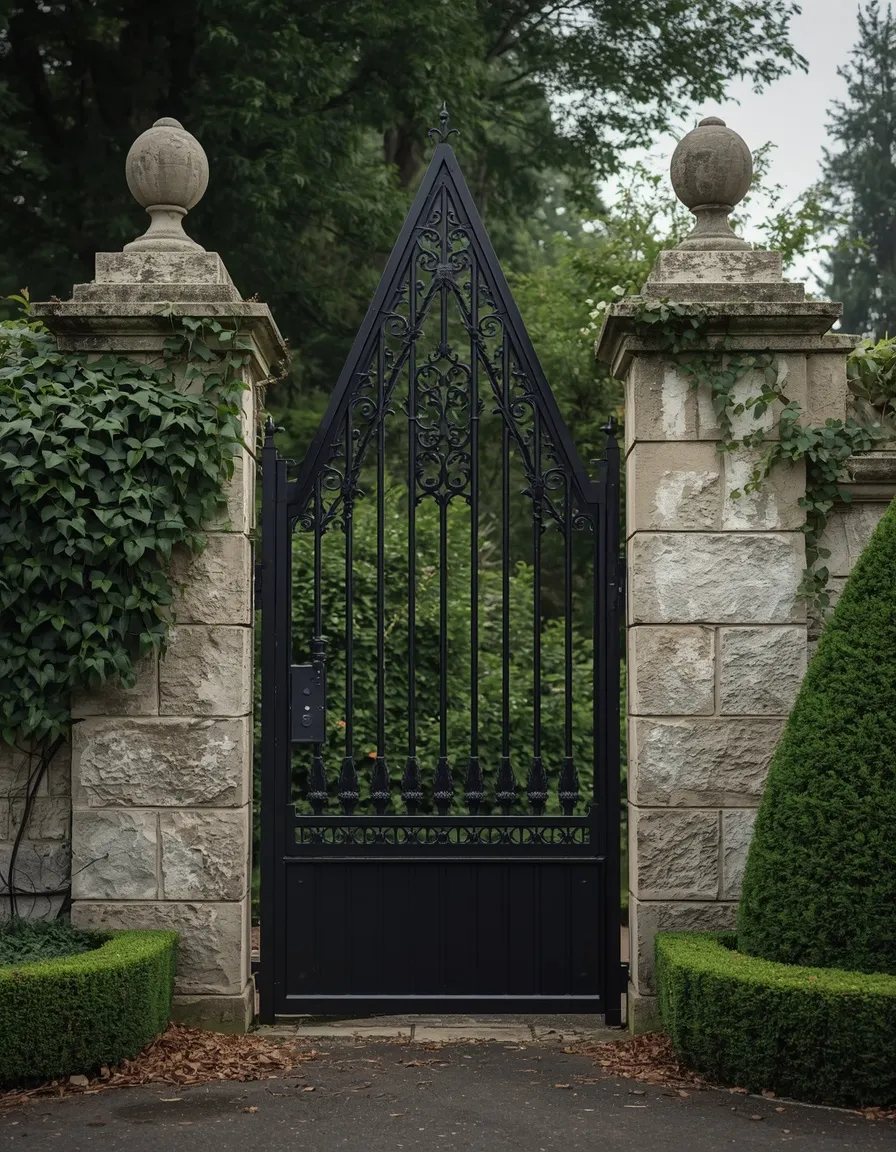
A tall, pointed gothic arch, rather than the shallow curve of a cottage gate, gives an entrance genuine drama and vertical presence, particularly on properties with mature trees, stone walls, or a Victorian-era house to match. The steep arch draws the eye up rather than across, making even a modestly sized garden entrance feel taller and more imposing than it actually is.
Because the gothic arch shape concentrates visual weight at the top, balance it with a solid, wide base, either substantial stone or brick pillars, or heavily built timber posts, so the gate does not look top-heavy against its supports. Detail work such as finials, cross bars, or a central medallion should stay proportional to the gate’s overall height; oversized ornamentation on a modest garden gate tends to look costume-like rather than architectural. This style pairs best with equally traditional planting nearby, clipped boxwood, climbing roses, or ivy-covered stone, rather than a loose, informal cottage border.
- Adds genuine vertical drama to period, Victorian, and stone-wall properties
- Makes a modest-sized entrance feel taller and more established
- Solves the problem of a gate reading as decorative rather than architectural
18. Gate with Overhead Arbor Topper
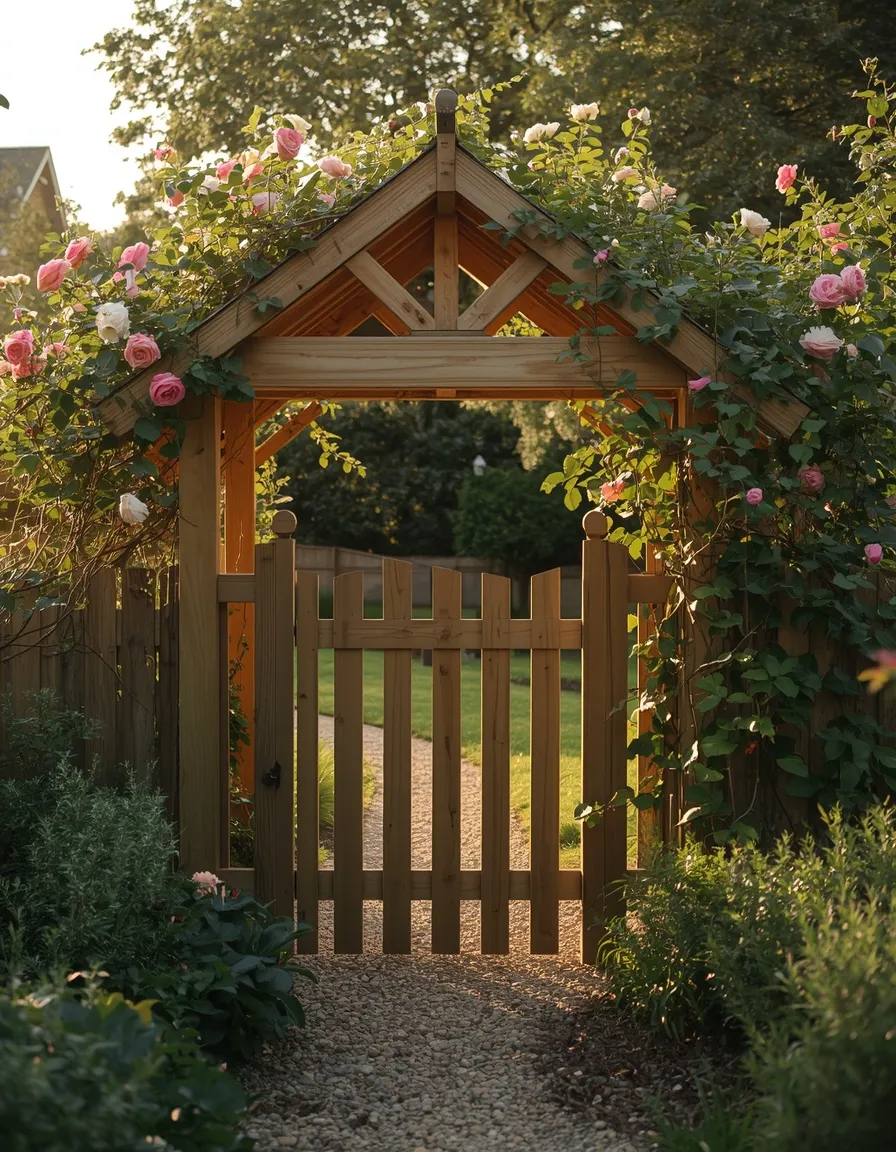
Adding a wooden or metal arbor structure above the gate itself turns a simple opening into a genuine entrance moment, framing whoever walks through with an overhead canopy rather than just a side-to-side barrier. This idea works particularly well at the transition between a driveway and a back garden, or as the formal start of a path leading toward a front door.
Because the arbor adds both height and, eventually, the weight of any climbing plants trained over it, the supporting posts need to be set at least 45 to 60 centimeters (18 to 24 inches) into concrete footings, not simply into loose soil, to resist wind load and prevent leaning over time. Build the arbor and gate as a single connected structure rather than two separate builds fixed together after the fact, since a gate hinged directly to an arbor post carries stress differently than one hinged to a standalone fence post. Leave the top of the arbor open initially and let climbing plants fill it in gradually, rather than starting with dense planting that adds unplanned weight before the structure has fully cured and settled.
- Creates a genuine “entrance moment” rather than just a gap in a fence
- Suits driveway-to-garden transitions and formal front path starts
- Solves the problem of a gate feeling like a barrier rather than a welcome
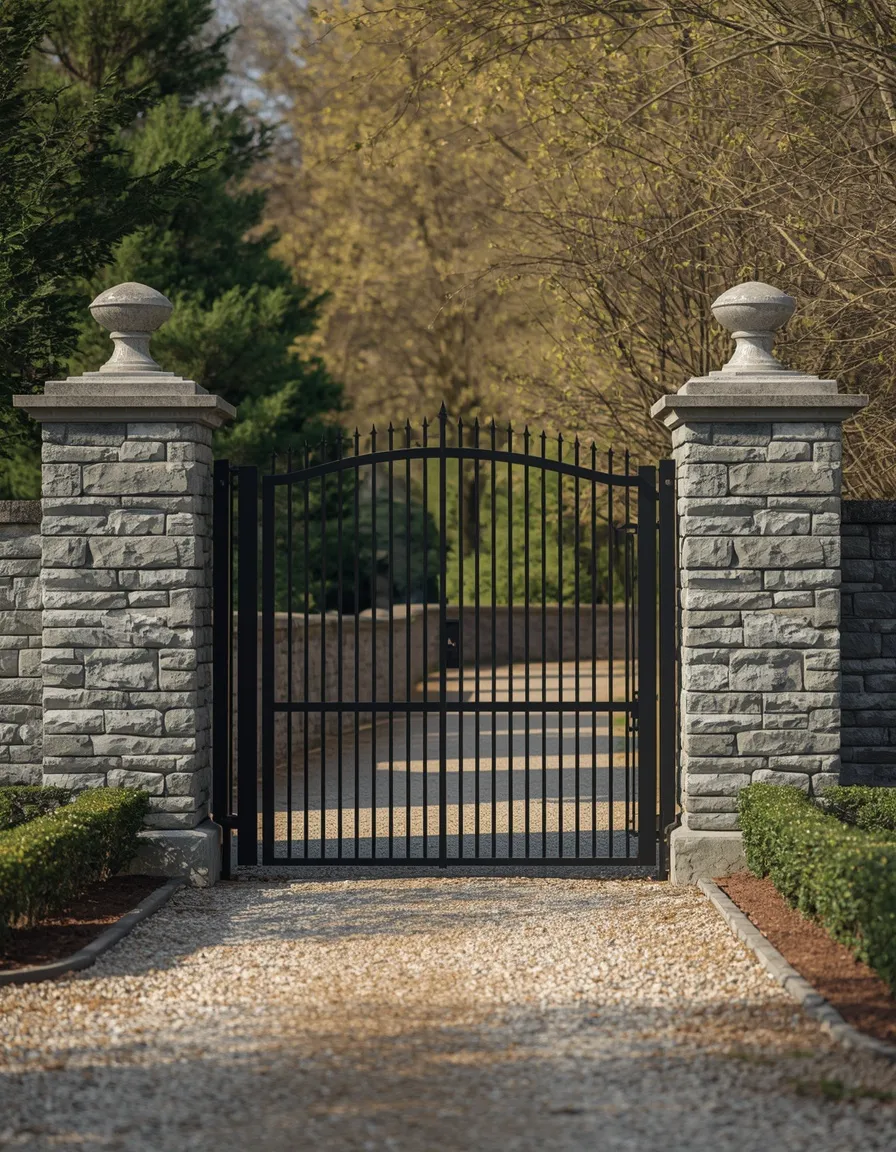
19. Stone Pillar Flanked Entrance Gate
Flanking a gate with substantial stone or brick pillars gives even a relatively simple gate panel a sense of permanence and formality, since the hardscaping does most of the visual heavy lifting. This idea suits properties with existing stone walls, brick facades, or gravel driveways, where matching or complementary masonry ties the new entrance into the rest of the property’s materials.
Keep the gate panel itself relatively restrained, simple wood boards or plain iron bars, so it does not compete visually with the pillars; the strongest versions of this idea treat the masonry as the star and the gate as a supporting element. Cap each pillar with a stone or precast concrete cap that overhangs slightly on all sides, which sheds rainwater away from the masonry joints and significantly slows long-term weathering and moss growth. Because pillar construction is genuinely structural masonry work, involving a mason for the footings and coursing is worth the investment, even if the gate panel itself is a straightforward DIY build.
- Suits properties with existing stone, brick, or gravel materials to match
- Gives even a simple gate panel a sense of formality and permanence
- Solves the problem of a lightweight fence gate looking flimsy at the entrance
20. Sliding Barn-Style Garden Gate
A sliding gate that rolls along a horizontal track, rather than swinging on hinges, solves a very specific problem: narrow paths, tight driveways, or gate openings where a swinging arc would hit a car, a planting bed, or a wall. Styled with visible board-and-batten construction and exposed black steel hardware, it borrows directly from classic barn door design and reads as intentional rather than purely functional.
The gate needs to overlap its opening by at least 5 to 10 centimeters (2 to 4 inches) on each side once fully closed, so measure the finished gate width accordingly rather than cutting it to the exact opening size. Mount the track hardware to a genuinely solid header, either a reinforced fence post or a dedicated support beam, since the entire weight of the gate hangs from the rollers rather than being distributed across ground-level hinges. A floor guide or bottom track at the base keeps the gate from swinging outward in wind, which is a common frustration with sliding gates installed without one.
- Solves the specific problem of a swing gate arc hitting a car or path
- Suits narrow side entries, tight driveways, and modern farmhouse styling
- Works well where a swinging gate simply will not physically fit
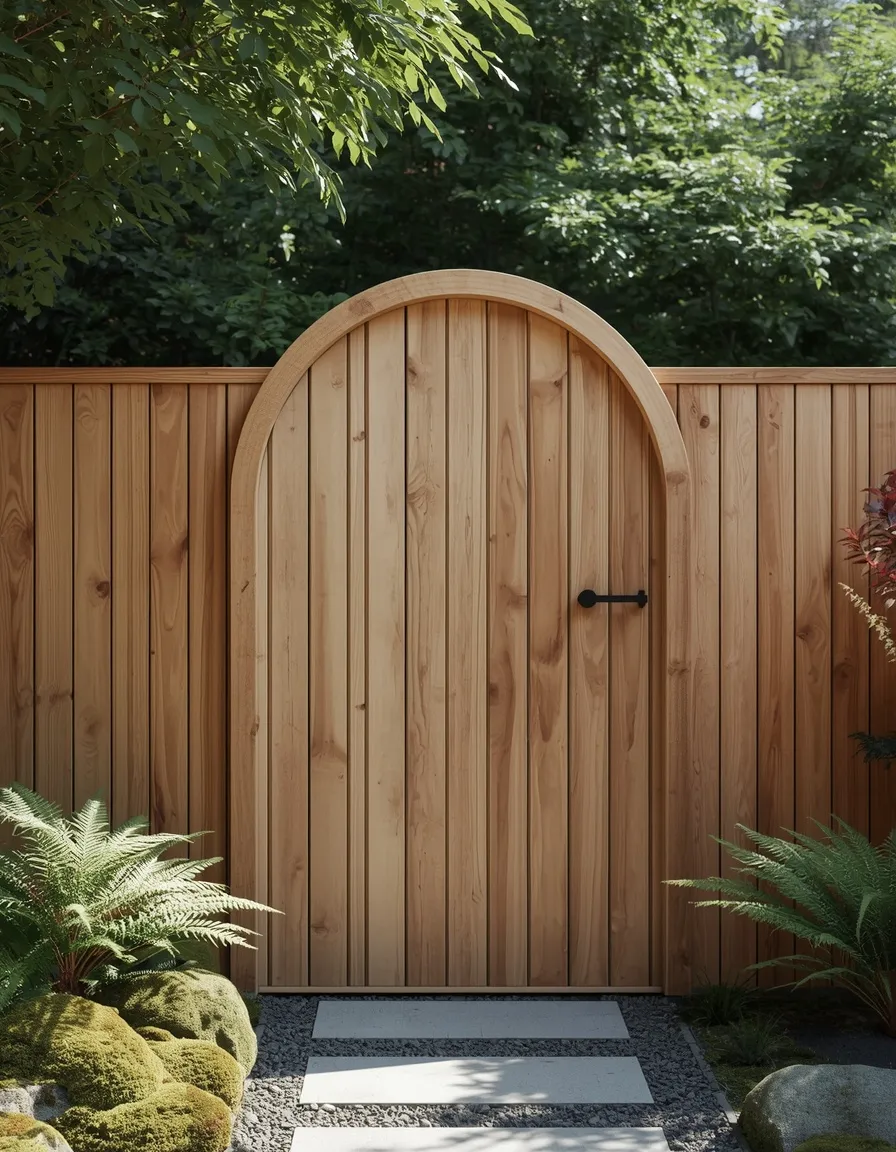
21. Moon-Inspired Curved Timber Gate
A gate built with a gently curved or arched top, echoing the circular form of a traditional moon gate without committing to a full circular opening, brings a quiet, meditative quality borrowed from Asian garden design into a more conventional Western layout. The curve is subtler than a full moon gate structure, making it an approachable way to reference that style within an existing fence line rather than building a freestanding circular feature.
Cut the curve from laminated timber strips rather than a single solid board, which resists warping far better as the wood expands and contracts with humidity and temperature changes over the seasons. Pair the gate with simple, restrained planting nearby, moss, ferns, or clipped evergreens, rather than a busy cottage-style border, since the calm of this style depends on visual restraint around it. For a deeper look at the fully circular version of this concept, including how it works as a freestanding garden feature rather than a fence gate, see Sunday Abode’s guide to moon gate garden design.
- Introduces a quiet, Asian-inspired design element without a full structural rebuild
- Suits meditation gardens, Zen-influenced spaces, and minimal planting schemes
- Solves the problem of wanting a moon gate’s calm feeling within a standard fence
Conclusion
A garden gate carries more visual weight than its size suggests, and the right choice among these garden gate ideas can genuinely change how a whole property feels from the street or the driveway. Whether the goal is a weekend paint refresh on an existing gate, a full DIY build from reclaimed or pallet wood, or a professionally installed wrought iron entrance, the details that matter most stay consistent: rot-resistant materials, hardware rated for the gate’s actual weight, and a style that speaks to the fence, path, or planting around it rather than standing apart from it. For more garden design inspiration to carry that same thinking through the rest of the outdoor space, explore Sunday Abode’s Garden Design category. Pick the idea that matches your climate, skill level, and budget, then give it a proper foundation, literally and stylistically, so it holds up for years rather than one season.
Frequently Asked Questions
What is the cheapest way to add a new garden gate idea to my yard?
Repurposing what you already have costs the least: painting an existing plain gate in a bold color, or building a simple frame from disassembled pallet wood, both cost little more than hinges, a latch, and finishing materials. Salvaged windows, doors, or fencing from an architectural reclamation yard are another low-cost route that also adds character a brand-new gate cannot replicate.
What is the best wood for a garden gate?
Cedar, redwood, and pressure-treated pine are the most reliable choices, since all three resist rot and insect damage better than untreated softwoods like standard pine or fir. Cedar and redwood also weather to an attractive silver-gray tone naturally, which suits rustic and coastal styles that do not need repainting to still look intentional.
How do I keep a wooden garden gate from sagging?
A diagonal brace running from the bottom hinge corner to the top latch corner is the single most effective fix, since it resists the racking force that pulls square frames out of shape over time. Pairing that brace with a heavy-duty strap hinge, rather than a small decorative one, and making sure gate posts are set in concrete rather than loose soil, addresses the two other most common causes of sagging.
What height should a garden gate be?
Decorative garden gates that simply mark a boundary or frame a path typically sit between 90 and 120 centimeters (roughly 3 to 4 feet) tall, matching a low picket or post-and-rail fence. Gates intended for privacy or added security are usually built taller, from 150 centimeters upward, though local regulations in some areas restrict front-yard fence and gate height, so it is worth checking before building a tall gate near a street-facing boundary.
Can I paint or repaint a metal garden gate?
Yes, and it is one of the most effective low-cost updates on this list, provided the surface is properly prepared first. Remove any rust with a wire brush, apply a rust-inhibiting metal primer, then finish with an exterior metal enamel in two thin coats, working in a well-ventilated outdoor space away from direct sun so the paint does not dry too quickly and show brush marks.
What is a good garden gate idea for a small yard, balcony, or rental?
A small decorative gate panel set into an existing railing, or a simple trellis-style frame gate trained with a fast-growing annual climber, both deliver the visual effect of a garden gate without requiring permanent structural changes. Many of these can be attached with removable brackets or weighted planters rather than fixed posts, which makes them realistic options for renters who cannot alter the property permanently.
How do I choose a garden gate style to match my fence or house?
Start with the material already dominant on the property, brick, stone, painted timber cladding, or render, and choose a gate that either matches it directly or deliberately contrasts in a considered way, such as black metal against warm brick. Matching the gate’s formality to the house helps too: a period or traditional home generally suits wrought iron or classic picket styles, while a contemporary build suits clean slat or minimalist metal designs better than ornate scrollwork.