

Introduction
A tangle of cucumber vines sprawled across bare soil is how most gardens lose half their harvest to slugs, mildew, and fruit that turns into a baseball bat before anyone spots it in the leaves. Cucumber trellis ideas fix that by lifting vines into open air, where foliage dries faster, fruit hangs straight, and picking takes seconds instead of a search through tangled growth. This guide moves past the usual grab a tomato cage advice, covering genuinely distinct builds, from a walk through cattle panel arch to a repurposed headboard leaning against a cottage fence, sized for raised beds, containers, and tight balconies alike. Whatever the space, a small patio or a full backyard plot, there is a structure here that fits, in keeping with the practical, good looking approach found across Sunday Abode.
Cucumber Trellis Ideas for Raised Beds and In-Ground Rows
These builds work best for raised beds or open garden rows, where posts can be driven at least 12 inches (30 cm) into the soil for real stability. According to University of Maryland Extension, training cucumber vines onto a trellis keeps fruit off the ground, improves airflow around the leaves, and produces straighter, cleaner fruit than vines left to sprawl.
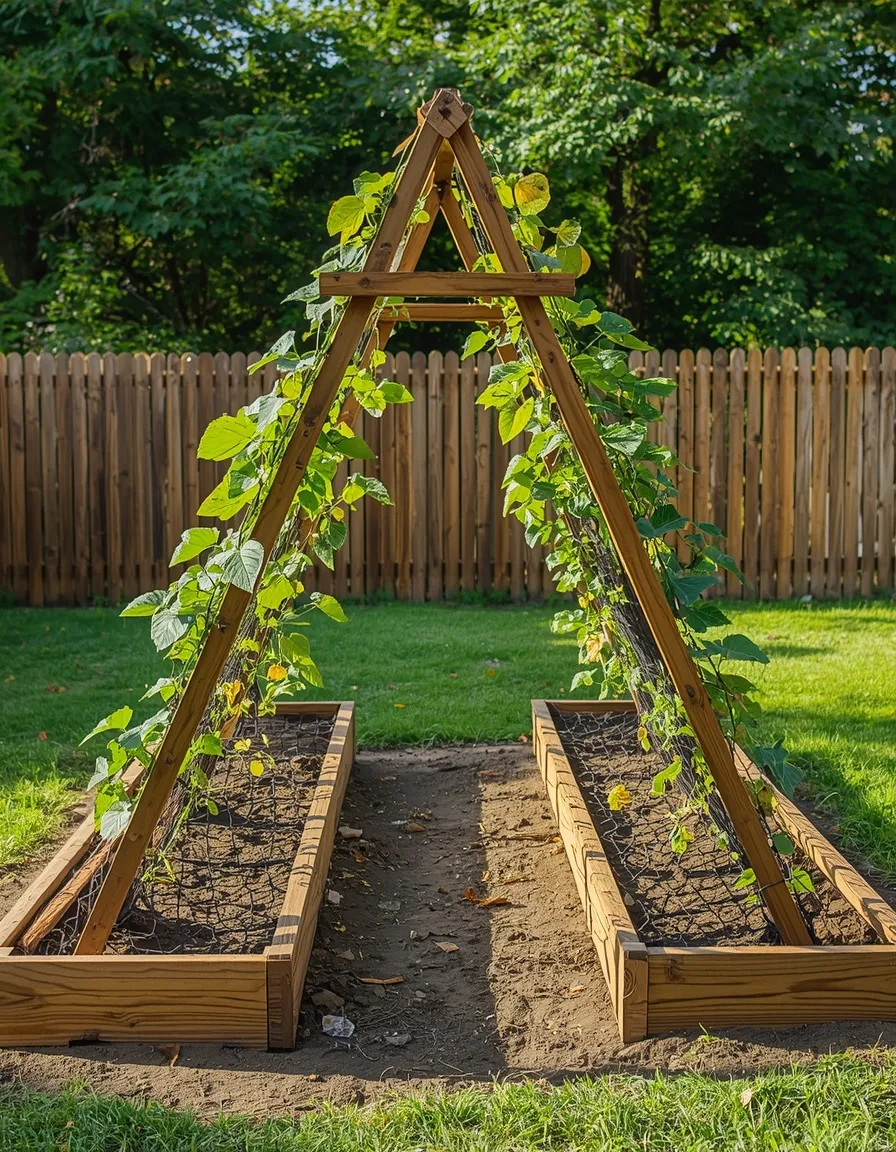
1. A-Frame Wood Trellis
A pair of hinged wooden frames leaning together into an upside-down V turns a straight raised bed row into its own small tunnel of vines, with cucumbers dangling cleanly on the inside where they are easy to spot at a glance.
Build two identical ladder frames from cedar or pressure-treated 2×2 lumber, roughly 5 to 6 feet (1.5 to 1.8 m) tall, then join them at the top with a single bolt so the whole structure hinges open and folds flat for winter storage. Staple wood lattice or nylon garden netting across each frame for the vines to grip. Straddle the trellis directly over a raised bed row and give each side at least 3 feet (90 cm) of base width; a narrower frame crowds mature vines and blocks the airflow that keeps powdery mildew in check.
- Doubles usable growing space by climbing both sides of the frame
- Folds flat between seasons for easy storage
- Keeps fruit visible and easy to harvest from either side
2. Cattle Panel Arch Tunnel
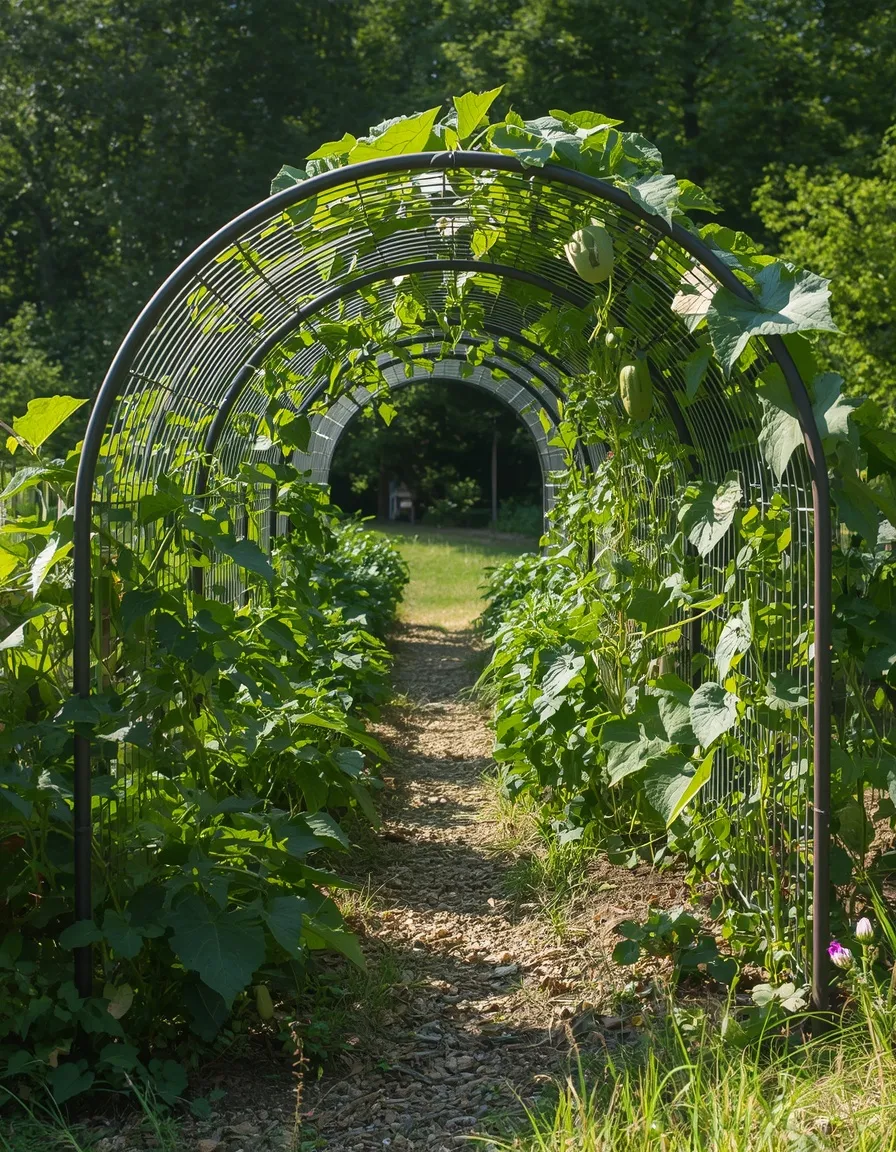
Bend a livestock cattle panel into a tall arch over a garden path and cucumbers become a walk-through experience, with fruit hanging down inside the tunnel at a comfortable, no-bending picking height.
Use a 16-foot by 50-inch (4.9 m by 1.27 m) galvanized cattle panel and curve it into a U-shape between two rows of T-posts spaced about 4 feet (1.2 m) apart, then attach the panel to the posts with wire or zip ties. Drive each T-post at least 12 inches (30 cm) into the ground, since a mature vine load plus summer wind can shift a shallow-set post. Plant cucumbers along both outer edges of the arch for the best yield per square foot of garden space. Wear sturdy gloves when bending and attaching the panel, since cut wire edges are genuinely sharp.
- Creates a shaded, walk-through harvesting tunnel
- Galvanized steel holds up for years without rusting through
- Ideal for a full garden row or a decorative entry feature
3. Corner Trellis for Raised Beds
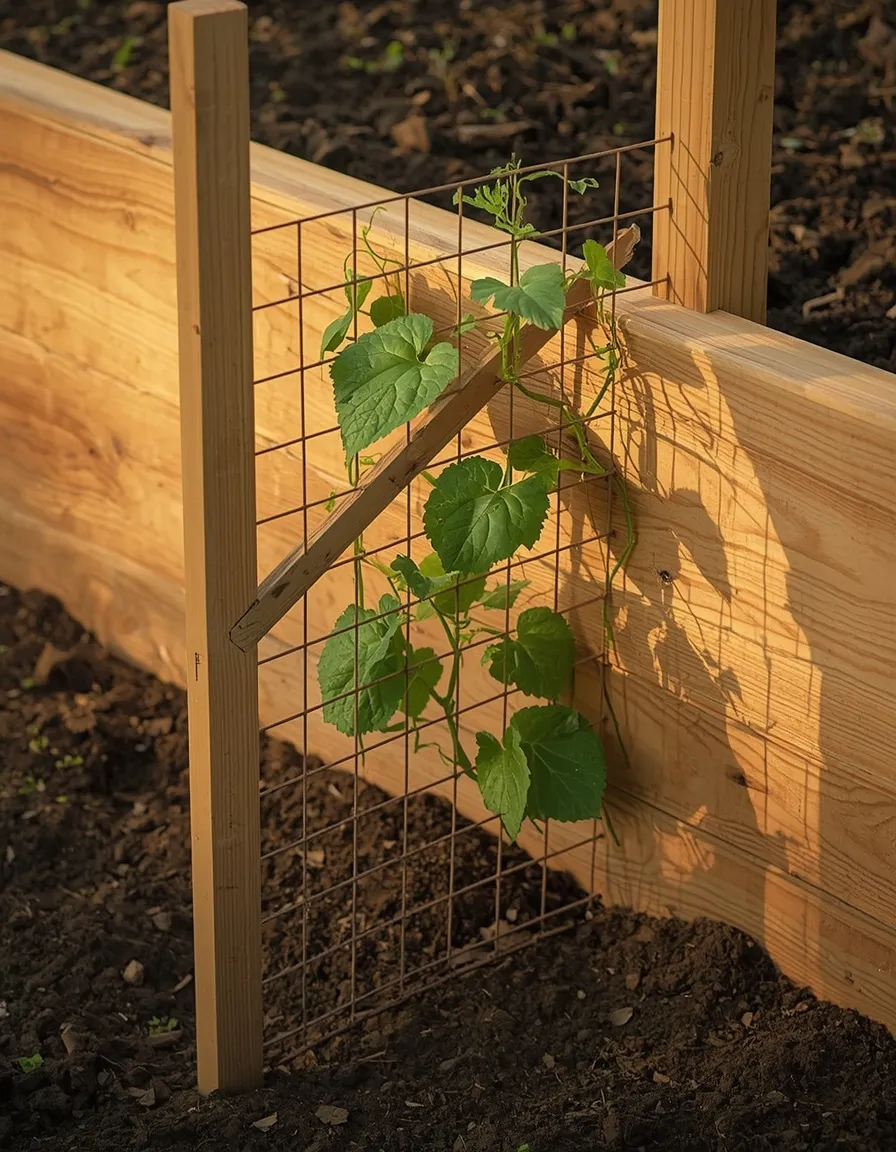
A raised bed rarely has room for a full-width trellis, but the corner is almost always free, and that is exactly where a diagonal panel earns its keep without stealing space from neighboring crops.
Set two short stakes or a simple L-shaped wood frame diagonally across one corner of the bed, then stretch wire mesh or netting between them at roughly a 45-degree angle. Track the sun’s path across the bed before building, and angle the panel so the cucumbers get full sun without throwing shade over shorter, sun-loving crops like peppers or herbs planted nearby. This works especially well in square-foot or small raised beds, where every inch is already assigned to something else.
- Uses otherwise wasted corner space in a small bed
- Avoids shading the rest of the bed when angled correctly
- Simple to build with minimal materials and cost
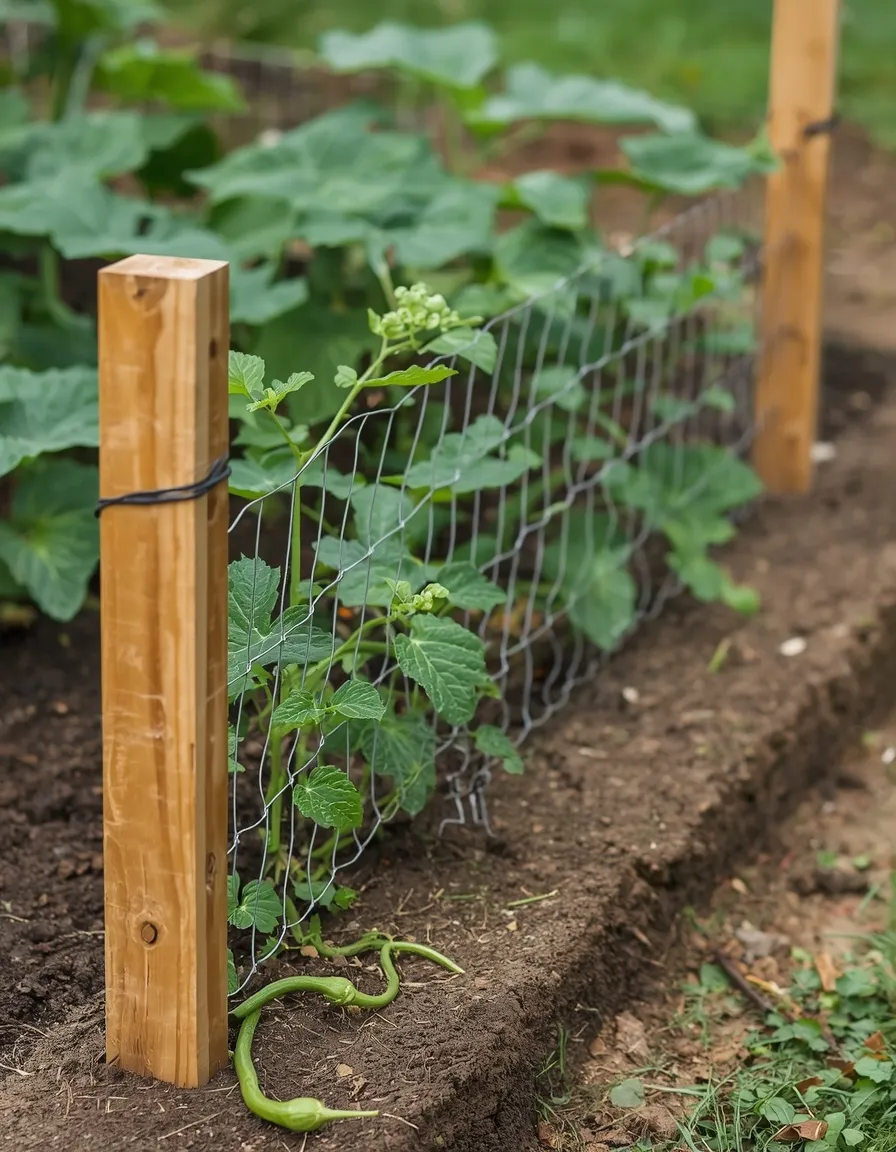
4. Chicken Wire Garden Panel
A roll of chicken wire stretched between two stakes is about as low-effort as a trellis gets, and it still does the one job that matters most: getting the vines up off the soil.
Unroll a 4-foot (1.2 m) section of chicken wire or hex netting and staple it to two sturdy stakes or a simple wood frame set along the edge of the bed. Choose wire with roughly 2-inch (5 cm) openings so developing fruit does not get trapped inside the mesh as it swells. Add a wood top rail across the frame if the wire starts to sag under vine weight partway through the season; without one, the panel bows forward and loses its shape by midsummer.
- One of the cheapest trellis builds to put together
- Small openings still let tendrils grip easily
- Works well as either a temporary or semi-permanent fixture
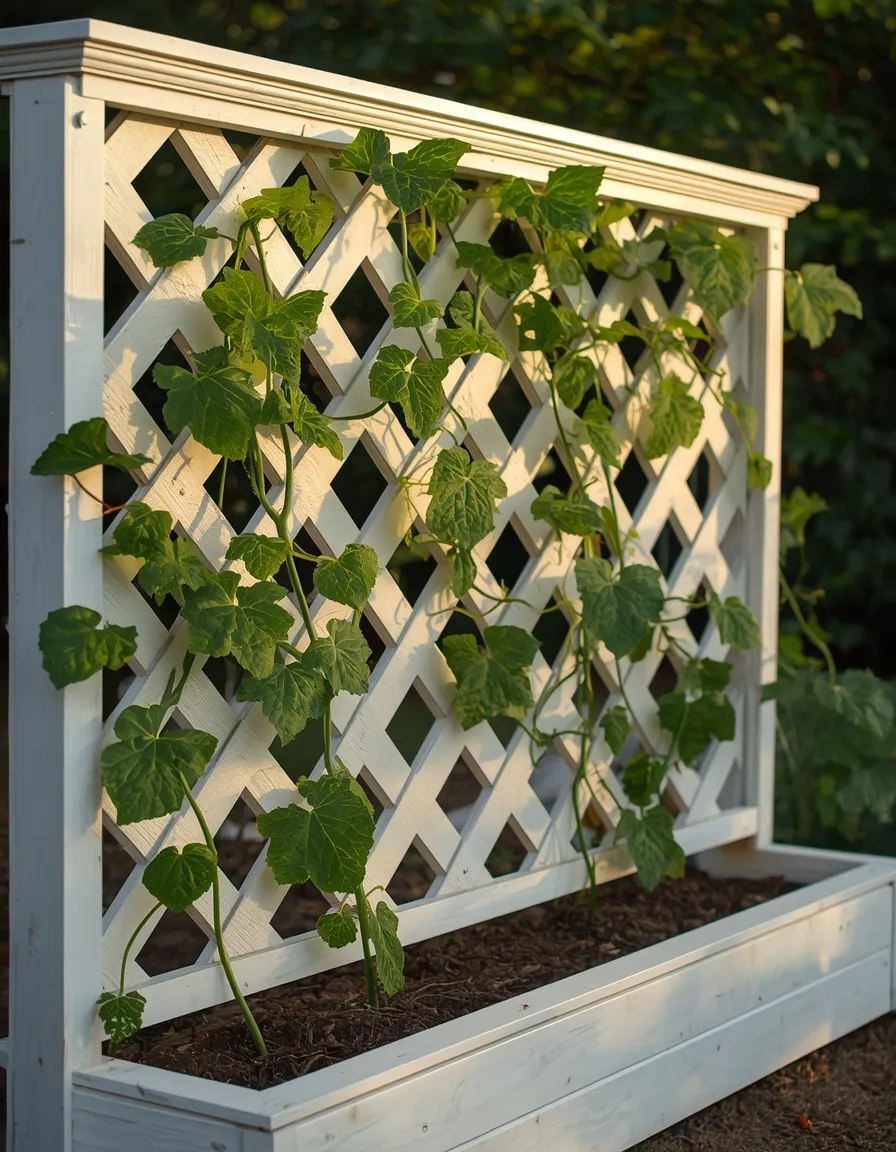
5. Wooden Lattice Panel Trellis
A classic diamond-pattern lattice panel gives a raised bed the polished, finished look of an established garden from the very first season, not just a support structure bolted on as an afterthought.
Mount a pre-made lattice panel inside a simple 2×4 frame, either fixed to an existing fence or freestanding on two buried posts along the bed’s edge. Seal or paint the wood before installing it; lattice left raw tends to warp and split after a single humid growing season. Choose a panel with 2 to 3 inch (5 to 7 cm) diamond openings, since tighter patterns trap vines and make them difficult to untangle at cleanup time.
- Adds finished, decorative structure to a working vegetable bed
- Sealed wood holds up through a full humid growing season
- Can double as support for beans or peas in crop rotation
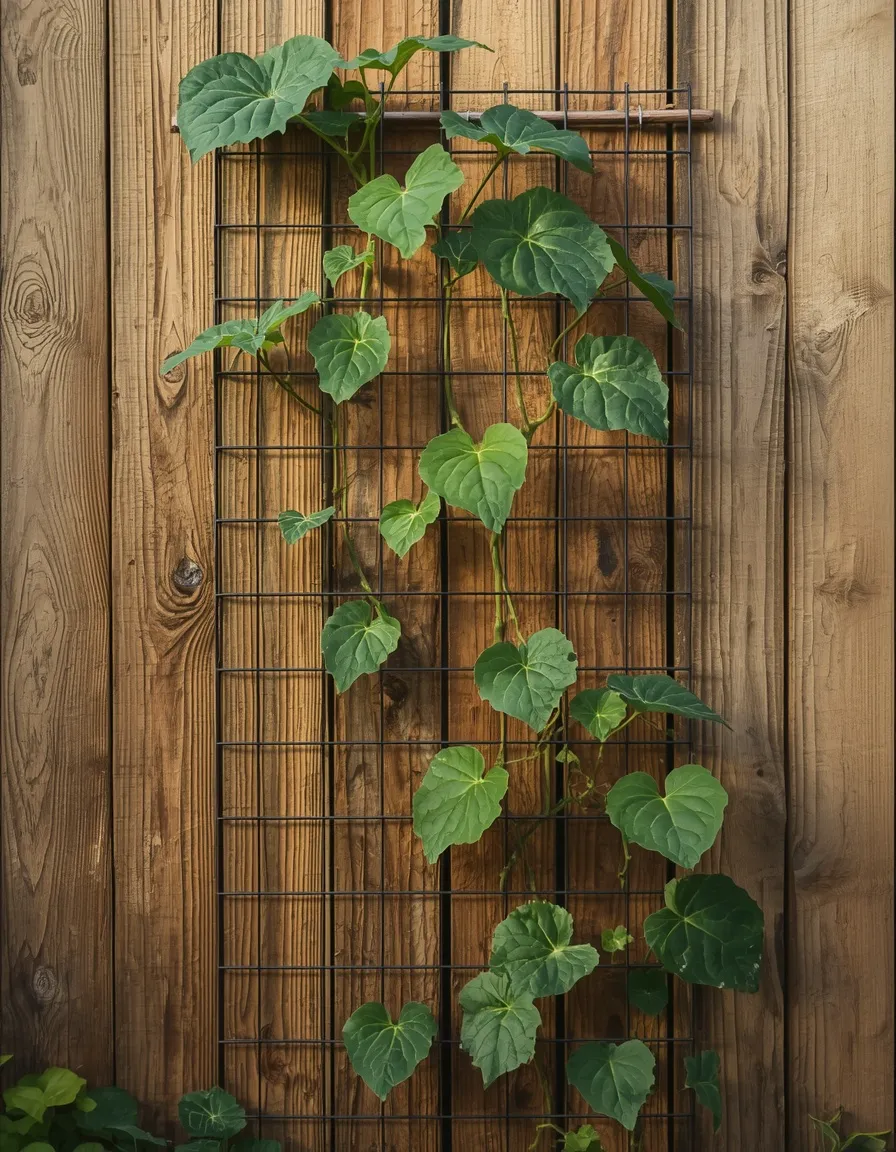
6. Hog Wire Fence-Mounted Trellis
If a fence line already runs along the edge of the garden, it is most of a trellis already, needing only a wire panel and a little standoff space to become a proper climbing surface.
Mount a section of hog wire or leftover cattle panel flat against the existing fence, using spacers or short wood blocks to hold it 2 to 3 inches (5 to 7 cm) off the fence surface. That gap matters more than it looks: mounting the wire flush against a solid fence blocks airflow behind the leaves, which cancels out much of the disease-reduction benefit of trellising in the first place. This setup suits permanent garden borders and property-line plantings, where the structure needs to last for years rather than a single season.
- Reuses an existing fence instead of building new posts
- Standoff spacing keeps airflow moving behind the foliage
- A durable, long-term option for permanent garden beds
Cucumber Trellis Ideas for Pots, Containers, and Small Spaces
Container growing does not rule out vertical cucumbers, it just changes the math: the structure needs to be lightweight, sized to the pot, and anchored well enough that a loaded vine will not tip the whole thing over in a gust of wind.
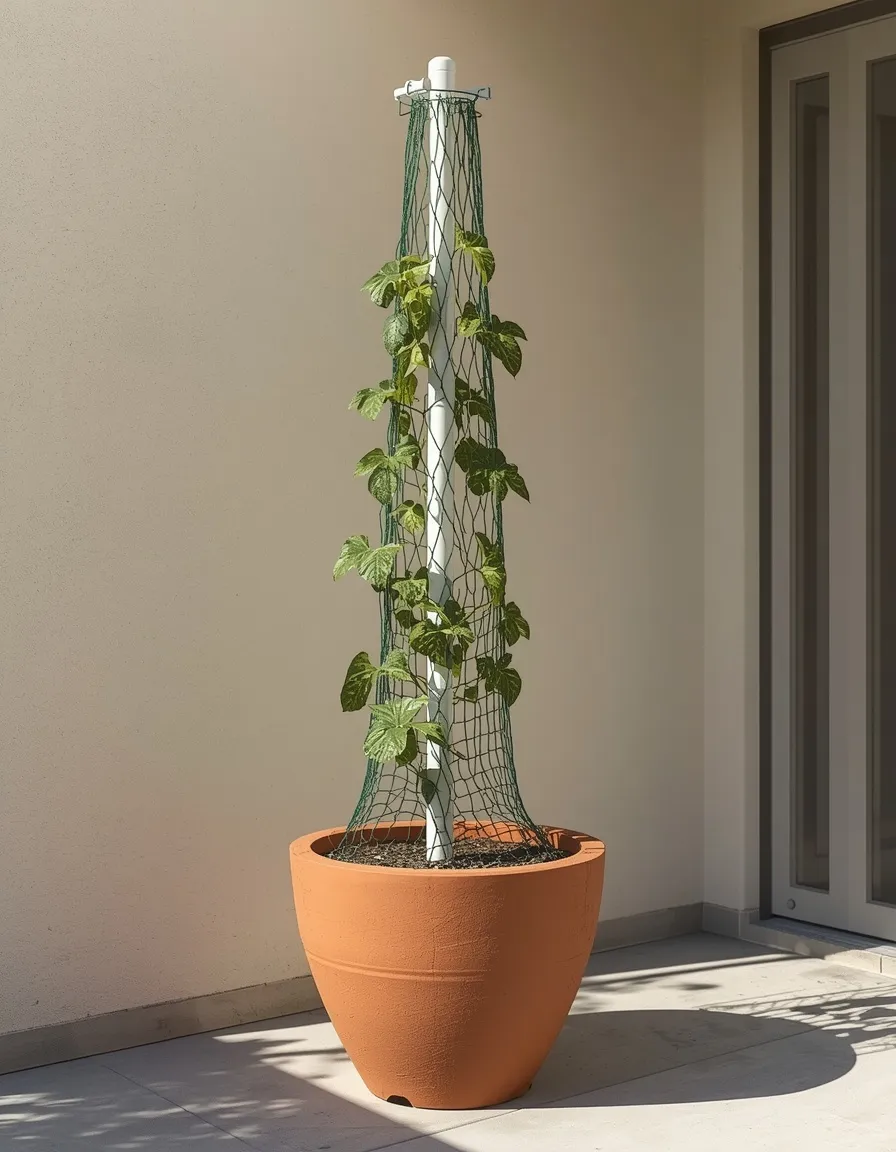
7. PVC Pipe Obelisk
A slim four-legged pyramid built from half-inch PVC pipe weighs next to nothing, which makes it the trellis of choice for a container that might need to move with the sun, or come indoors before a frost.
Cut PVC pipe into four legs and a handful of cross braces, then join them with elbow and tee fittings into a pyramid shape roughly 4 to 5 feet (1.2 to 1.5 m) tall. Wrap garden netting or twine around the frame for vines to grip. Skip the glue at every joint; leaving a few connections dry-fit lets the whole obelisk come apart flat for storage over winter. Use a container at least 16 inches (40 cm) across, since anything smaller gets top-heavy once the vines fill in.
- Lightweight enough to reposition or move indoors
- Disassembles flat for compact off-season storage
- Fits neatly into a single large container
8. Repurposed Tomato Cage Tower
An unused tomato cage already sitting in the shed solves a container cucumber problem for free, standing the wire cone upright to give a single pot’s vine something to climb from day one.
Choose the largest cage size available, around 42 inches (107 cm), since smaller cages run out of height fast once a vine gets going. Push the legs firmly into the container’s soil and, if the cage narrows toward the top, weave the growing tips gently through the rings rather than letting them bunch up at the point. This setup suits compact or bush-type cucumber varieties best; a vigorous vining cucumber will usually outgrow the cage by midsummer and need a taller structure added alongside it.
- Repurposes equipment most gardeners already own
- Ready to use immediately with no building required
- Best matched to bush and compact cucumber varieties
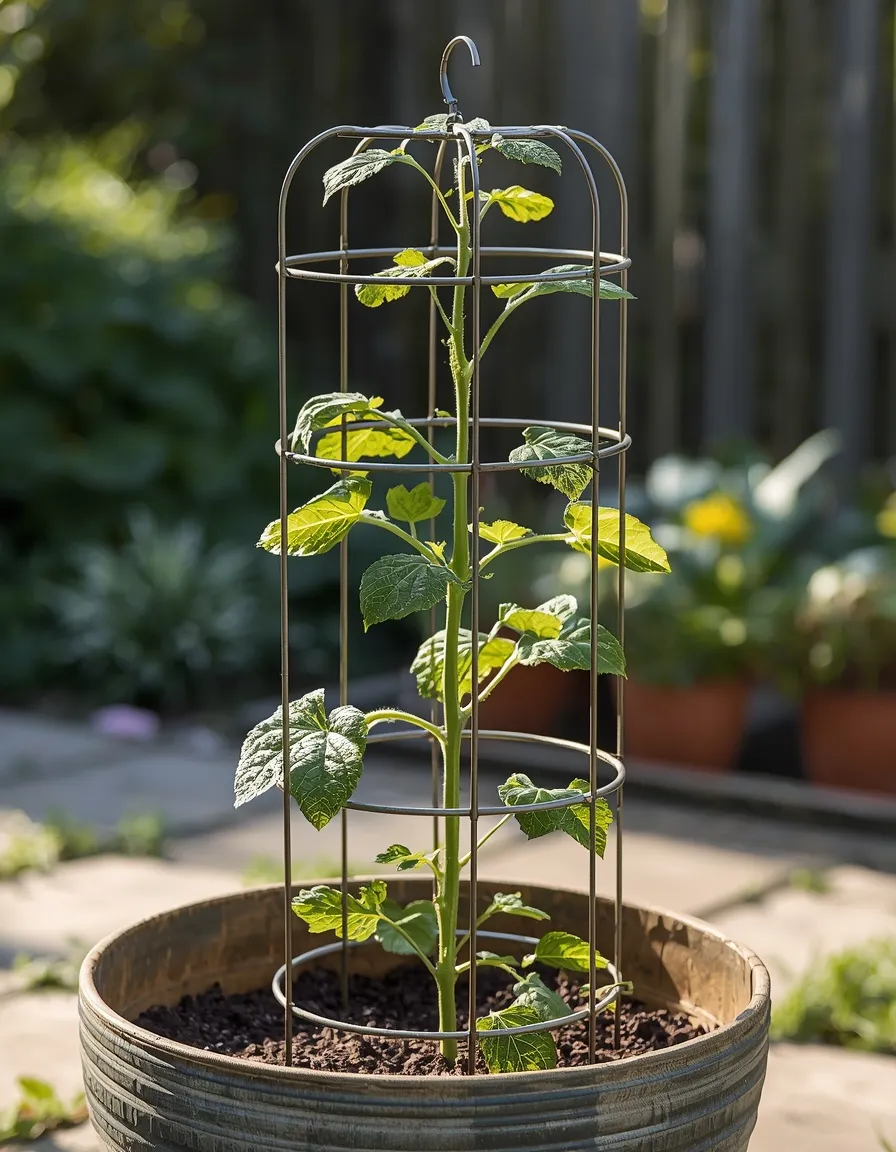
9. Hula-Hoop Teepee for Pots
Two or three plastic hula hoops stacked at different heights and connected by a ring of dowels turn a container into a playful, almost sculptural climbing frame, one that looks as good on a balcony as it works in the garden.
Set 4 to 6 bamboo skewers or thin dowels into the container soil in a circle, then tie a hula hoop horizontally around them near the base and another near the top, cinching each connection with garden twine so nothing shifts. Skip the top tie and the structure leans and loosens within a few weeks of vine weight; that connection is what holds the whole shape together. A quick coat of outdoor paint on the hoops helps the structure blend into a patio or balcony setting instead of looking like a leftover toy.
- A genuinely decorative option for patios and balconies
- Uses inexpensive materials most households already have
- Works well for two or three plants sharing one large pot
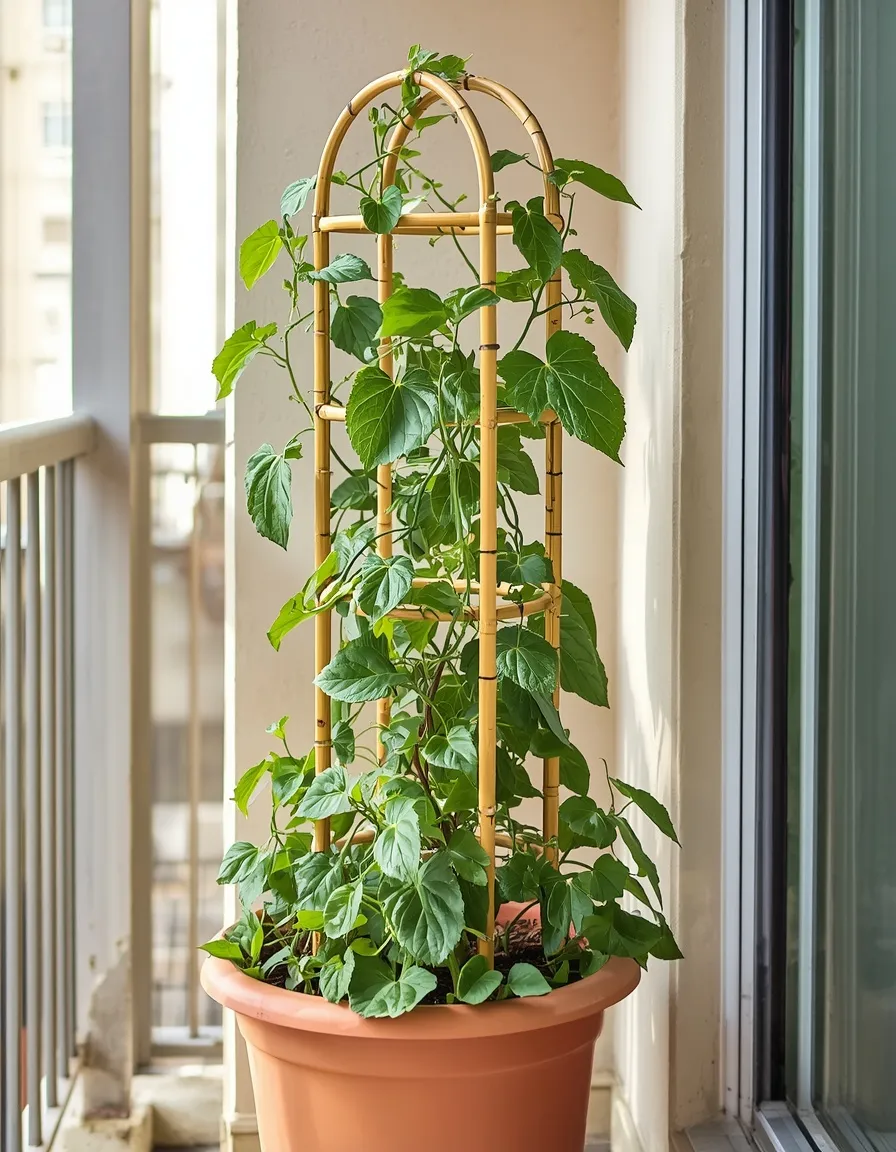
10. Bamboo Fan Trellis
Where a balcony railing or narrow side yard leaves no real depth to work with, a flat fan of bamboo canes solves the width problem without needing any floor space at all.
Cut bamboo canes to matching lengths and arrange them in a flat, fan-shaped spread, lashing each crossing point with twine so the canes hold their angle. Lean the finished fan against a wall, railing, or trellis bracket rather than freestanding it; the flat profile is not built to stand alone in wind. Keep the fan’s spread at least 3 feet (90 cm) wide at the top, since a narrower fan crowds vines onto the same few canes and makes training difficult later in the season.
- Needs almost no planting depth, ideal for tight balconies
- Inexpensive to build from a single bundle of bamboo canes
- Slim profile fits neatly against railings and narrow walls
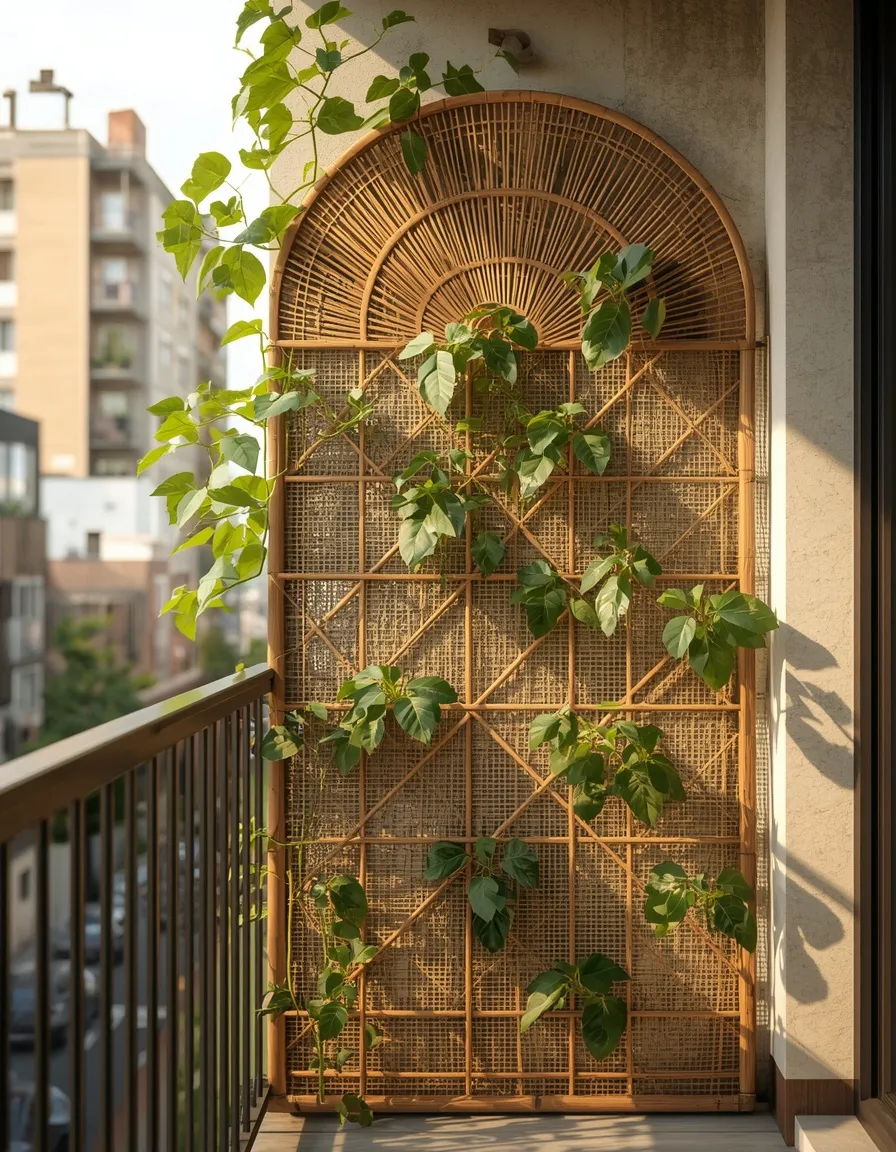
Budget-Friendly and Upcycled DIY Cucumber Trellis Ideas
None of the builds in this group need a trip to a specialty supplier. Most start with materials already sitting in a garage, a shed, or a curbside pile, which makes them a genuinely low-cost way to test whether vertical growing suits a bed before investing in anything permanent.
11. Bamboo Teepee Trellis
Six or eight bamboo poles gathered at the top and pushed into open soil make one of the fastest trellises to put up, ready for planting in the time it takes to walk the garden and cut the canes.
Push 6 to 8 poles, each 6 to 7 feet (1.8 to 2.1 m) long, firmly into the soil in a circle roughly 3 feet (90 cm) across, then gather the tops together and bind them tightly with garden twine. Wind extra twine in a loose spiral around the outside of the poles for the first few weeks; young vines need something to grip before their tendrils are strong enough to find the bamboo on their own. Fewer than 6 poles leaves gaps too wide for vines to bridge, so it’s worth resisting the urge to save a cane or two.
- One of the fastest trellises to set up from scratch
- Uses inexpensive or garden-grown bamboo canes
- Well suited to small in-ground plots and beginner gardens
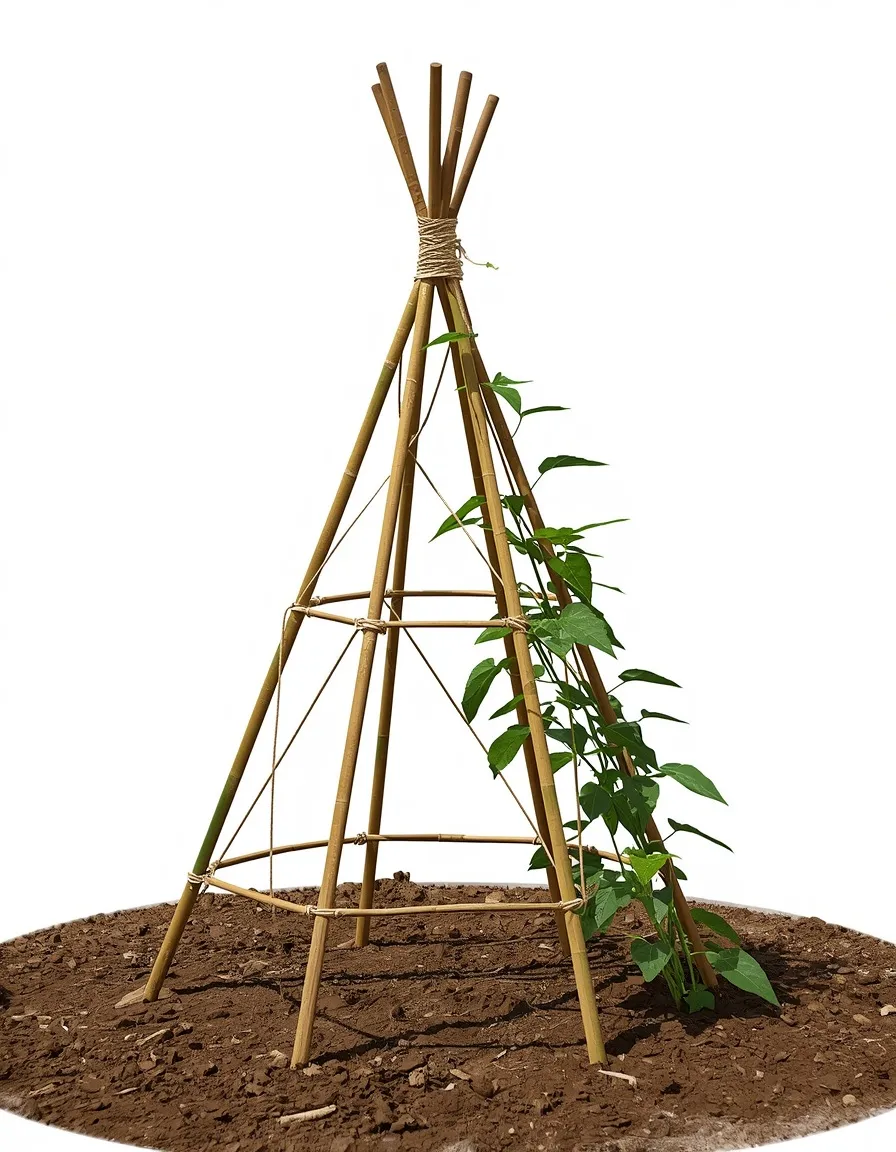
12. Repurposed Pallet Trellis
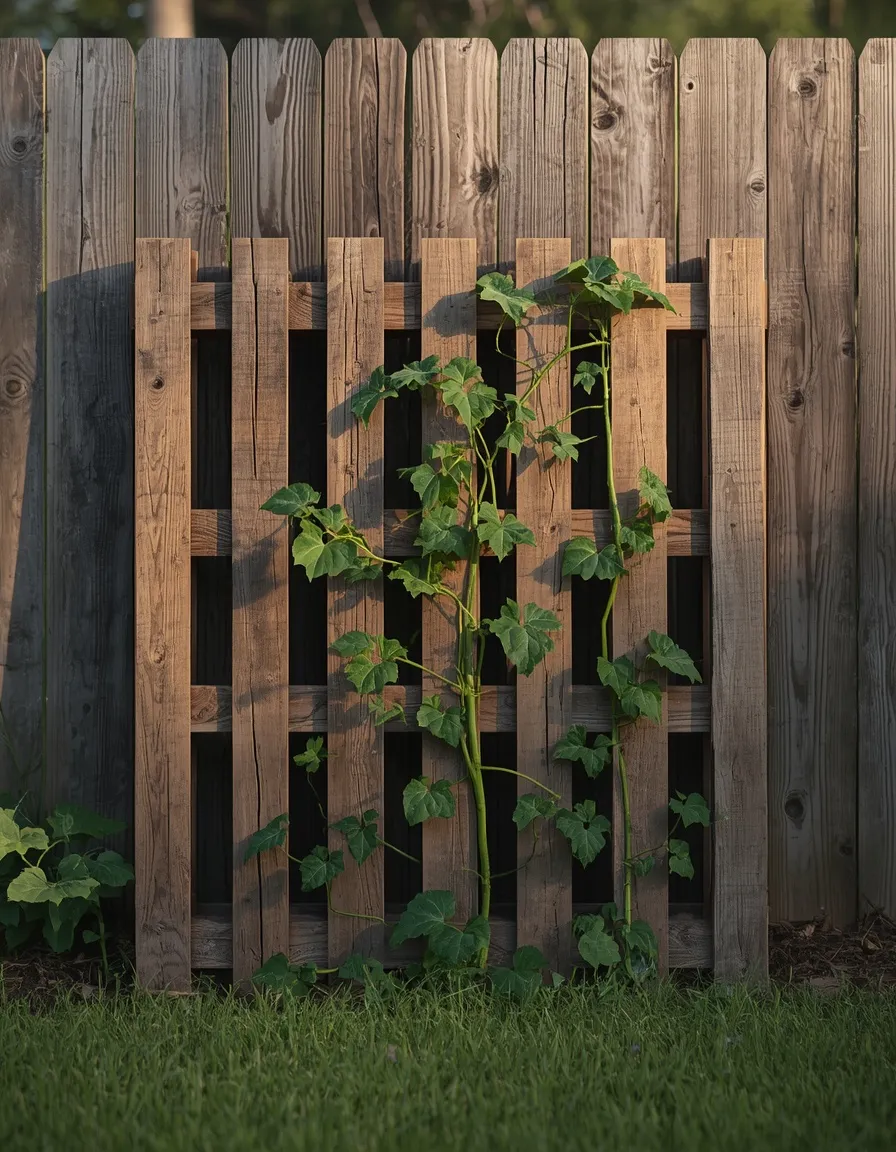
A single wooden shipping pallet stood on end against a fence turns its own slats into a ready-made climbing grid, with no cutting or assembly required beyond finding a stable spot for it to lean.
Sand down any rough edges and check the pallet’s stamp before using it near food crops; only heat-treated pallets, marked HT, are considered safe for edible gardens, since chemically fumigated pallets marked MB can leach residue into the soil over time. Prop the pallet upright against a fence or wall and secure the top with a strap or hook so it cannot tip forward once vines add weight. Elevate the base slightly on bricks or pavers rather than leaving it flush on damp ground, which speeds up rot and shortens the trellis’s usable life.
- Free or very low-cost when a pallet is already on hand
- Slats provide an instant climbing grid with no building
- A genuinely upcycled option for budget-conscious gardens
13. Leaning Ladder Trellis
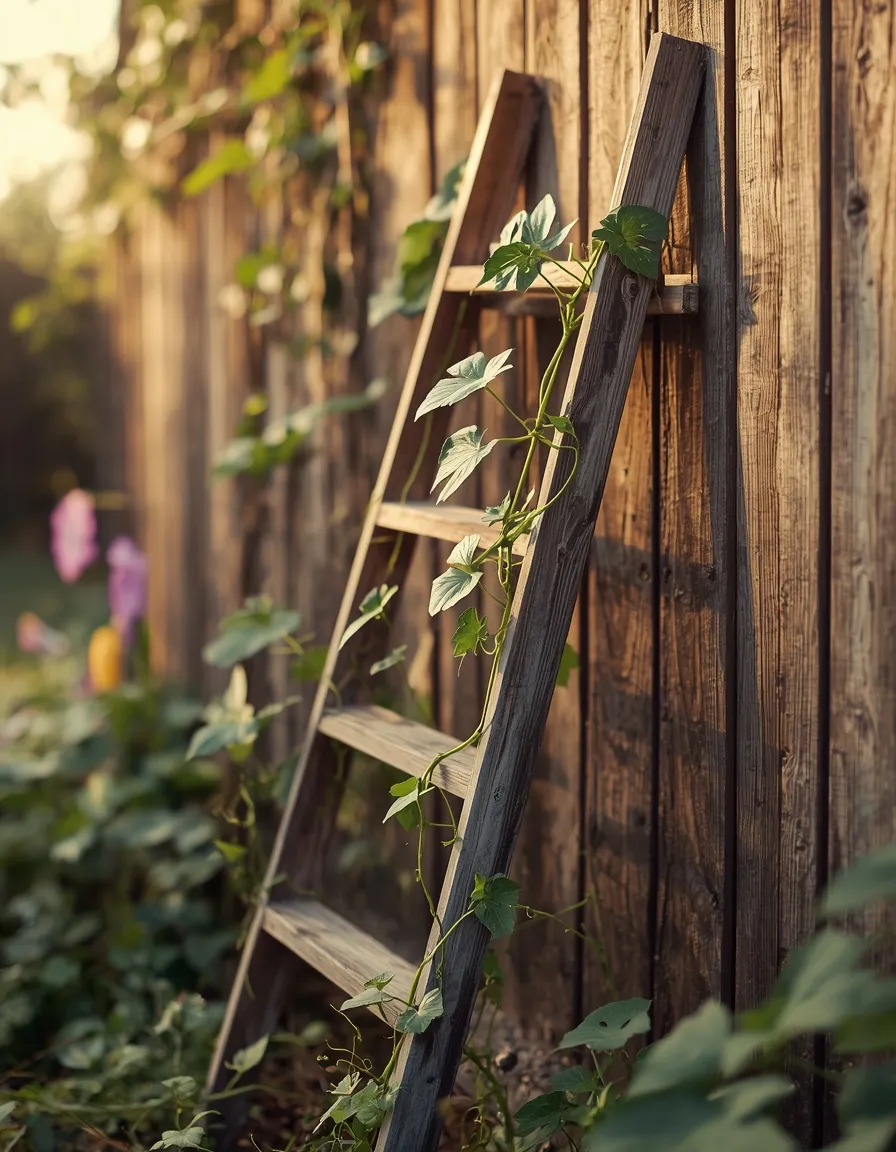
An old wooden ladder retired from the garage finds a second life leaning against a wall, its rungs doubling as ready-made horizontal grips for climbing vines, in a look that reads more decorative than utilitarian.
Lean the ladder at a 60 to 70 degree angle against a solid wall or fence; anything shallower risks tipping once the vines fill in and add weight to one side. Hook or strap the top rung to the wall so it cannot slide out from under the load. Wind a little twine between rungs where the spacing runs wide, since bare rungs alone often sit too far apart for young tendrils to bridge on their own.
- Gives an old ladder a genuinely useful second purpose
- Adds cottage-style character to a small garden corner
- Rungs already provide ready-made horizontal grip points
14. Rebar and Twine Vertical Tower
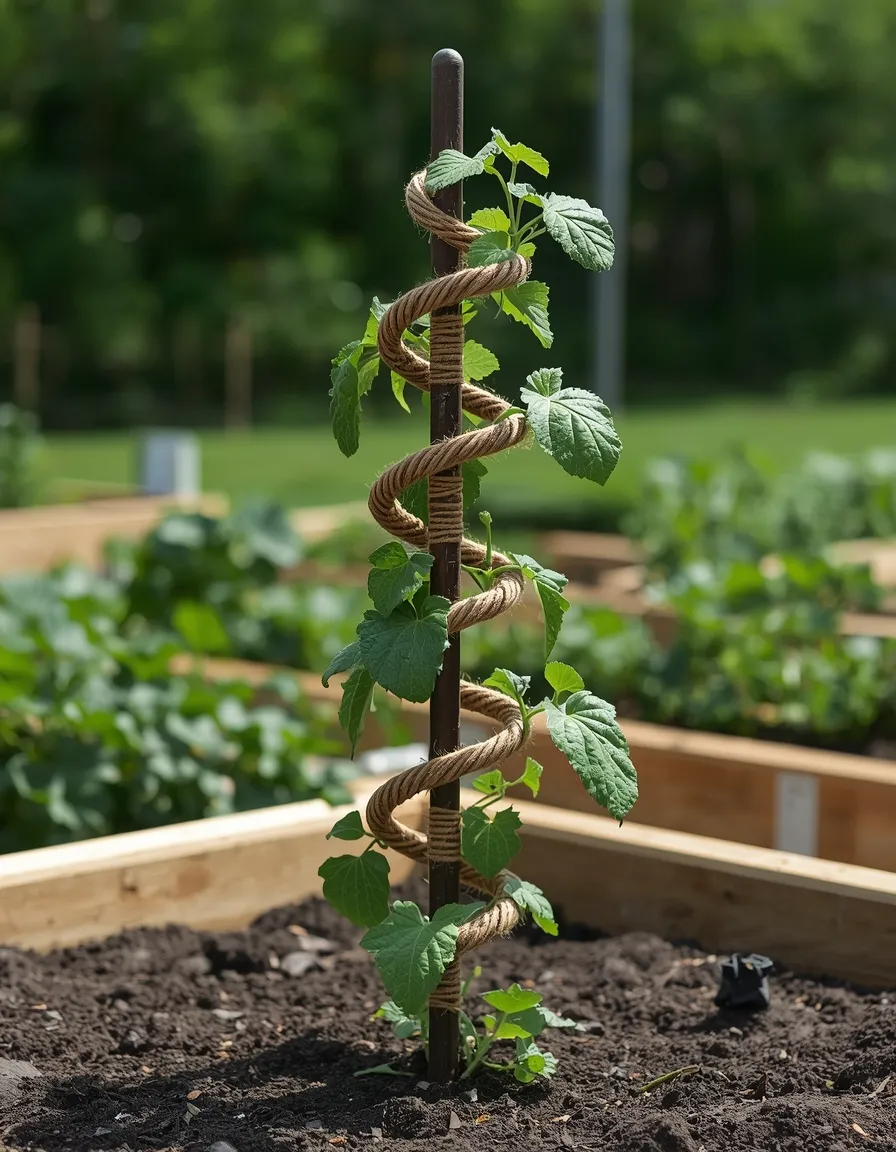
Three or four lengths of rebar driven into a tight circle and wrapped in a spiral of twine build one of the most minimal trellises possible, with almost no visual bulk once the vines fill in around it.
Drive 3 to 4 rebar stakes into the soil in a circle about 18 inches (45 cm) across, then wind garden twine in a continuous spiral from the base to the top, adding horizontal wraps every 8 to 10 inches (20 to 25 cm) so vines have something to grip at multiple heights, not just a single vertical line. Cap every exposed rebar tip with a rubber safety cap; an uncapped rebar end left at eye or shin height is a genuine puncture hazard, especially in a bed that children or pets pass through.
- Minimal materials and almost no visual footprint in the bed
- Easy to take down and store flat between seasons
- Works well tucked into a raised bed corner or row end
Decorative and Space-Saving Row Trellis Ideas
This last group leans into structures that either save real space in a dense planting row or double as a garden feature in their own right, worth considering when a trellis needs to look as good as it works.
15. Vertical String Trellis, Florida Weave Style
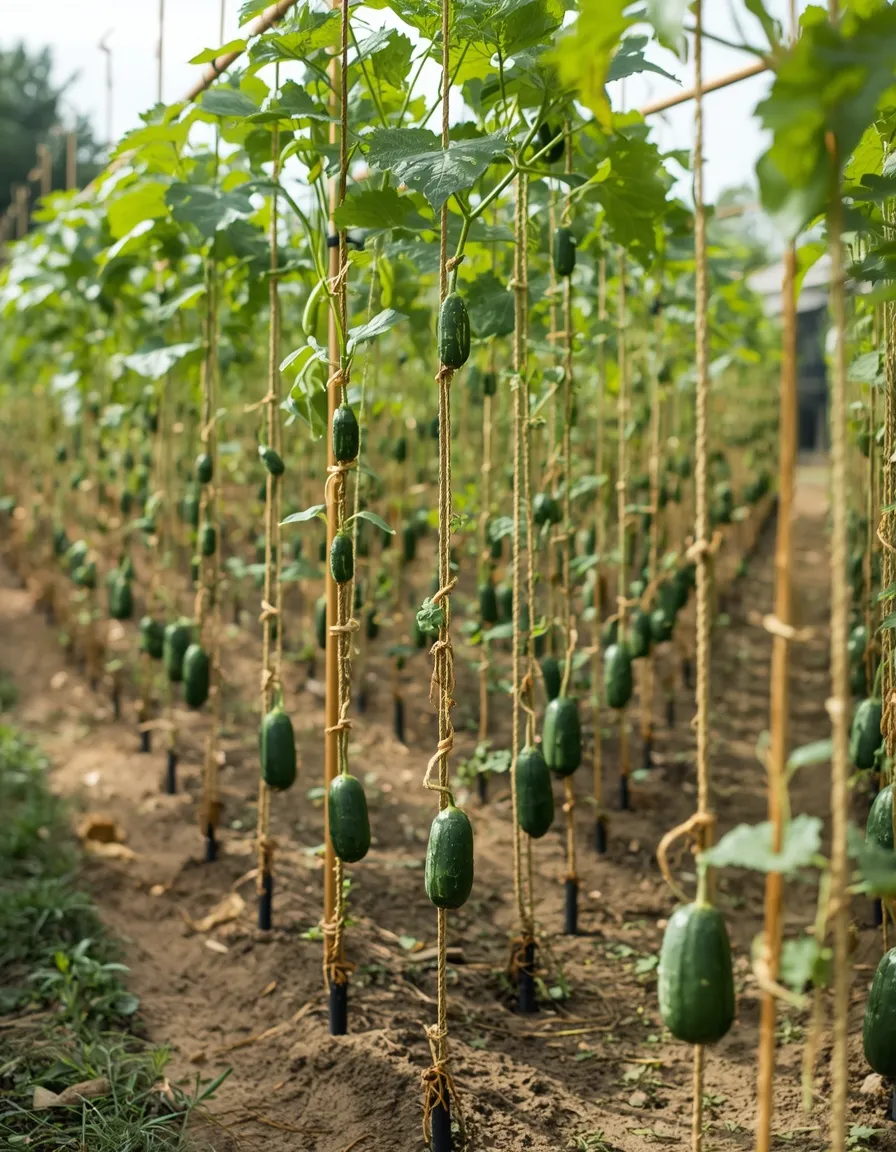
Running individual strings from a top rail down to the soil and training one vine per string is how commercial growers pack the most cucumbers into the least amount of row, and the same trick scales down neatly for a home garden bed.
Fix a sturdy horizontal rail or wire above the row, then tie individual jute or garden twine strands down to ground stakes every 6 to 8 inches (15 to 20 cm), training one seedling per string. Prune away side shoots below the first four nodes so each plant grows as a clean single stem rather than a tangle competing for the same string. Space the strings too far apart and vines cross over into their neighbor’s line, tangling the whole row together by midseason.
- Fits more plants into a narrow row than any other design here
- Suits greenhouse, tunnel, or high-density raised bed growing
- Keeps each vine visually separate and easy to manage
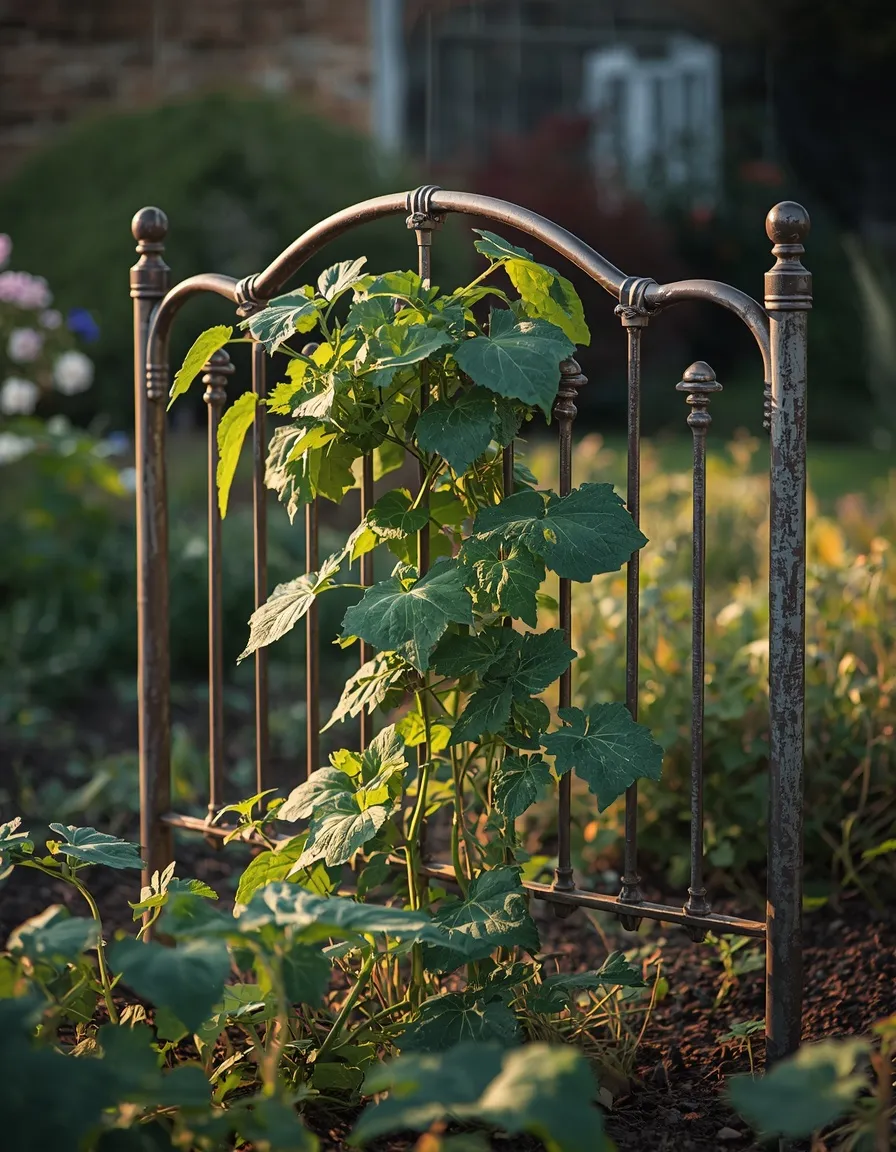
16. Salvaged Headboard Trellis
An old bed headboard rescued from a curbside pile or a secondhand shop makes an unexpectedly charming trellis, planted at the back of a bed where it reads as a garden feature first and a support structure second.
Push the headboard’s legs or frame firmly into the soil at the back of a bed, choosing a metal frame with wide-spaced bars over a solid wood panel, since open bars give vines far more places to grab hold. Headboards were not built to stand in soil long-term, so add a short stake behind the frame for real stability once the vines add weight. This idea fits especially well in a small cottage garden, where a mix of found and repurposed pieces is part of the charm rather than something to hide.
- Adds genuine character and a collected, cottage-garden look
- A meaningful way to give a secondhand piece new use
- Metal frames with open bars give vines the best grip
17. Repurposed Metal Garden Arch
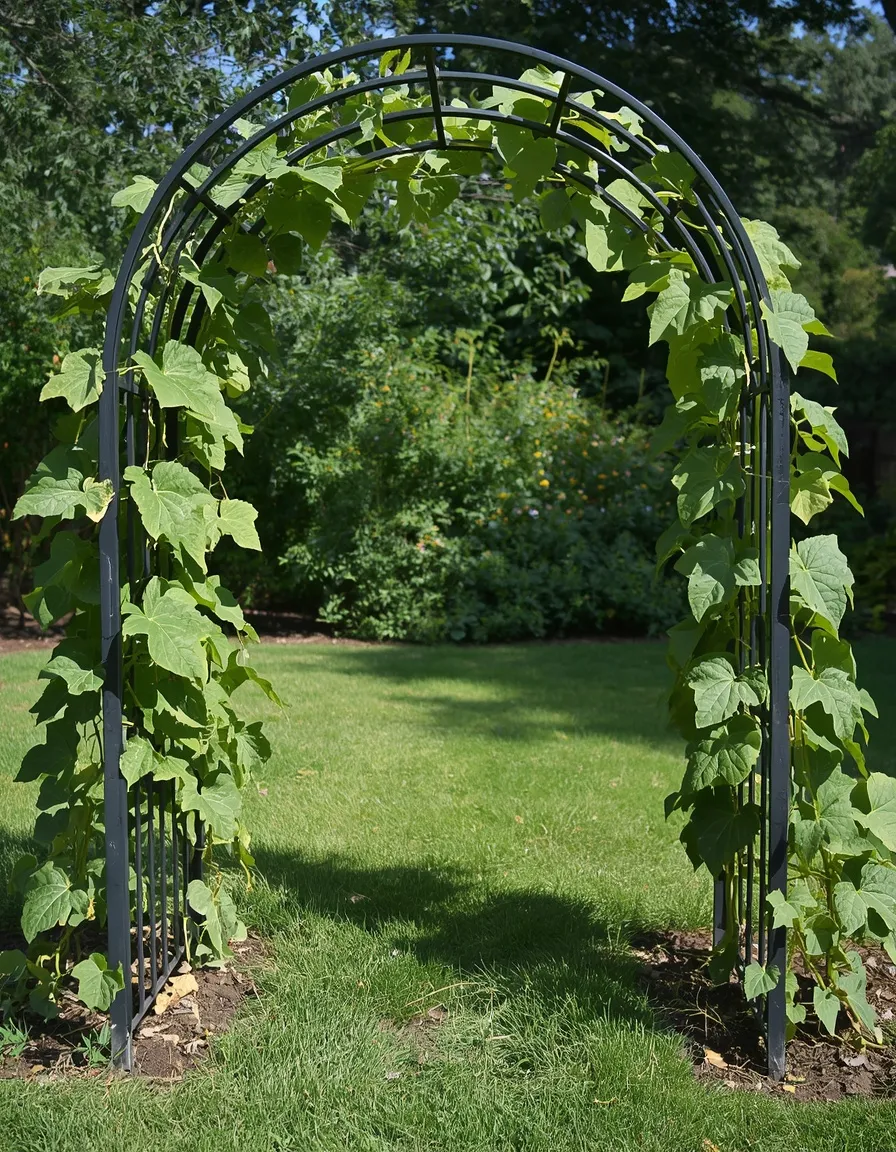
A decorative rose arch or garden arbor already built for climbing plants works just as well for cucumbers, turning a path or entryway into a genuinely dual-purpose feature that produces food as well as shade.
Plant cucumbers at the base of each side of the arch and train the vines up and over as they grow. If the arch’s existing bars are spaced too widely for tendrils to grip, add a few extra strands of galvanized wire running vertically between them. Choose a powder-coated or stainless finish rather than a bare or rust-prone one for any arch used near food crops, since flaking rust is not something to have shedding into an edible bed. For more structural inspiration for a bed like this, the site’s garden design ideas cover more ways to combine form and function in the same space.
- Doubles as an ornamental feature and a working trellis
- Works well over a path, gate, or entryway
- Suits gardeners who want food and beauty from the same structure
Conclusion
None of these builds require a specialty tool or an unlimited budget; a bamboo teepee and a salvaged headboard start from the same basic idea as a cattle panel arch, just at a different scale. The right cucumber trellis idea comes down to available space, materials on hand, and how much of a design statement the structure should make in the bed. Pick one that matches this season’s setup, drive the stakes in before planting, and the payoff shows up by midsummer: straighter fruit, drier leaves, and a harvest actually visible from the path. For more ways to shape a working garden, the wider collection of garden ideas on the site is worth a browse next.
Frequently Asked Questions
What is the best material for a DIY cucumber trellis?
There is no single best material; it depends on how permanent the structure needs to be. Galvanized cattle panel or hog wire holds up for years and suits a permanent raised bed, while bamboo, chicken wire, or a repurposed pallet costs very little and works well for testing a new spot for a single season.
How tall should a cucumber trellis be?
Most vining slicing and pickling cucumbers do well with a trellis between 5 and 8 feet (1.5 and 2.4 m) tall, while compact bush varieties are comfortable on something closer to 3 to 4 feet (90 cm to 1.2 m), a range in line with University of Minnesota Extension guidance on trellising home garden cucumbers. Whatever the height, drive posts or stakes at least 12 inches (30 cm) into the soil so the structure stays stable once it is carrying a full load of vines and fruit.
Can I grow cucumbers on a trellis in a pot or container?
Yes, container trellising works well as long as the structure is sized to the pot; a lightweight PVC obelisk, hula-hoop teepee, or repurposed tomato cage all suit a container at least 16 inches (40 cm) across. Choose a compact or bush-type variety where possible, since vigorous vining types can outgrow a small container trellis by midsummer.
Do all cucumber varieties need a trellis?
No, bush and compact cucumber varieties are bred to stay relatively contained and can be grown without any support at all. Vining types benefit the most from trellising, since left on the ground they sprawl widely, develop curved or misshapen fruit, and are more exposed to soil-borne disease and pests.
What is the cheapest way to trellis cucumbers?
A bamboo teepee or a length of chicken wire stretched between two stakes are typically the least expensive options, often costing very little if bamboo or scrap wire is already on hand. A salvaged pallet or an old ladder can cost nothing at all if either is already sitting unused in a shed or garage.
How do I get cucumber vines to attach to a trellis?
Cucumber tendrils grip on their own within minutes of touching a suitable surface like string, wire, or narrow wood, so most of the work is simply guiding new growth toward the structure in the first couple of weeks. Loosely tying the main stem to the lowest support with soft garden twine helps establish the climbing direction before the tendrils take over.
Can I reuse an existing garden structure, like a tomato cage or arch, as a cucumber trellis?
Absolutely; a spare tomato cage, an unused rose arch, or even an existing fence line can all be adapted for cucumbers rather than building something new. The main adjustment is usually spacing: add extra wire or twine if the existing structure’s openings are too wide for young tendrils to grip.