
Introduction
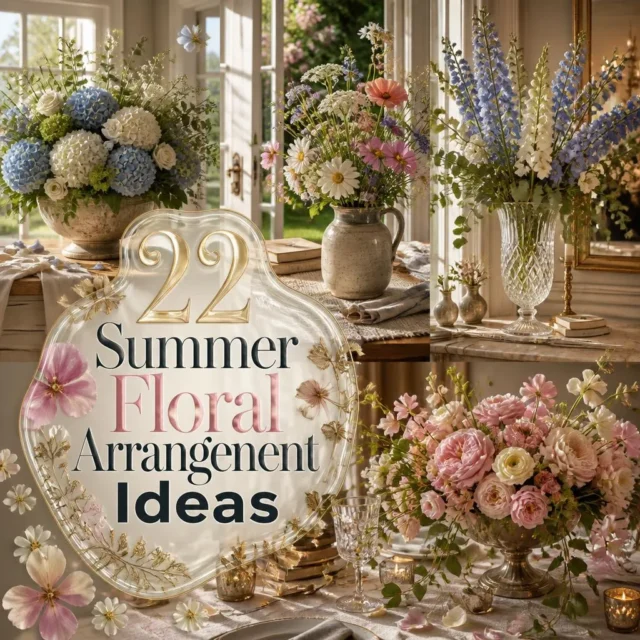
A jug of garden flowers on a kitchen table does more for a room than most furniture. These summer floral arrangement ideas cover 22 complete looks, hydrangea bowls, wildflower jugs, tall vase statements, low centerpieces, church pedestals, wedding tables, and memorial arrangements, with the technique that makes each one last.
Summer is the most generous season for cutting and the hardest on cut stems, so alongside the styling you’ll find what actually matters in heat: when to cut, how to condition stems before arranging, why hydrangeas collapse and how to bring them back, and which flowers give you ten days rather than three. Most arrangements here use what’s already growing outside. Consider it a guide to bringing your abode’s garden indoors, properly.
The rule that changes everything: Cut in the cool of early morning or evening, never in midday heat, when stems hold the most water. Then condition before you arrange: strip the lower leaves, recut each stem at an angle, and stand everything in deep cool water somewhere dark for two to four hours. Flowers arranged straight from the garden in July often wilt within a day, while conditioned stems from the same plant last a week.
22 Summer Floral Arrangement Ideas
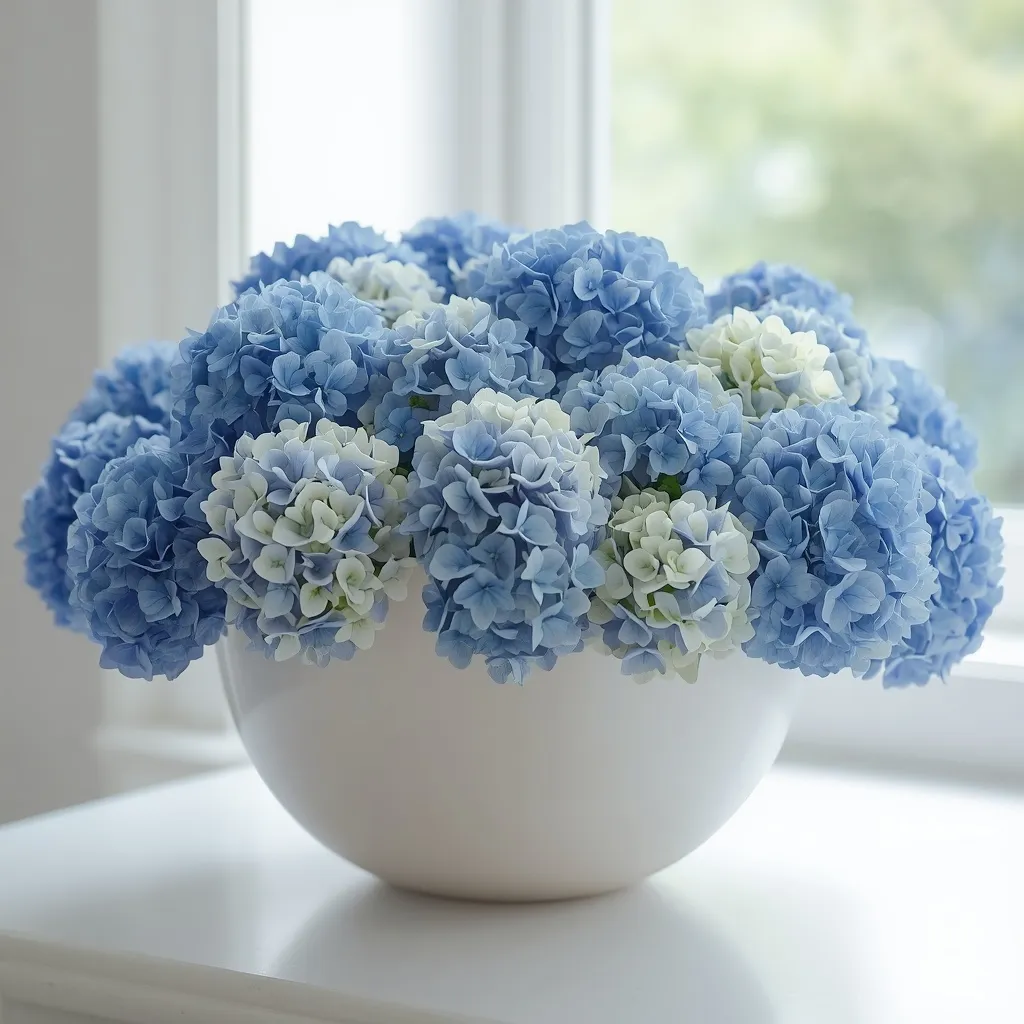
1. Blue and White Hydrangea Bowl
A wide bowl packed with hydrangea heads is summer at its most generous: dense mopheads in blue and white, their stems short, the blooms touching rim to rim in a low cloud of color. Full and effortless, hydrangeas do all the work themselves. Lush, rounded, and classic.
Use a wide low bowl and cut stems short, around 15 cm (6 in), so the heads sit just above the rim and support each other, three or four mophead stems fill a bowl completely. Hydrangeas are the most notorious wilters in the vase because their woody stems struggle to draw water, so cut the stem underwater, or dip the bottom 2–3 cm (1 in) of the cut end in boiling water for about 30 seconds before arranging. This suits summer gardens with established hydrangeas and beginners wanting instant impact.
- Why it works: Short stems let hydrangea heads support each other, so no mechanics or foam are needed.
- Best for: Beginners; gardens with established hydrangeas; instant fullness.
- Key elements: wide low bowl, 15 cm stems, 3–4 mopheads, stems cut underwater or dipped in boiling water.
2. Wildflower Meadow Jug
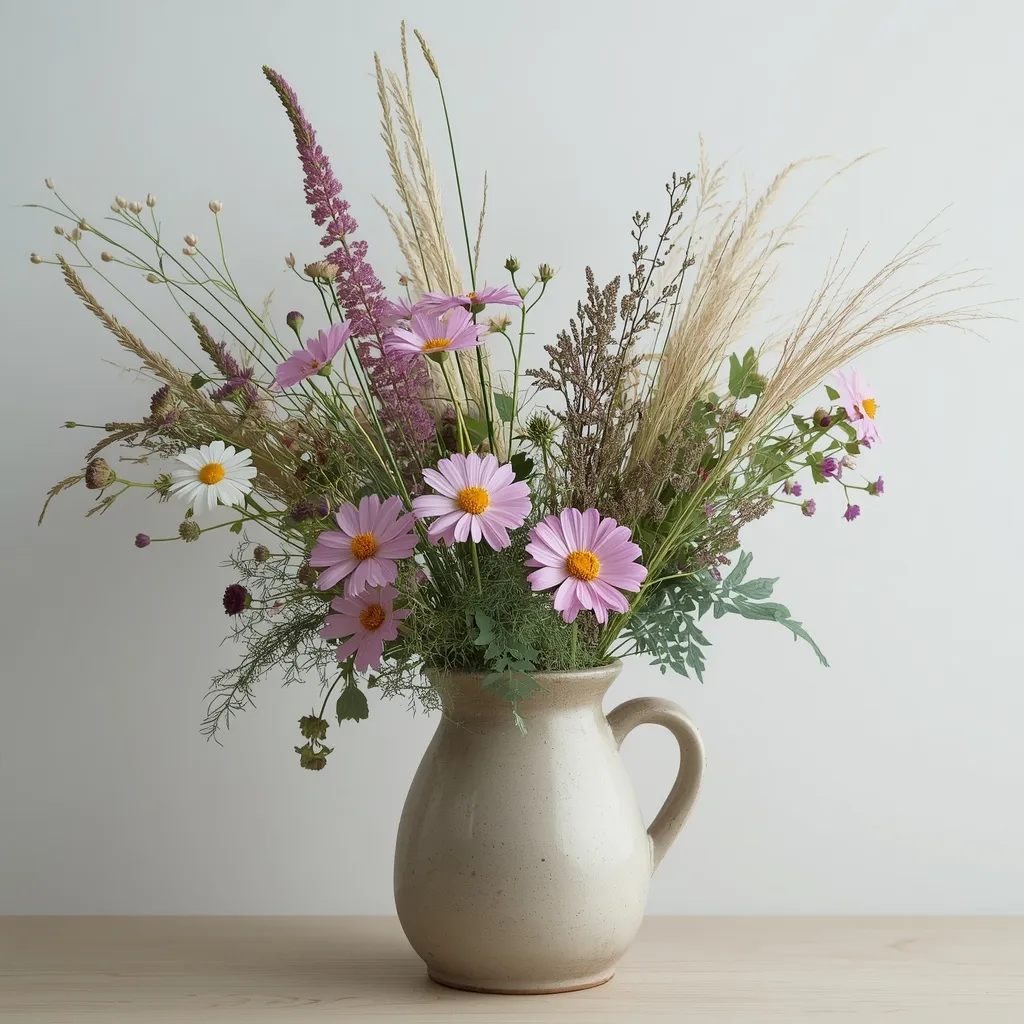
A meadow jug looks gathered rather than arranged: cosmos, scabious, ammi, and grasses at varying heights, loose and slightly wild, as though someone walked back from a field with an armful. Informal and romantic, this is the easiest style to get right. Airy, natural, and charming.
Vary stem heights deliberately rather than cutting everything level, letting some flowers stand well above the mass and others sit low, which is what creates the meadow feel. Use an opaque jug so you don’t need to worry about stem mechanics showing. Add airy fillers like ammi or grasses last, threading them through so they float above the solid blooms. This suits cottage gardens, casual homes, and anyone who finds formal arrangements intimidating.
- Why it works: Deliberately uneven heights create the gathered look that a level-cut arrangement never achieves.
- Best for: Cottage gardens; casual styling; nervous beginners.
- Key elements: opaque jug, varied stem heights, cosmos and scabious, airy ammi and grasses added last.
3. Cottage Garden Pitcher
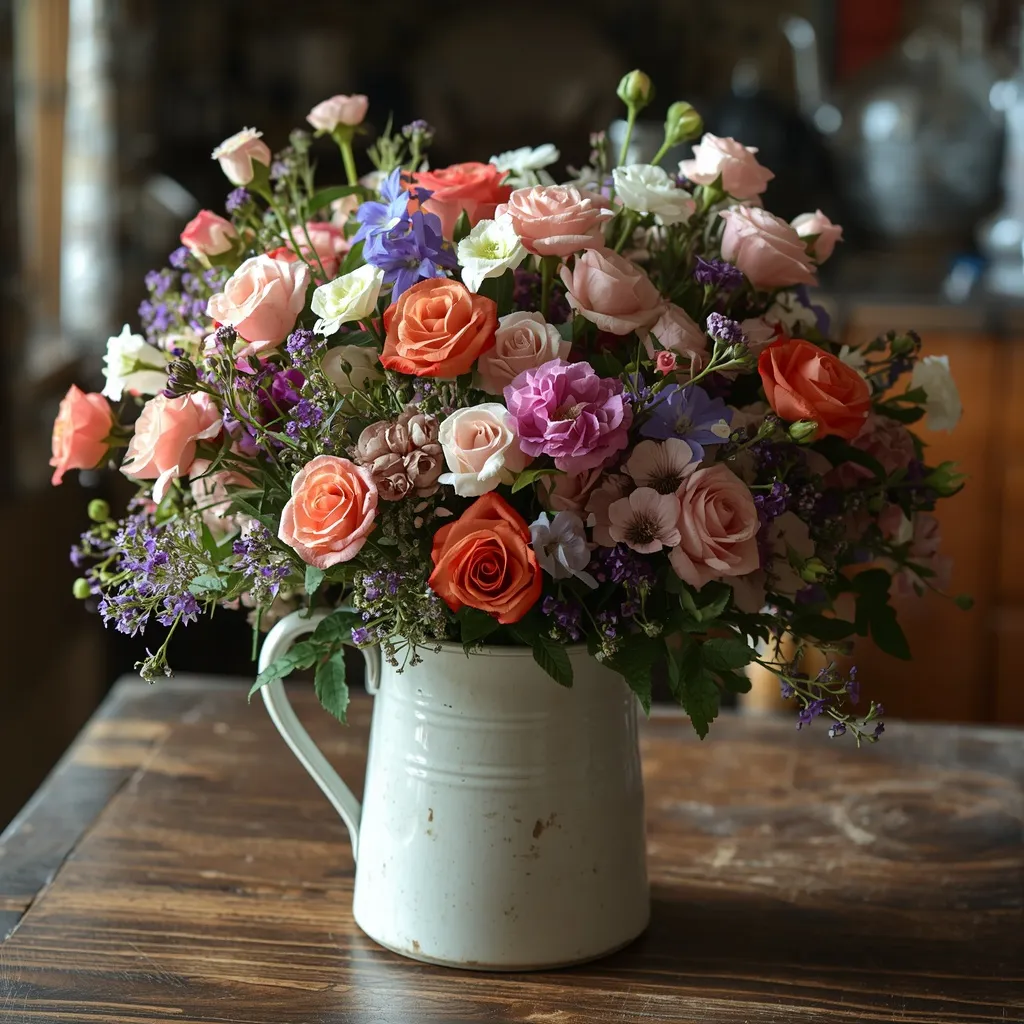
A cottage pitcher is dense and old-fashioned: roses, sweet peas, larkspur, and phlox crowded into an enamel or ceramic pitcher, colors mingling the way they do in a border. Abundant and nostalgic, this arrangement smells as good as it looks. Full, fragrant, and homely.
Build a rough dome by placing the tallest stems in the center and working outward, filling gaps until the whole shape reads as one mass with no obvious holes. Cottage arrangements suit mixed colors, so resist the urge to coordinate too tightly. Sweet peas are the shortest-lived element here at roughly four to six days, so place them where they can be pulled out and replaced without disturbing the rest. This suits cottage gardens, kitchen tables, and fragrance lovers.
- Why it works: Building a dome from the center outward gives structure without needing floral mechanics.
- Best for: Cottage gardens; kitchen tables; scented arrangements.
- Key elements: ceramic or enamel pitcher, central dome, mixed colors, sweet peas placed for easy replacement.
4. Single-Stem Bud Vase Trio
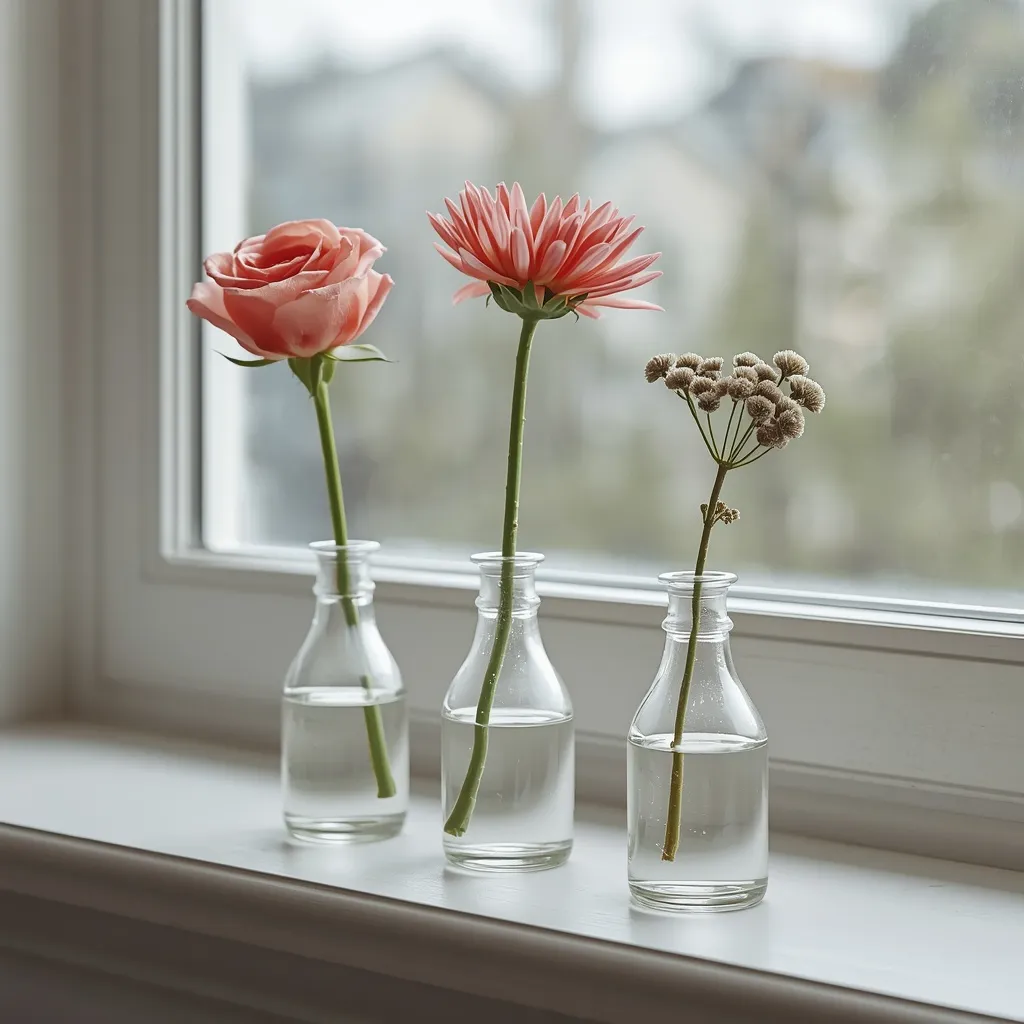
Three small bud vases in a row hold one perfect stem each: a single rose, a lone dahlia, a stem of scabious, each isolated so you actually look at it. Minimal and modern, this is the arrangement for when you have almost nothing to cut. Simple, sculptural, and quiet.
Group vases in odd numbers at slightly different heights, keeping the vessels visually related, same glass, same tone, varied shapes, so the group reads as one composition. This is the most efficient use of a small harvest, since three stems fill a table where a single vase would look sparse. Bud vases suit narrow spaces like windowsills and desks, and small vessels of water need changing every two days in summer heat. This suits small gardens, minimal interiors, and tiny harvests.
- Why it works: Three isolated stems fill a table where the same three in one vase would look sparse.
- Best for: Small gardens; minimal interiors; windowsills and desks.
- Key elements: odd-numbered related vessels, varied heights, one stem each, water changed every 2 days.
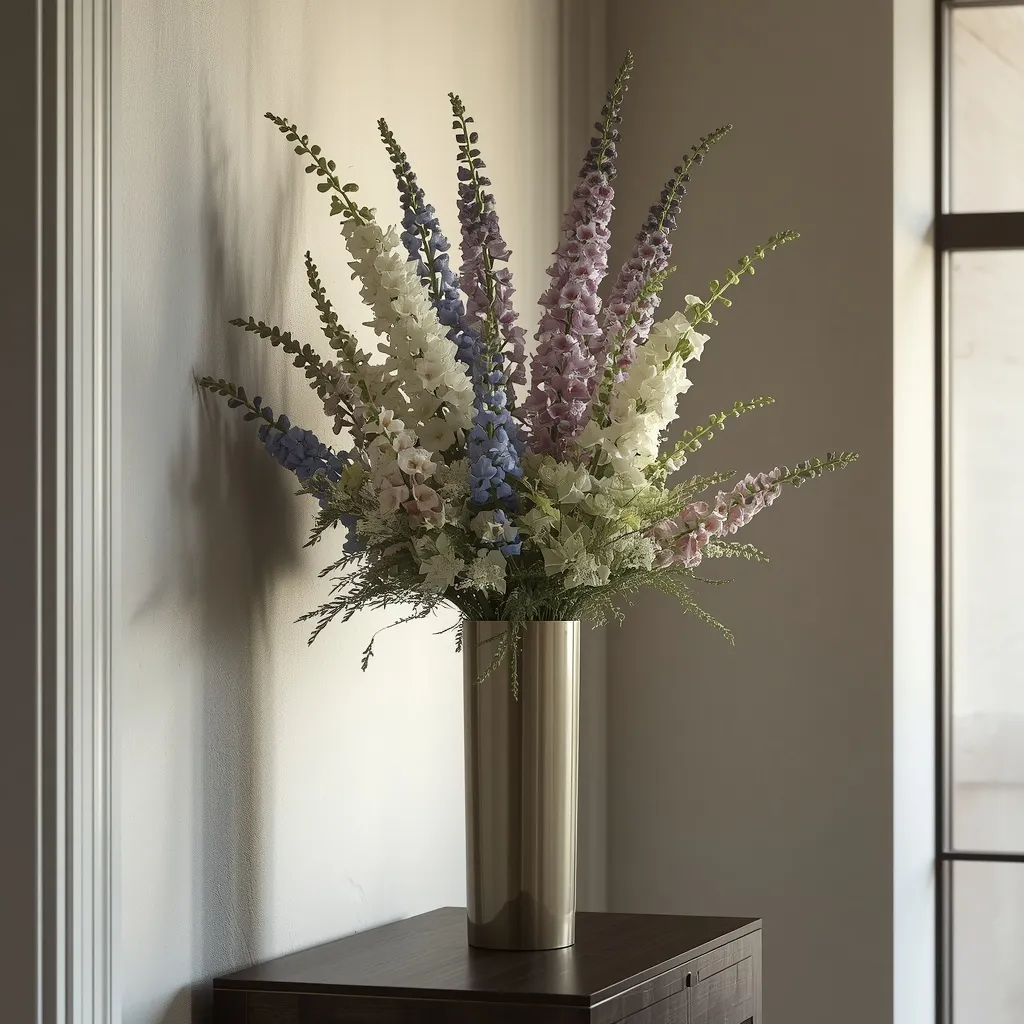
5. Tall Vase Statement
A tall vase arrangement commands a hallway or console: long stems of delphinium, gladioli, and branching foliage rising well above the rim, with the vase itself part of the composition. Architectural and formal, height changes how a room reads. Vertical, dramatic, and elegant.
Follow the proportion rule florists use: flowers should stand roughly one and a half to two times the vase height for a balanced silhouette, so a 40 cm (16 in) vase needs stems reaching 60–80 cm (24–32 in) above it. Tall vases need weight in the base to stay stable, add clean pebbles or use a heavy vessel, since a top-heavy arrangement tips easily. Place it where nobody brushes past. This suits hallways, console tables, and formal rooms.
- Why it works: Stems at 1.5–2 times vase height give the proportion that makes tall arrangements look designed.
- Best for: Hallways; console tables; formal entertaining.
- Key elements:5–2x vase height, delphinium and gladioli, weighted base, placed away from traffic.
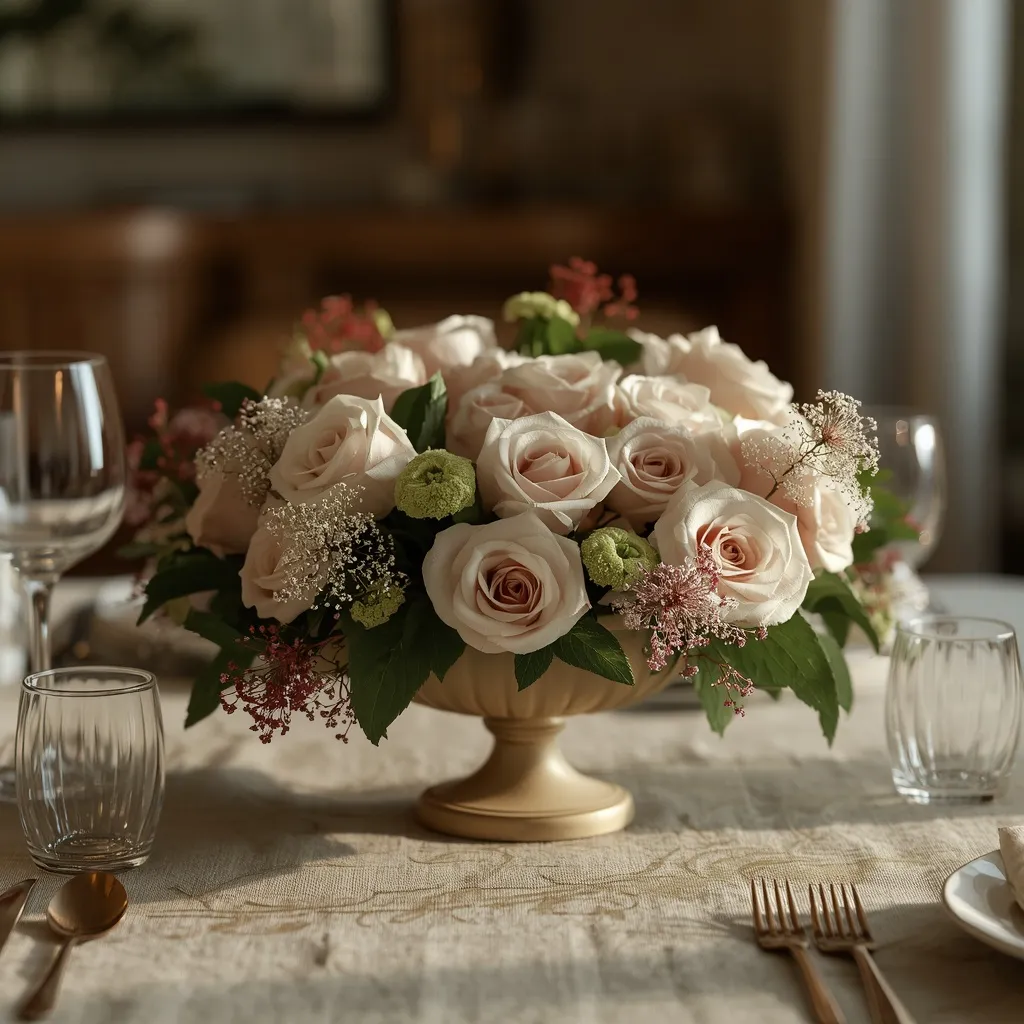
6. Low Table Centerpiece
A low centerpiece sits below eye level so conversation flows over it: a compact mound of roses, astrantia, and soft foliage in a shallow compote, wide rather than tall. Considerate and elegant, the best table flowers are the ones you can see past. Low, round, and social.
Keep the whole arrangement under about 30 cm (12 in) tall, the classic dining rule is that guests should see each other over it without leaning, and make it round so it reads well from every seat. A pin frog or a ball of chicken wire in the compote holds stems in place without floral foam. Foam is worth avoiding where you can, since it is a single-use plastic that does not biodegrade. This suits dinner parties, dining tables, and everyday table styling.
- Why it works: Keeping the arrangement under 30 cm lets guests see each other across the table.
- Best for: Dinner parties; dining tables; conversation-friendly styling.
- Key elements: shallow compote, under 30 cm tall, round from all sides, pin frog or chicken wire not foam.
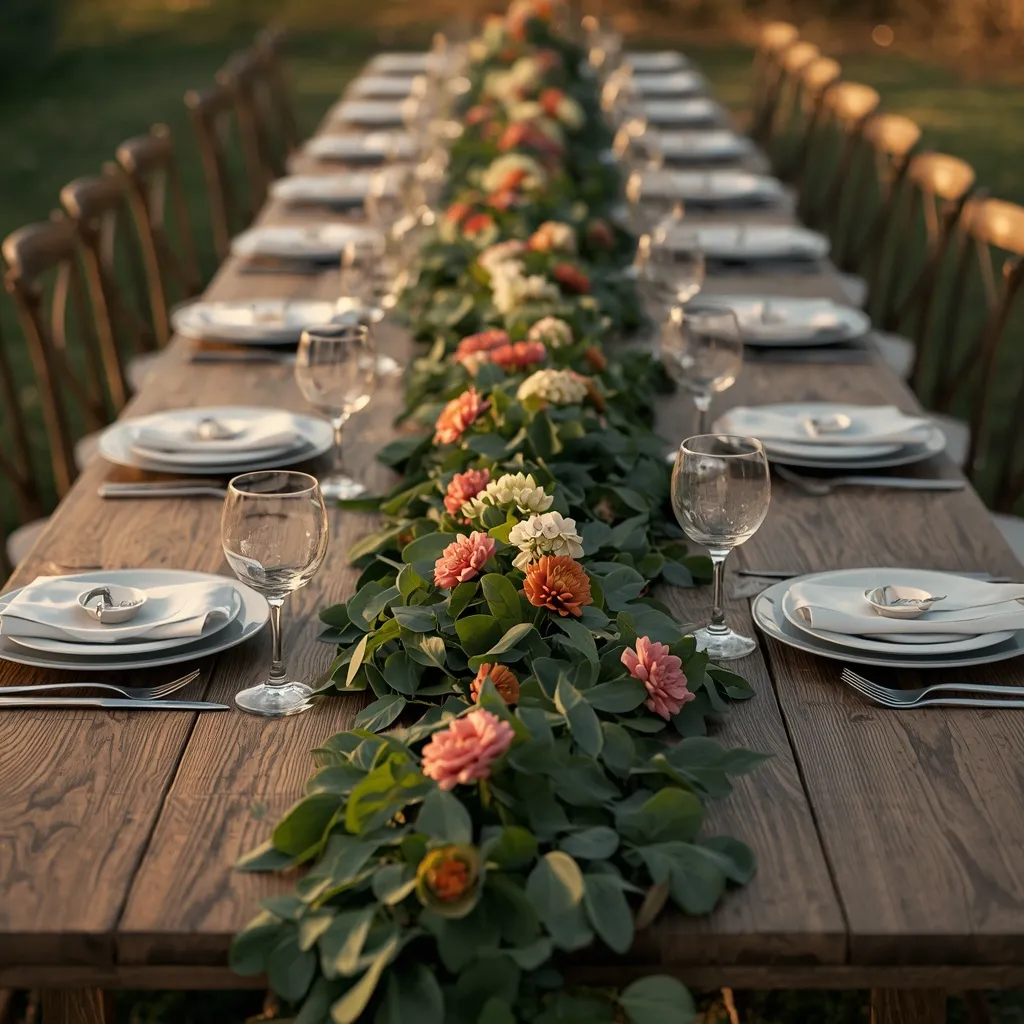
7. Long Table Garland Runner
A garland runner stretches down the center of a long table: a low ribbon of foliage with flowers tucked through it, running unbroken between candles and plates. Generous and celebratory, a runner turns a table into an event. Linear, lush, and impressive.
Build the garland on a base of trailing foliage laid directly on the table, then tuck flower stems into the foliage in small water tubes so they stay fresh through a long meal. Keep the whole runner narrow, around 20–25 cm (8–10 in) wide, so there’s room for plates and glasses on both sides. Build it no more than a few hours ahead in summer, and mist lightly. Keep it clear of lit candles. This suits weddings, long tables, and celebration meals.
- Why it works: Small water tubes tucked into the foliage keep flowers fresh through a long summer meal.
- Best for: Weddings; long tables; celebration dinners.
- Key elements: trailing foliage base, water tubes for flowers, 20–25 cm wide, built a few hours ahead, clear of candles.
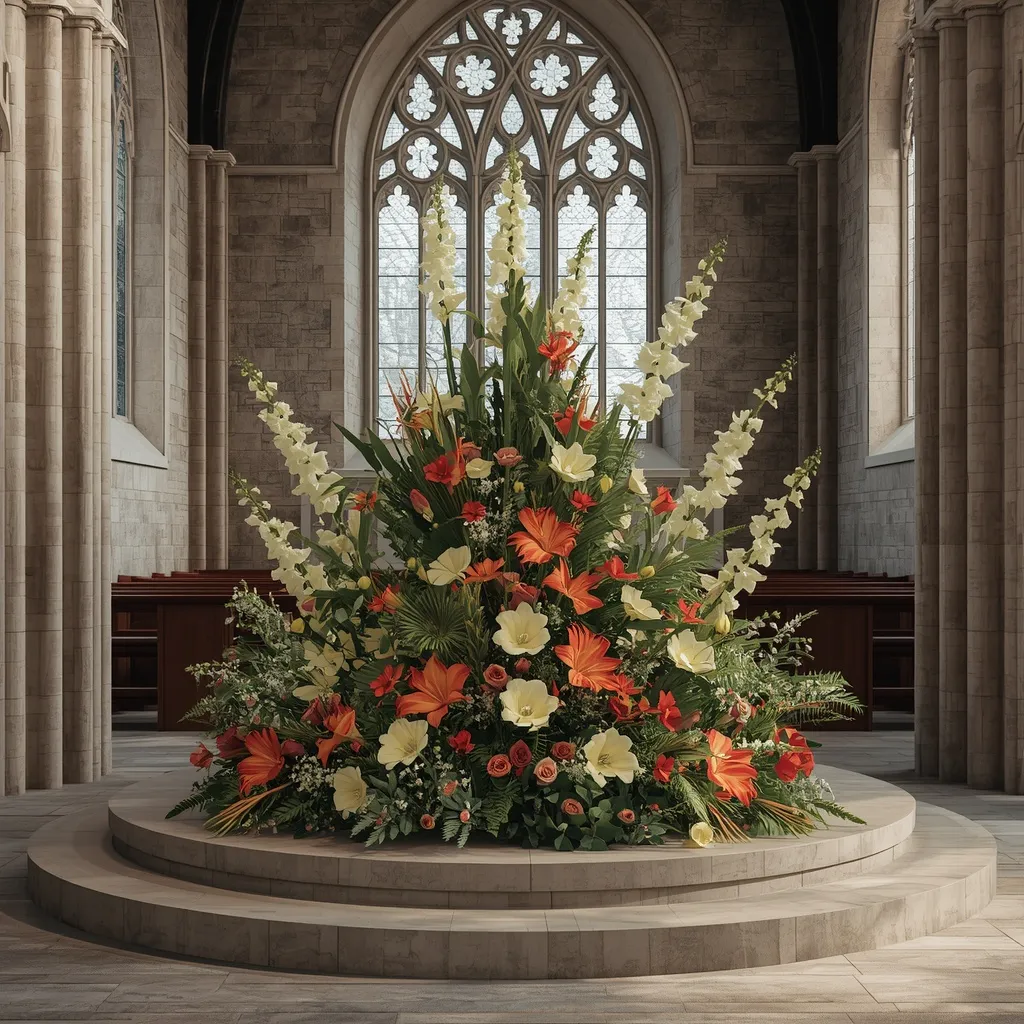
8. Church Pedestal Arrangement
A church pedestal reads from thirty paces: a large, open, triangular arrangement of tall foliage, lilies or gladioli, and mass flowers, built to be seen from the back pew. Grand and structured, church flowers work at architectural scale. Tall, bold, and formal.
Scale for distance rather than detail, delicate flowers vanish beyond a few meters, so use bold blooms, strong color blocks, and generous foliage that reads from the back of the building. Build a wide triangle with the tallest stem roughly one and a half times the container height. Consider fragrance carefully in an enclosed space, since heavily scented lilies can overwhelm a small church, and remove lily pollen anthers to prevent staining fabric. This suits church volunteers, large venues, and formal occasions.
- Why it works: Bold blooms and color blocks read at distance where delicate detail disappears entirely.
- Best for: Church flower rotas; large venues; formal occasions.
- Key elements: wide triangle, bold mass flowers, generous foliage, fragrance considered, lily anthers removed.
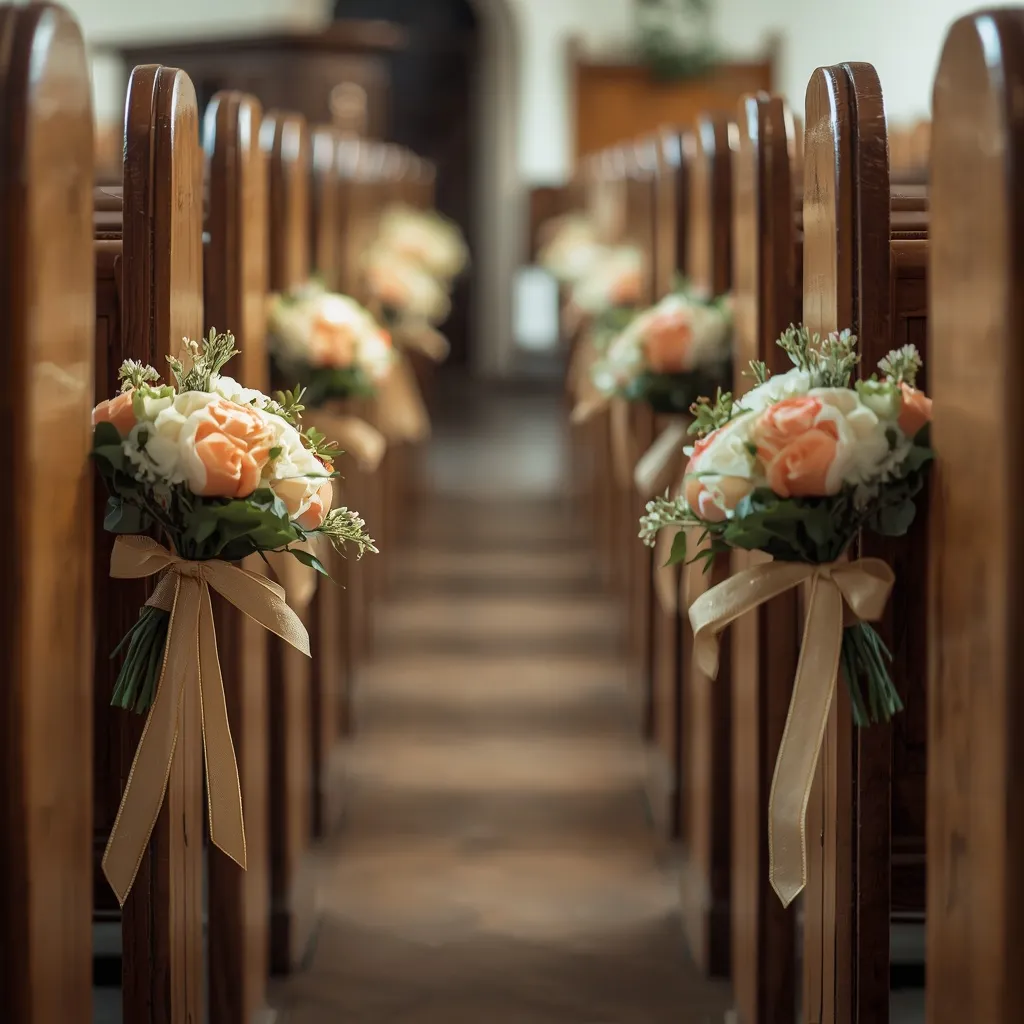
9. Compact Pew-End Posy
A pew-end posy is small, tidy, and repeated: a neat bunch of summer flowers tied and hung at the end of each row, identical down the aisle. Rhythmic and charming, repetition is what makes pew ends work. Small, uniform, and pretty.
Make every posy as close to identical as possible, since the effect comes entirely from repetition down the aisle rather than from any single arrangement. Keep them compact, around 15–20 cm (6–8 in) across, so nobody catches them walking past. Attach with ribbon or fabric ties rather than wire, which can scratch pew woodwork, and check with the venue before fixing anything. This suits weddings, church events, and volunteers making many arrangements at once.
- Why it works: The effect comes from repetition down the aisle, so uniformity matters more than individual detail.
- Best for: Weddings; church events; batch-making volunteers.
- Key elements: identical posies, 15–20 cm across, fabric ties not wire, venue permission checked.
10. Wedding Table Centerpiece
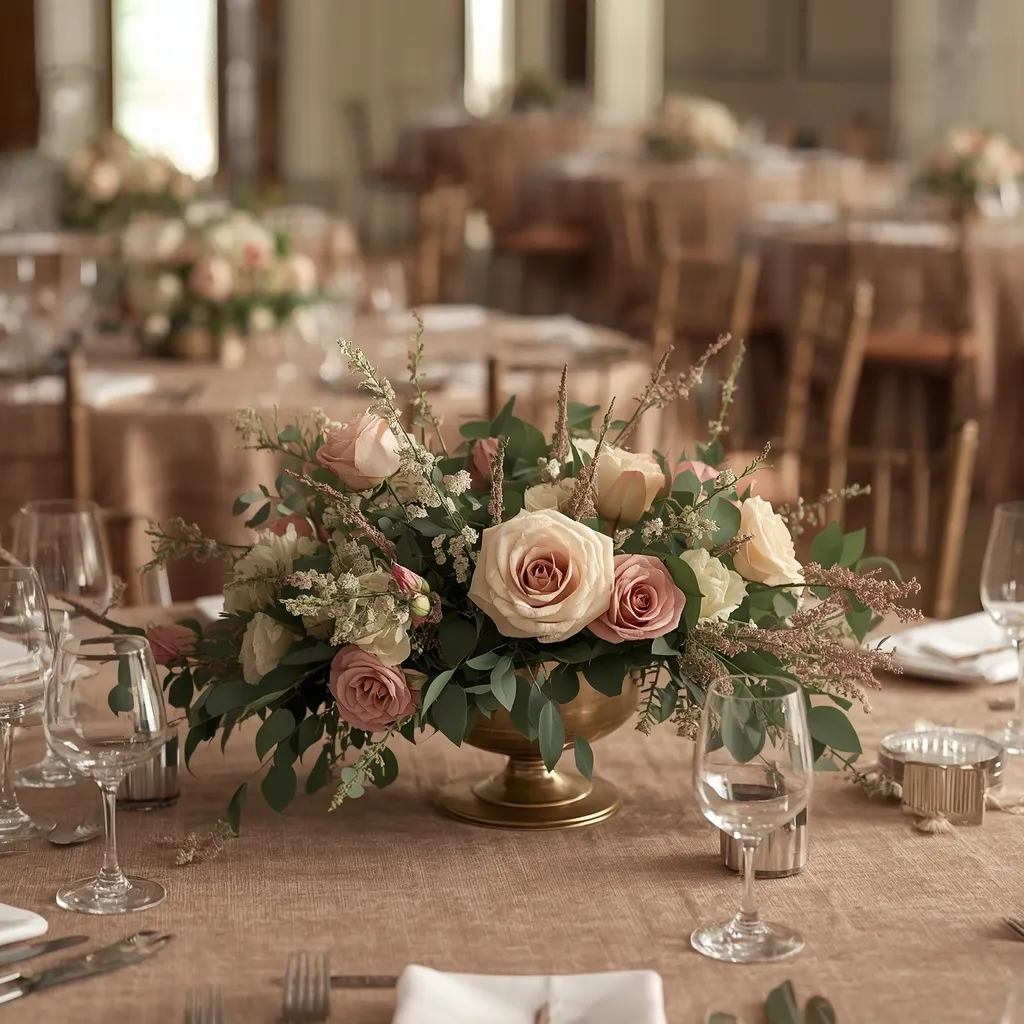
A wedding centerpiece balances elegance with practicality: a refined low arrangement in a restrained palette, repeated across every table, pretty from all angles and impossible to knock over. Polished and consistent, wedding flowers must work en masse. Coordinated, low, and graceful.
Choose a palette of two or three colors plus foliage and repeat it exactly across every table, since consistency is what makes a room look professionally styled rather than assembled. Keep centerpieces low and stable, and use vessels wide enough at the base that a brushed elbow won’t tip them. Build no more than a day ahead and store somewhere cool and dark overnight, never in a warm room or direct sun. This suits weddings, formal events, and anyone making many matching arrangements.
- Why it works: An exactly repeated palette across every table is what makes a room read as professionally styled.
- Best for: Weddings; formal events; multiple matching tables.
- Key elements: 2–3 colors plus foliage, repeated exactly, low stable vessels, stored cool and dark overnight.
11. Hand-Tied Summer Bouquet
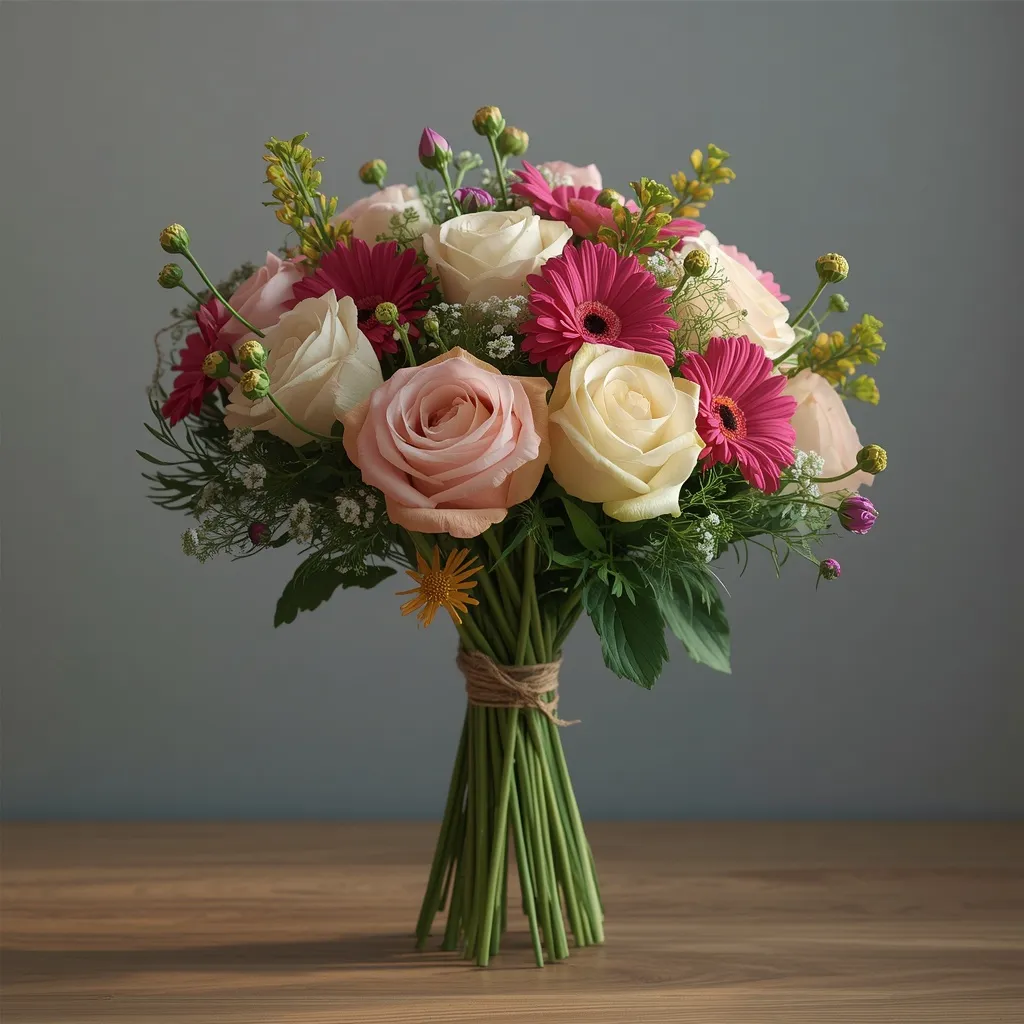
A hand-tied bouquet spirals in the hand: stems laid at a consistent angle so they twist into a natural cone, the finished bunch standing unaided on its own stems. Skilled and satisfying, the spiral is the foundation of florist technique. Rounded, structured, and giftable.
Lay each stem across the previous one at the same angle, always adding in the same rotational direction and turning the bunch a little as you go, which builds the spiral that lets a bouquet stand by itself. Strip all leaves below where your hand grips. Tie firmly at the binding point with twine, then cut all stems level. Wrap the stem ends in damp paper if it’s a gift traveling in summer heat. This suits gifts, market bunches, and anyone learning florist basics.
- Why it works: Adding every stem at the same angle in one direction builds the spiral that lets a bouquet stand alone.
- Best for: Gifts; learning florist technique; market-style bunches.
- Key elements: consistent stem angle, one rotation direction, leaves stripped at grip, tied at binding point, damp paper for travel.
12. Cemetery Memorial Arrangement
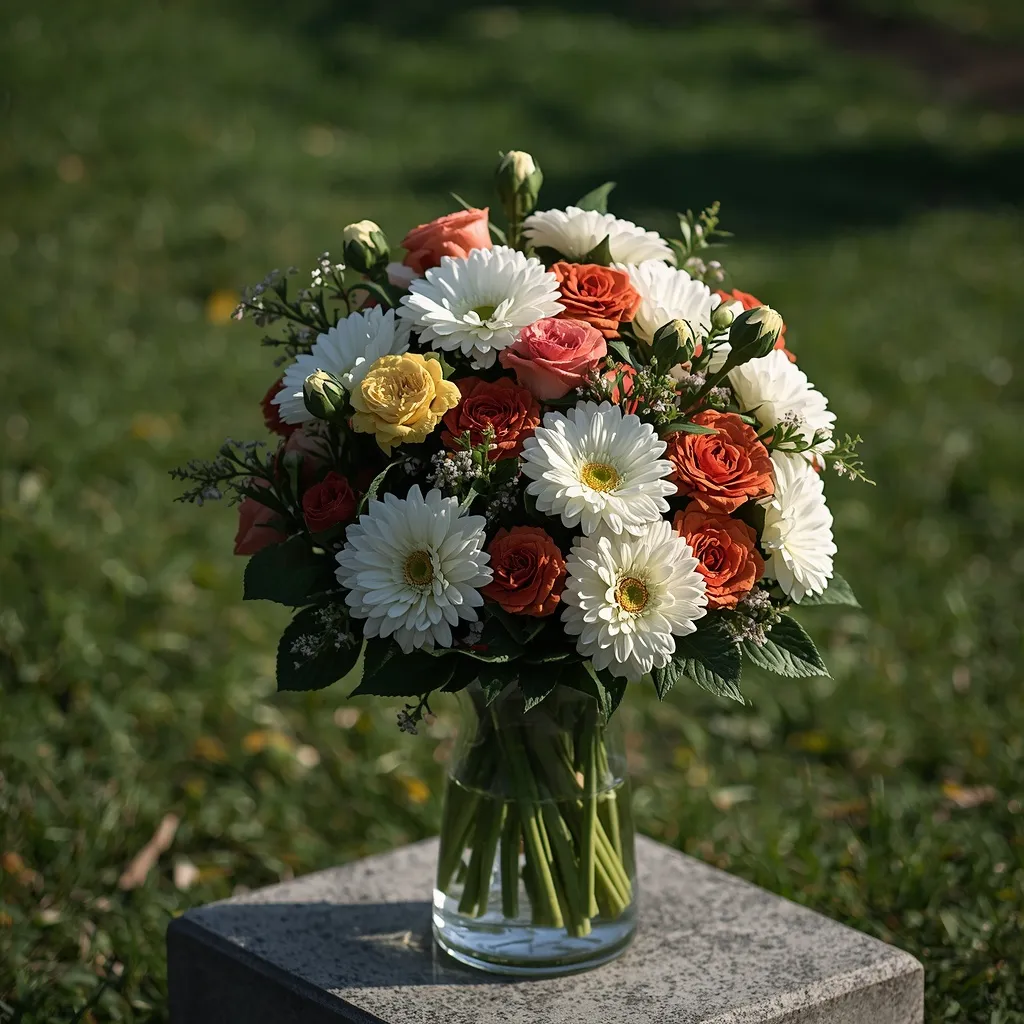
A memorial arrangement is built for exposure: a sturdy, weighted display of durable flowers set on a grave, designed to hold up in open sun and wind. Dignified and practical, memorial flowers need resilience above all. Steady, simple, and lasting.
Check the cemetery’s rules before choosing a container, since many prohibit glass outright because breakage creates a hazard for staff and mowers, and some restrict container types or removal schedules entirely. Choose heat-tolerant, sturdy flowers, chrysanthemums, carnations, and statice hold far better in exposed sun than soft-stemmed garden flowers, which can collapse within a day in summer. Weight the base with stones or use a ground-anchored vase. Silk arrangements are a practical alternative where rules permit. This suits memorial visits and exposed sites.
- Why it works: Sturdy heat-tolerant flowers hold in open sun where soft garden stems collapse within a day.
- Best for: Memorial visits; exposed graveside placement.
- Key elements: cemetery rules checked, no glass where prohibited, chrysanthemums and carnations, weighted or anchored base.
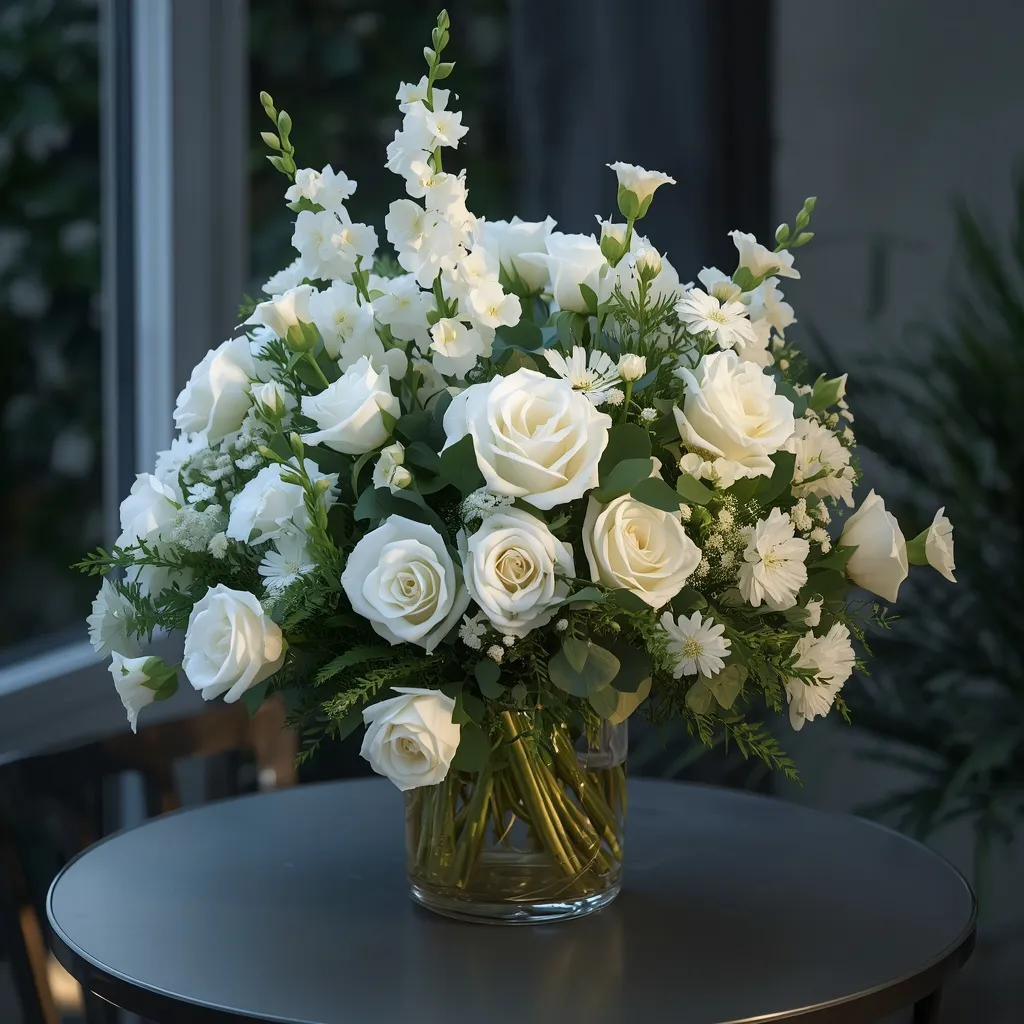
13. Monochrome White Garden
An all-white arrangement is calm and quietly luxurious: white roses, phlox, ammi, and cosmos with green foliage, letting shape and texture carry everything. Serene and refined, white reads as considered. Pale, textural, and elegant.
Use at least three different flower shapes so texture replaces color as the point of interest, a round rose, a flat umbel, an airy filler, since a single-color arrangement of similar shapes reads flat. Whites vary more than people expect, ranging from cool blue-white to warm cream, so group them deliberately rather than mixing tones randomly. White arrangements glow at dusk, which makes them ideal for evening tables. This suits formal rooms, weddings, and evening entertaining.
- Why it works: Varied flower shapes replace color as the interest, which is what stops a white scheme reading flat.
- Best for: Formal rooms; weddings; evening tables.
- Key elements: three-plus flower shapes, whites grouped by warm or cool tone, green foliage, dusk placement.
14. Sunset Warm Palette
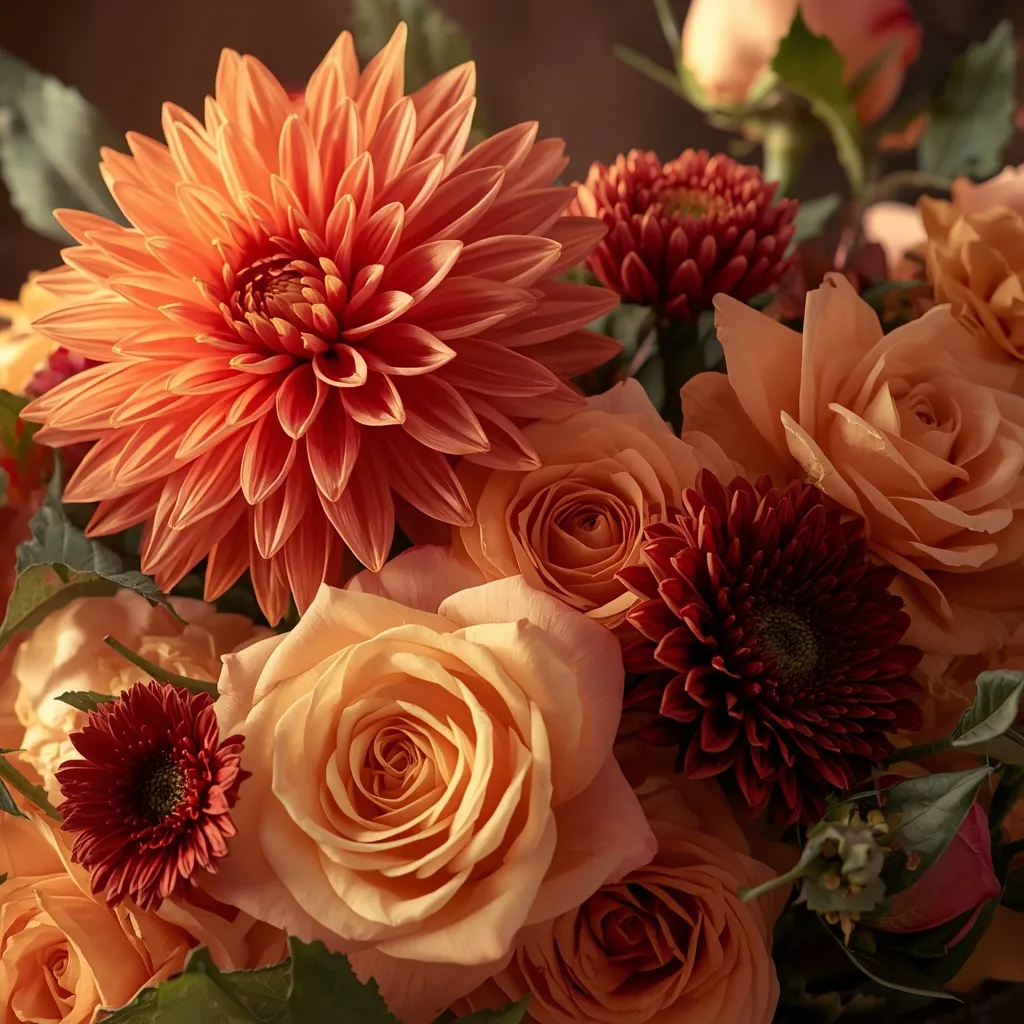
A sunset arrangement burns warm: coral dahlias, apricot roses, rust helenium, and golden rudbeckia layered together like late evening light. Rich and glowing, warm palettes suit high summer perfectly. Fiery, saturated, and cheerful.
Blend adjacent warm tones rather than jumping between them, apricot into coral into rust reads as one glow, where scattered unrelated brights read as jumbled. Add one deeper accent, such as burgundy foliage or a dark dahlia, which gives the eye somewhere to rest and stops the whole thing feeling flat and bright. Dahlias are thirsty and short-lived, typically four to seven days, so check the water daily. This suits late summer gardens, warm interiors, and bold color lovers.
- Why it works: Blending adjacent warm tones reads as one glow where scattered brights read as jumbled.
- Best for: Late summer gardens; warm interiors; bold palettes.
- Key elements: apricot to coral to rust progression, one deep accent, dahlias checked daily for water.
15. Coastal Blue and Grass
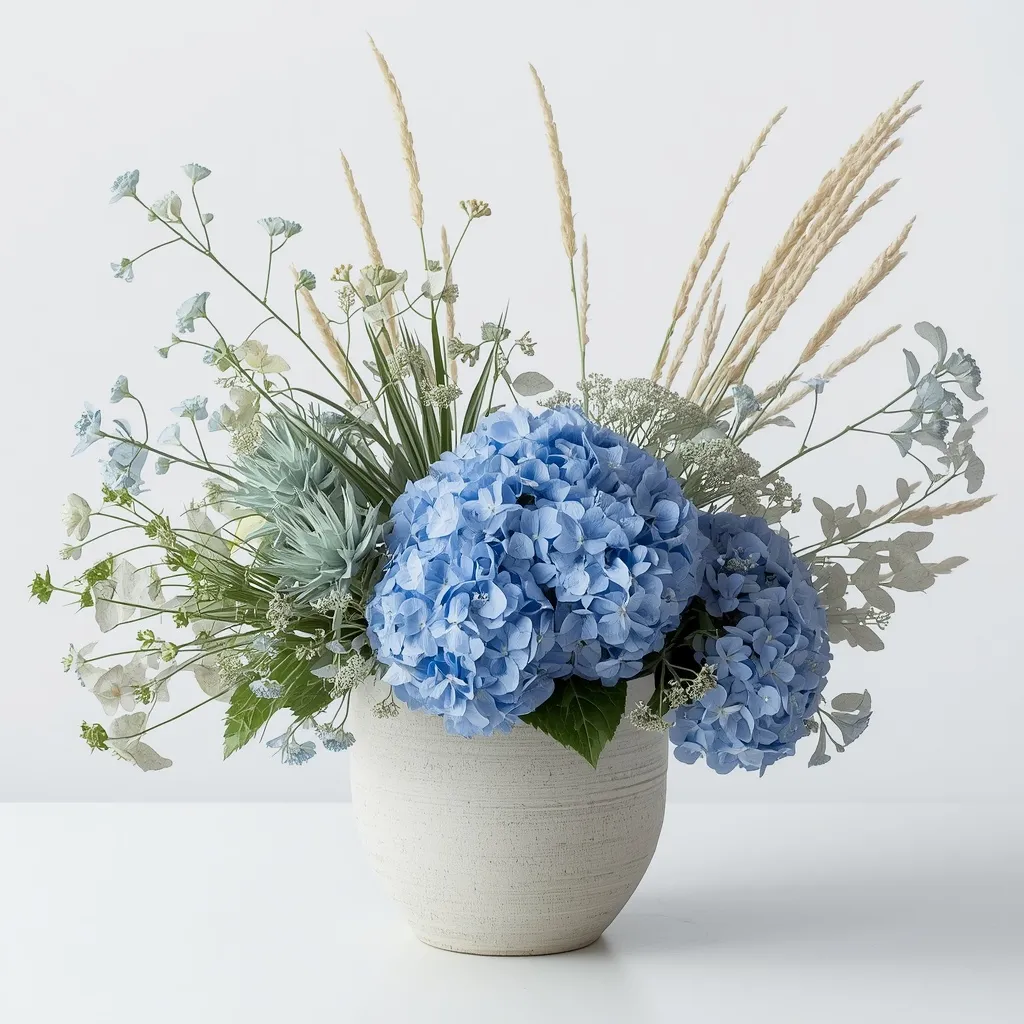
A coastal arrangement is cool and breezy: blue hydrangea, sea holly, and nigella threaded with ornamental grasses in a simple glass or stoneware vessel. Fresh and relaxed, blue and green feels ten degrees cooler. Cool, airy, and calm.
Combine true blues with silvery foliage and grasses, keeping the whole palette cool so nothing warm interrupts it. Sea holly, or Eryngium, holds its structure exceptionally well and dries beautifully in place, so the arrangement evolves rather than dying. Handle it carefully, since its bracts are genuinely spiky. Grasses cut when young shed less pollen than mature seedheads. This suits coastal homes, summer heat, and low-maintenance arrangements.
- Why it works: Sea holly dries in place, so the arrangement evolves rather than simply dying back.
- Best for: Coastal homes; hot rooms; low-maintenance display.
- Key elements: blue hydrangea and Eryngium, silver foliage, young grasses, cool palette throughout.
16. Herb and Flower Kitchen Jug
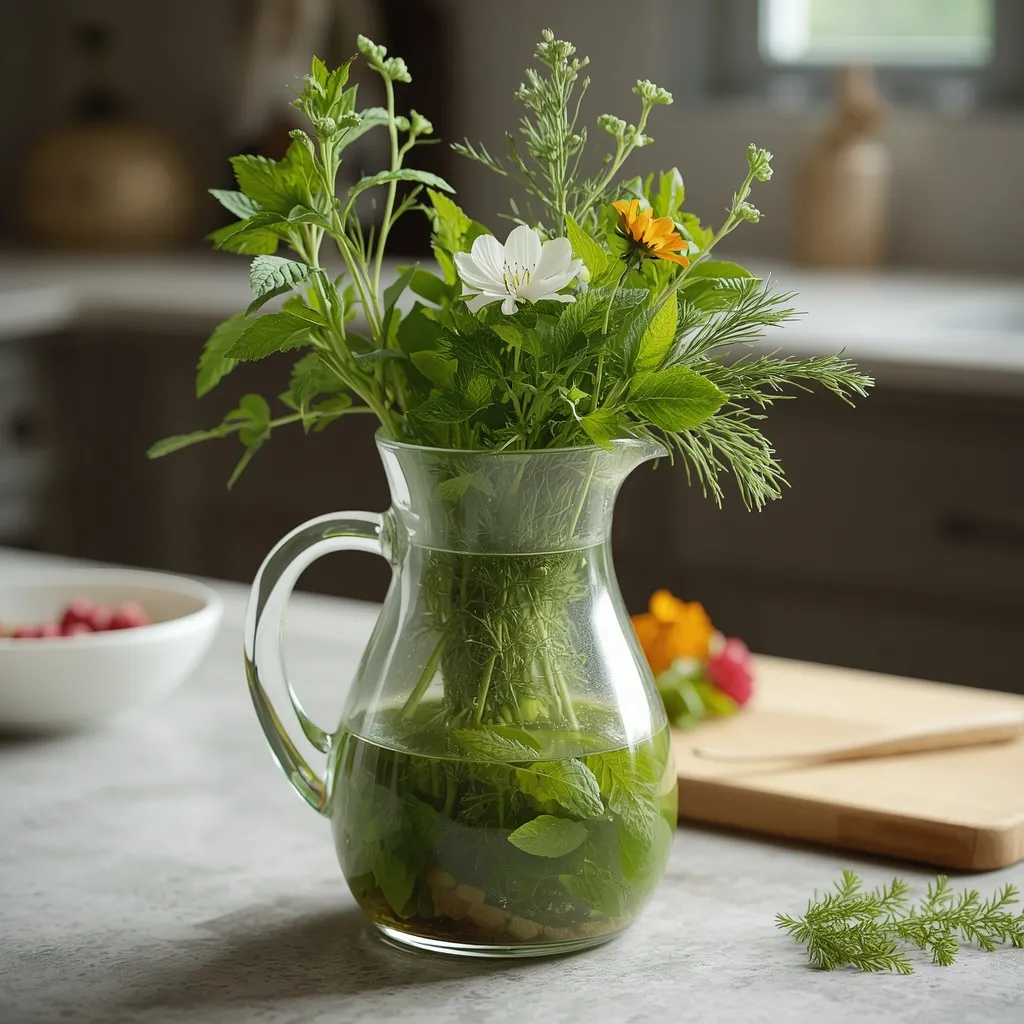
A kitchen jug mixes flowers with herbs: mint, dill, and flowering oregano among cornflowers and nasturtiums, smelling of the garden every time you pass. Practical and charming, herb arrangements earn their place twice. Green, scented, and useful.
Cut herbs before they flower fully for the best scent and structure, and note that dill and mint both wilt fast, so condition them in deep water for several hours before arranging. Nasturtium and borage flowers are edible, which makes this arrangement genuinely dual-purpose, though only eat flowers you’ve grown yourself and know to be unsprayed. Change the water every two days, as herb stems cloud water quickly. This suits kitchens, cooks, and small windowsill harvests.
- Why it works: Herbs cut before full flowering hold both scent and structure far better in the vase.
- Best for: Kitchens; cooks; windowsill and container harvests.
- Key elements: mint and dill and oregano, conditioned in deep water, edible nasturtium and borage, water changed every 2 days.
17. Sunflower Farmhouse Crock
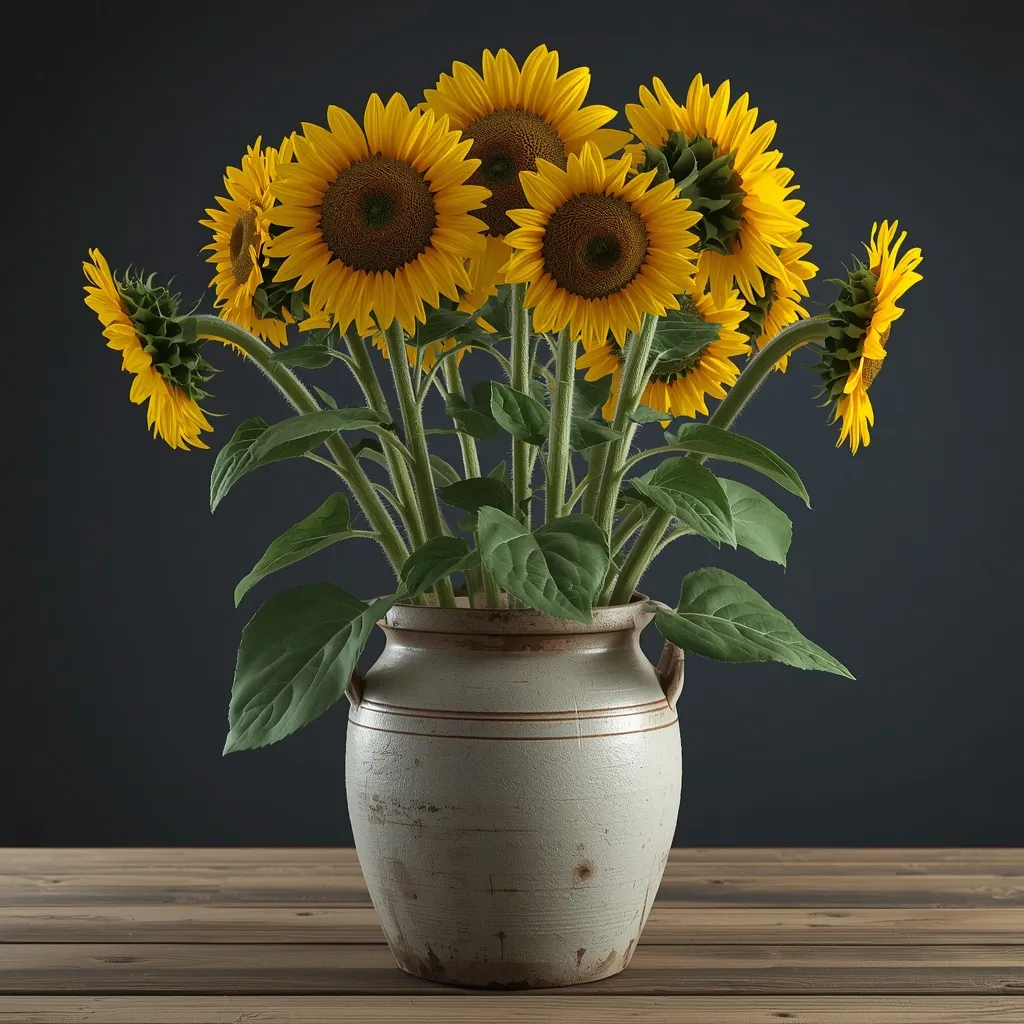
Sunflowers in a stoneware crock are pure high summer: heavy golden heads leaning outward, thick stems, and a vessel solid enough to hold them. Bold and cheerful, sunflowers need no help at all. Golden, chunky, and joyful.
Use a genuinely heavy vessel, since sunflower heads are top-heavy and a light vase will tip, a stoneware crock or thick ceramic jug is ideal. Cut stems at a sharp angle and strip all lower leaves, which are large, coarse, and rot quickly underwater. Sunflowers drink heavily, so check the water level daily rather than every few days; they can empty a small vase in twenty-four hours. This suits farmhouse kitchens, late summer, and children’s flower picking.
- Why it works: Sunflowers drink heavily enough to empty a small vase in a day, so daily topping up is essential.
- Best for: Farmhouse kitchens; late summer; family flower picking.
- Key elements: heavy stoneware vessel, angled cuts, lower leaves stripped, water checked daily.
18. Rose Garden Compote
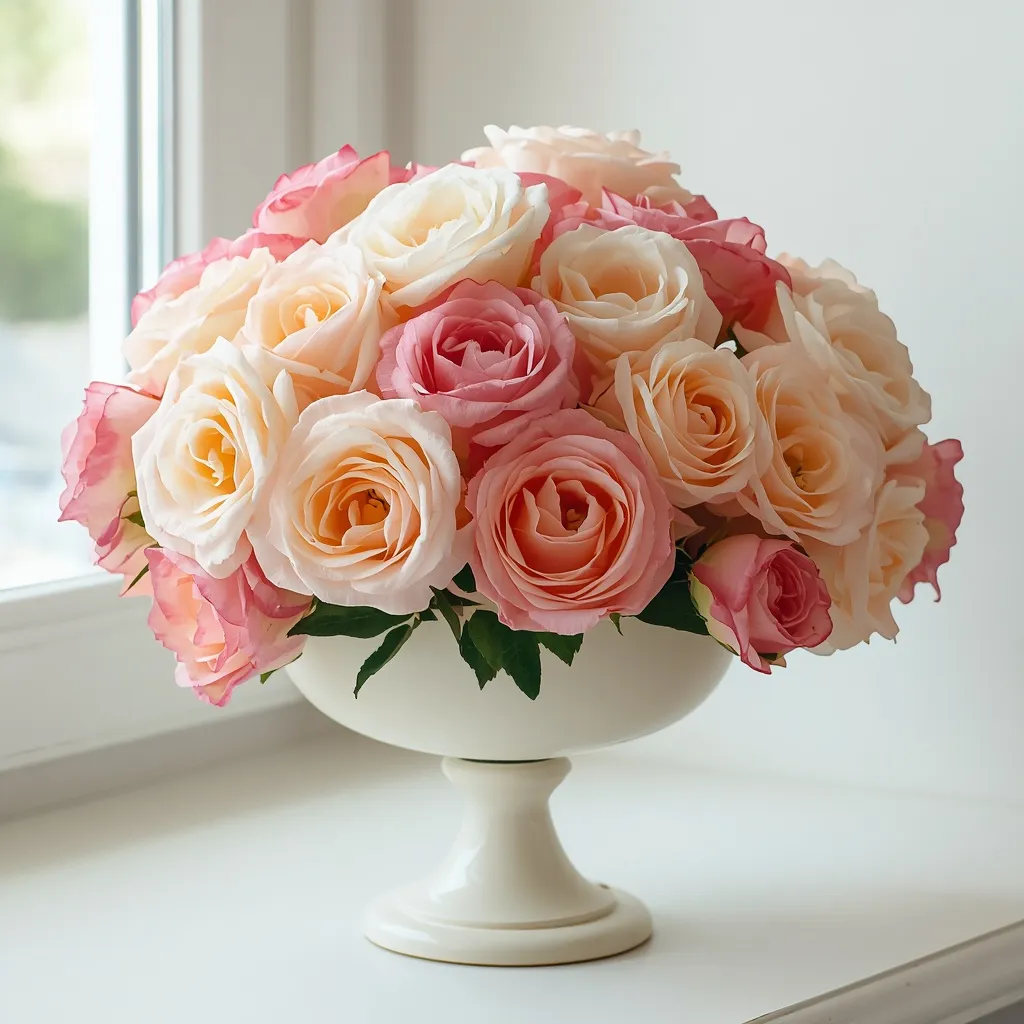
A compote of garden roses is the most romantic arrangement there is: open, blowsy blooms in soft pinks and creams, arranged loosely in a footed bowl with a little foliage. Lush and old-world, garden roses beat florist roses on scent every time. Soft, full, and fragrant.
Cut garden roses when the outer petals have just begun to unfurl rather than in tight bud, since garden varieties opened too early often fail to develop. Recut stems underwater at an angle and remove thorns and lower leaves, a rose stripper or careful secateurs work better than pulling thorns by hand, which tears the stem and shortens vase life. Wear gloves. This suits rose growers, romantic interiors, and anniversary tables.
- Why it works: Cutting when outer petals just start to unfurl gives blooms that actually open, unlike tight buds.
- Best for: Rose growers; romantic interiors; special occasions.
- Key elements: footed compote, outer petals just unfurling, stems recut underwater, thorns removed with a tool, gloves.
19. Dried and Fresh Mix
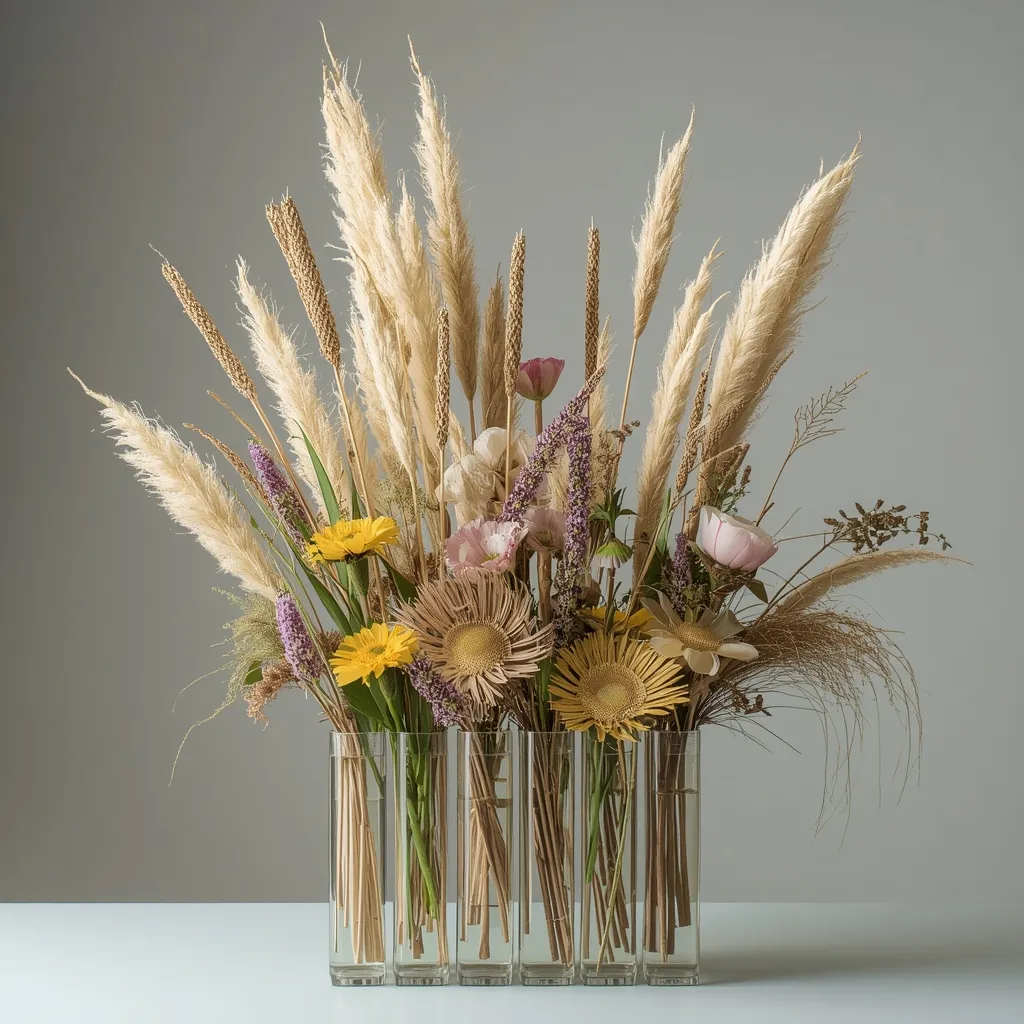
Mixing dried with fresh gives an arrangement two lifespans: dried grasses, statice, and seedheads forming a permanent skeleton, with fresh summer blooms tucked in and swapped as they fade. Clever and economical, this arrangement never fully dies. Textural, lasting, and thrifty.
Build the dried elements first as a structure, then add fresh stems into the gaps in small water tubes or a separate inner vessel so the dried material never sits in water and goes moldy. That separation is the whole trick, and it’s what most attempts get wrong. As fresh flowers fade, pull and replace them while the dried framework stays. This suits small budgets, low-effort styling, and gardeners with sporadic harvests.
- Why it works: Keeping dried material out of water using tubes or an inner vessel prevents the mold that ruins mixed arrangements.
- Best for: Small budgets; low-effort styling; occasional harvests.
- Key elements: dried skeleton built first, fresh stems in tubes or inner vessel, faded blooms swapped out.
20. Foraged Branch and Bloom
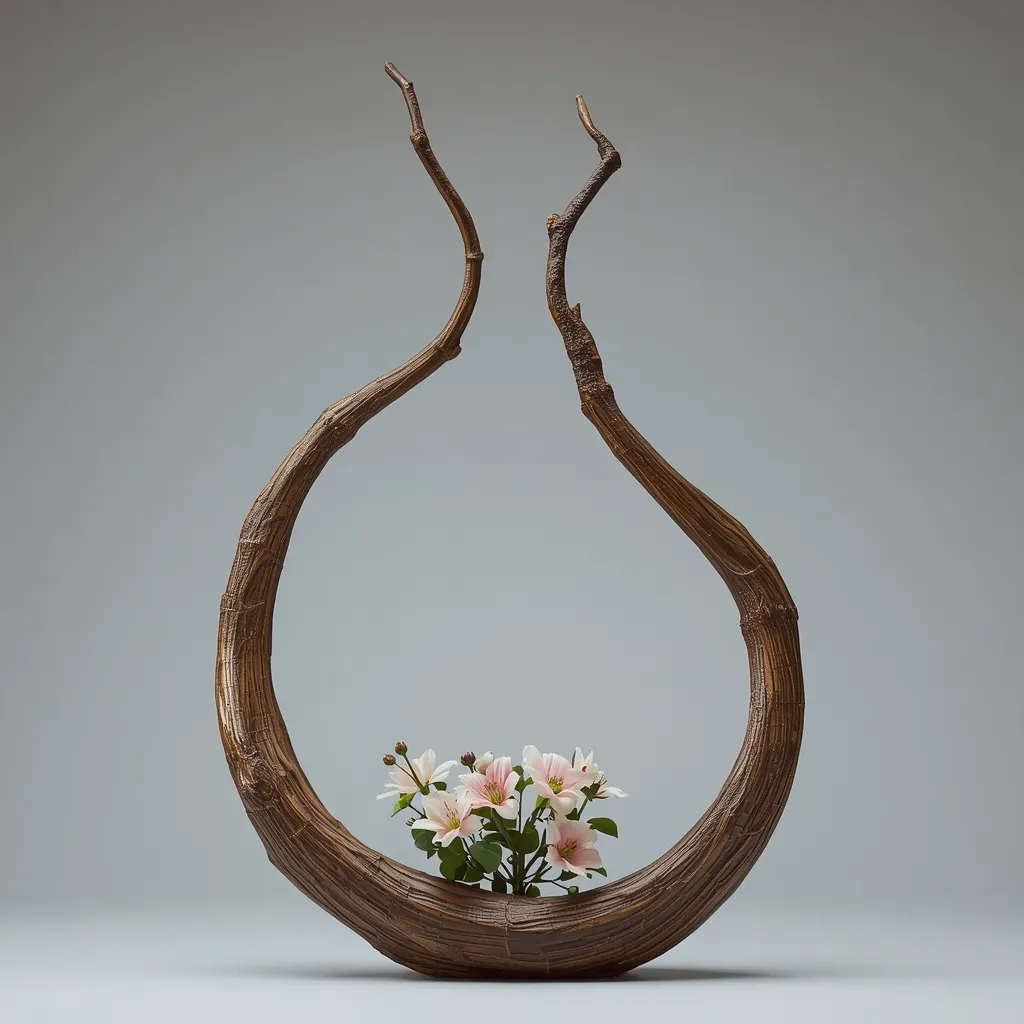
A branch arrangement builds architecture first: a few curving branches establishing the shape, with a handful of summer flowers placed low among them. Sculptural and restrained, this style makes five flowers look like twenty. Structural, spare, and striking.
Set the branches first and let their natural curves dictate the arrangement’s shape rather than forcing a symmetrical outline. Place flowers low and toward the center, where the eye lands, letting the branches carry the height. This is the most economical style here, since branches are free and the flower count can be tiny. Forage only from your own garden or with permission, never from protected sites, and check what you’re cutting. This suits minimal interiors, tiny harvests, and modern rooms.
- Why it works: Branches carrying the structure means five flowers can fill a space that would otherwise need twenty.
- Best for: Minimal interiors; very small harvests; modern rooms.
- Key elements: branches set first, natural curves followed, flowers placed low and central, foraged with permission.
21. Grocery Bunch Upgrade
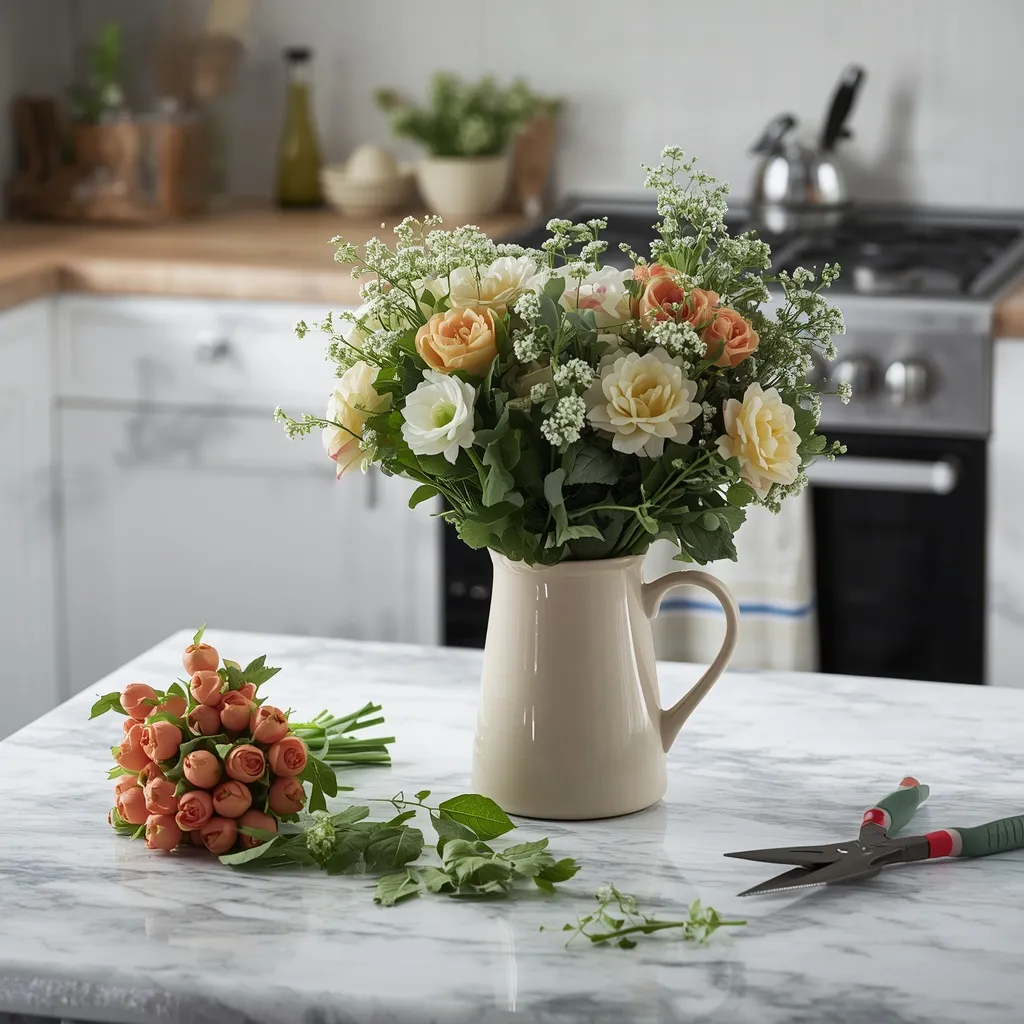
A supermarket bunch can look florist-made in ten minutes: the bunch split up, the filler discarded, one type of garden foliage added, and everything rearranged in a better vessel. Transformative and cheap, this is the most useful skill here. Fresh, considered, and inexpensive.
Break the bunch apart completely and discard the standard filler, which is usually what makes shop bunches look generic, then rebuild using one or two flower types plus foliage cut from your own garden. Recut every stem at an angle and strip the lower leaves before rearranging. Choosing a vessel that suits the stem length matters more than people expect, a bunch that looks awkward in a tall vase often looks lovely in a low jug. This suits renters, gardenless homes, and small budgets.
- Why it works: Discarding the standard filler and adding garden foliage is what removes the generic shop-bunch look.
- Best for: Renters; homes without gardens; tight budgets.
- Key elements: bunch broken apart, filler discarded, garden foliage added, stems recut, vessel matched to stem length.
22. The Cut and Condition Method
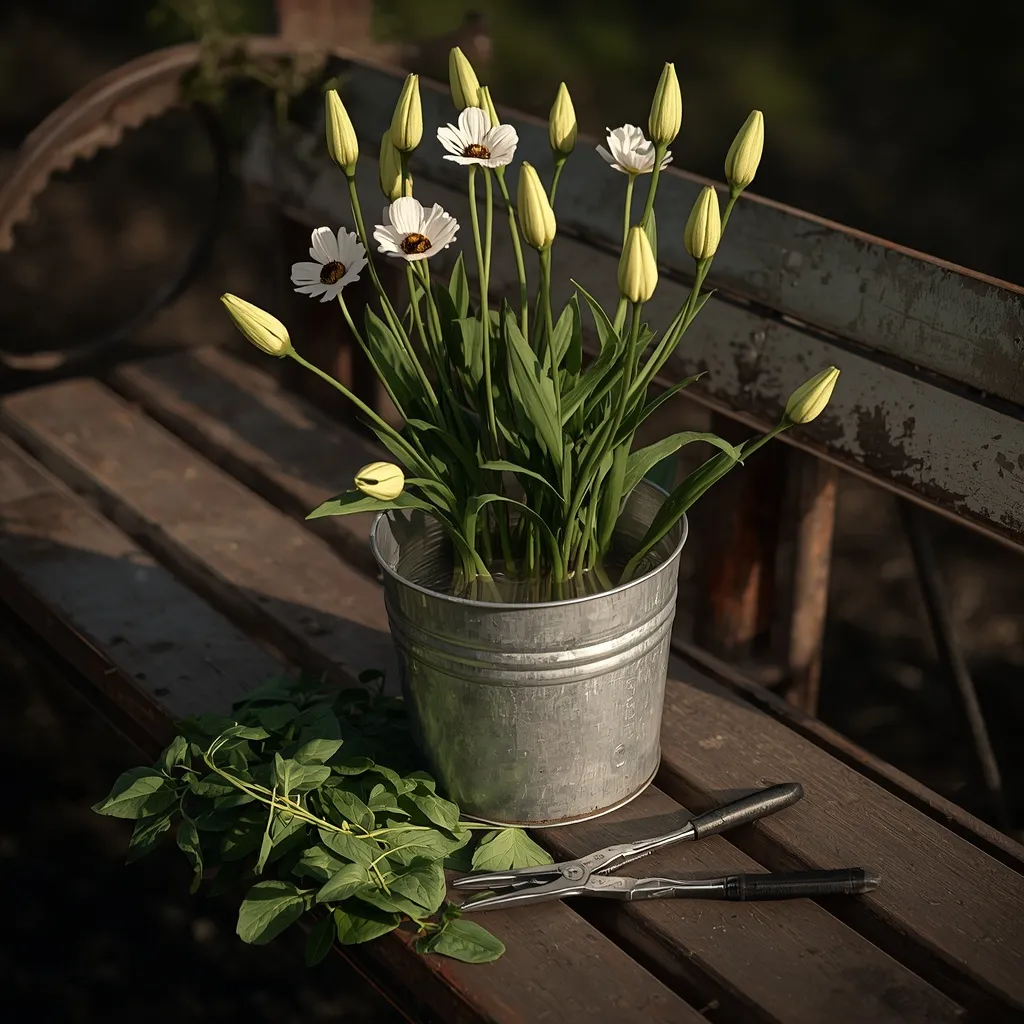
Conditioning is the invisible step that decides whether flowers last three days or ten: cutting at the right hour, stripping, recutting, and resting stems in deep water before a single one goes into a vase. Methodical and unglamorous, this is what separates florists from the rest of us. Ordered, patient, and essential.
Cut at dawn or dusk when stems are fullest of water, carrying a bucket of water into the garden and putting stems straight in. Strip every leaf that would sit below the waterline, since submerged foliage rots quickly and is the main cause of cloudy water and short vase life. Recut each stem at a 45-degree angle, then rest everything in deep cool water in a dark place for two to four hours. Use a scrupulously clean vase, as bacteria block stem uptake, and change the water every two days in summer. Keep arrangements out of direct sun and away from fruit bowls, since ripening fruit releases ethylene gas that ages flowers prematurely. For wilted hydrangeas, submerge the entire head in cool water for 30–60 minutes, as they absorb water through their bracts. This suits every arrangement in this article.
- Why it works: Stripping submerged foliage removes the main source of the bacteria that block stem water uptake.
- Best for: Every arrangement; anyone whose flowers fade too fast.
- Key elements: dawn or dusk cutting into water, leaves stripped below waterline, 45-degree recut, 2–4 hour deep-water rest, clean vase, water changed every 2 days, kept from sun and fruit.
How Do You Keep Summer Flowers Fresh Longer?
Keep summer flowers fresh by cutting at dawn or dusk, stripping every leaf below the waterline, recutting stems at an angle, and resting them in deep cool water for two to four hours before arranging. Use a scrupulously clean vase, since bacteria block the stems’ water uptake, and change the water every two days in warm weather. Keep arrangements out of direct sun and away from ripening fruit, which releases ethylene gas that ages flowers early.
Bringing the garden indoors is central to the Sunday Abode approach. The best arrangements start outside, and our guide to planning a flower bed covers growing the stems you’ll want to cut. For more seasonal inspiration, browse the rest of our flower garden ideas.
Which Summer Flowers Last Longest in a Vase?
Vase life varies enormously between summer flowers, which matters when you’re choosing what to cut for an occasion. These are typical ranges for well-conditioned stems in a clean vase.
| Flower | Typical vase life | Handling note | Best used for |
| Chrysanthemum | 10–14 days | Very hardy in heat | Memorial, long displays |
| Statice, Eryngium | 10–14 days; dries | Dries in place | Lasting mixed arrangements |
| Carnation | 7–14 days | Tolerates warmth well | Events, exposed sites |
| Sunflower | 6–10 days | Drinks heavily; top up daily | Bold summer displays |
| Rose (garden) | 5–7 days | Cut as outer petals unfurl | Romantic arrangements |
| Hydrangea | 5–10 days | Wilts; submerge head to revive | Bowls, full mass |
| Dahlia | 4–7 days | Thirsty; check water daily | Warm palettes, late summer |
| Sweet pea | 4–6 days | Short-lived; place for swapping | Scent, cottage jugs |
Safety notes: true lilies, including Lilium and daylilies, are highly toxic to cats, every part of the plant is dangerous, including pollen and the vase water itself, and ingestion can cause acute kidney failure. Leave lilies out of any arrangement going into a home with cats, and consult the ASPCA’s plant toxicity list when in doubt about other species. Several common garden plants have irritant sap: euphorbia sap in particular can cause painful skin and eye irritation, so wear gloves and eye protection when cutting it and never rub your eyes afterward. Wear gloves when handling roses and sea holly, and use a rose stripper rather than pulling thorns by hand, which tears the stem. Keep secateurs and floral knives sharp and cut away from yourself. Never leave lit candles unattended near a foliage garland or dried material, both of which are highly flammable. Check cemetery regulations before placing an arrangement, since many sites prohibit glass containers because breakage endangers staff and mowers. Forage only from your own garden or with the landowner’s permission, never from protected sites, and be certain of identification before cutting unfamiliar plants. Keep arrangements containing unknown or toxic species out of reach of children and pets, and consider skipping floral foam, which is a single-use plastic that does not biodegrade, chicken wire and pin frogs do the same job.
Frequently Asked Questions
What flowers are best for summer arrangements?
Hydrangea, dahlia, rose, sunflower, cosmos, sweet pea, scabious, and phlox are all at their peak in summer, supported by ammi, grasses, and sea holly as fillers. If you need longevity, chrysanthemums, carnations, statice, and Eryngium last ten days or more, while dahlias and sweet peas give you closer to four to seven. Match the flower to how long the arrangement needs to hold.
Why do my hydrangeas wilt so quickly?
Hydrangeas have woody stems that struggle to draw water, which makes them the most notorious wilters in the vase. Cut the stem underwater, or dip the bottom 2–3 cm (1 in) of the cut end in boiling water for about 30 seconds before arranging. If a head has already collapsed, submerge the entire flower head in cool water for 30–60 minutes, since hydrangeas take up water through their bracts as well as their stems.
When is the best time to cut flowers from the garden?
Early morning or evening, never in the heat of midday, because stems hold the most water when it’s cool. Take a bucket of water into the garden and put stems straight in as you cut. Then condition before arranging: strip the lower leaves, recut each stem at a 45-degree angle, and rest everything in deep cool water somewhere dark for two to four hours.
How do I make a low centerpiece for a dining table?
Keep the whole arrangement under about 30 cm (12 in) tall so guests can see each other across the table, and make it round so it reads well from every seat. Use a shallow compote with a pin frog or a ball of chicken wire to hold stems, which works as well as floral foam without the single-use plastic. Repeat the same palette if you’re styling several tables.
What should I use for a cemetery arrangement?
Check the cemetery’s rules first, since many prohibit glass containers outright because breakage is a hazard to staff and mowers, and some restrict container types altogether. Choose sturdy heat-tolerant flowers such as chrysanthemums, carnations, and statice, which hold up in open sun far better than soft-stemmed garden flowers. Weight the base with stones or use a ground-anchored vase so wind can’t tip it.
Are any cut flowers dangerous for pets?
Yes. True lilies, including Lilium and daylilies, are highly toxic to cats, and every part is dangerous, pollen brushed onto fur and even the vase water can cause acute kidney failure. Leave lilies out entirely if you have cats. Several other common cut flowers are toxic if eaten, so check the ASPCA’s plant list and keep arrangements out of reach of curious pets and children.
How can I make supermarket flowers look better?
Break the bunch apart completely and discard the standard filler, which is usually what makes shop bunches look generic. Rebuild using one or two flower types plus foliage cut from your own garden, recutting every stem at an angle and stripping the lower leaves. Match the vessel to the stem length, a bunch that looks awkward in a tall vase often looks lovely in a low jug.
Conclusion
The best summer floral arrangement ideas are only half about styling. A meadow jug, a hydrangea bowl, or a low table centerpiece will all look lovely on day one; whether they still look lovely on day seven comes down to cutting in the cool hours, stripping the leaves below the waterline, and giving stems a long drink before they ever reach a vase. Learn the conditioning routine once and every arrangement here becomes easier and lasts longer. For more seasonal inspiration, explore the flower garden ideas collection on Sunday Abode and cut something for the kitchen table this week.