
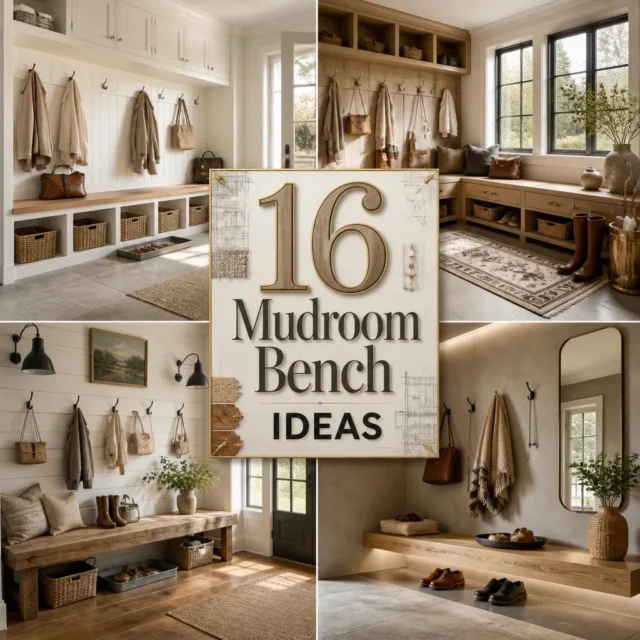

A mudroom bench is the hardest-working piece of furniture in the house, and the one most likely to be photographed spotless and empty. The best mudroom bench ideas are designed for the reality instead: wet boots, dripping coats, school bags dumped at speed, and a family who will only use a system that’s genuinely easier than the floor. At Sunday Abode, we care about the details that decide whether a beautiful room still works in February. These 16 designs come with the seat heights, hook heights, and wet-weather details that turn a pretty bench into one your household actually uses.
Key Takeaways
- Build the seat at 43–46 cm (17–18 in) high and 35–45 cm (14–18 in) deep, the height that’s comfortable to sit and pull boots on.
- Hang hooks at two heights. Adult hooks at 150–170 cm mean children physically can’t reach, so their coats end up on the floor; add a lower rail at 100–120 cm.
- Wet boots need airflow. Open or slatted cubbies dry out; sealed boxes trap damp and grow mold and smell.
- Specify washable surfaces: satin or semi-gloss paint rather than flat matte, a wipeable floor, and a performance or removable cushion cover.
- Allow roughly 30–35 cm (12–14 in) of cubby width and 45–60 cm (18–24 in) of bench length per person.
1. Classic Built-In with Cubbies
The classic mudroom built-in gives everyone a place of their own. A run of bench seating with open cubbies above, hooks in each bay, and baskets below turns a chaotic entryway into a system where every family member has a personal column.
Give each person a bay of roughly 30–35 cm (12–14 in) wide, with a hook, a cubby above for hats and gloves, and a basket below for shoes. Keep the cubbies open rather than fitted with doors: open shelving lets wet gear dry and, crucially, means nobody has to open anything, which is what makes a family actually use it. Anchor the tall upper section to the wall, since children climb these. This suits families and any dedicated mudroom, and it’s the layout everything else is a variation of.
- Best for: families; giving every person their own column of storage.
- Why it works: open cubbies dry wet gear and remove the friction of opening doors.
- Key elements: 30–35 cm bays, hook per bay, open cubby above, basket below.
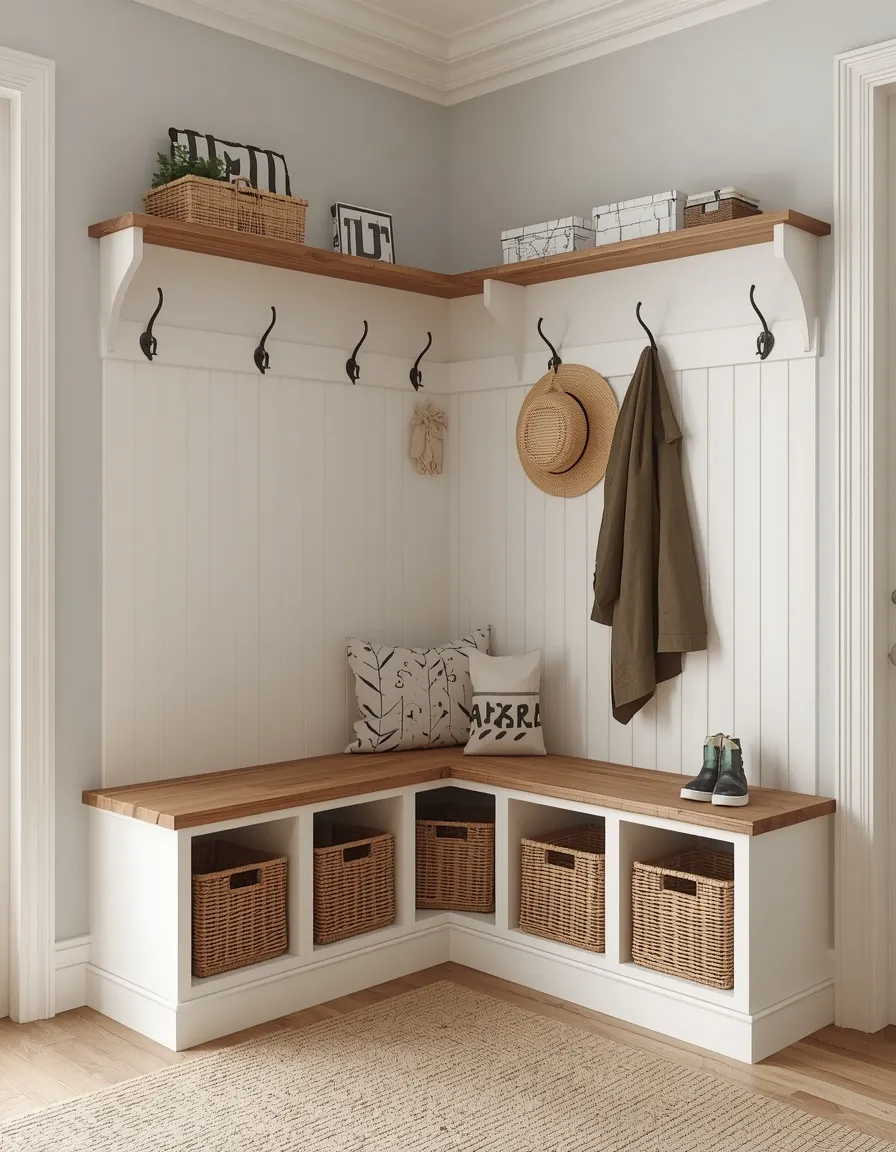
2. Corner Mudroom Bench
An L-shaped corner bench uses the one part of an entryway that furniture never fits. Two runs meeting at right angles create generous seating and storage without pushing into the walking path.
Build both runs at the same 43–46 cm (17–18 in) seat height, and use the corner itself for a tall basket or a boot tray rather than treating it as a seat, since the inside corner is awkward to sit in. Corners are dead space in most entryways, which is exactly what makes this the most efficient use of a small mudroom. Add hooks along both walls to double the hanging capacity. This suits small mudrooms, square entryways, and anyone squeezing storage into an awkward footprint.
- Best for: small, square mudrooms and awkward entryway footprints.
- Why it works: corners are dead space standard furniture can’t use anyway.
- Watch out: don’t plan the inside corner as a seat; use it for a basket or boot tray.
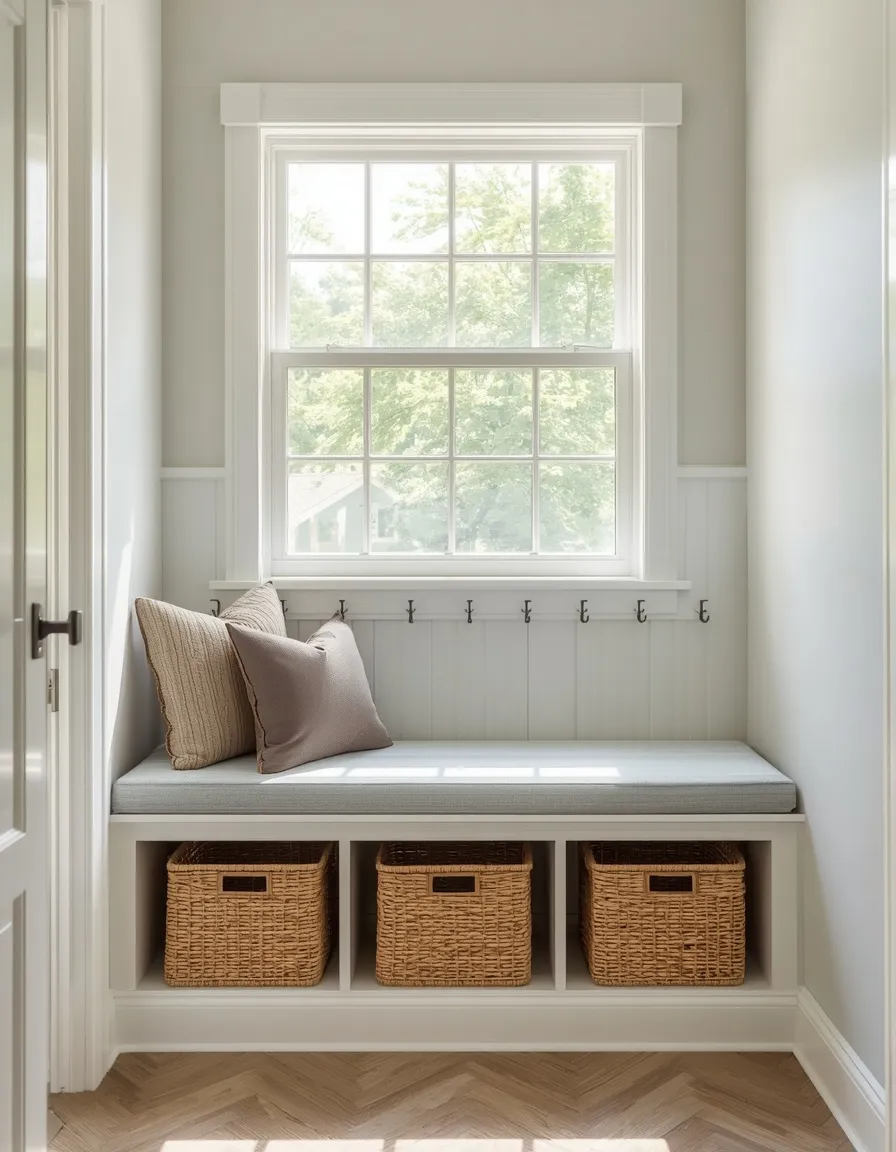
3. Bench Under a Window
A bench beneath a window turns a mudroom into somewhere you’d actually linger. Natural light falls across the seat, a cushion softens it, and the view makes pulling on boots feel less like a chore.
Before building, check what’s under that window, a radiator is the most common obstacle, and boxing one in solidly will waste its heat and warm the seat unpleasantly. If a radiator is there, leave a ventilated gap or fit a slatted front so heat escapes. Daylight is genuinely useful in a mudroom for spotting mud and matching gloves. Keep the cushion cover removable and washable. This suits mudrooms and entryways lucky enough to have a window, and it makes the room feel like part of the house rather than a utility corridor.
- Best for: mudrooms with a window; making the space feel less utilitarian.
- Watch out: check for a radiator; box it in only with a ventilated or slatted front.
- Key elements: bench under the window, washable cushion, storage beneath.
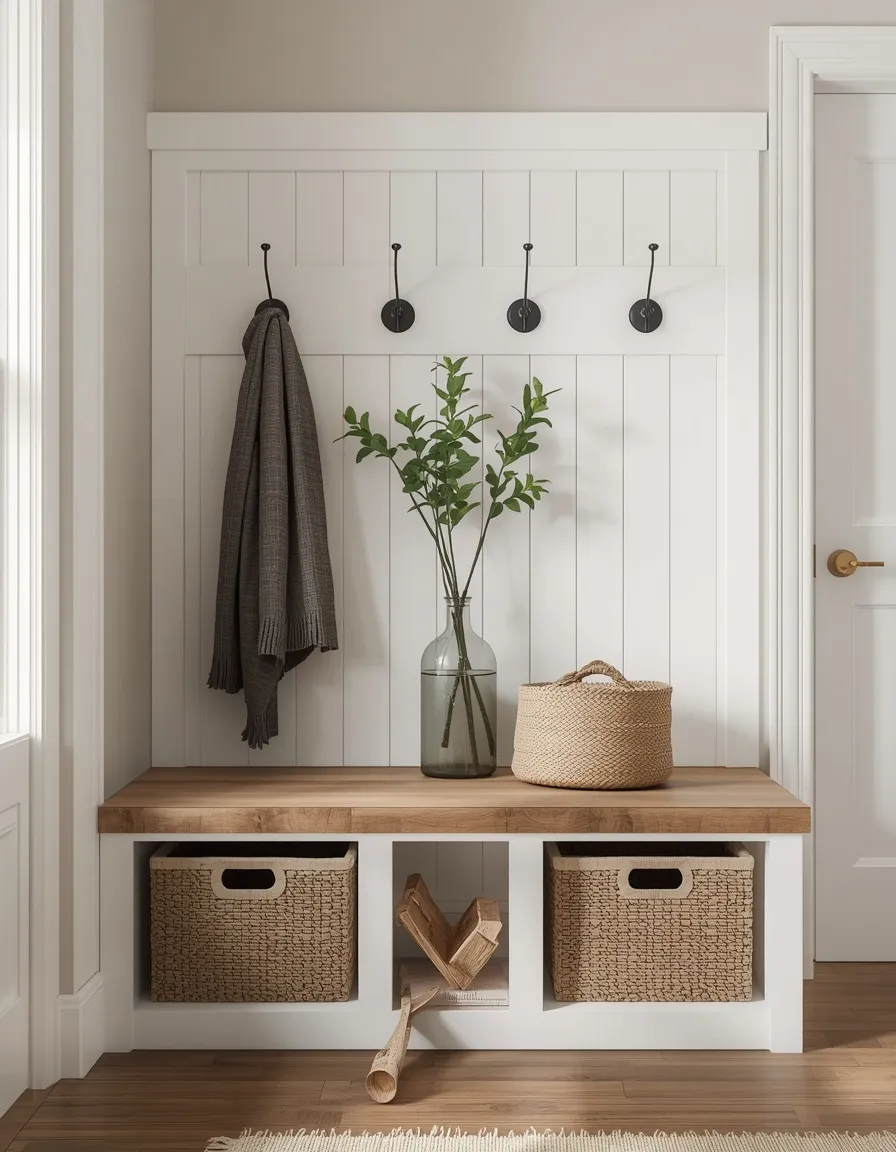
4. Farmhouse Shiplap Bench
Shiplap panelling behind a mudroom bench delivers instant farmhouse warmth. Horizontal boards painted soft white, black iron hooks, a chunky wood seat, and woven baskets create the classic country drop zone.
Run shiplap or beadboard up the wall behind the bench to around 120–150 cm (48–60 in), which protects the wall from bags and boots as well as looking good. Paint it in a satin or semi-gloss finish rather than flat matte, because a mudroom wall gets scuffed constantly and flat paint cannot be scrubbed. Pair with iron hooks and seagrass baskets. This suits farmhouse, cottage, and traditional homes, and the panelling doubles as genuine wall protection where it takes the most abuse.
- Best for: farmhouse and cottage homes; panelling protects the wall too.
- Watch out: use satin or semi-gloss paint; flat matte can’t be scrubbed clean.
- Key elements: shiplap to 120–150 cm, iron hooks, chunky seat, woven baskets.
5. Modern Floating Bench
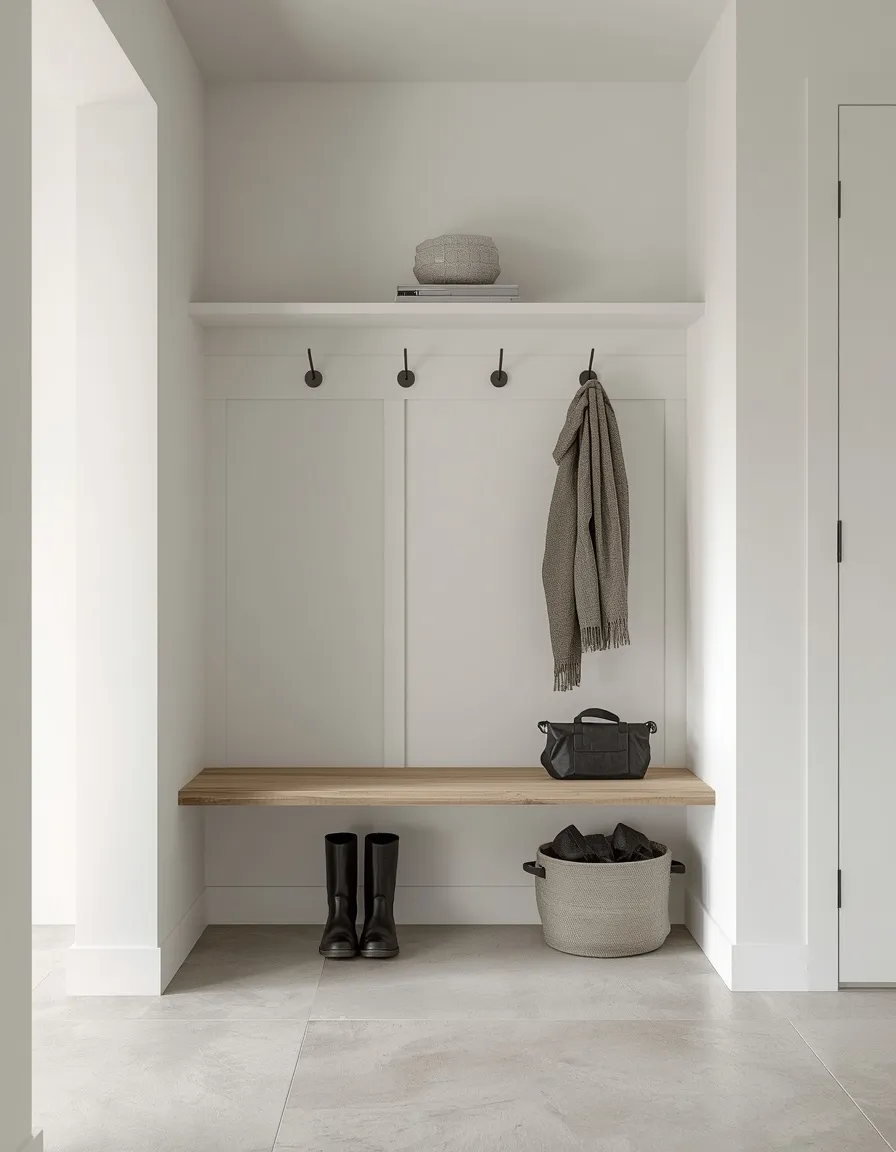
A wall-mounted floating bench keeps a modern entryway sharp and open. With no legs, the seat appears to hover, the floor stays clear beneath, and cleaning under it takes seconds.
The floating design has a practical advantage beyond looks: a clear floor beneath means you can mop straight under it, which matters enormously in a room that collects grit and mud. Mount it into wall studs, not just plasterboard, since a bench takes the full weight of an adult sitting down hard. Keep the seat at 43–46 cm (17–18 in), and add a boot tray beneath rather than closed storage. This suits modern homes, small entryways, and anyone who wants the room easy to clean.
- Best for: modern homes and anyone who wants to mop straight under the bench.
- Watch out: fix into studs; a bench takes an adult’s full weight sitting down.
- Key elements: wall-mounted seat, clear floor beneath, boot tray.
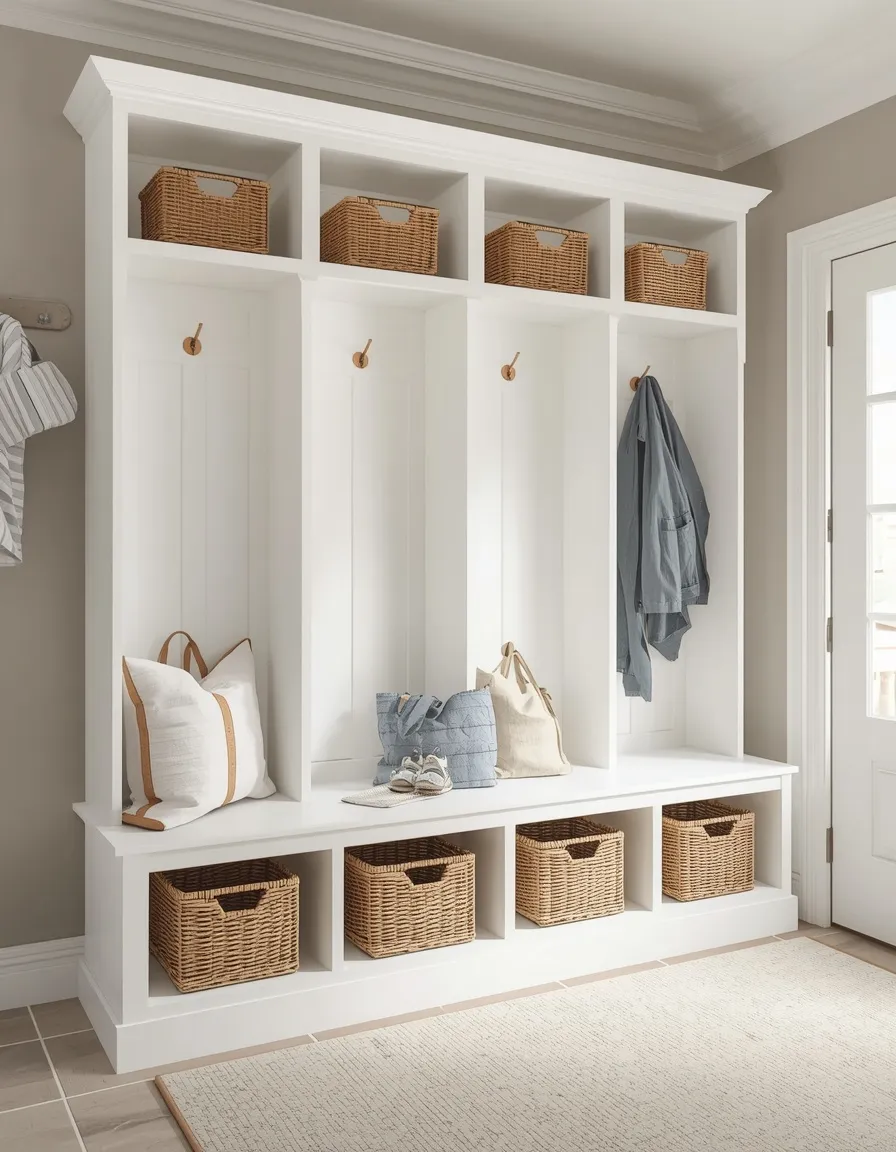
6. Crisp White Locker Bench
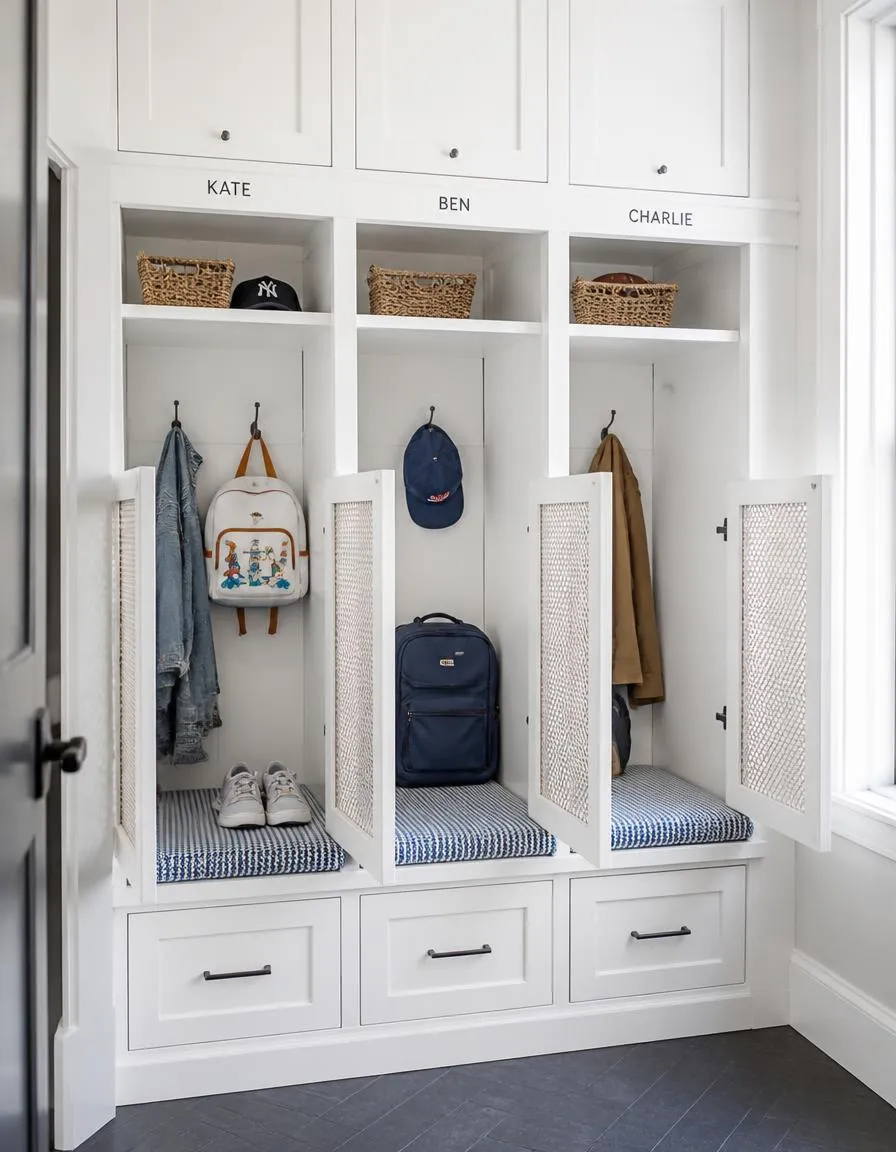
Locker-style storage brings order to a busy family entryway. Tall white lockers with a bench seat between them, each with a hook and a shelf, look clean and impose structure on the daily chaos.
Give each locker a name or label, since named ownership is what actually stops the system collapsing into a shared dumping ground. Half-doors or open fronts beat full closed doors, both for airflow around damp coats and because doors add a step people skip. Choose a durable, wipeable finish in satin or semi-gloss white, and anchor the tall lockers securely to the wall, which is essential in any home with children. This suits busy families and larger mudrooms with wall space to give.
- Best for: busy families and larger mudrooms with wall space.
- Why it works: named lockers stop the system becoming a shared dumping ground.
- Watch out: anchor tall lockers to the wall; children climb them.
7. Rustic Reclaimed Wood Bench
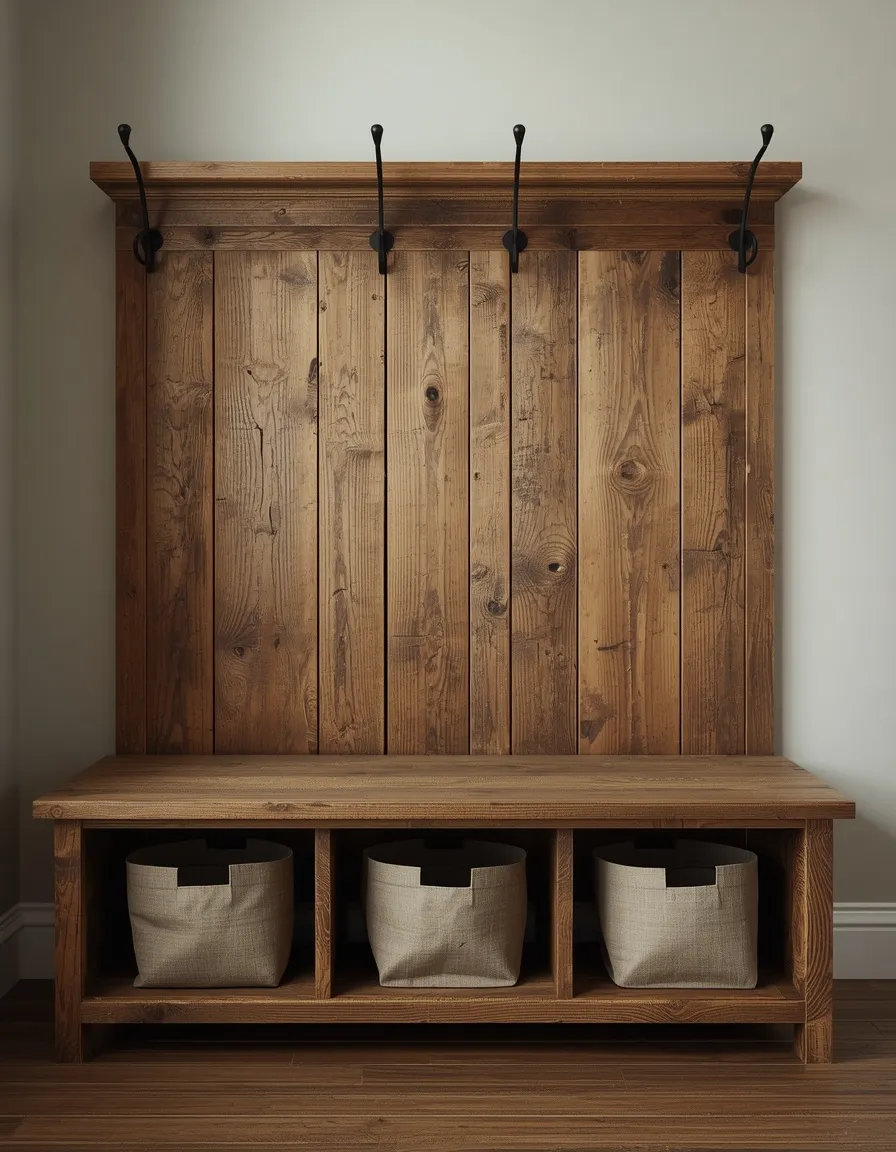
A reclaimed timber bench brings warmth and forgiveness to a hardworking room. Weathered wood with visible grain and old nail holes looks better with every scuff, which is exactly the right instinct for a mudroom.
Choose reclaimed or solid timber and seal it well, a mudroom bench meets wet coats and dirty boots constantly, so an unsealed surface will stain and eventually rot. Use a hardwearing water-resistant finish rather than a decorative wax. The great advantage of reclaimed wood here is that it already looks weathered, so a new scratch simply joins the story rather than ruining a pristine surface. Pair with iron hooks and canvas baskets. This suits rustic and farmhouse homes and anyone tired of protecting furniture.
- Best for: rustic homes and anyone tired of protecting perfect furniture.
- Why it works: weathered timber absorbs new scuffs into its character.
- Watch out: seal it properly; unsealed wood stains and rots in a wet mudroom.
8. Slim Entryway Bench
In a narrow hallway, a slim bench is the only kind that works. A shallow seat against one wall, hooks above, and a low shoe rack beneath give you a proper drop zone in a corridor with no room to spare.
Keep the depth to around 30–35 cm (12–14 in), shallower than a full mudroom bench, so you preserve walking width, and check you still have at least 90 cm (36 in) of clear passage. This is enough to sit and pull shoes on, which is the bench’s real job. Wall-mounted hooks and a shallow shoe rack beneath do the storage work without eating floor space. This suits narrow hallways, apartments, and homes with no dedicated mudroom at all, proving you don’t need a whole room to have a drop zone.
- Best for: narrow hallways and homes with no dedicated mudroom.
- Watch out: keep 90 cm (36 in) of clear passage; 30–35 cm bench depth is enough.
- Key elements: shallow seat, wall hooks above, low shoe rack beneath.
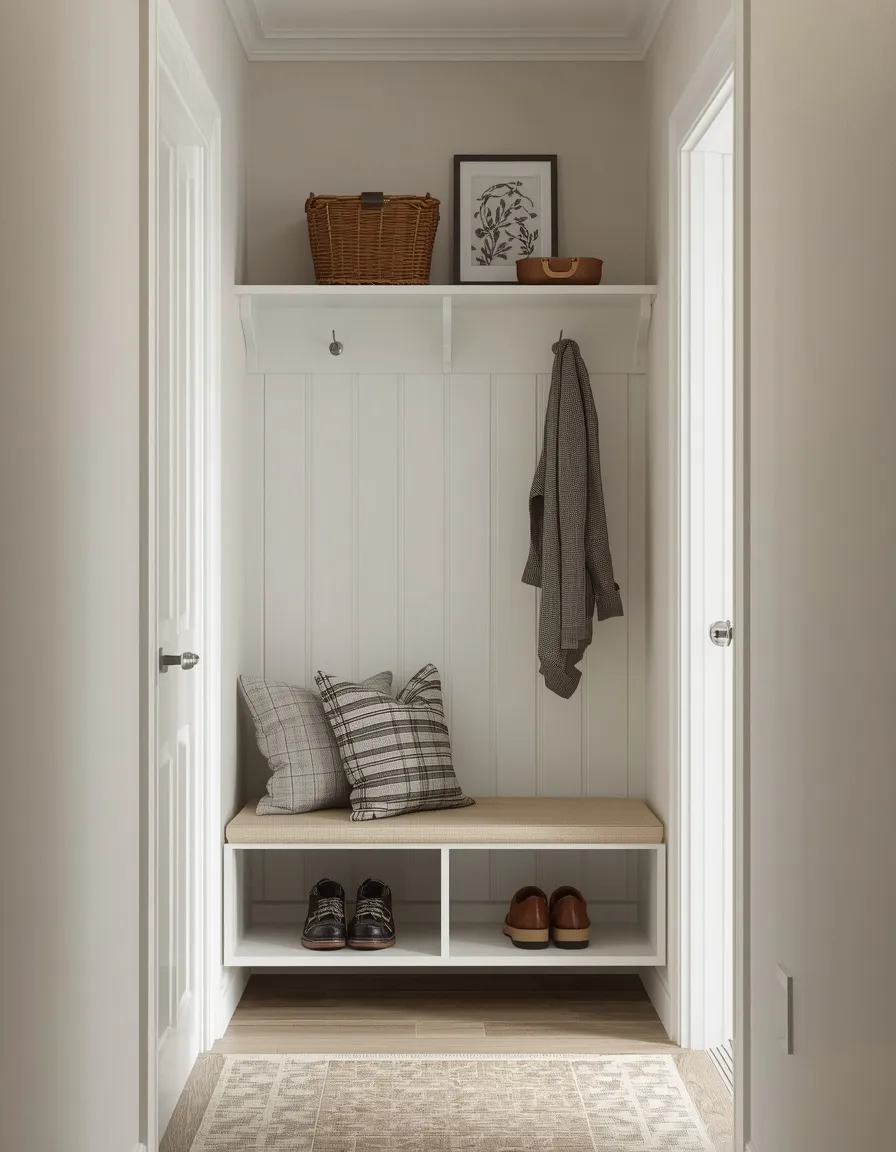
9. Bench with Shoe Drawers
Pull-out drawers beneath a bench hide the shoe pile completely. Deep drawers slide out to reveal neatly stacked footwear, keeping the floor clear and the entryway looking tidy even when it isn’t.
Drawers on full-extension runners let you reach the back, which is the difference between a drawer that gets used and one that becomes a shoe graveyard. The important caveat: closed drawers trap moisture, so wet boots should never go straight in. Keep a separate open boot tray for wet footwear and reserve the drawers for dry shoes, or drill ventilation holes in the drawer backs. This suits tidy households, formal entryways, and anyone who wants the shoes genuinely out of sight.
- Best for: tidy households wanting shoes completely out of sight.
- Watch out: never put wet boots in closed drawers; keep an open tray for those.
- Key elements: full-extension runners, dry-shoe drawers, separate wet boot tray.
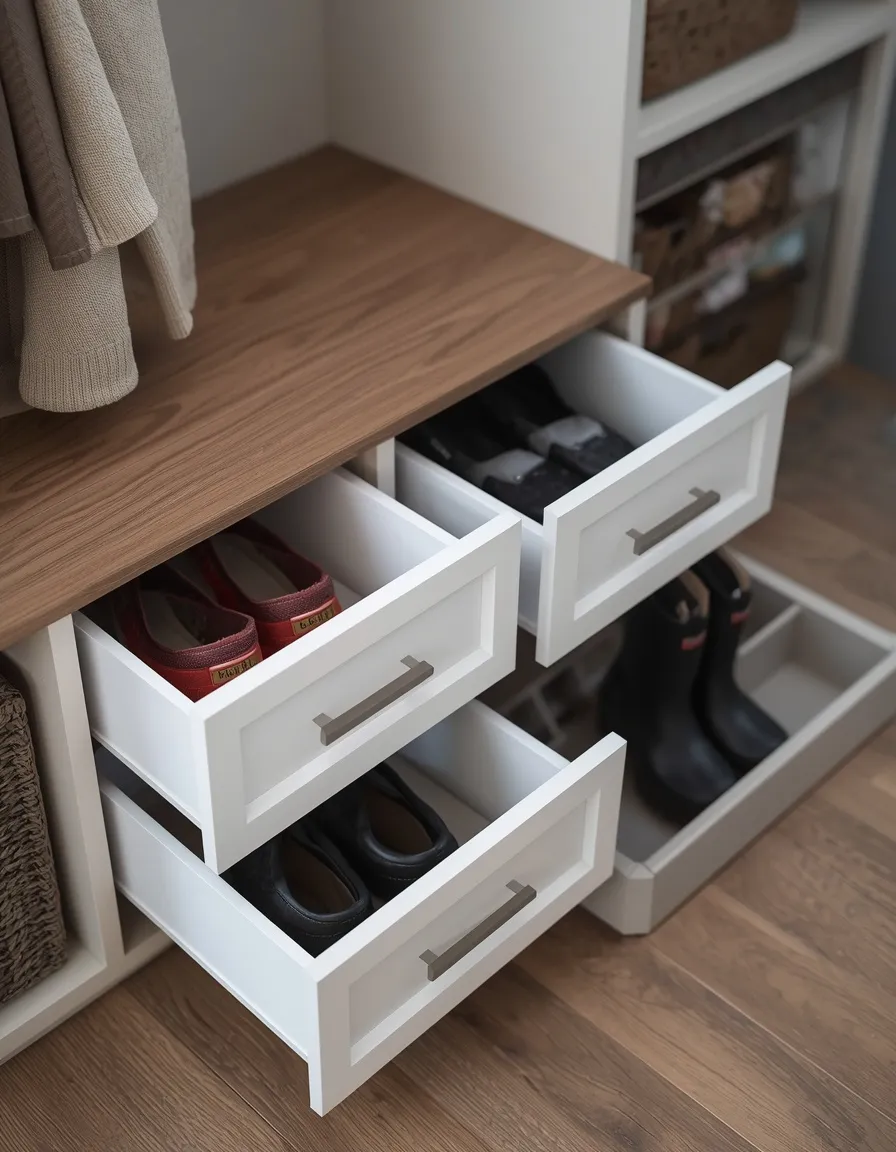
10. Full Drop Zone with Hooks
A bench paired with a proper hook wall becomes the household’s landing strip. Coats, bags, dog leads, and keys all land in one place the moment anyone walks in, and the floor stays clear.
This is where the most useful detail in the whole article lives: hang hooks at two heights. Adult hooks sit at around 150–170 cm (60–67 in), but a child physically cannot reach them, which is precisely why children’s coats end up on the floor. Add a lower rail at 100–120 cm (40–47 in) and the problem largely solves itself. Use sturdy double hooks rated for a heavy winter coat and a school bag together, fixed into studs. This suits families and any home where the entryway becomes a coat mountain.
- Best for: families; the single fix for coats ending up on the floor.
- Why it works: a lower rail at 100–120 cm lets children hang their own coats.
- Key elements: dual-height hooks, sturdy double hooks, fixed into studs.
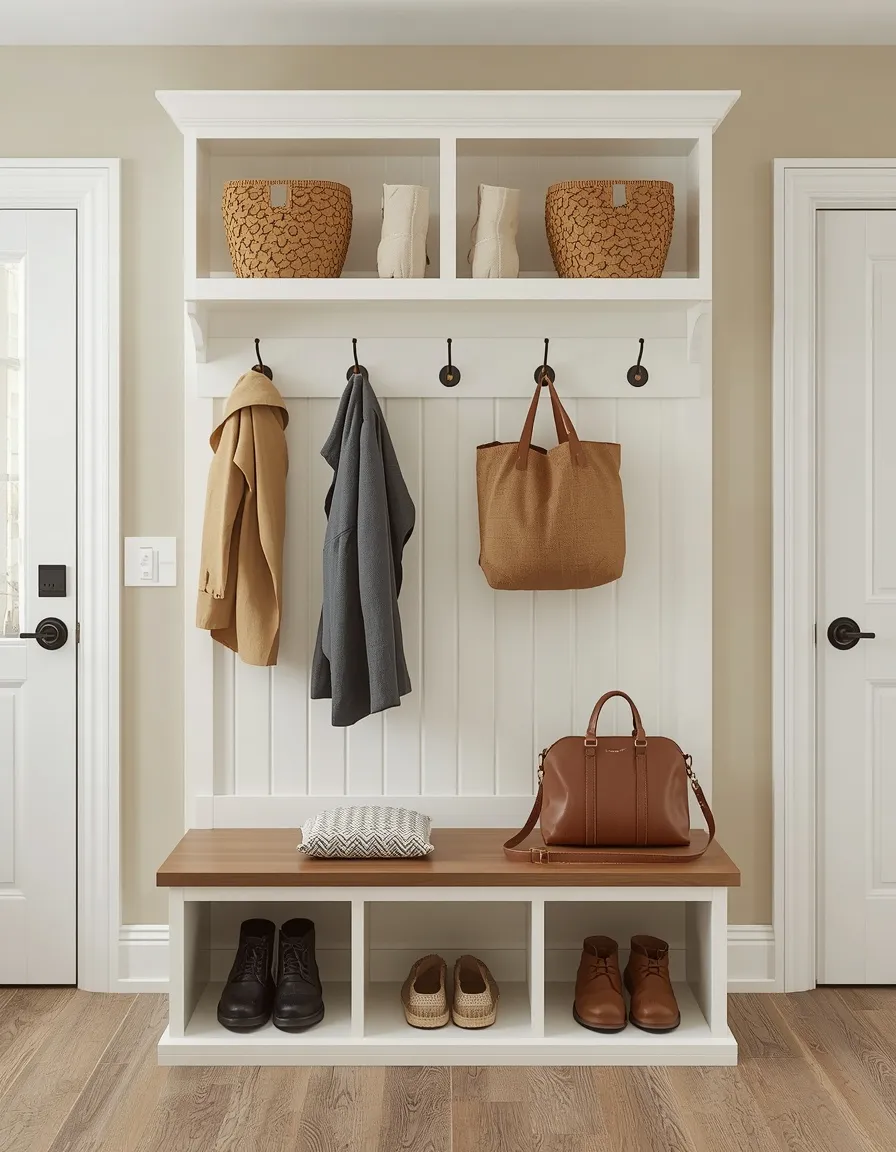
11. Bench with Basket Storage
Baskets under a bench are the most forgiving storage there is. Woven bins slide in and out beneath the seat, swallowing hats, gloves, and sports kit with no lids to open and no organizing required.
Baskets win because they demand nothing: there’s no lid, no drawer, no folding, so even a rushed child can use them. Size the openings to fit the baskets before you build, allowing about 2–3 cm of clearance each side. Choose baskets that can be pulled out entirely and tipped over a bin, and label them if more than one person is using them. Woven baskets breathe, which suits a mudroom far better than sealed plastic boxes. This suits families, children, and anyone whose storage systems keep failing.
- Best for: families and anyone whose tidier systems keep collapsing.
- Why it works: no lid and no folding means even a rushed child will use them.
- Key elements: breathable woven baskets, 2–3 cm clearance, labels.
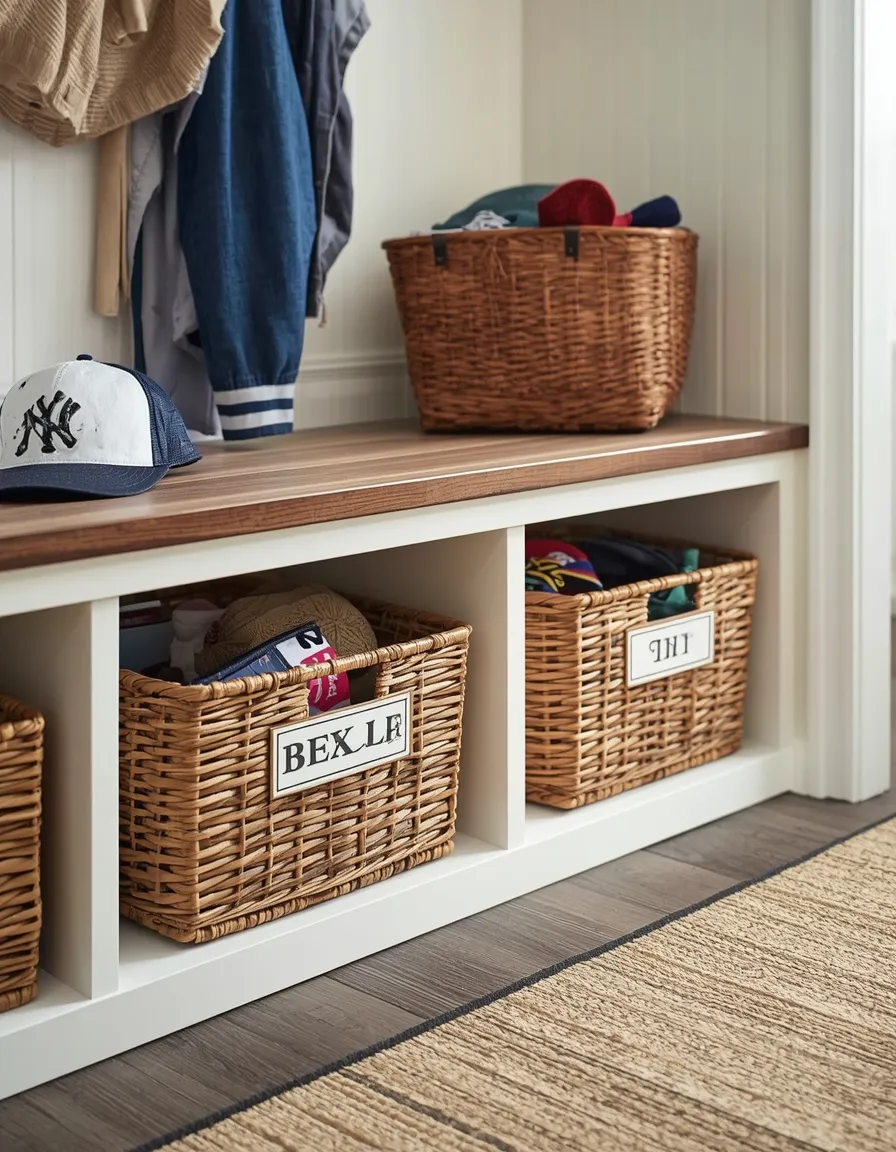
12. Family Command Center
A mudroom bench with a command center above turns the entryway into the household’s control panel. A chalkboard or pinboard, a calendar, mail slots, and a charging drawer sit above the seat, catching everything that comes through the door.
Combine the bench with a wall system holding a family calendar, a slot per person for post and school letters, and a small charging station for phones and keys. Keeping keys, mail, and school forms at the door is what stops them migrating to the kitchen counter, which is the usual fate. If you include charging, keep the outlet properly installed and don’t run trailing extension leads across a wet-floor room. This suits busy families, larger mudrooms, and anyone tired of hunting for permission slips.
- Best for: busy families drowning in mail, keys, and school letters.
- Why it works: catching paper at the door stops it colonizing the kitchen counter.
- Watch out: no trailing extension leads in a room with a wet floor.
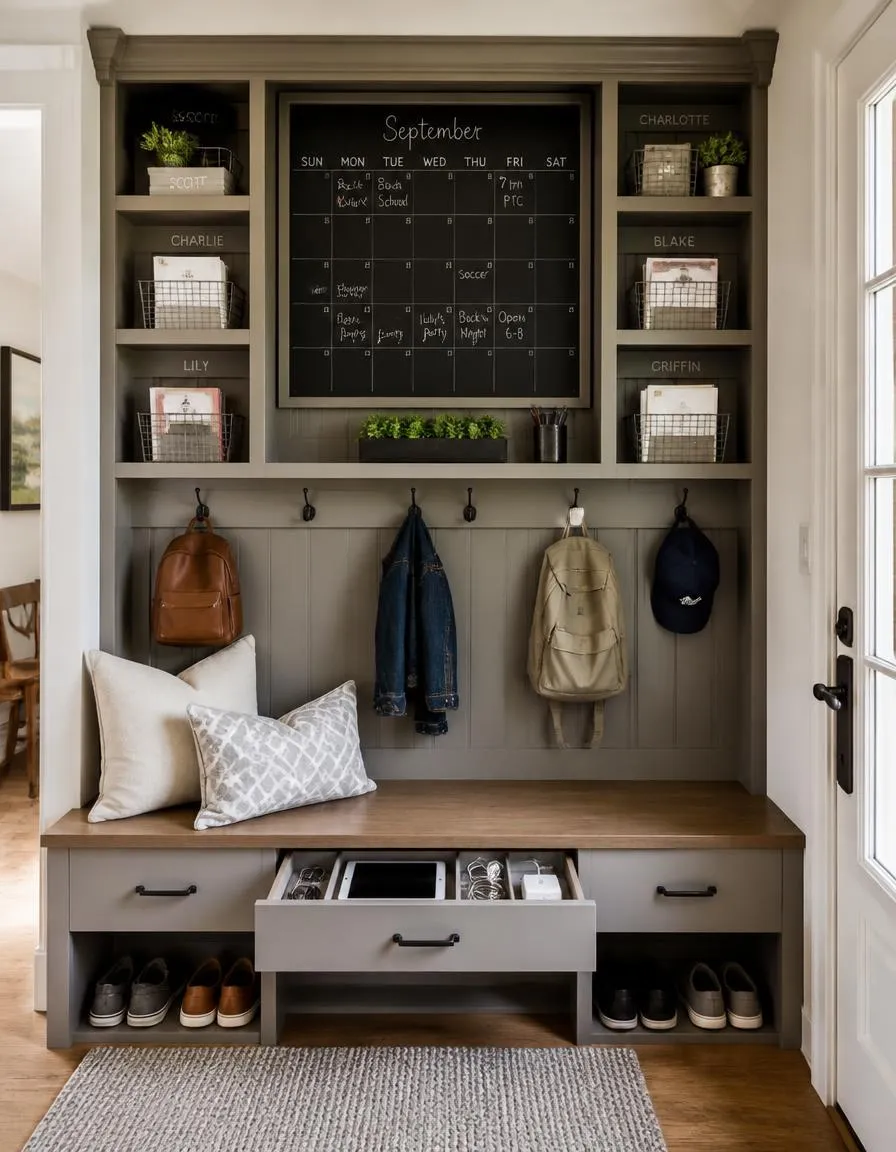
13. Budget DIY Cabinet Bench
A row of kitchen cabinets topped with a timber board makes an excellent mudroom bench for very little. Standard wall cabinets laid on their backs, capped with a solid seat, give you built-in looks and generous closed storage.
Use stock kitchen wall cabinets as the base, checking the finished height lands at 43–46 cm (17–18 in) once you add the seat board and any plinth. Cap them with a solid timber top, add a cushion, and fix hooks above. This is the classic budget route to a built-in look and costs a fraction of custom joinery. Fix the cabinets to the wall so the bench can’t shift when someone sits down heavily. This suits DIY builders, renters with permission, and anyone wanting the built-in look on a budget.
- Best for: DIY builders wanting a built-in look at a fraction of the cost.
- Watch out: check the finished height lands at 43–46 cm; fix cabinets to the wall.
- Key elements: stock wall cabinets, solid timber top, cushion, hooks above.
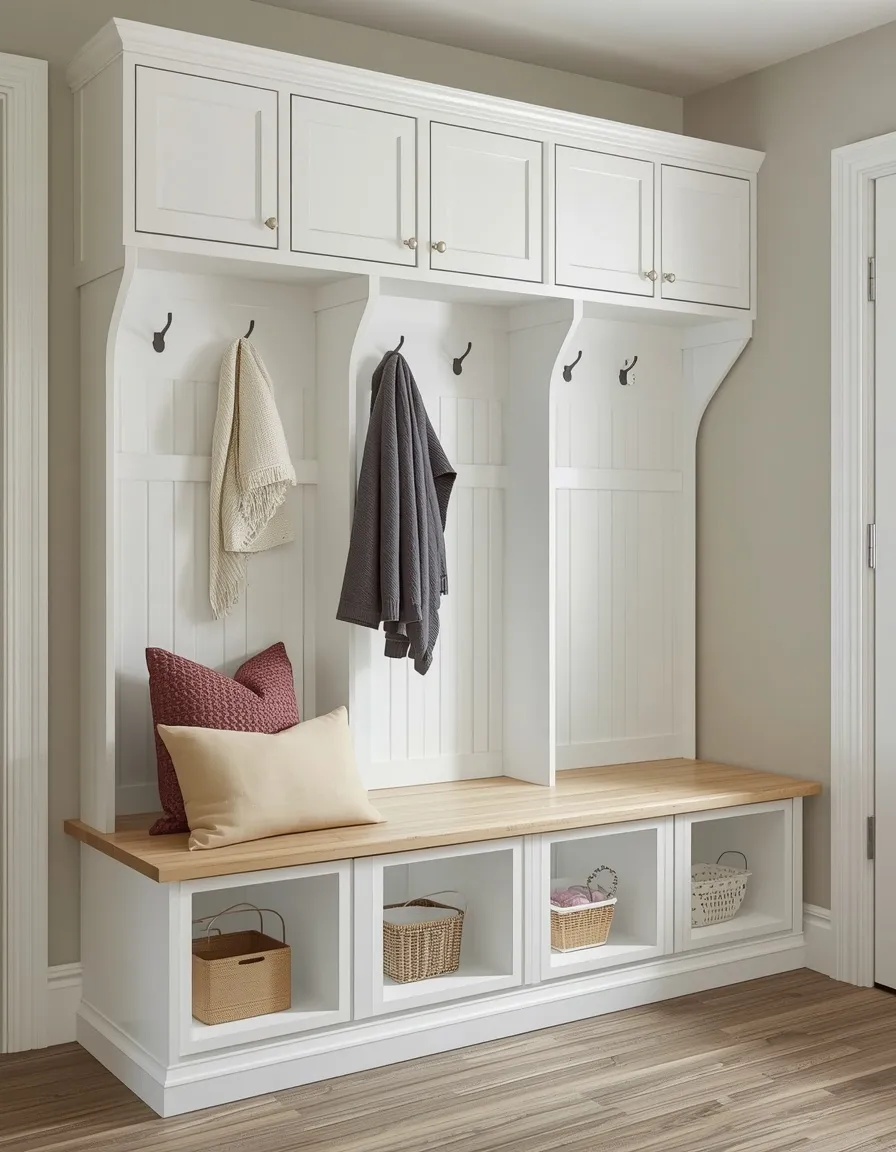
14. Pet-Friendly Mudroom Bench
For households with dogs, the mudroom is where muddy paws are dealt with. A bench with leash hooks, a towel rail, a feeding nook beneath, and a wipeable floor makes the whole routine happen at the door rather than through the house.
Build in a low hook for leashes and a rail for a dedicated dog towel right beside the door, so paws get wiped before the dog reaches the hallway. A recessed nook beneath the bench for food and water bowls keeps them out of the walkway. Choose a genuinely wipeable floor, tile or vinyl rather than raw timber, since this corner takes the worst of it. A wet dog and a warm sealed cupboard is a mold recipe, so keep the towel out in the air to dry. This suits dog owners in any home.
- Best for: dog owners; dealing with muddy paws at the door.
- Key elements: leash hook, towel rail, recessed bowl nook, wipeable floor.
- Watch out: dry the dog towel in open air; a damp towel in a cupboard grows mold.
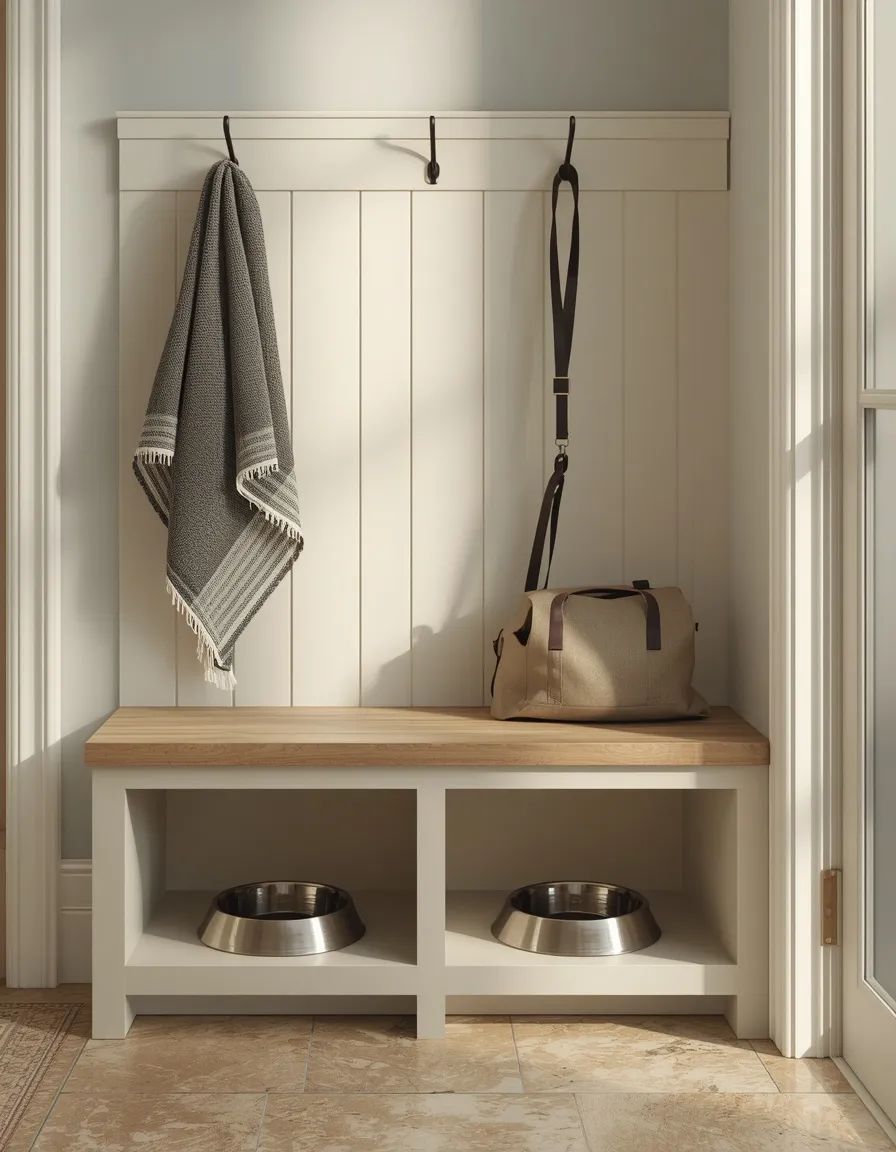
15. Laundry-Mudroom Combo
Combining a mudroom bench with laundry makes a genuinely efficient utility room. A bench and hooks beside the machines mean muddy clothes go straight into the wash instead of tracking through the house.
Place a laundry basket or a built-in hamper right beside the bench, so filthy sports kit gets stripped off and dropped in at the door, which is the whole point, and the reason this combination works so well. Add a folding counter above the machines if space allows. Ventilation is critical here, since a room with a washing machine, damp coats, and wet boots holds a lot of moisture; make sure there’s an extractor or an opening window, or the room will smell and grow mold. This suits homes where the back door and utility room share a space.
- Best for: homes where the back door and utility room already share a space.
- Why it works: muddy kit goes straight into the wash instead of through the house.
- Watch out: ventilate properly; damp coats plus a washer breeds mold and smell.
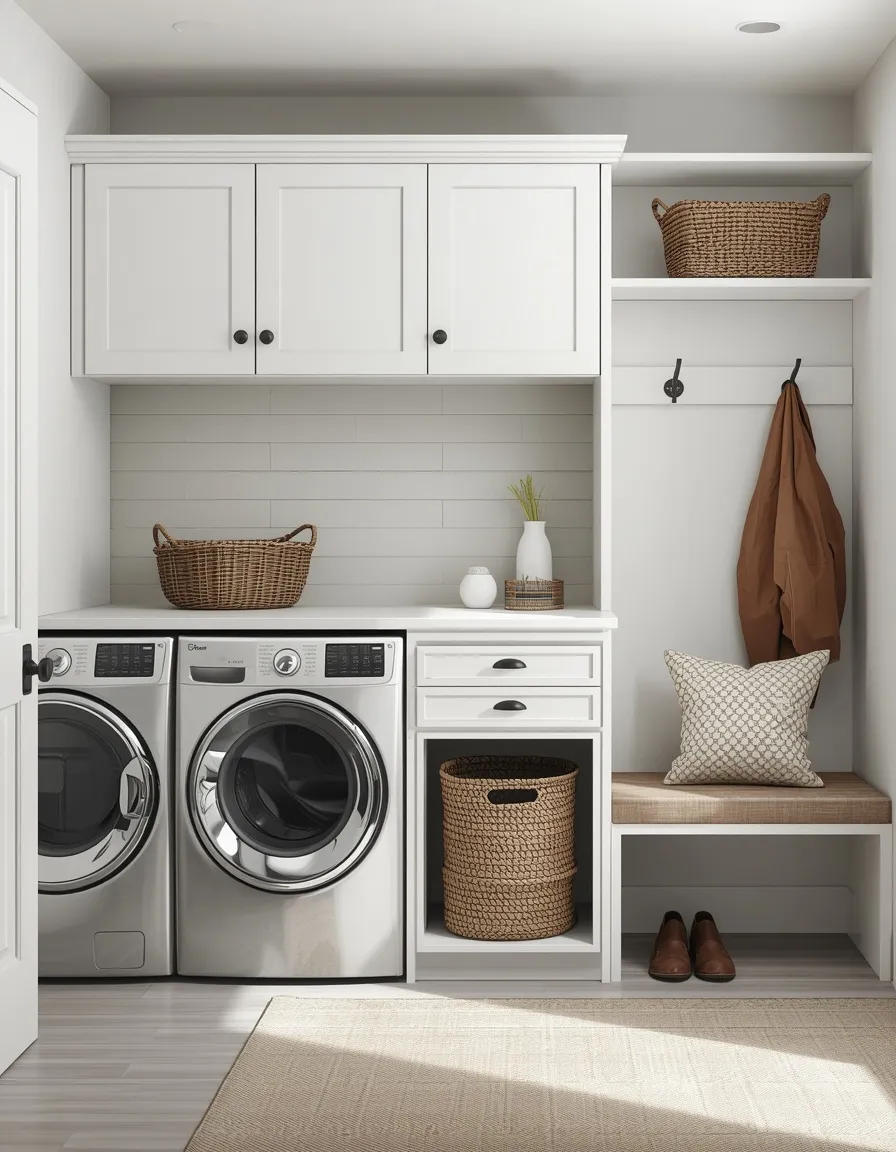
16. Styled Bench with Decorative Accents
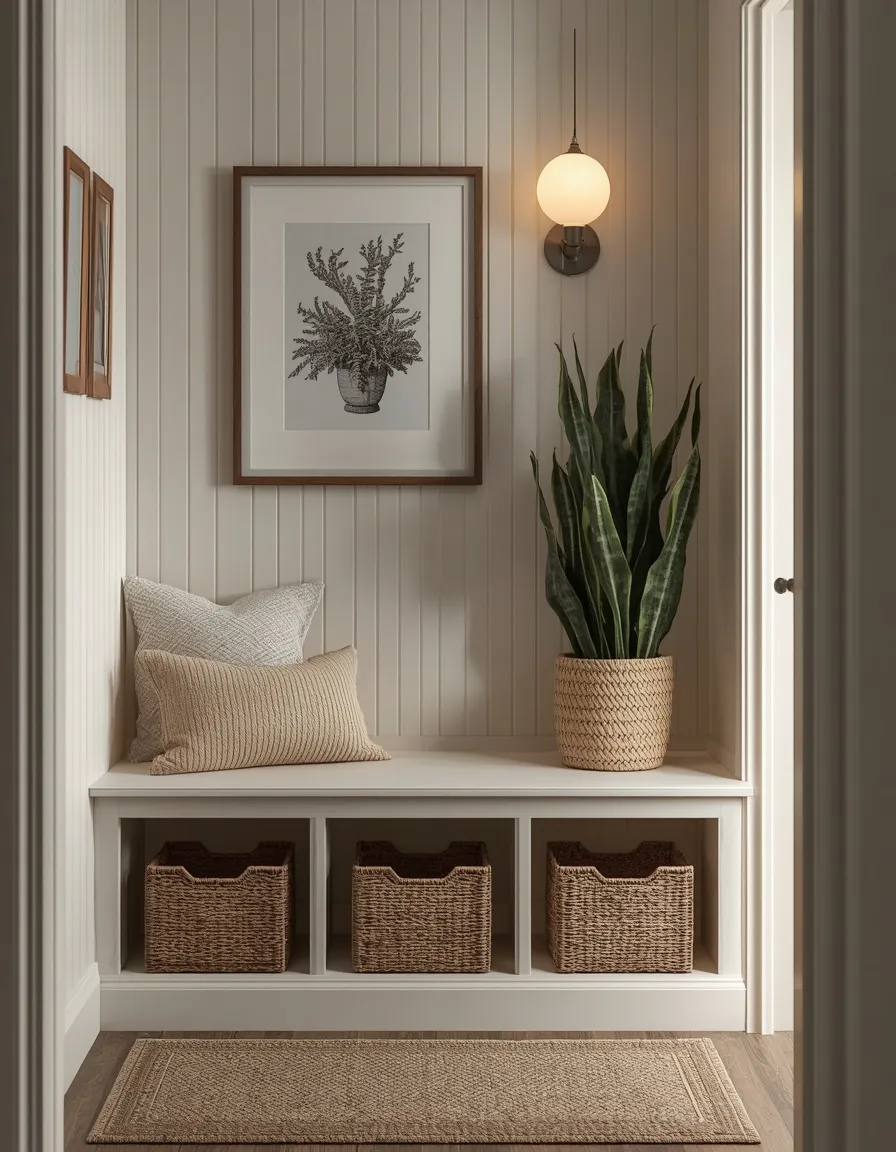
A mudroom bench can be genuinely beautiful as well as useful. A cushion, a framed print, a small plant, a woven runner, and a lamp turn a utility bench into a considered part of the home rather than a storage unit by the door.
Style it with things that survive the room: a performance-fabric or washable cushion cover, a plant that tolerates the cooler, dimmer conditions near a door, and art that won’t be ruined by a knock. Keep the seat itself mostly clear, decorating a mudroom bench so heavily that there’s nowhere to sit defeats the entire purpose, and it’s the most common styling mistake. A lamp or wall light makes the room welcoming on a dark evening. This suits anyone whose entryway is visible from the main living space.
- Best for: entryways visible from the main living space.
- Watch out: keep the seat clear; styling it so there’s nowhere to sit defeats the point.
- Key elements: washable cushion, hardy plant, runner, lamp, framed art.
What Are the Right Mudroom Bench Dimensions?
Build the seat at 43–46 cm (17–18 in) high and 35–45 cm (14–18 in) deep. That’s the height that lets an adult sit comfortably and lean down to pull on boots, which is the bench’s actual job.
Beyond the seat itself, the numbers that matter are the ones per person: roughly 45–60 cm (18–24 in) of bench length and 30–35 cm (12–14 in) of cubby width each, so a family of four needs a run of about 1.8–2.4 m (6–8 ft) to work without crowding. And the hooks, the detail that decides whether children use the system at all, need to be at two heights.
Mudroom Bench Dimensions Cheat Sheet
Use these as your starting point, then adjust to the people who’ll actually use the room.
| Element | Recommended size | Why it matters |
| Seat height | 43–46 cm (17–18 in) | Comfortable to sit and pull boots on |
| Seat depth | 35–45 cm (14–18 in) | Deep enough to sit; narrow halls: 30–35 cm |
| Bench length per person | 45–60 cm (18–24 in) | Two people can sit without crowding |
| Cubby width per person | 30–35 cm (12–14 in) | Fits a coat, bag, and hat per bay |
| Adult hook height | 150–170 cm (60–67 in) | Coats hang clear of the seat |
| Child hook height | 100–120 cm (40–47 in) | Children can reach, or coats hit the floor |
| Clear passage width | At least 90 cm (36 in) | Keeps the walkway usable |
Designing for Wet Boots and Real Life
A mudroom’s whole purpose is to handle wet and dirty things, yet most designs are specified as though everything arrives clean and dry. Getting the materials right is what keeps a mudroom from smelling within a winter.
Airflow beats enclosure. Wet boots and damp coats in a sealed cupboard trap moisture, which is how a mudroom develops that unmistakable musty smell and, eventually, mold. Open cubbies, slatted shelves, and baskets that breathe all dry gear out; closed drawers should be reserved for dry shoes only, with a separate open boot tray for wet ones. A tray with a raised lip catches meltwater instead of letting it run onto the floor.
Then specify for scrubbing. Use satin or semi-gloss paint rather than flat matte, which marks instantly and cannot be washed. Choose a wipeable floor such as tile or vinyl over raw timber, seal any exposed wood, and pick a removable, washable cushion cover or performance fabric, a beautiful linen cushion in a mudroom is a short-lived idea.
Building a hardworking bench doesn’t have to be expensive, and reclaimed timber is a natural fit for a room this rugged, our guide to building furniture from pallets covers the safety checks worth knowing first. You’ll find more built-ins that earn their footprint in our furniture and layout ideas.
Conclusion
The mudroom bench ideas that last are the ones designed for a wet Tuesday in February, not a photoshoot. Set the seat at 43–46 cm (17–18 in), give every person a bay, hang hooks at two heights so children can reach their own, let wet boots breathe rather than sealing them in, and choose finishes you can scrub. Do that, and the bench stops being the thing everyone dumps things beside and becomes the thing everyone uses. For more built-ins that work harder than they look, browse our furniture and layout ideas, then go measure the wall by your back door.
Frequently Asked Questions
Q: How high should a mudroom bench be?
Aim for 43–46 cm (17–18 in) from the floor to the top of the seat, including any cushion. That’s the height that lets an adult sit comfortably and bend to pull boots on, which is the bench’s real job. Keep the depth to 35–45 cm (14–18 in), or 30–35 cm in a narrow hallway where walking room matters more.
Q: How high should mudroom hooks be?
Use two heights. Adult hooks sit at roughly 150–170 cm (60–67 in), but children can’t reach those, which is exactly why their coats end up on the floor. Add a lower rail at 100–120 cm (40–47 in) so children can hang their own things. This single change does more for a family mudroom than any amount of storage.
Q: Should mudroom cubbies be open or have doors?
Open is almost always better. Wet coats and boots need airflow to dry, and a sealed cupboard traps moisture, which causes musty smells and eventually mold. Open cubbies also remove a step, nobody has to open anything, which makes the system far more likely to actually get used, especially by children.
Q: Where do you put wet boots in a mudroom?
In an open boot tray with a raised lip, which catches meltwater instead of letting it run across the floor. Never put wet boots into closed drawers or cupboards, where the trapped moisture causes odor and mold. Reserve closed drawers for dry shoes only, or drill ventilation holes in the backs.
Q: How much space do you need per person in a mudroom?
Allow roughly 45–60 cm (18–24 in) of bench length and 30–35 cm (12–14 in) of cubby width per person. A family of four therefore needs a run of about 1.8–2.4 m (6–8 ft) to work without crowding. Give each person their own labeled bay, hook, and basket, since named ownership is what stops the space becoming a shared dumping ground.
Q: Can you have a mudroom bench without a mudroom?
Yes, a slim bench in a hallway does the same job. Keep it to around 30–35 cm (12–14 in) deep, leave at least 90 cm (36 in) of clear passage, and add wall hooks above and a low shoe rack beneath. Somewhere to sit and take shoes off, plus hooks at the right heights, is really all a functioning drop zone needs.