
Introduction
Good growing cucumbers ideas start with one simple question: what space do you actually have to work with? A single vine can turn a bare fence, an empty balcony rail, or a quiet corner of the yard into a green, fruitful little jungle within a few weeks of warm weather. This guide walks through twenty-four ways to grow cucumbers, organized by trellis style, container type, raised bed setup, and indoor method, each one built around real technique rather than a pretty photo alone. Some gardens have room for a sprawling bed and a cattle panel arch; others have only a sunny windowsill or a single rented balcony rail. Consider this a working list for shaping your own patch of the abode into something that quietly feeds you all summer long.
Before You Start: What Cucumbers Need to Thrive
Every idea on this list works best once a few basics are in place, so it is worth grounding them here first.
Cucumbers (Cucumis sativus) are warm-season vines that want heat, sun, and steady moisture. Aim for at least six to eight hours of direct sun daily; less than that and vines grow leggy with fewer flowers. Soil should be loose, rich in compost, and well-draining, with a pH around 6.0 to 6.8. Cold, waterlogged soil is the most common reason seeds fail to sprout at all.
Two growth habits come up again and again in the ideas below. Vining varieties can climb 5 to 6 feet (1.5 to 1.8 m) or more and need a trellis, fence, cage, or other support to keep fruit off the ground and foliage open to airflow. Bush or compact varieties, often sold as “patio” or “container” types, stay closer to 2 to 3 feet (0.6 to 0.9 m) and need little to no support, which is why they turn up repeatedly in the container and hanging ideas.
Consistent watering matters more than almost anything else with this crop. Cucumbers are roughly 95 percent water, and letting soil dry out and then soaking it is the single most common cause of bitter, misshapen fruit. A layer of mulch and a dependable watering routine solve most problems before they start, and it is exactly the kind of unglamorous groundwork that Sunday Abode always comes back to before any structure or styling gets added on top.
Vertical and Trellis Growing Ideas
Trellising is less about saving space and more about airflow: lifted off the ground, cucumber leaves dry faster after rain or watering, which cuts down on powdery mildew, and fruit grows straighter and stays cleaner. The right structure depends on your budget, how permanent you want it to be, and whether it needs to look good doing its job.
1. A-Frame Ladder Trellis
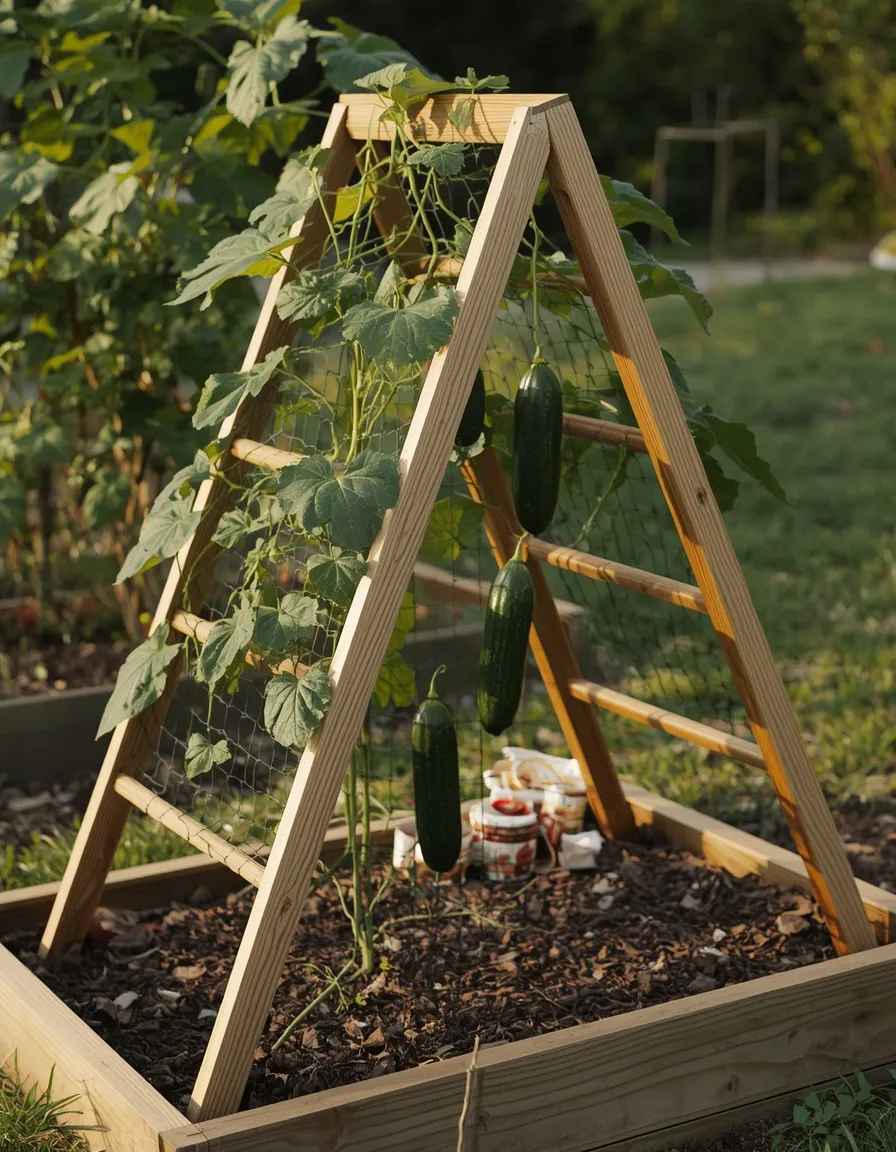
Picture two hinged wooden frames leaning together into a peak above a garden row, netting or twine strung between the rungs and cucumber vines climbing both sides like a green tent. It is the classic vegetable-garden trellis for a reason: simple to build, easy to walk under to harvest, and it works equally well straddling a raised bed or an in-ground row.
Build it from 2×2 or 2×3 lumber, hinge the two panels at the top, and string garden netting or heavy twine horizontally every 4 to 6 inches (10 to 15 cm) for tendrils to grip. Set it up before you plant, not after, since cucumber roots resent disturbance once vines are established. A common mistake is under-anchoring the base legs; wet, fruit-laden vines get heavy, so drive stakes into the ground at each foot or weight the frame with bricks, especially if the trellis will be near a path where kids or pets pass by. Wear gloves when cutting and handling lumber edges.
- Straddles a raised bed or in-ground row without taking extra footprint
- Folds flat for off-season storage, unlike permanent structures
- Best for vining varieties that need 5 feet (1.5 m) or more of climbing height
2. Cattle Panel Arch Tunnel
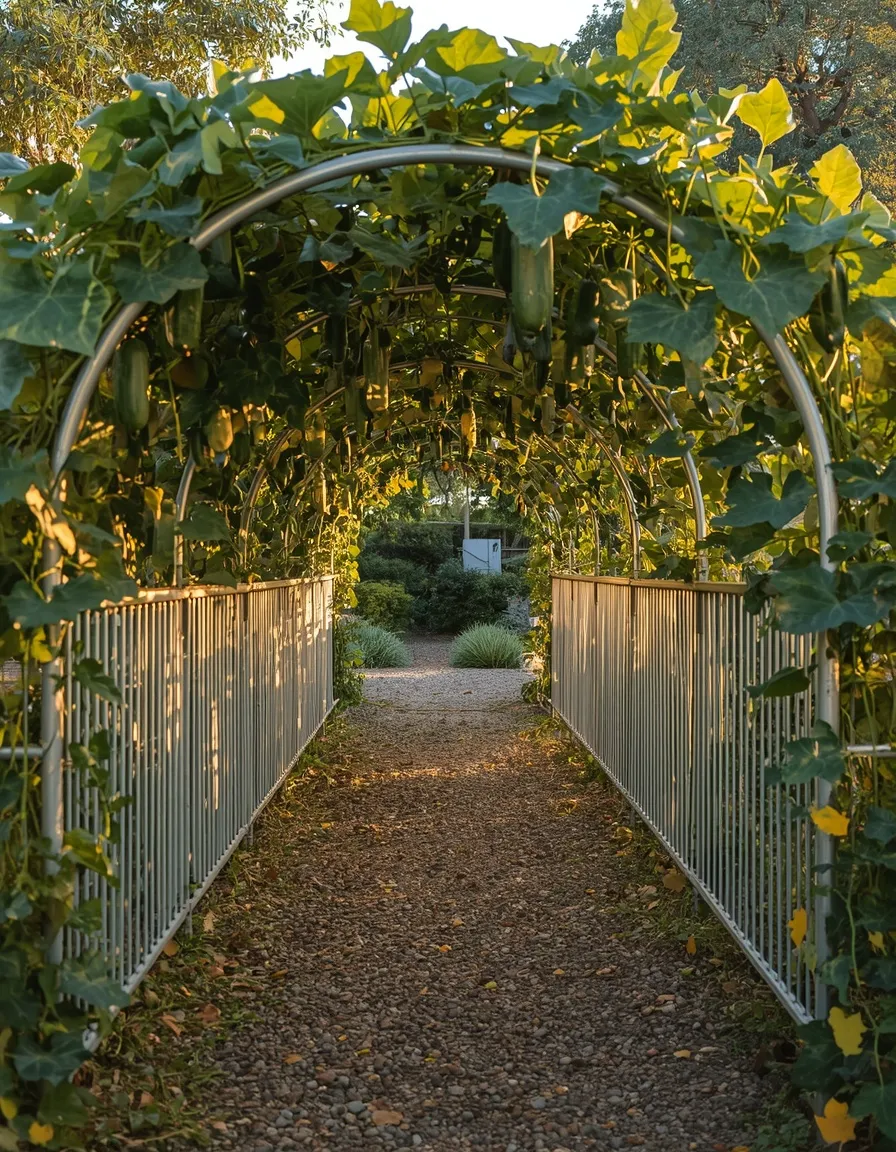
A galvanized steel cattle panel, bent into a rainbow arch and anchored at both ends, turns a vegetable row into a walk-through tunnel dripping with cucumbers by midsummer. It is one of the more dramatic structural choices on this list and reads as a genuine garden feature rather than just plant support.
Standard cattle panels run about 16 feet (4.9 m) long and 50 inches (127 cm) wide; bending one into an arch over a 3 to 4 foot (90 to 120 cm) wide bed and securing each end with T-posts or rebar driven at least 18 inches (45 cm) into the ground gives a structure that will outlast the vines by years. This is the sturdiest option here, well suited to heavy vining slicers or a mixed planting of cucumbers and pole beans on the same arch. The main trade-off is upfront effort and cost compared to a teepee or fence line, and cut panel edges can be sharp, so gloves and eye protection are worth it while bending and anchoring the metal.
- Handles heavy vine loads better than lightweight trellis materials
- Doubles as a shaded, walk-through garden feature
- A multi-year structure rather than a rebuild-it-annually option
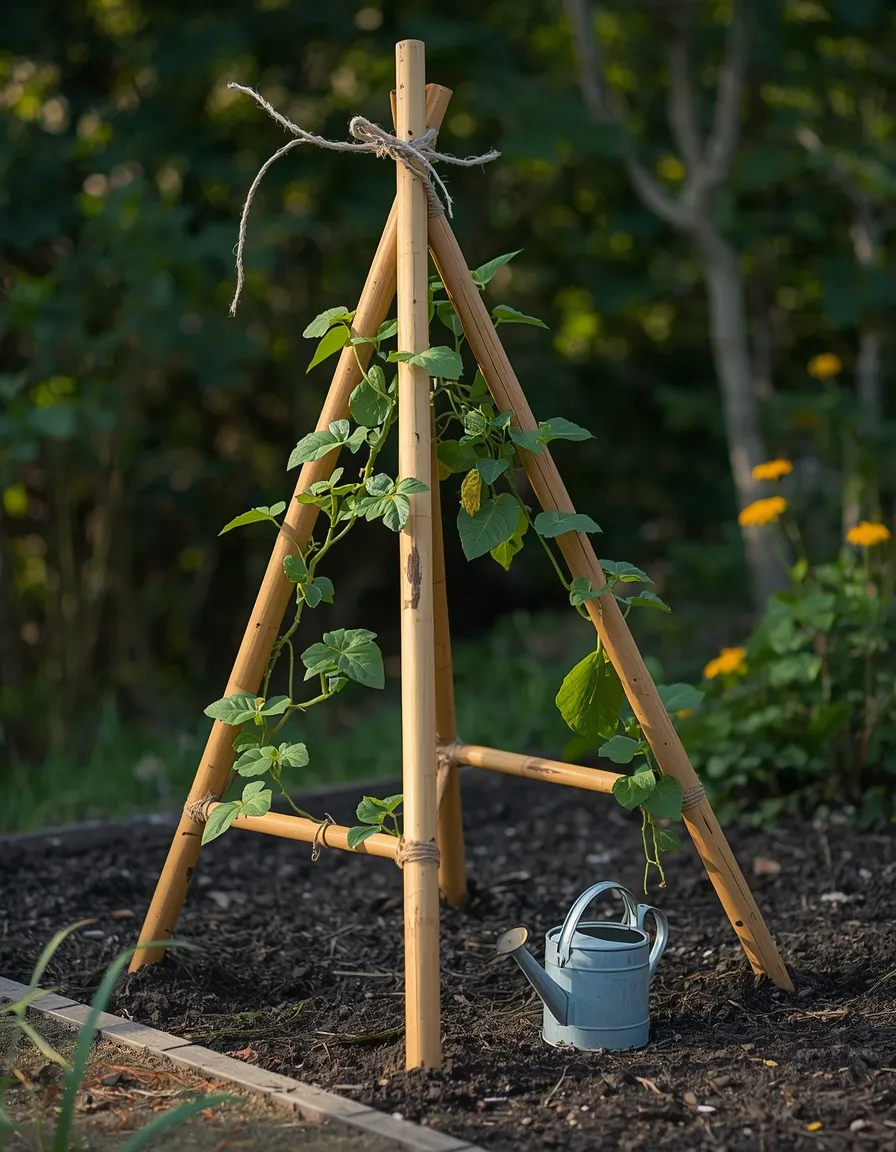
3. Bamboo Teepee Trellis
Three to five bamboo poles, tied together near the top with garden twine and splayed out into a circle at the base, make one of the cheapest and most forgiving supports for cucumbers, especially in a small bed or a child’s first garden plot.
Push poles 6 to 8 feet (1.8 to 2.4 m) long about 6 inches (15 cm) into loosened soil, spaced evenly in a circle roughly 2 to 3 feet (60 to 90 cm) across, then lash the tops with sturdy twine or wire. Plant two or three seeds or seedlings at the base of each pole. As vines fill in, the structure becomes a shaded little hideout, which makes it a favorite for family garden beds where kids enjoy ducking inside. Because it uses less material than an A-frame or panel arch, it also has less structural margin, so tie the top joint tightly and check it after storms; a loose lashing is the most common failure point.
- Lowest material cost of any trellis idea on this list
- Small footprint suits raised beds and tight backyard corners
- The enclosed shape doubles as an informal play space for kids
4. Obelisk or Garden Tower Trellis
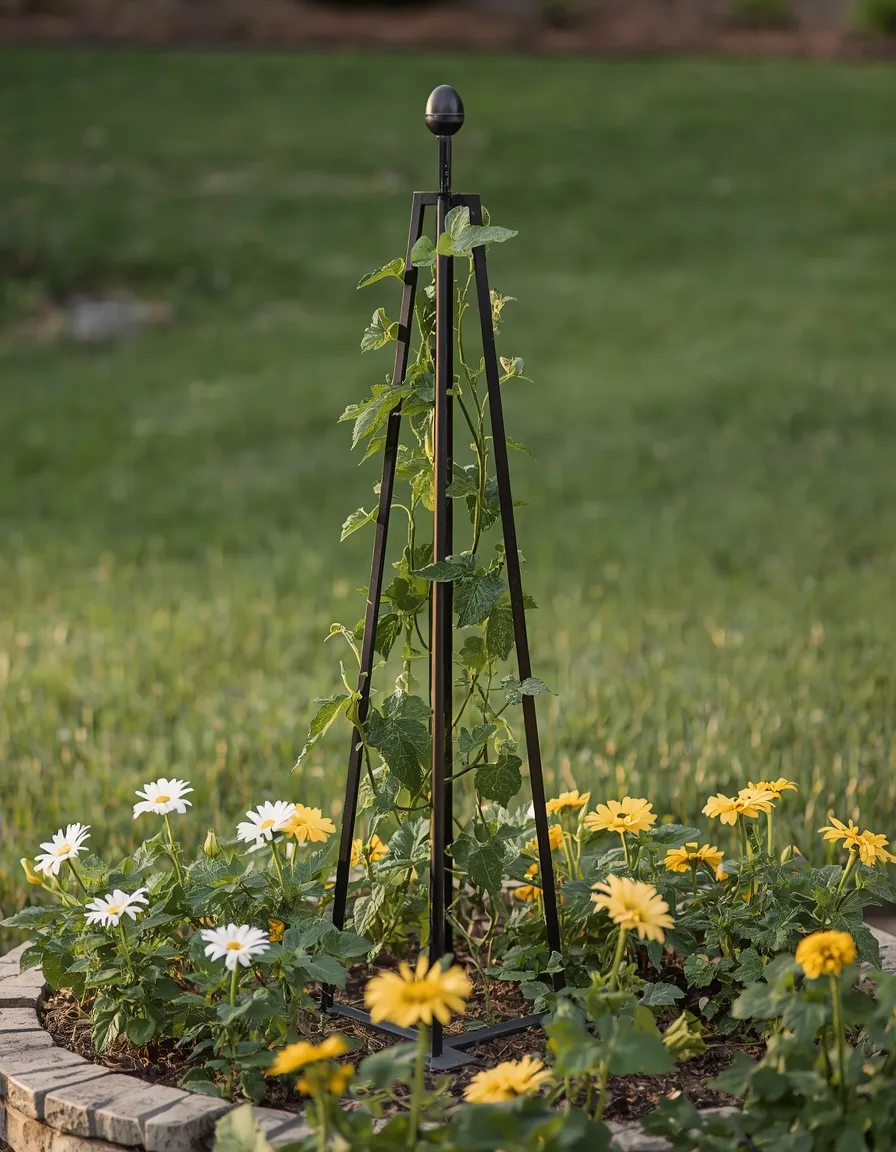
A tall, tapered obelisk, the kind usually sold for climbing roses or clematis, works just as well as a functional cucumber support while looking intentional in an ornamental bed rather than purely utilitarian. This is the idea for a front yard, entry garden, or anywhere a plain wooden frame would look out of place.
Choose a metal or cedar obelisk at least 5 to 6 feet (1.5 to 1.8 m) tall with reasonably wide-spaced rungs, since cucumber tendrils need something to grip that is not too fine. Set it in the center of a container or bed and plant two to three seedlings around the base. Because obelisks are freestanding and often lighter than they look, anchor the feet into the soil or secure them to a paver if wind is a regular issue in your area, particularly once the structure is carrying a full season of vine growth. Off-season, the same piece can support sweet peas or morning glories, which makes the investment worth it beyond a single cucumber crop.
- Reads as garden decor first, plant support second
- Reusable across seasons for other climbing flowers
- Good fit for small ornamental beds near entries or patios
5. Growing Along a Pergola or Arbor
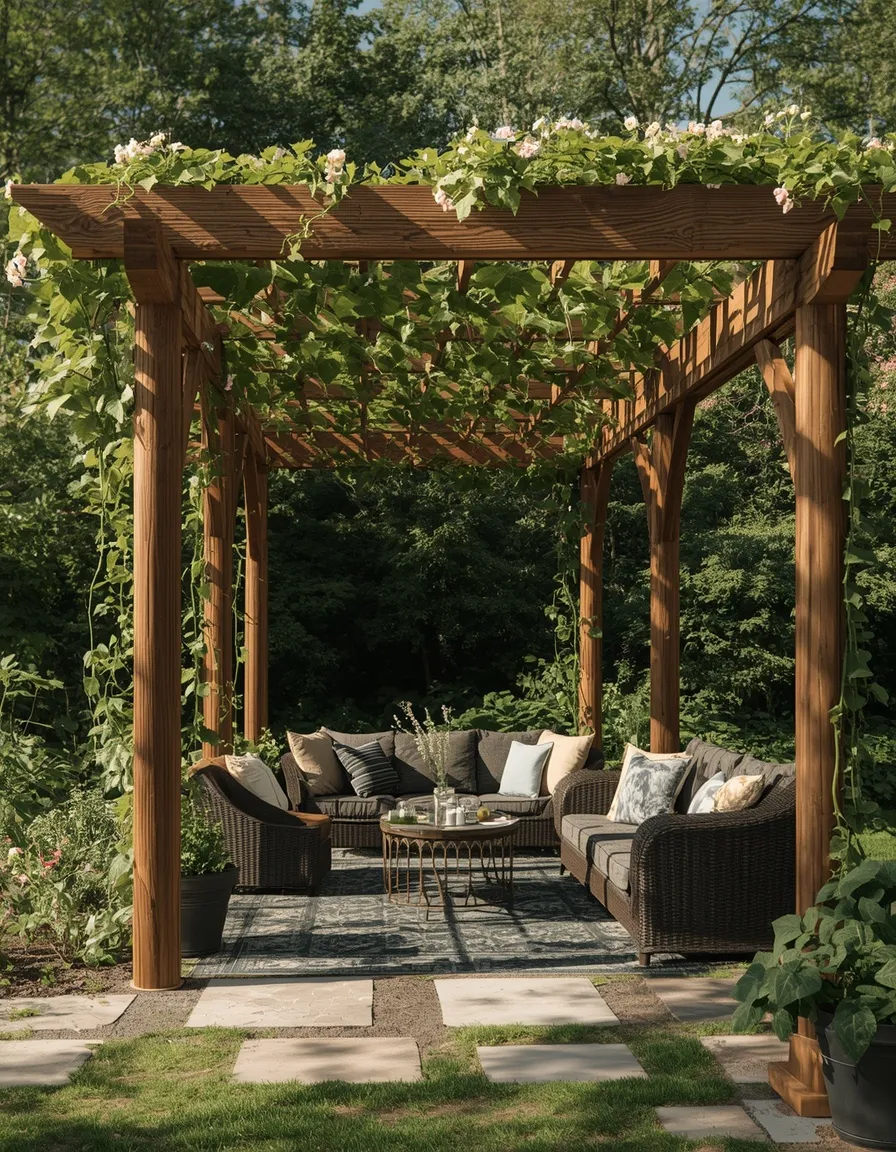
If a pergola, arbor, or covered walkway already exists in the garden, training cucumbers up one side alongside other climbers turns an existing structure into a productive, lush feature instead of building something new from scratch.
Because pergola beams and arbor lattice are usually wider and smoother than netting, cucumber tendrils often need help gripping; loosely tie the main stem to the structure every 12 to 18 inches (30 to 45 cm) with soft garden twine or plant ties rather than relying on tendrils alone. This works especially well mixed with beans, sweet peas, or a climbing rose, which gives the structure visual interest even before the cucumbers fill in. Keep in mind that cucumber vines are more brittle than woody climbers like wisteria, so avoid forcing a stem around a beam; guide it gently instead. Position plants on the side that gets the most direct sun, since a pergola’s own shade can work against a sun-hungry crop.
- Uses a structure you likely already have, at no extra material cost
- Combines well with ornamental climbers for a fuller look
- Provides light shade underneath, useful in hot climates
6. Repurposing an Existing Fence or Railing
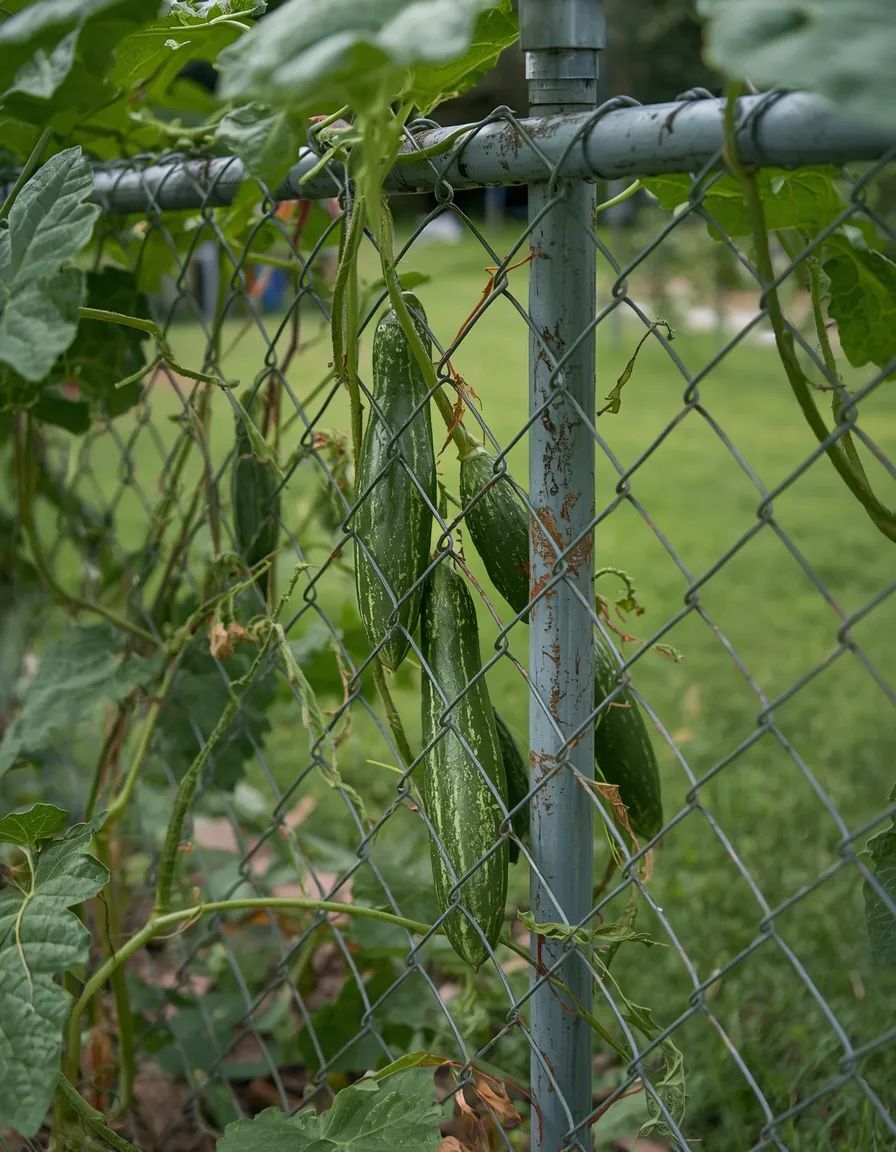
A chain-link fence, a deck railing, or even a porch balustrade can support cucumbers with little to no extra hardware, which makes this the most budget-friendly and renter-friendly idea on the list. If you cannot drill, dig, or install anything permanent, this is where to start.
Chain-link is the easiest: cucumber tendrils grip the wire mesh on their own with minimal guidance needed. Solid deck railings or flat porch balusters are trickier, since there is nothing for tendrils to grab, so loosely loop soft twine or plant clips around the rail at intervals to give young vines something to follow. Plant directly in the ground along a garden fence, or set a container at the base of a railing, which is the more realistic option for balcony and apartment renters. Because you are not building anything, this idea also carries no anchoring risk, though it is worth checking that a shared or HOA-managed fence allows plants to be trained on it before committing a whole season to the spot.
- Zero material cost if the structure already exists
- No tools, drilling, or landlord permission typically required
- A realistic first project for renters and first-time growers
Container and Small-Space Growing Ideas
Containers open cucumber growing up to balconies, patios, and courtyards with no in-ground bed at all. The two decisions that matter most here are pot size and variety: bush types stay compact and forgiving, while vining types need real volume and a support to match. As a baseline, plan on at least a 5-gallon (19-liter) container per plant, with drainage holes non-negotiable no matter what you are growing in.
7. Classic Container and Pot Growing
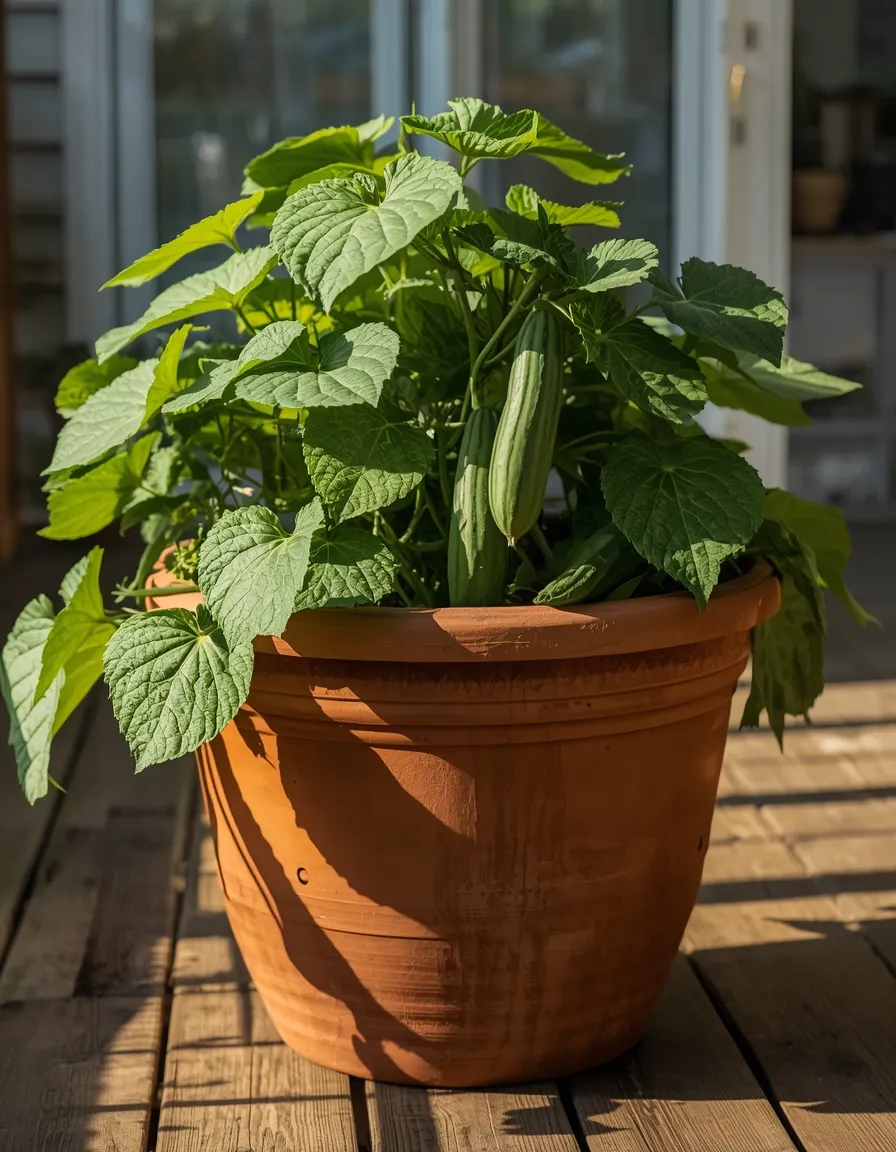
A single glazed ceramic pot or heavy-duty plastic planter on a sunny patio, one bush cucumber tumbling gently over the rim, is the most familiar version of container growing and still one of the most reliable for beginners.
Use a pot at least 12 inches (30 cm) wide and deep, holding a minimum of 5 gallons (19 liters) of potting mix, one plant per pot for bush or compact varieties. Vining types need more root room, 7 to 10 gallons (26 to 38 liters) and a trellis or cage set in place at planting time. Fill with a quality potting mix rather than garden soil, which compacts and drains poorly in a container. The most common beginner mistake is under-watering: pots dry out far faster than ground soil, often needing daily water in summer heat, so check soil moisture with a finger test each morning rather than sticking to a fixed schedule.
- No in-ground bed required, just a sunny patio or courtyard spot
- Portable enough to chase the sun or move out of early frost
- Bush varieties need no trellis, simplifying the whole setup
8. Fabric Grow Bags and Self-Watering Buckets
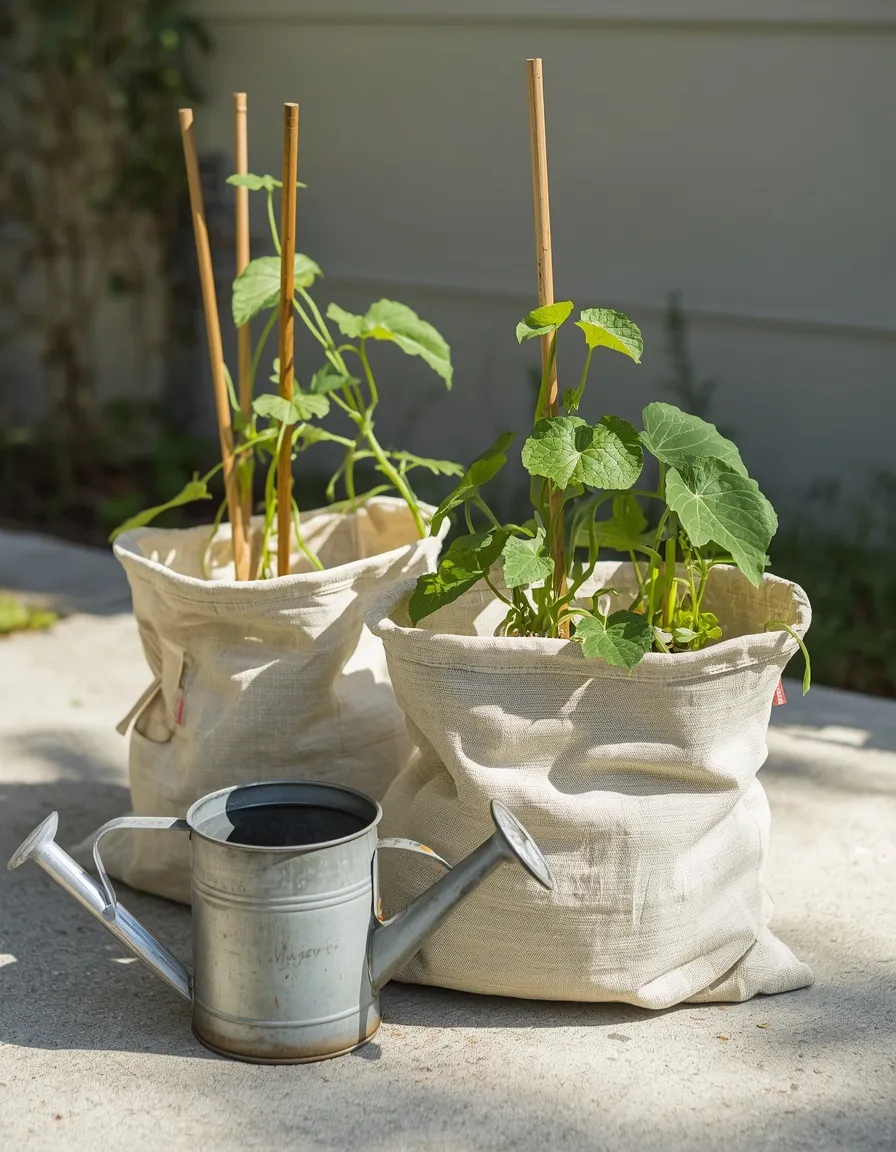
A soft-sided fabric grow bag or a repurposed 5-gallon bucket with drilled drainage holes gives cucumbers better root conditions than many rigid pots, at a fraction of the cost of buying planters.
Fabric grow bags “air-prune” roots at the fabric walls, which encourages a denser, healthier root system than a plastic pot where roots simply circle the container. The trade-off is that fabric dries out faster than plastic or ceramic, so bags benefit from mulch on top and, in hot climates, twice-daily checks. Repurposed buckets need at least four evenly spaced quarter-inch drainage holes drilled in the base before filling; use a drill with a sharp bit and wear eye protection, since plastic can crack unpredictably. Either option works especially well for gardeners upcycling materials or growing on a tight budget, and both are light enough to move as the season’s sun angle shifts.
- Fabric bags improve root health through natural air-pruning
- Buckets are a near-free option using materials already on hand
- Lightweight enough to reposition through the season
9. Tomato Cage Support for Patio Containers
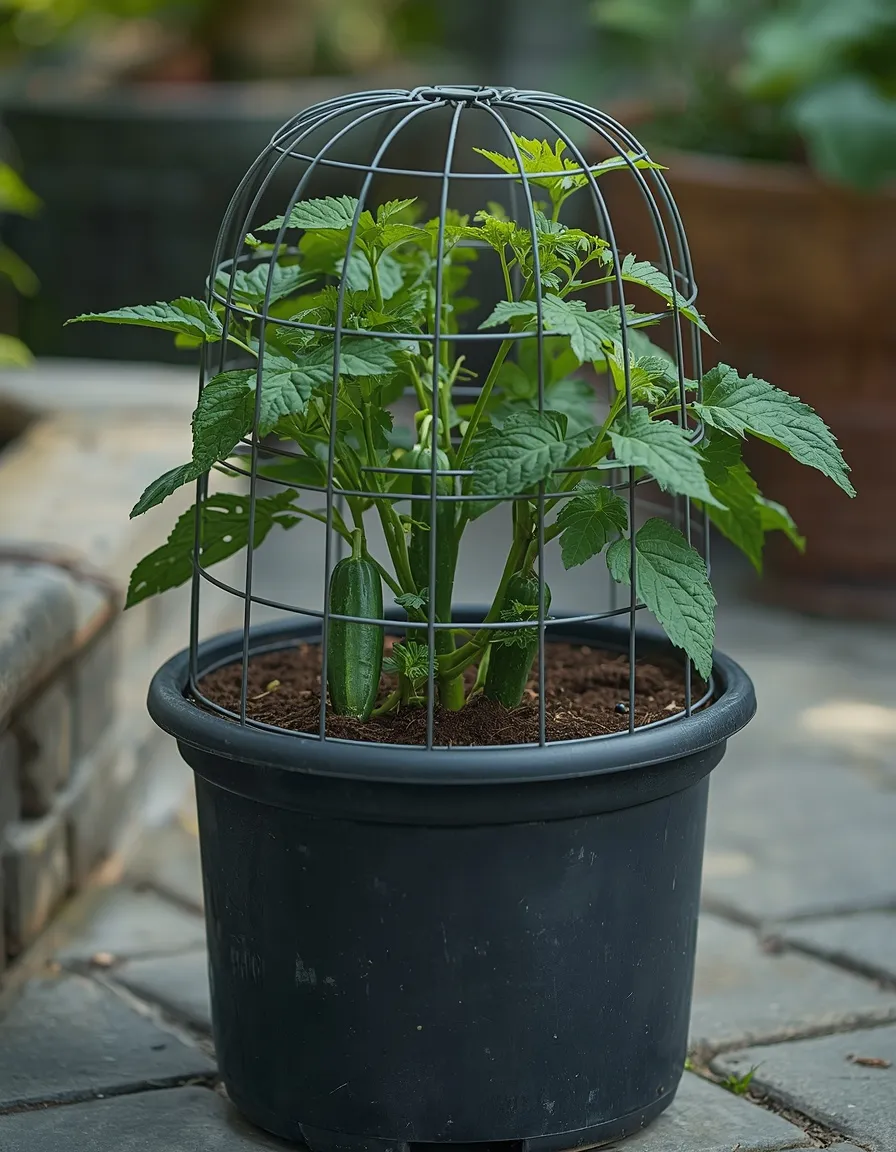
A simple wire tomato cage, dropped into a container at planting time, gives even bush cucumbers a little lift and keeps fruit from resting directly on wet soil, all without the footprint of a full trellis.
Set the cage in place before or right at planting so roots are not disturbed later, and gently tuck vines through the wire rings as they grow since cucumber tendrils grip cage wire less readily than a tomato’s own stems do. This is one of the simplest support ideas to execute, which makes it a good starting point for first-time container growers who want cleaner fruit without building anything. It works for bush varieties, which do not strictly need support but benefit from it, and for compact vining types in larger pots. Because the cage is unanchored beyond the container itself, choose a wider, heavier pot as a base so a mature, fruit-laden plant does not tip the whole thing over in wind.
- Repurposes garden equipment you likely already own
- Keeps fruit off wet potting soil, reducing rot and pest contact
- Minimal setup time compared to building a dedicated trellis
10. Balcony Rail Planter Boxes
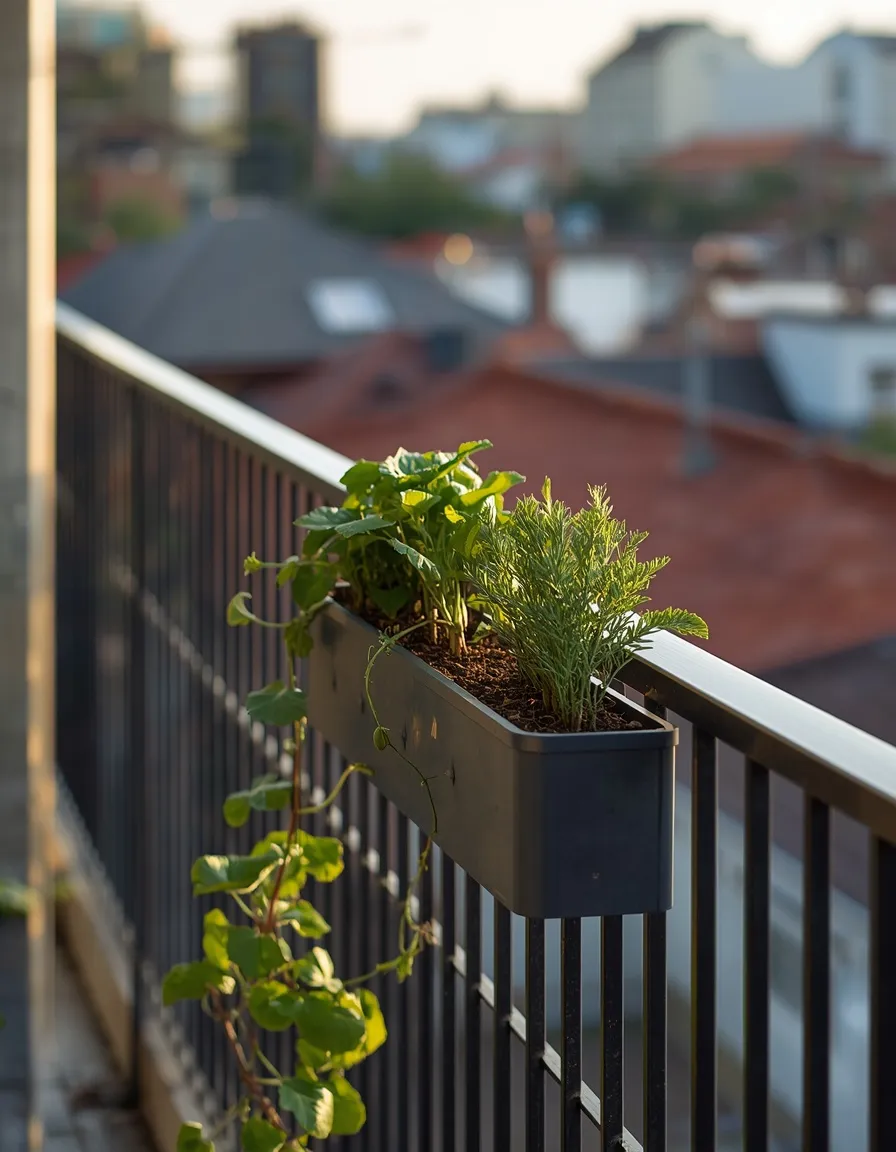
Rail-mounted planter boxes, clipped or bracketed to a balcony railing, let apartment dwellers grow cucumbers without giving up any floor space at all, which makes this one of the more genuinely apartment-specific ideas here.
Choose compact, bush-type or dwarf “patio” cucumber varieties bred specifically for small containers, since rail planters rarely hold more than a few gallons of soil per section. Check the weight rating of both the planter brackets and the railing itself before filling and watering; a saturated rail box full of soil is considerably heavier than it looks, and this matters most in high-rise or shared-building settings where a fall risk affects more than just your own plants. Confirm building or HOA rules about railing attachments before installing anything permanent. Position boxes on the sunniest side of the balcony, and expect to water more frequently than an in-ground bed, since rail planters are shallow and exposed to wind on most sides.
- Uses vertical railing space with zero floor footprint
- Purpose-built for apartment and high-rise balconies
- Pairs naturally with trailing herbs or flowers in the same box
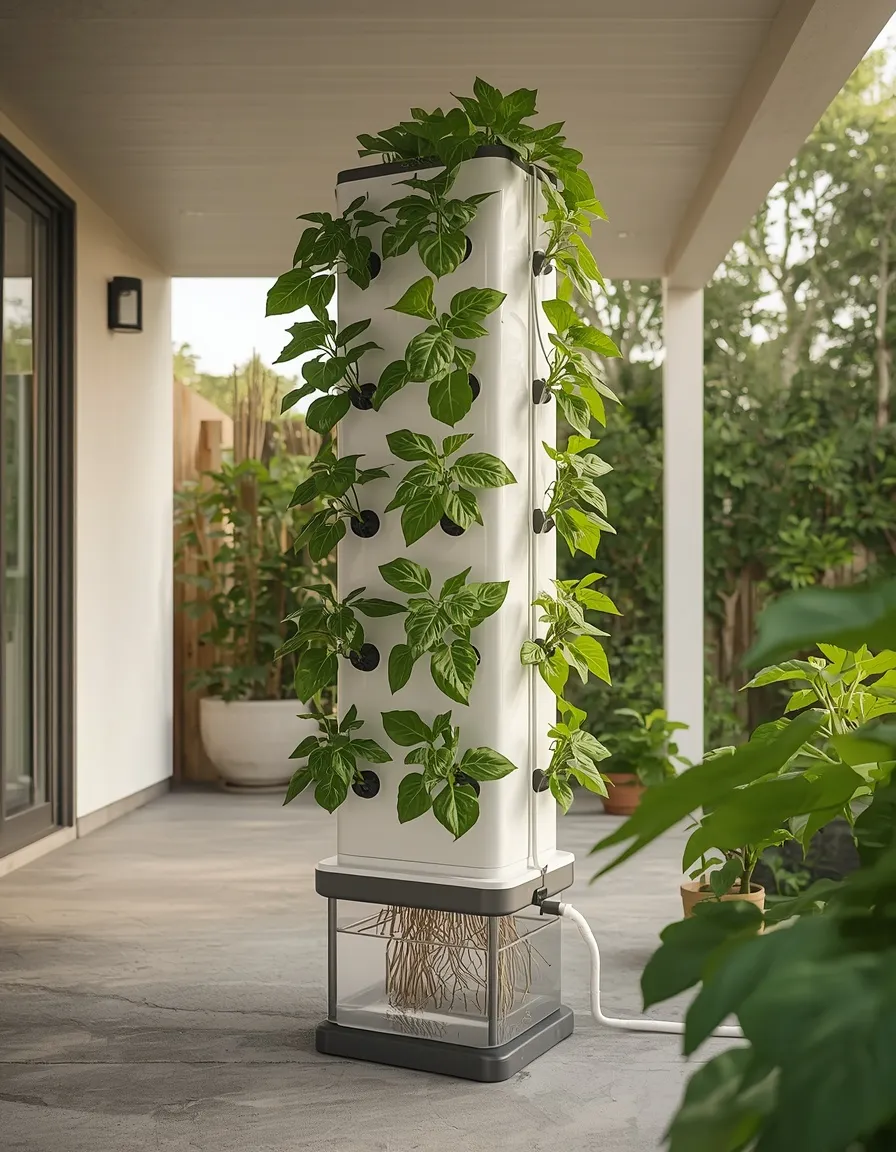
11. Vertical Hydroponic or Soilless Tower
A freestanding hydroponic tower, with cucumber roots suspended in a nutrient solution rather than soil, is the most modern option on this list and a genuinely good fit for a covered patio, sunroom, or bright indoor corner with no garden bed in reach.
Compact or dwarf cucumber varieties bred for greenhouse and hydroponic use perform best in a tower system, since standard vining types quickly outgrow the support structure most towers provide. These systems recirculate a nutrient solution past the roots on a timer, which uses noticeably less water than soil growing and removes soil-borne pests and diseases from the equation entirely. The trade-off is a higher upfront cost and a learning curve around nutrient balance and pH, which needs periodic checking with a simple test kit. Because towers are usually used in covered or indoor spaces without insect access, choose a parthenocarpic (self-fruiting) variety that sets fruit without pollination, covered in more detail in the indoor growing idea later in this guide.
- Recirculating system uses significantly less water than soil growing
- Removes soil-borne pests and diseases from the equation
- Well suited to covered patios, sunrooms, or bright indoor corners
12. Hanging Baskets for Trailing and Bush Varieties
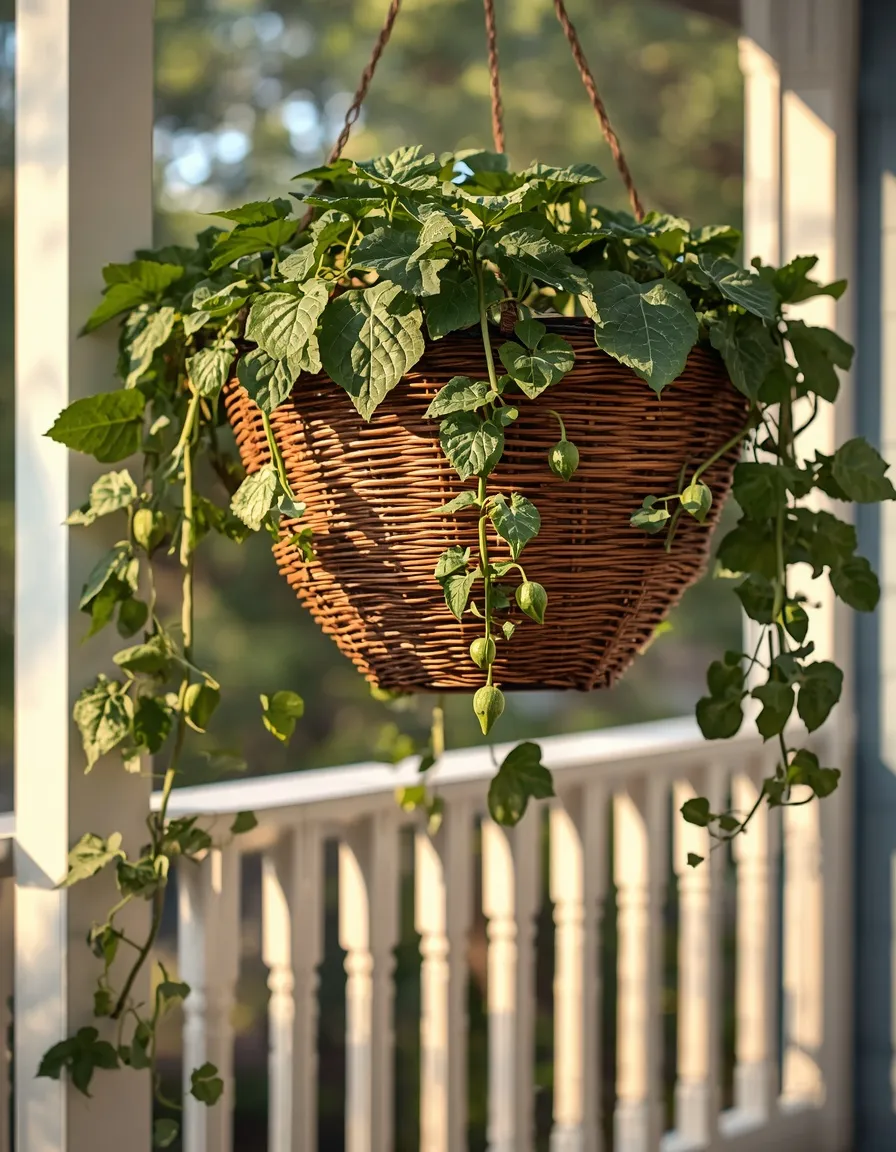
A bush or compact cucumber variety planted in a large hanging basket, vines trailing gently down and over the rim, makes efficient use of overhead space on a small balcony or porch where every inch of floor and rail is already spoken for.
Choose the largest hanging basket practical, at least 12 to 14 inches (30 to 35 cm) across, since smaller hanging pots dry out fast and rarely hold enough soil volume for healthy roots. A sturdy bracket rated for the basket’s fully watered weight matters here; wet potting mix plus a mature plant is considerably heavier than the empty basket suggests, so check the mounting point, whether it is a ceiling hook, wall bracket, or shepherd’s hook, before hanging anything overhead where people walk underneath. Bush varieties are the better pick for baskets, since sprawling vining types quickly outgrow the space and can pull the whole basket off balance. Water more often than you would a ground container, since hanging position exposes the basket to drying wind on every side.
- Makes use of overhead space when floor and rail space are full
- Keeps trailing fruit clean and visible rather than hidden in foliage
- A strong fit for porches, pergola beams, and covered patios
Raised Bed and In-Ground Ideas
For gardeners with an actual yard, the ground itself is the starting material, and the ideas below shape how that soil is prepared rather than what container holds it. Raised beds, straw bales, mounded hills, and mulched rows each solve a different soil problem, from poor native drainage to a short, cool growing season.
13. Raised Bed Growing
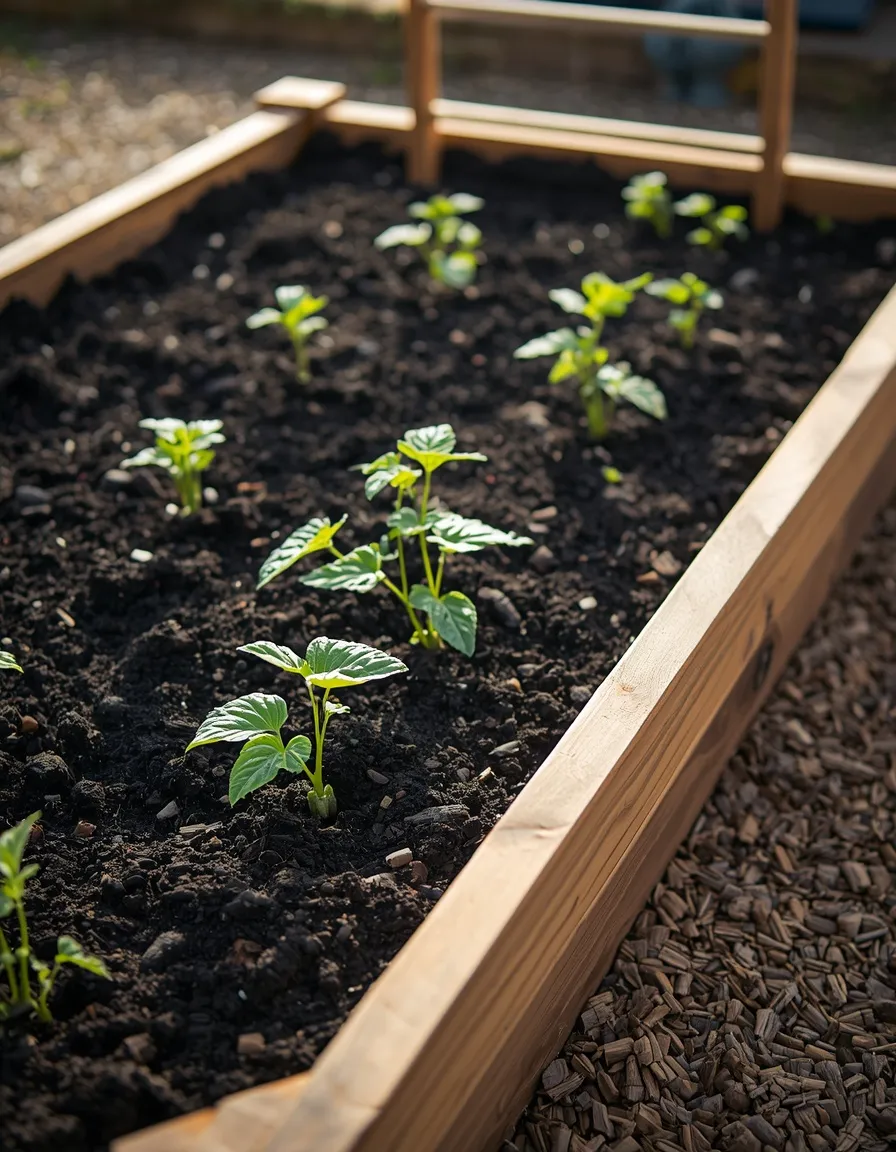
A raised bed, whether a bought cedar kit or a simple frame of untreated lumber, gives complete control over soil quality, which matters enormously for a crop as sensitive to drainage as cucumbers. It is also one of the more accessible ideas here, since the elevated soil line means less bending and kneeling than an in-ground row.
Fill with a mix of quality topsoil, compost, and coarse material like perlite for drainage, aiming for at least 12 inches (30 cm) of depth so roots have room to establish. Position the bed where it gets full sun and install a trellis, whether an A-frame, obelisk, or simple stake-and-twine setup, along the back or north edge so mature vines do not shade shorter companion plants. Raised beds warm up faster than ground soil in spring, which can mean an earlier planting date, but they also dry out faster, so plan on more frequent watering than an equivalent in-ground bed, especially in a raised bed built from dark-colored materials that absorb extra heat.
- Full control over soil quality, drainage, and pH from day one
- Elevated soil line reduces bending, useful for limited mobility
- Warms earlier in spring, allowing a slightly earlier planting date
14. Straw Bale Gardening
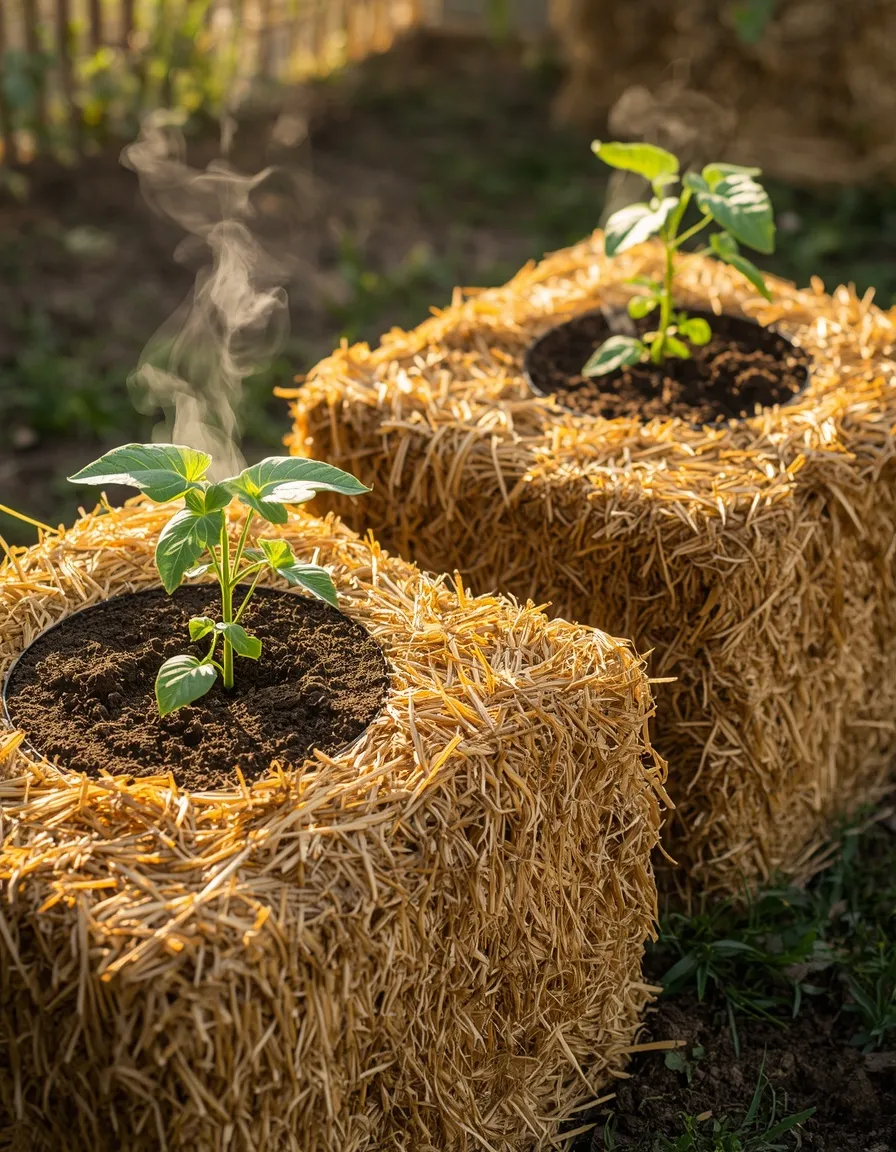
Two or three straw bales, conditioned and planted directly with cucumber seedlings, turn poor native soil into a non-issue entirely, since the bale itself becomes the growing medium as it slowly composts from the inside out over the season.
Condition bales for about two weeks before planting by soaking them daily and adding a nitrogen source, whether blood meal or a balanced fertilizer, which kickstarts internal decomposition and generates gentle heat that can extend the growing season. Plant seedlings directly into pockets carved in the bale’s top surface, filled with a handful of potting soil. One safety and sourcing note is worth taking seriously: straw and hay from fields treated with certain persistent pasture herbicides can carry residue that survives composting and severely stunts sensitive vegetables, cucumbers included, showing up as curled, twisted new growth. Buy bales from a known, herbicide-free source, or do a simple test by sprouting a few bean seeds in a bale sample before committing a whole season’s planting to it.
- Solves poor native soil without amending or replacing it
- Internal composting adds gentle bottom heat during the season
- Bales break down into usable compost for beds the following year
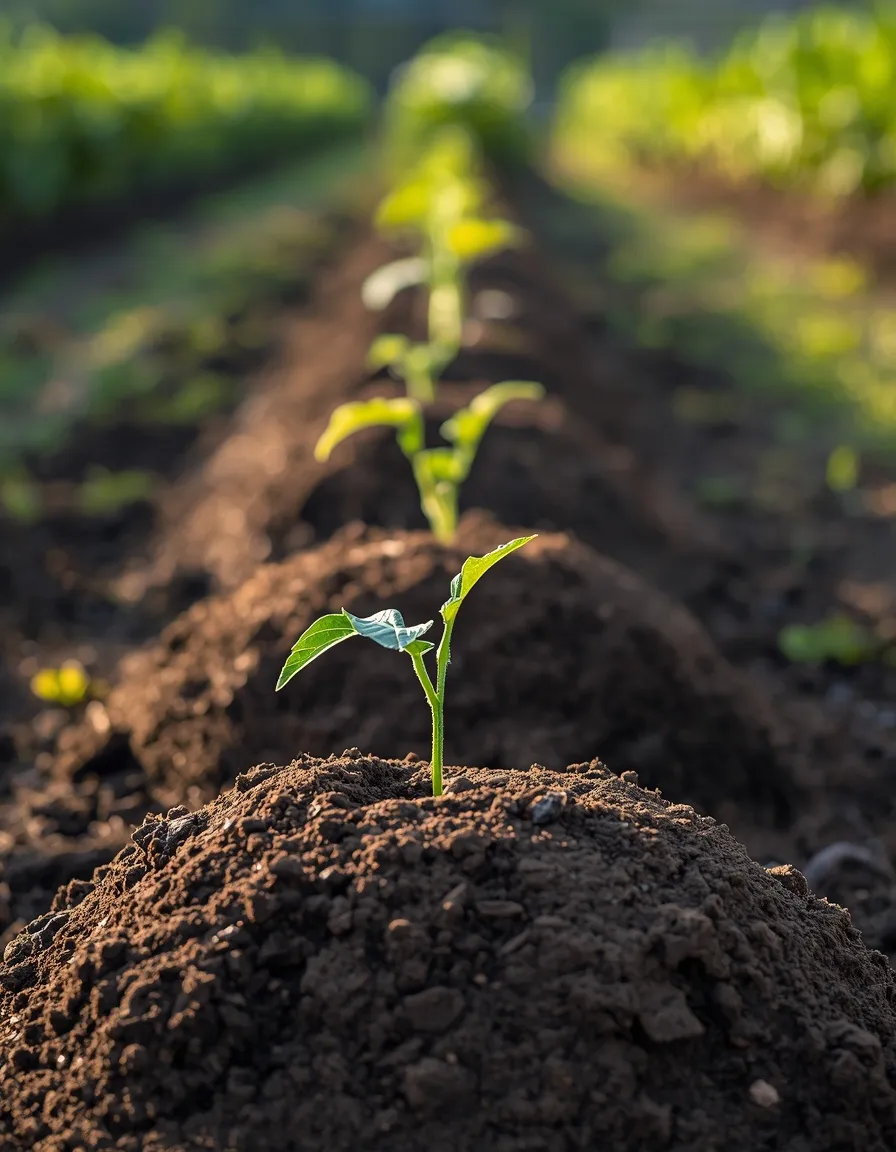
15. Traditional Hill or Mound Planting
Mounded soil hills, a few inches high and spaced generously across a garden bed, are the old-school way cucumbers have been grown for generations, and the method still holds up on its own practical merits rather than nostalgia alone.
Build mounds about 4 to 6 inches (10 to 15 cm) high and roughly 12 inches (30 cm) across, spaced 3 to 4 feet (90 to 120 cm) apart in every direction to leave room for vines to sprawl if left untrellised. Plant four or five seeds per mound, then thin to the two or three strongest seedlings once true leaves appear. The raised shape sheds excess water and warms faster in spring than flat ground, both of which reduce the cold, soggy soil conditions that keep cucumber seeds from sprouting. This idea suits gardeners happy to let vines sprawl across open ground rather than trellising, though a mound can also anchor a teepee or obelisk if vertical growth is preferred instead.
- Improves drainage and soil warming with no materials beyond soil
- A low-cost, low-effort method for larger in-ground gardens
- Works equally well left to sprawl or paired with a support
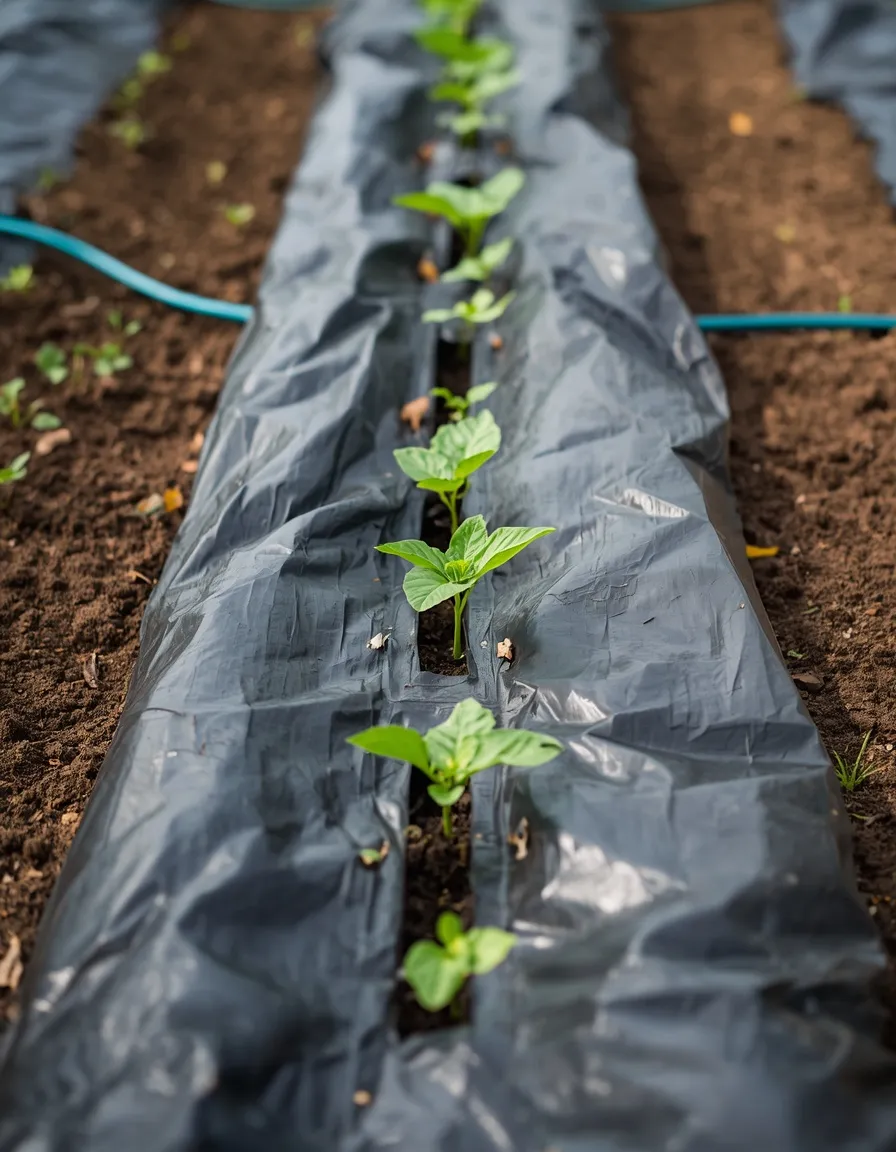
16. Black Plastic Mulch Rows for Cool Climates
A row of soil covered edge to edge in black plastic sheeting, with cucumber seedlings planted through slits cut in the material, is a season-extension trick borrowed from commercial growers that works just as well in a home garden with a short or cool summer.
Lay black plastic mulch over prepared, moist soil in early spring, securing the edges with soil or landscape staples, then cut planting holes or slits at the correct spacing for your variety. The plastic traps solar heat, warming soil several degrees above bare ground and allowing planting one to two weeks earlier than the surrounding garden. Because plastic blocks rainfall from reaching the soil beneath it, this method pairs naturally with the drip irrigation idea covered later in this guide; running drip line under the plastic before laying it keeps watering consistent without needing to lift the sheeting. Remove and discard or recycle the plastic at season’s end rather than leaving it to degrade in place.
- Warms cool soil by several degrees, enabling earlier planting
- Suppresses weeds along the entire row with no additional effort
- A commercial-grower technique scaled down for home vegetable rows
Starting and Extending the Season
How and when cucumbers begin their life, whether from seed in open ground, under grow lights indoors, or behind the protection of a cold frame, shapes everything that follows. These three ideas cover propagation and season-stretching rather than a permanent growing setup.
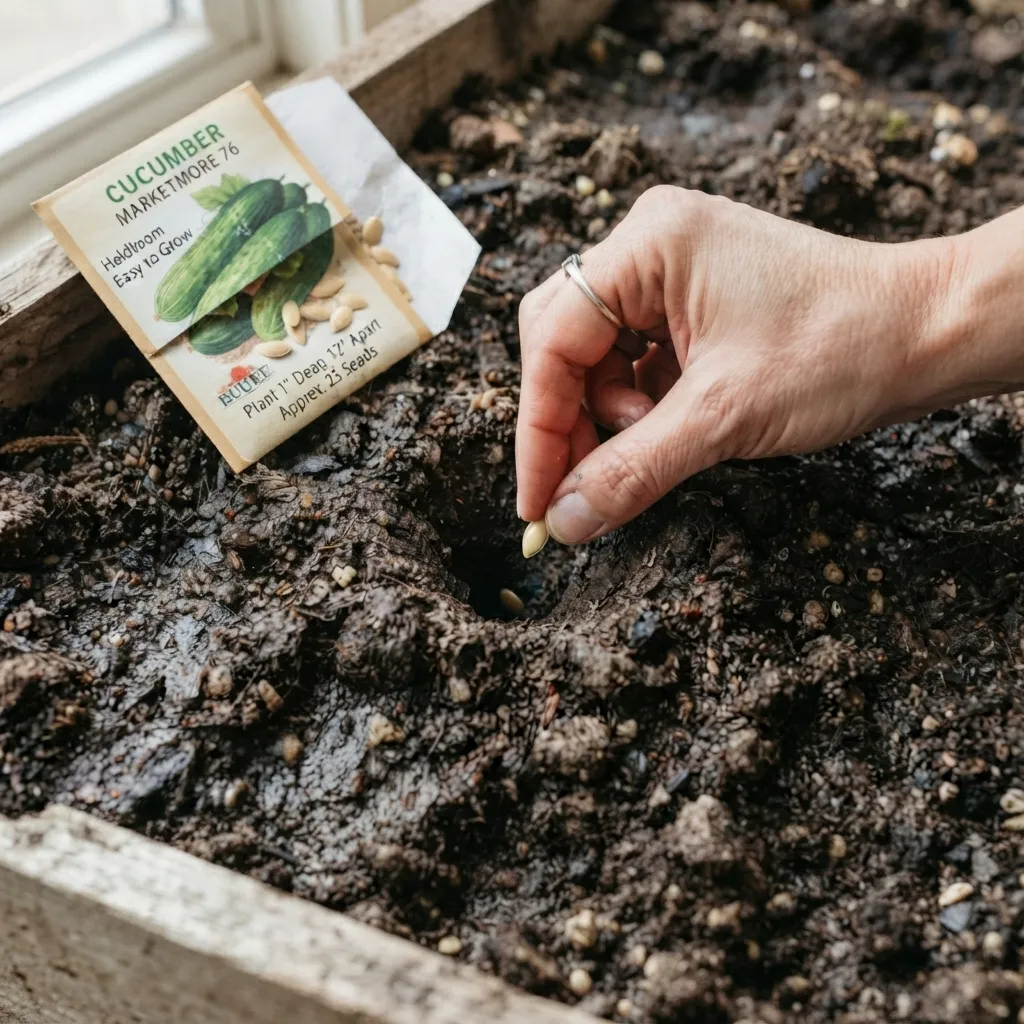
17. Starting Cucumbers From Seed
Cucumbers are one of the vegetable garden’s most forgiving seeds to start directly in the ground, and in most cases direct sowing actually outperforms starting indoors and transplanting, since the plant’s taproot strongly dislikes disturbance.
Wait until the danger of frost has passed and soil temperature has reached at least 70°F (21°C) at a one-inch (2.5 cm) depth, checked with an inexpensive soil thermometer rather than guessed at from air temperature alone, since soil warms more slowly than the air above it. According to the University of Minnesota Extension, direct seeding is the most reliable method for home gardens once soil has reached that threshold, with seeds sown about half an inch (1.25 cm) deep. If your season is short, start seeds indoors no earlier than three to four weeks before your last frost date, using biodegradable peat or fiber pots that go straight into the ground to avoid disturbing the taproot at transplant. Starting too early indoors only produces a leggy, root-bound seedling that loses most of its head-start advantage.
- Direct sowing avoids the transplant shock cucumbers are prone to
- A soil thermometer removes the guesswork of “when is warm enough”
- Biodegradable pots let indoor-started seedlings skip a disruptive transplant
18. Indoor Growing Under Grow Lights
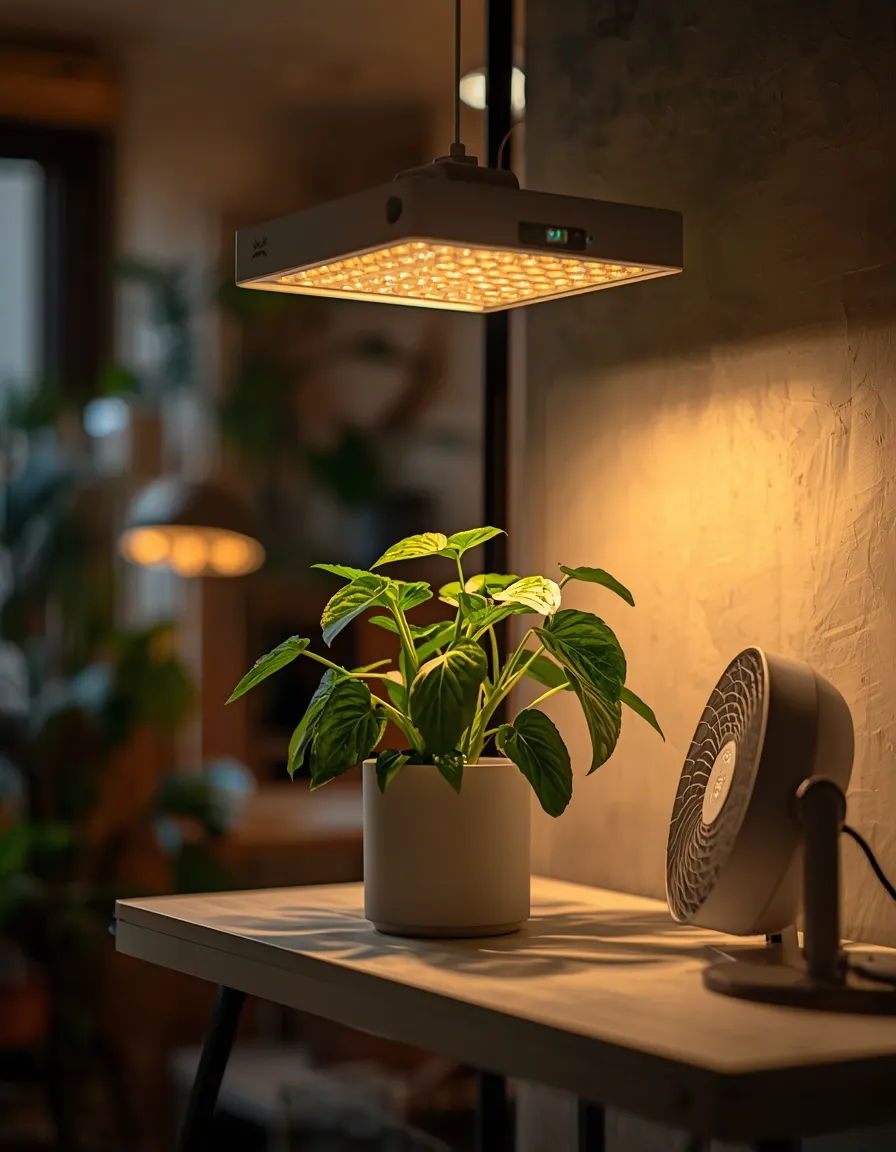
A compact cucumber plant, growing year-round on a plant stand or shelf under full-spectrum LED grow lights, brings this crop to anyone without outdoor space at all, from a small apartment to a basement corner with no natural light.
Choose a compact, ideally parthenocarpic variety, meaning one bred to set fruit without pollination, since indoor plants have no bee access; most greenhouse-style “burpless” or English cucumber varieties fall into this category and are the easiest indoor choice for that reason alone. Run lights 12 to 16 hours daily positioned close enough to prevent legginess, and keep a small fan running nearby, which both strengthens stems and improves air circulation to prevent fungal issues in a still indoor room. Indoor growing rewards the same patient, consistent attention any light-loving houseplant needs. If you already keep something like African violets thriving on a bright windowsill (our african violet care tips cover the same light-management instincts), that same care translates directly to a cucumber vine under grow lights. Keep electrical cords and timers well away from watering cans and drip trays.
- Works with zero outdoor space, ideal for apartments and basements
- Parthenocarpic varieties remove the pollination problem entirely indoors
- A genuine year-round option, unbound by outdoor frost dates
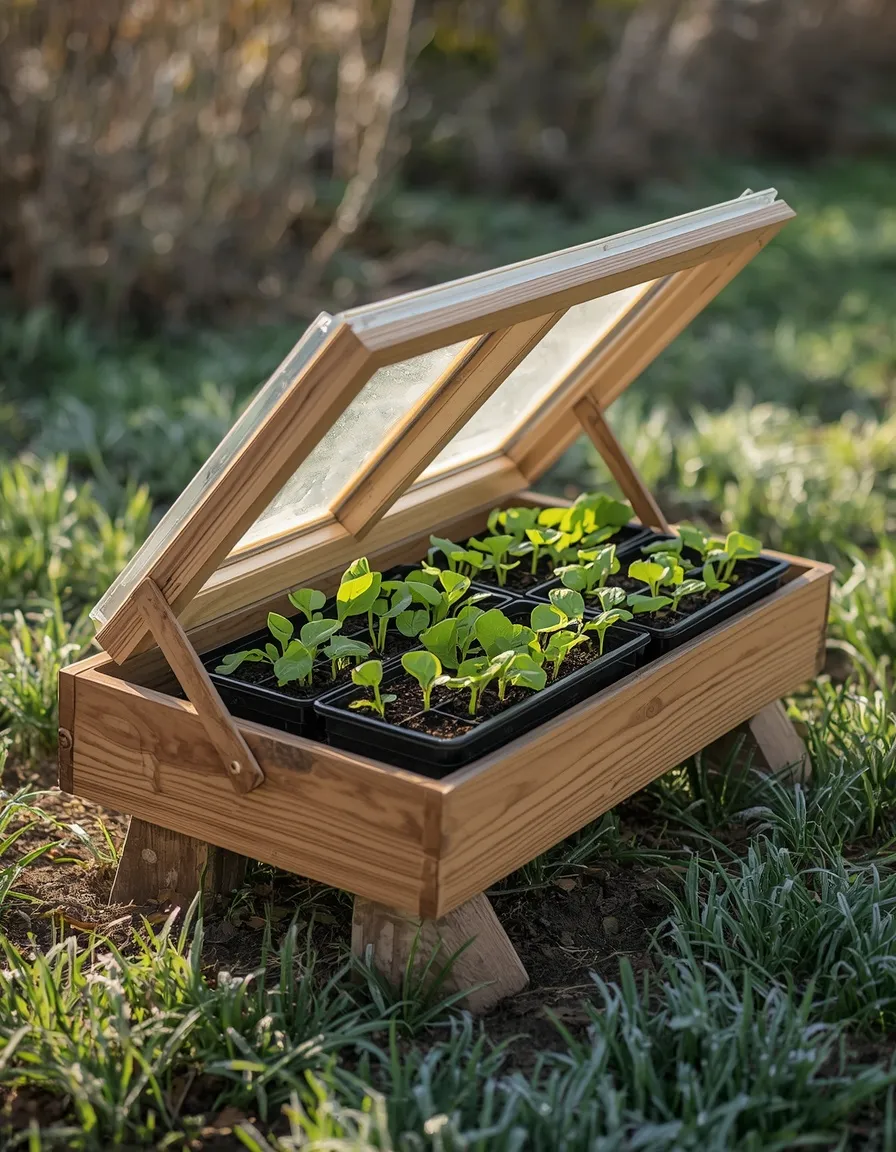
19. Cold Frame or Mini Greenhouse Starting
A simple cold frame, essentially a bottomless box topped with an old window or clear polycarbonate lid, or a small backyard mini greenhouse, buys a few extra weeks at both ends of the season by trapping daytime heat and buffering plants from a late or early frost.
Use a cold frame to start seeds two to three weeks earlier than open-ground planting would allow, or to harden off indoor-started seedlings before their final move outside. The one detail most first-time users miss is ventilation: on a sunny day, even when outdoor air is still cool, temperatures inside a closed cold frame can spike high enough to scorch young seedlings within an hour, so prop the lid open during the day and close it only at night or during a genuine cold snap. This idea suits gardeners in cooler climates or anyone wanting a head start on the growing season without the cost of a full-sized greenhouse, and the same structure can protect fall crops from an early frost at the other end of the season.
- Extends the growing season by several weeks at both ends
- Lower cost and footprint than a full greenhouse structure
- Doubles as a hardening-off space before seedlings move outdoors
Smart Techniques for a Better Harvest
These three ideas are not structures or containers but techniques, ways of managing timing, companions, and water that shape how much you actually harvest from any of the setups already covered above.
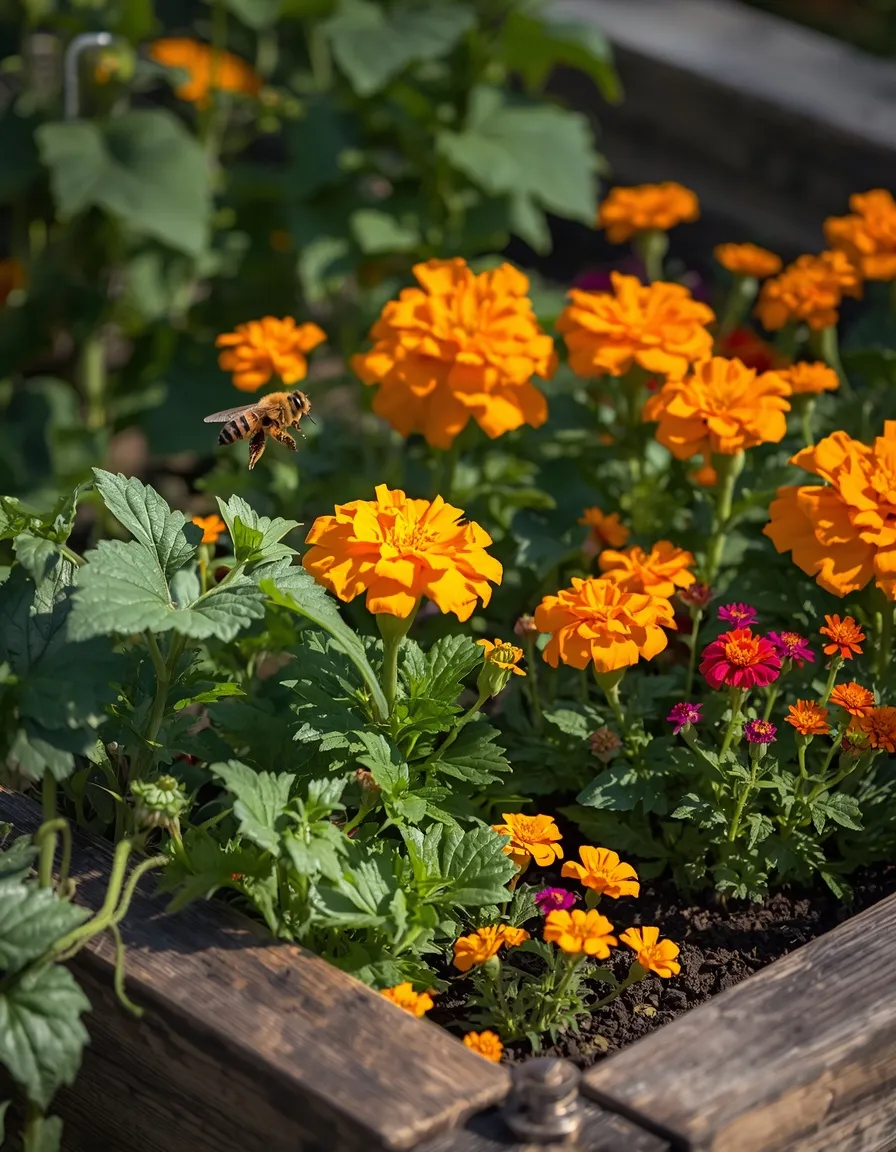
20. Companion Planting for Pest Control and Pollinators
Tucking radishes, dill, nasturtiums, or marigolds around the base of cucumber plants is less about the cucumbers themselves and more about shaping the whole bed into a small, self-supporting ecosystem that attracts pollinators and confuses common pests.
Radishes are traditionally planted as a trap crop for cucumber beetles, drawing pest attention away from the main crop, while dill and nasturtiums attract the bees and other pollinators cucumber flowers depend on for fruit set. Marigolds are widely used along bed edges for their scent, which many gardeners find deters a range of common vegetable pests. Many gardeners avoid pairing cucumbers with aromatic herbs like sage, or with potatoes, which are traditionally thought to compete for nutrients or increase disease pressure, though the science behind specific pairings varies in strength. If pets have access to the garden, it is worth knowing that the cucumber plant itself is listed as non-toxic to dogs and cats by the ASPCA, though it is always worth checking any unfamiliar companion plant separately before adding it to a bed pets can reach.
- Trap crops and scent-based deterrents reduce pest pressure without spraying
- Flowering companions draw in the bees cucumbers need to fruit
- Builds a more resilient, mixed planting instead of a single-crop row
21. Succession Planting for Continuous Harvest
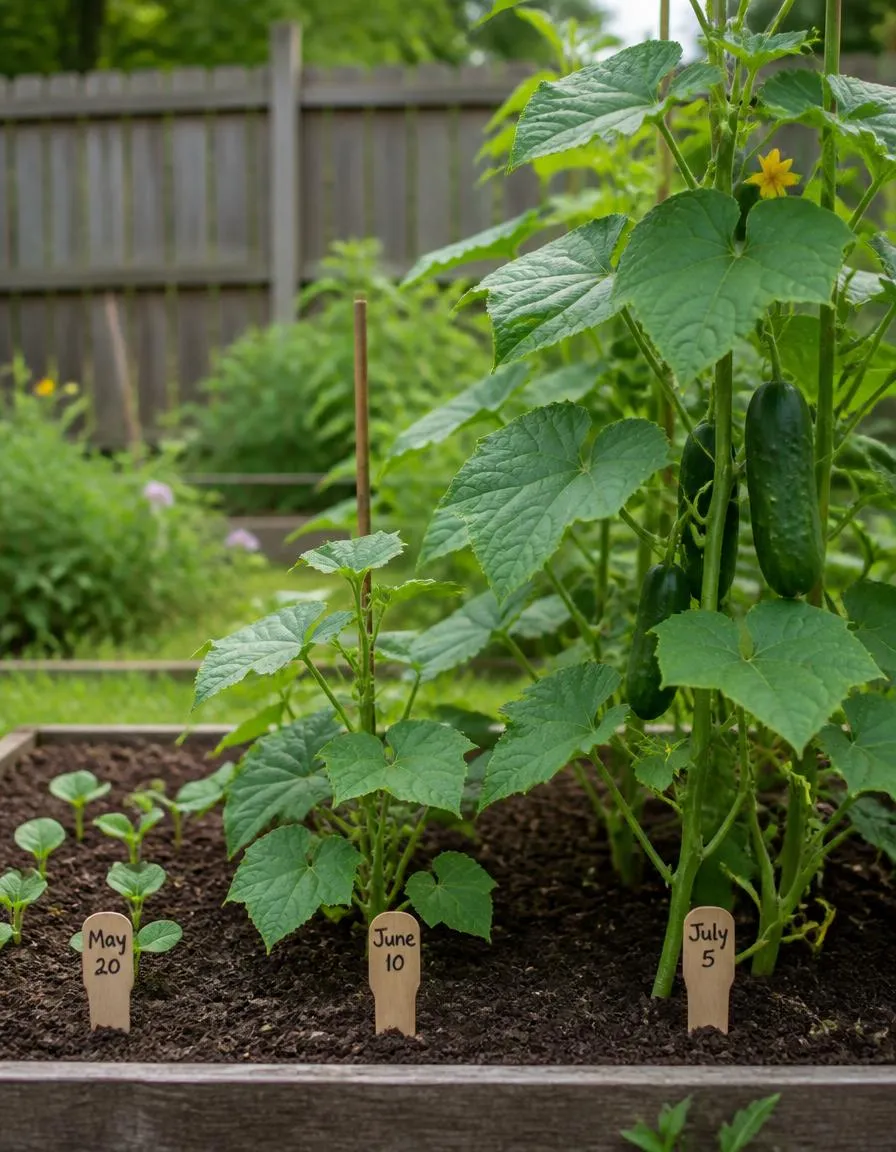
Sowing a new round of cucumber seeds every two to three weeks through late spring and early summer, rather than planting the whole season’s crop at once, keeps a steady trickle of fresh cucumbers coming instead of one overwhelming glut followed by nothing.
Stagger plantings across two or three different spots, containers, or sections of the same bed, tracking sow dates on a simple calendar or garden journal so new plantings do not get lost among established vines. Because most cucumber varieties reach harvest in 50 to 70 days and tend to slow down in the peak heat of summer, succession sowing also acts as insurance against one planting being knocked back by a pest outbreak or a spell of bad weather. This idea works especially well paired with any of the container or raised bed methods above, since a spare pot or bed corner is all that is needed for the next round, without committing an entire garden’s footprint to cucumbers at once.
- Prevents the classic “too many cucumbers at once” glut
- Provides a natural backup if one planting underperforms
- Requires no new structure, just staggered timing of existing methods
22. Drip Irrigation or a Wicking Self-Watering System
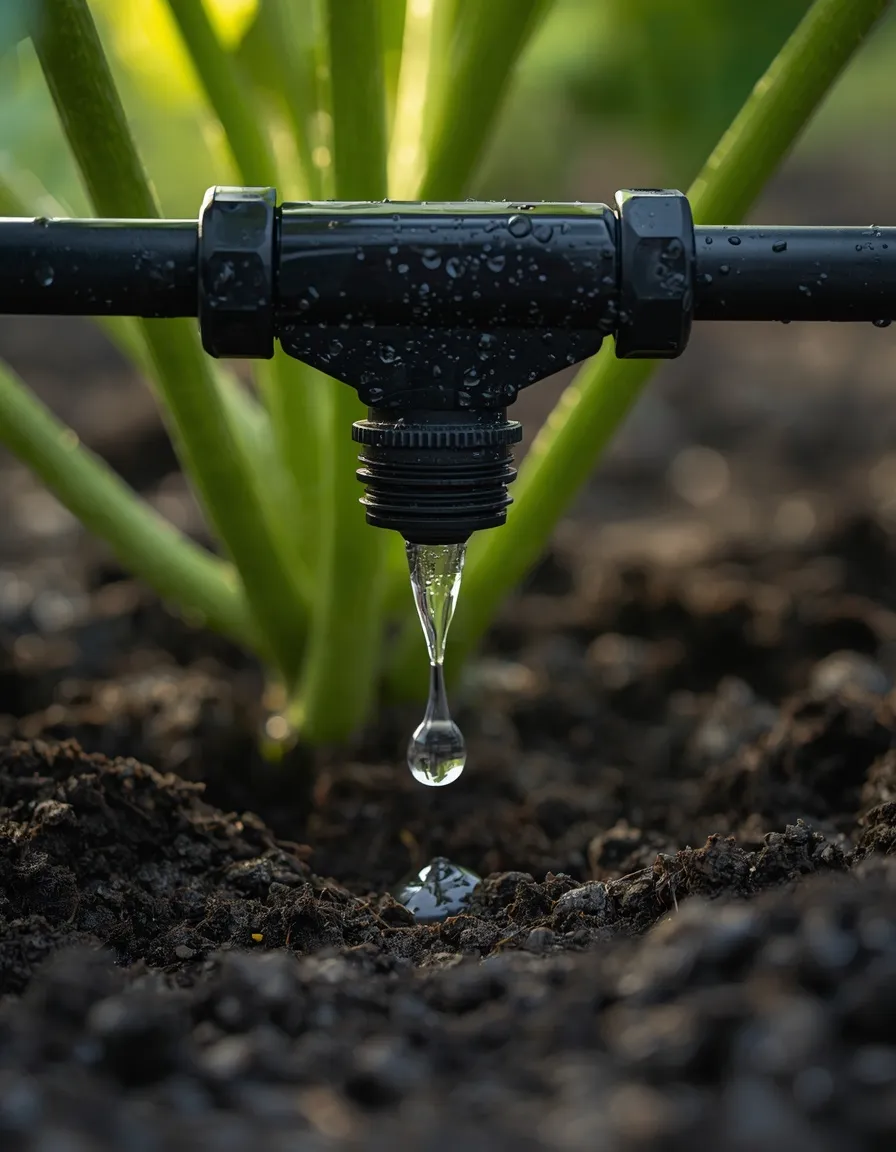
A simple drip line snaked along the base of cucumber plants, or a self-watering wicking container with a water reservoir built into its base, solves the single biggest cause of cucumber problems: inconsistent moisture.
Drip irrigation delivers water slowly and directly to the root zone rather than wetting foliage, which also helps prevent the fungal leaf diseases that thrive in damp, still air. Set drip line on a simple timer for early morning watering, adjusting run time seasonally as temperatures rise. Wicking or self-watering containers work on the same principle at a smaller scale, using a reservoir and wicking material to pull moisture up to roots as needed, which is especially useful for container and grow bag setups during a hot week away from home. Either system particularly suits busy or frequently traveling gardeners, since both remove the guesswork of a manual watering schedule and directly address the bitterness and blossom-end problems that stem from a dry-then-soaked watering pattern.
- Directly prevents the bitterness caused by inconsistent watering
- Keeps foliage dry, reducing fungal disease pressure
- Removes the risk of a missed watering day during travel or a busy week
Decorative and Design-Forward Ideas
These last two ideas lean into aesthetics as much as function, proof that a productive cucumber patch and an intentionally styled outdoor space are not mutually exclusive.
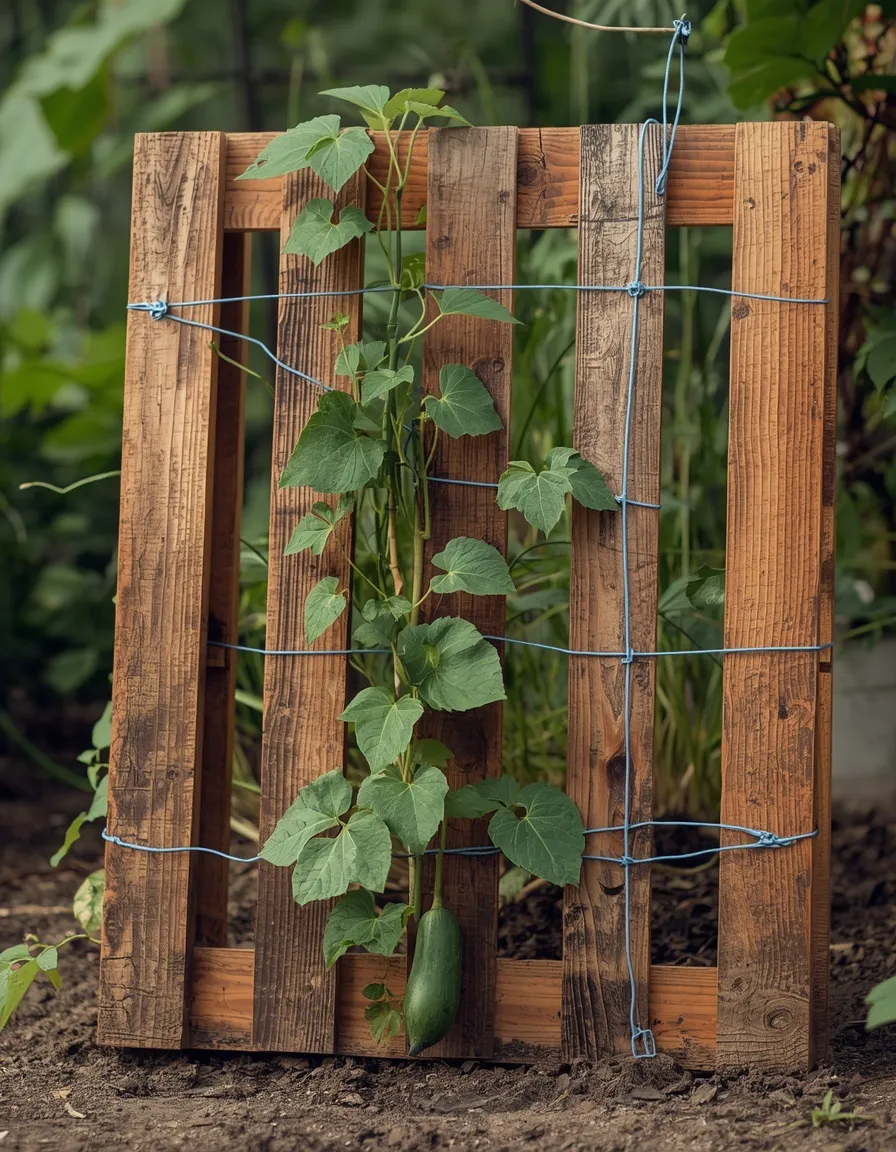
23. Vertical Pallet or Upcycled Living Wall Trellis
An old wooden shipping pallet, stood on end and fitted with netting or wire mesh across its face, makes a rustic, upcycled trellis frame with genuine cottage-garden character, especially useful for gardeners who want a distinctive vertical feature without buying new materials.
One correction worth making here, since it trips up a lot of pallet-garden advice: cucumbers should not be planted to root directly inside a pallet’s shallow slat pockets the way strawberries or shallow-rooted herbs sometimes are. Cucumber roots need real depth and volume, so use the pallet purely as a frame, attaching garden netting or wire mesh across the front, and plant cucumbers in the ground or in a proper container positioned at its base instead. Sand any rough edges and check that the pallet has not been chemically treated (stamped “HT,” for heat-treated, is the safer choice over “MB,” for chemically fumigated) before bringing it into a food-growing space. Secure the pallet upright with stakes on both sides so wind or a heavy, vine-laden season does not topple it.
- Uses free or low-cost reclaimed material for a distinctive look
- Delivers cottage-garden texture a bought trellis rarely matches
- Works as a mounting frame even though roots stay in soil below
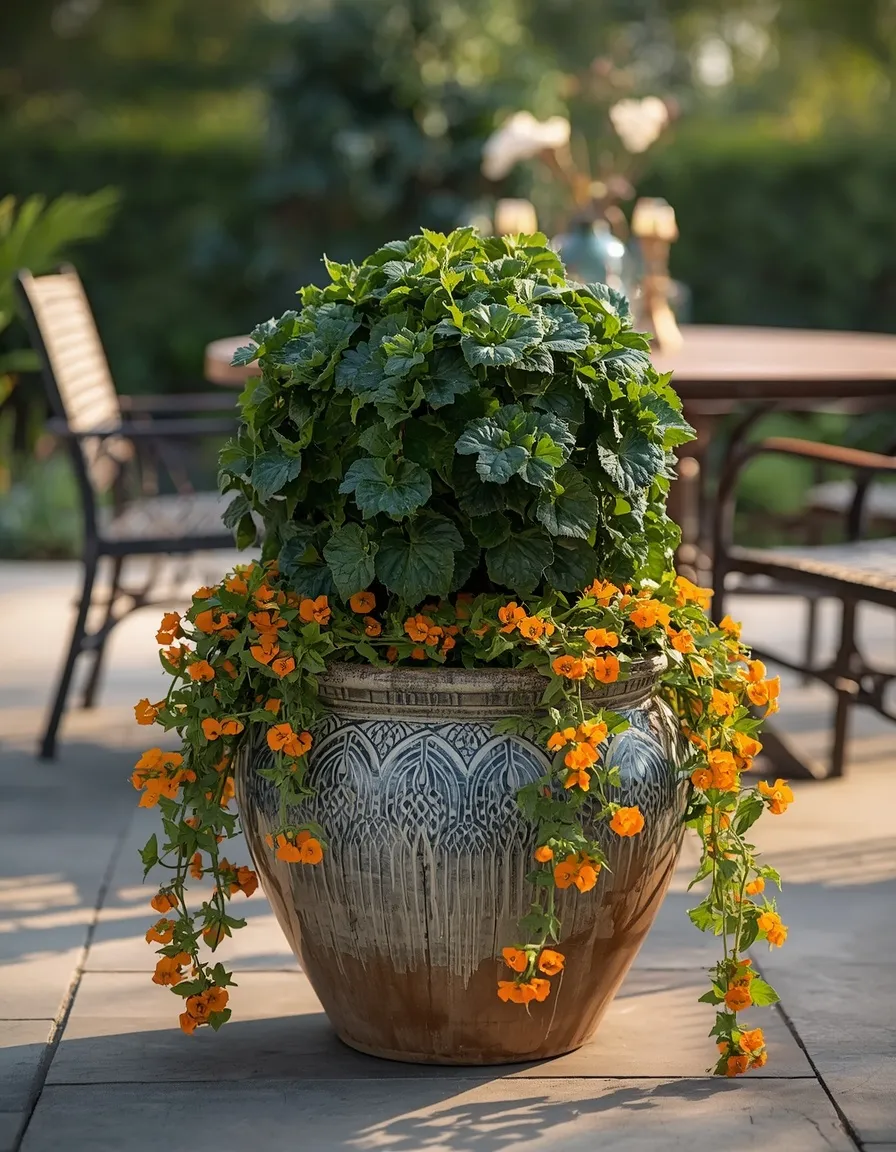
24. Mixed Ornamental Container Display
A large decorative pot planted with a trailing bush cucumber alongside flowering companions like nasturtiums or trailing marigolds turns a purely productive plant into a genuine piece of patio styling, the kind of container arrangement that looks equally at home in a lifestyle photo and a working kitchen garden.
Anchor the planting with one bush cucumber slightly off-center, then fill in around it with edible, trailing nasturtiums, which soften the pot’s edge and draw in pollinators, or low marigolds for color and pest deterrence along the rim. Keep the container generously sized, at least 16 to 18 inches (40 to 45 cm) across, since it is now supporting several root systems rather than one, and feed lightly through the season since a mixed planting draws more heavily on the same soil volume. This idea is best suited to a patio, entry, or dining-adjacent spot where the display gets noticed daily, rather than a tucked-away utility bed, and it is a genuinely different use of a cucumber plant than any purely productivity-focused container idea earlier in this guide.
- Doubles as ornamental patio styling, not just a food crop
- Companion flowers draw pollinators right to the pot
- Suited to visible, lived-in spaces rather than a back-corner bed
Choosing the Right Idea for Your Space
Every one of these growing cucumbers ideas comes back to one principle: match the method to the space you have, keep watering consistent, and give the vines airflow, then let them do the rest. That might mean a cattle panel arch anchoring the vegetable rows, or a single grow bag by the back door of a small apartment. Start with one or two ideas rather than all twenty-four, note what thrives in your light and climate, and build outward next season. For more ways to shape a garden around how you live in it, our garden design ideas are a good next stop, and a trellis heavy with cucumbers by late summer is reason enough to spend more time outside.
Frequently Asked Questions
Can you grow cucumbers in a small space, like a balcony or patio?
Yes, and it is one of the more forgiving vegetables for small spaces once you match variety to container. Choose a compact bush or “patio” variety, give it at least a 5-gallon (19-liter) pot or grow bag with good drainage, and set it somewhere it gets six or more hours of direct sun. Rail planters and large hanging baskets extend this further for balconies with no floor space to spare.
What is the best trellis for growing cucumbers?
It depends on budget and how permanent you want the structure to be. A bamboo teepee is the cheapest and quickest to build, a wooden A-frame is the most versatile for a raised bed or row, and a cattle panel arch is the sturdiest long-term option for heavy vining varieties. All three improve airflow around the leaves compared to letting vines sprawl on the ground, which reduces powdery mildew.
How many cucumber plants fit in one pot or container?
As a general rule, plan one vining cucumber plant per 5 to 10 gallons (19 to 38 liters) of container volume, or one compact bush variety per 5 gallons (19 liters). Crowding more plants into the same pot usually costs more in yield than it gains, since the plants end up competing for water and nutrients in a fixed volume of soil.
Can cucumbers be grown indoors year-round?
Yes, with the right variety and setup. Choose a compact, parthenocarpic (self-fruiting) type, since indoor plants have no bee access for pollination, and run full-spectrum grow lights for 12 to 16 hours a day. A small fan nearby helps prevent the still, humid air that encourages fungal problems indoors.
What is the best way to start cucumbers from seed?
Direct sowing outdoors, once soil has warmed to at least 70°F (21°C) at a one-inch (2.5 cm) depth, generally outperforms starting indoors, since cucumber taproots dislike being disturbed at transplant. If your season is short, start seeds indoors no earlier than three to four weeks before your last frost date, using biodegradable pots that can go straight into the ground.
Do cucumbers need full sun, and what if I only have partial shade?
Cucumbers grow best with six to eight hours of direct sun daily, and less than that typically means fewer flowers and a leggier plant. In partial shade, four to five hours of direct sun, expect a smaller harvest rather than no harvest at all, and prioritize the sunniest spot available, even if that means a container positioned to follow the light through the day.
What should you avoid when growing cucumbers vertically?
The most common mistake is under-anchoring the support. Wet, fruit-laden vines are heavier than an empty trellis suggests, so any structure, whether an A-frame, obelisk, or cattle panel arch, needs its base staked, weighted, or driven into the ground before vines fill in. It also helps to guide young vines onto the support early, since a trellis added after vines have already sprawled is far harder to train.